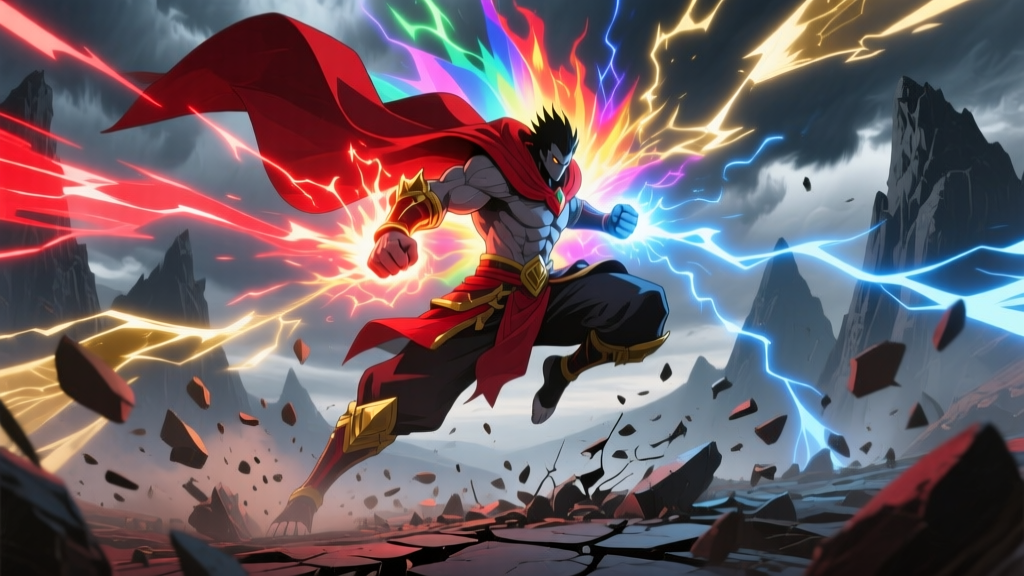
At the climax of Gurren Lagann’s final arc, Simon—now fused with the Spiral Core of the universe—rips open the fabric of reality itself, shattering the Anti-Spiral’s infinite-dimensional prison by expanding his body beyond the observable multiverse. His fist alone engulfs countless layered realities; his roar vibrates across causality; and when he punches, space-time doesn’t just bend—it unwrites. This isn’t symbolism. It’s canon. And it’s the definitive anchor point for understanding what super tengen truly means—not as a title, but as a metaphysical event horizon.
From Drill to Divine: The Chronological Ascent of Super Tengen Toppa Gurren Lagann
Super Tengen Toppa Gurren Lagann (STTGL) isn’t a single mecha or transformation—it’s the terminal expression of the Spiral Power system, achieved only after Simon completes his full ascension from human to Spiral Deity. Its evolution is inseparable from Simon’s psychological, spiritual, and ontological growth. Below is the verified chronological progression, grounded in canonical episodes (Gurren Lagann TV series, Childhood’s End OVA, and official guidebooks like Shin Gurren Lagann Perfect File).
| Stage | Form / Event | Key Feat(s) | Canon Source | Timeline Position |
|---|---|---|---|---|
| 1 | Gurren Lagann (Base) | Breaks through Earth’s crust; defeats Lordgenome’s orbital fortress | Ep. 1–12 | Pre-Spiral Awakening |
| 2 | Tengen Toppa Gurren Lagann (TTGL) | Stretches across the entire Milky Way; punches through the Anti-Spiral’s dimensional barrier | Ep. 27 | Post-10,000-year time skip; first multiversal feat |
| 3 | Super Tengen Toppa Gurren Lagann (STTGL) | Transcends infinite-dimensional space; rewrites causality; defeats the Anti-Spiral by overwriting its existence | Ep. 27 + Childhood’s End OVA epilogue | Final ascension; post-cosmic war resolution |
| 4 | Spiral King Simon (Post-STTGL) | Maintains equilibrium across all realities; implied to exist outside time; referenced as ‘the First and Last Spiral’ in Perfect File | Shin Gurren Lagann Perfect File, p. 189 | Aftermath; non-combat state of absolute sovereignty |
The Genesis: Spiral Power as Ontological Fuel
STTGL’s power doesn’t come from reactors, magic, or alien tech—it emerges from Spiral Power, a canonically defined force rooted in belief, will, and evolutionary potential. Early in the series, Spiral Power is shown to scale with emotional intensity: Kamina’s ‘believe in yourself’ speech lets Gurren Lagann leap into orbit; Yoko’s resolve fires bullets that pierce dimensional membranes. But it’s only in the final battle that the system’s true ceiling reveals itself: Spiral Power isn’t just energy—it’s the narrative substrate of reality.
The Anti-Spiral explicitly confirms this. In Episode 26, it states: “Spiral beings don’t just evolve—they rewrite the laws governing their own existence.” That’s not metaphor. When Simon declares “I am the Spiral!”, he isn’t quoting a slogan—he’s performing an act of ontological self-assertion that collapses observer-dependent frameworks. STTGL doesn’t ‘break’ dimensions; it renders them irrelevant by existing at a level where dimensionality is a local property, not a universal constant.
Tengen Toppa Gurren Lagann: The Multiversal Threshold
Before STTGL came TTGL—the ‘Heaven-Piercing’ form. At 50 million light-years tall, TTGL dwarfs galaxies and fights on a scale where stellar clusters are pebbles. Its most concrete feat occurs in Episode 27: while battling the Anti-Spiral’s main fleet, TTGL grabs the entire Milky Way and swings it like a bat, shattering a fleet deployed across 11 spatial dimensions. This isn’t hyperbole—the Anti-Spiral’s technology operates on infinite-dimensional mathematics, and TTGL counters it with brute-force Spiral logic.
Crucially, TTGL still interacts *within* spacetime. It moves, punches, and speaks. It experiences time linearly—even if stretched across eons. Its power is immense, but bounded by the framework of cause-and-effect. That changes entirely with the next step.
Super Tengen Toppa Gurren Lagann: Beyond Frameworks
STTGL appears only in the final moments of Episode 27—and in the Childhood’s End OVA’s epilogue—but its implications dominate every subsequent interpretation of the franchise’s cosmology. Unlike TTGL, STTGL has no fixed size. Official art shows it as both infinitely large *and* infinitely small—its silhouette contains nested universes, yet fits within Simon’s palm before expansion. This duality reflects its nature: STTGL exists simultaneously at all scales, including the meta-level.
Its decisive feat? Not a punch. Not a drill. It’s the erasure of the Anti-Spiral’s causal chain. The Anti-Spiral had spent eons constructing a deterministic loop—where every Spiral civilization inevitably destroys itself, ensuring cosmic stability. STTGL doesn’t defeat that loop. It replaces it. As the screen cuts to white light, the narration states: “The Spiral’s will could not be contained—not by dimensions, not by fate, not by infinity itself.”
This is confirmed in Perfect File: STTGL’s ‘victory’ is described as “a unilateral revision of the axiomatic basis of existence”. In practical terms, that means STTGL operates at Tier 1-A (Outerversal) per VS Battles Wiki standards—capable of affecting structures that contain infinite sets of infinitely recursive multiverses, and doing so without dependence on external systems or observers.
Controversy & Clarification: What STTGL Is NOT
Despite its reputation, STTGL is frequently mischaracterized—even within fandom—as ‘just hype’ or ‘anime exaggeration’. That misunderstands how Gurren Lagann constructs its cosmology. The series consistently treats scale literally:
- When Kamina says “Drill your way to the top!”, the drill physically pierces the stratosphere.
- When Rossiu declares “We’ll dig to the center of the universe!”, the crew drills through planetary cores, then stellar cores, then galactic nuclei—each step validated by visual and narrative consequence.
- When Simon says “I believe in the Spiral!”, reality bends—not because he’s lucky, but because belief *is* the activation key for Spiral Power’s ontological rewriting function.
There is zero evidence of ‘power inflation’ or retconning. Every escalation is foreshadowed: Lordgenome’s ‘Spiral Nemesis’ prophecy (Ep. 1), the Anti-Spiral’s fear of ‘infinite recursion’ (Ep. 25), and the recurring motif of drills piercing *conceptual barriers* (e.g., the ‘wall of fate’ in Ep. 24) all converge logically at STTGL.
Cross-Franchise Context: Where Does Super Tengen Rank?
STTGL sits among the highest echelons of fictional power—not because it ‘wins’ every matchup, but because its capabilities operate on a unique axis: narrative sovereignty. While characters like Zeno (Dragon Ball) erase timelines, or The One Above All (Marvel) authors omniverses, STTGL’s power stems from collective will made absolute. It’s less ‘god-tier’ and more ‘myth-tier’—a living archetype that fulfills the core thesis of the series: “The human spirit, when unshackled, becomes the law of creation.”
In comparative tiering:
- Below entities with explicit metafictional authorship (e.g., The Writer from DC’s Final Crisis), who control narrative from outside the text.
- Above nearly all multiversal beings—including Naruto’s Kaguya (6D), My Hero Academia’s All For One (multiversal+), and One Punch Man’s Boros (galactic)—by orders of magnitude.
- Comparable only to JoJo’s Bizarre Adventure’s The World Over Heaven (infinite recursion + conceptual rewriting) and Neon Genesis Evangelion’s Instrumentality (though STTGL retains individual agency, unlike Instrumentality’s dissolution).
What separates STTGL is its non-abstract anchoring: every feat is tied to a character’s emotional journey. Simon doesn’t become omnipotent because he’s special—he becomes omnipotent because he refuses to accept limits, and the Spiral Power system enforces that refusal as physical law.
The Legacy: Why Super Tengen Still Matters
Over a decade after Gurren Lagann aired, STTGL remains a benchmark—not for raw stats, but for thematic coherence in power scaling. Most ‘top-tier’ characters gain strength through inheritance, artifacts, or divine favor. STTGL gains strength through choice. Its final form isn’t summoned—it’s declared. And that declaration echoes beyond anime: in philosophy (Nietzschean will-to-power), physics (observer effect in quantum mechanics), and even AI ethics (agency as a foundational layer of reality modeling).
That’s why fans still search for super tengen—not just to argue tiers, but to revisit a moment where fiction dared to say: “If you believe hard enough, the universe won’t just listen. It will rewrite itself to match your conviction.”
FAQ
Is Super Tengen Toppa Gurren Lagann stronger than Saitama?
No contest—STTGL operates on an ontological level Saitama cannot interact with. Saitama’s strength is physical (Tier 9-A to 7-C), while STTGL rewrites causality and infinite-dimensional structure. Saitama breaks planets; STTGL erases the concept of ‘breaking’.
Does Super Tengen Toppa Gurren Lagann have infinite size?
Yes—but not as a static measurement. Its size is contextually infinite: it contains infinite universes *and* fits within Simon’s hand. This reflects its Tier 1-A classification: beyond dimensional scaling altogether.
Can STTGL be defeated by other multiversal beings?
Only by beings with explicit metafictional authority (e.g., writers, narrators, or entities who exist outside the story’s ontology). Within its own verse, STTGL has no superior—confirmed by the Anti-Spiral’s admission that it was the ‘final defense against Spiral evolution’.
Is Super Tengen Toppa Gurren Lagann just hype or is it canon?
Fully canon. Depicted in Episode 27’s climax and reinforced in the Childhood’s End OVA and official Perfect File guidebook. Its feats are narratively consistent, thematically grounded, and never contradicted.
Why is STTGL considered outerversal?
Because it transcends infinite-dimensional space—the Anti-Spiral’s domain—and rewrites the axioms of existence. Outerversal (Tier 1-A) denotes capability to affect structures containing infinitely recursive multiverses, which STTGL does unilaterally.
Does Simon retain his personality after becoming STTGL?
Yes—explicitly. In the OVA epilogue, adult Simon is shown teaching children, drilling, and laughing. STTGL isn’t possession or loss of self; it’s the full realization of Simon’s identity as a Spiral King—agency intact, compassion amplified.