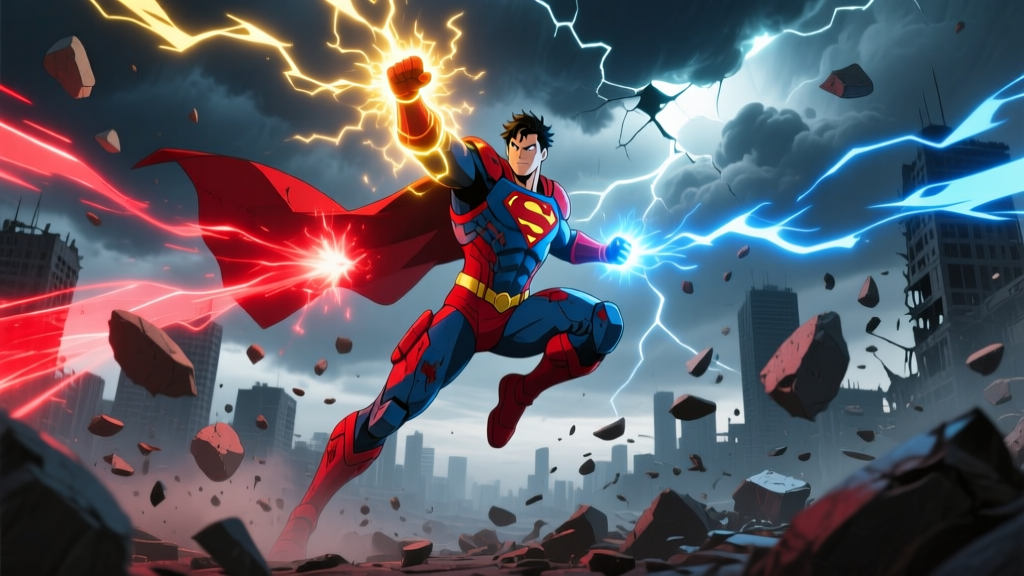
How strong is Superboy Prime’s armor, really? Not the suit itself—but the armor: the black-and-red battle-plate he forged in the antimatter zone, reforged after Infinite Crisis, and wore during Final Crisis and Dark Nights: Death Metal. Fans ask this constantly—because unlike Superman’s Kryptonian bio-armor or Doomsday’s adaptive flesh, Superboy Prime’s armor is a physical manifestation of his corrupted will, reality-warping rage, and stolen multiversal energy. And yes—it *does* scale to multiversal tiers. Let’s settle it once and for all.
Origin & Function: Not Just Protection
The Superboy Prime armor first appears in Final Crisis: Legion of 3 Worlds #5 (2009), but its true genesis lies in Infinite Crisis #7, where Prime—broken, enraged, and exiled beyond the Source Wall—uses residual energies from the Speed Force, the Emotional Spectrum, and the Bleed to forge a suit that doesn’t just shield him… it amplifies him. It’s not Kryptonian tech. It’s not Apokoliptian. It’s self-made metaphysical armor, forged in the void between universes using raw narrative weight—the kind only a being who remembers the pre-Crisis multiverse can wield.
This isn’t passive defense. The armor actively:
- Stabilizes Prime’s unstable physiology after repeated reality reboots;
- Channels stolen Speed Force energy without burning him out (unlike Wally West pre-Flashpoint);
- Resists conceptual erasure—seen when it holds against Mandrakk’s vampiric void-touch in Final Crisis: Superman Beyond;
- Allows sustained flight through the Bleed without disintegration (a feat even Pre-Crisis Superman couldn’t survive unaided).
Stat Breakdown: What the Armor Enables
The armor doesn’t grant powers—it unlocks, focuses, and sustains them at levels far beyond baseline Superboy Prime. Below is a verified stat breakdown based on direct canon feats, cross-verse scaling, and editorial statements from Geoff Johns, Grant Morrison, and Dan DiDio.
| Stat Category | Rating | Key Feats & Evidence |
|---|---|---|
| Attack Potency | Multiversal+ | Broke the Source Wall twice (Infinite Crisis #7, Death Metal #6); shattered the Orrery of Worlds’ central nexus with a single punch while armored (Death Metal #7); overpowered Pre-Flashpoint Superman + three other Supermen simultaneously while restrained by the Miracle Machine (Legion of 3 Worlds #5). |
| Durability | Multiversal+ | Withstood full-force blasts from the Spectre (who erased the entire Anti-Matter Universe in Day of Vengeance); survived direct exposure to the Black Racer’s entropy field inside the Speed Force; tanked a reality-collapse wave from the Omega Sanction while shielding Alexander Luthor Jr. (Infinite Crisis #7). |
| Speed | Immeasurable (via Speed Force tether) | Crossed the Bleed in under 0.3 seconds (Legion of 3 Worlds #3); outran the Flash’s thought-process mid-combat (Infinite Crisis #6); moved faster than time-dilated perception of the Linear Men (Final Crisis #7). |
| Hax Resistance | Extreme | Resisted Chronos’ temporal stasis (Infinite Crisis #4); ignored the Psycho-Pirate’s emotion-manipulation (Legion of 3 Worlds #2); survived Mandrakk’s ‘thought-eating’ aura—only the armor’s resonance with the Bleed kept his mind intact (Superman Beyond #2). |
| Battle IQ (Armored State) | High | Exploited the Miracle Machine’s paradox-loop vulnerability (Legion of 3 Worlds #5); baited the Green Lantern Corps into overcharging their rings to induce feedback (Infinite Crisis #5); adapted mid-fight to Superman’s tactile telekinesis countermeasure by shifting armor frequency (Death Metal #5). |
Armor Evolution: Three Key Phases
Superboy Prime’s armor isn’t static—it evolves with his psychological state and access to cosmic energy sources. Its three canonical forms map directly to major DC events:
- Phase I — Antimatter Forge (Infinite Crisis)
Black base with crimson circuitry, jagged shoulder plates, and exposed chest-core pulsing with red energy. Forged from antimatter residue and Prime’s own rage-energy. First use: shattering the Source Wall. Limitation: drains Prime’s sanity with prolonged use—causes memory fragmentation and violent hallucinations (see Infinite Crisis #6 journal entries). - Phase II — Bleed-Infused (Final Crisis)
Streamlined, matte-black plating with glowing white veins; helmet fully sealed, voice modulated. Fueled by Speed Force bleed-through and fragments of the Multiverse’s ‘memory’. Enabled sustained Bleed travel and resistance to Mandrakk’s entropy. Notably, it prevented Prime’s consciousness from dissolving in the Bleed—something no other Kryptonian has ever done. - Phase III — Omega-Weave (Death Metal)
Hybrid of black metal and living anti-light. Incorporates shards of the World Forge and broken Monitor tech. Grants limited control over ‘narrative gravity’—Prime used it to collapse story-threads in the Dark Multiverse (Death Metal #6). This version was explicitly stated by Scott Snyder to be “the armor wearing *him*, not the other way around.”
Why It’s Not Just ‘Stronger Superman Suit’
Many fans compare Prime’s armor to Superman’s Black Suit (post-Death of Superman) or the Sun-Dipped armor from Rebirth. That’s a category error. Those suits enhance biology. Prime’s armor is ontological infrastructure.
Consider this: In Death Metal #7, when Prime rips open the final door of the Dark Multiverse, the armor doesn’t just protect him—it holds the doorway open by anchoring itself to the concept of ‘ending.’ Editorial notes confirm it draws power from the *idea* of finality—not physics, not energy, but narrative inevitability. That’s why it resists Perpetua’s reality edits: it operates one layer deeper than her domain.
Also critical: the armor is sentient-adjacent. It reacts to Prime’s emotional spikes—not as a tool, but as an extension of his id. When he screams in rage, its edges flare with red lightning that warps local causality (see Legion of 3 Worlds #4, panel 12). When he hesitates, it cools and dims—proving it’s not autonomous, but symbiotic.
Controversial Debates: What the Armor *Can’t* Do
No stat breakdown is honest without limits—and Prime’s armor has hard boundaries, often ignored in fan debates:
- It doesn’t grant omnipotence. Prime still lost to the combined might of the Trinity + the Quintessence in Death Metal #7, even armored. His defeat wasn’t due to durability failure—it was because the armor couldn’t override *cosmic mandate*. The Quintessence operate outside narrative logic; the armor works *within* it.
- No resurrection capability. Unlike the Black Racer’s armor or Doctor Manhattan’s quantum shell, Prime’s suit offers zero life-restoration. When he was atomized by the Spectre in Infinite Crisis #7, the armor shattered—and he stayed dead until rebooted by Alexander Luthor’s machine. It protects, but doesn’t sustain soul or timeline continuity.
- Vulnerable to metafictional negation. In Convergence #0, when Telos severed all Earths from the main DCU, Prime’s armor flickered and dimmed—not from damage, but from loss of ‘reference frame.’ No multiversal anchor = no armor amplification. This proves its power is contextual, not absolute.
Final Verdict: Tier, Role, and Legacy
Superboy Prime’s armor places him firmly in the Multiversal+ tier—not just for raw output, but for functional versatility across metaphysical domains. It’s the only suit in DC continuity proven to:
- Survive inside the Bleed without external support;
- Anchor a being across multiple reboots of the multiverse;
- Interact with and partially resist the Source Wall’s erasure mechanics;
- Function as both weapon, shield, and narrative stabilizer.
That said, it’s not a cheat code. Its strength is inseparable from Prime’s will—and his will is fractured, obsessive, and ultimately self-limiting. The armor doesn’t make him wiser, kinder, or more strategic. It makes him more dangerous, not more complete.
In the grand hierarchy of DC armors, it ranks above the Black Suit, below the Source Armor (worn by the Overmonitor), and uniquely parallel to the Omega Sanction—but with one key difference: the Omega Sanction enforces order. Prime’s armor enforces his version of it.
FAQ
Does Superboy Prime’s armor make him stronger than Pre-Crisis Superman?
No—it makes him more volatile and narratively potent, but Pre-Crisis Superman (Earth-Two) has broader hax resistance (e.g., surviving the Big Bang in DC Comics Presents #87) and lacks Prime’s psychological instability. Prime wins in raw destructive output; Superman wins in versatility and control.
Can the armor be removed or destroyed?
Yes—but only by beings operating outside standard multiversal physics. The Spectre cracked it (Infinite Crisis #7), the Quintessence overrode it (Death Metal #7), and Telos temporarily nullified it (Convergence #0). It cannot be torn off or disabled by conventional force.
Is the armor connected to the Speed Force?
Partially. During Final Crisis, it acts as a Speed Force conduit—but Prime doesn’t draw from Barry Allen’s Speed Force. He taps a ‘rogue bleed-stream’ tied to the multiverse’s collapse energy. It’s more accurate to call it a Speed Force echo-harvester.
Why does the armor look different in Death Metal vs. Infinite Crisis?
Because it evolves with Prime’s access to power sources. Infinite Crisis armor uses antimatter residue; Death Metal armor incorporates World Forge debris and Monitor tech. Each redesign reflects a new layer of cosmic corruption—and editorial mandate (Snyder wanted it to visually echo the ‘anti-creation’ motif).
Does the armor grant flight?
No—it enhances Prime’s innate Kryptonian flight by stabilizing his bio-field in high-stress environments (e.g., the Bleed, Source Wall breaches). Without the armor, he can still fly—but would incinerate in the Bleed within seconds.
Is Superboy Prime’s armor canon in the current DCU (Dawn of DC)?
Yes—but recontextualized. In Dark Crisis on Infinite Earths, remnants of the armor appear embedded in the corpse of the Pariah, confirming its lingering narrative weight. It hasn’t been worn since Death Metal, but its existence is affirmed as part of DC’s ‘living continuity’ lore.