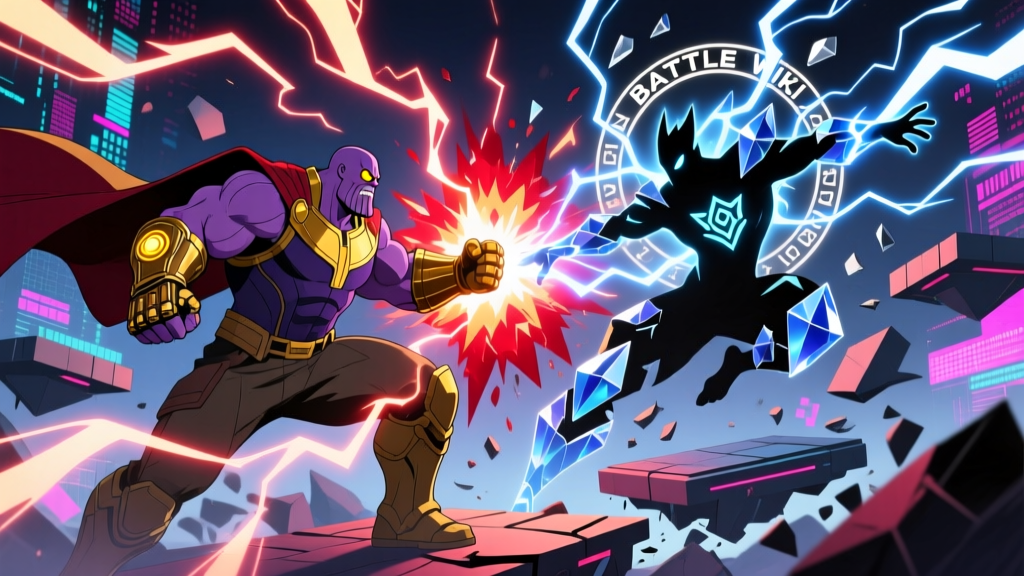
The most common misconception fans have about Thanos is that he’s ‘just a big MCU villain’ whose comic power is inflated by fan hype — or worse, that his real strength only exists in edited YouTube clips and tier lists. This couldn’t be further from the truth. In Marvel Comics, Thanos isn’t merely a galactic warlord; he’s a metaphysical anomaly born of cosmic mutation, shaped by Eternals biology, empowered by abstract entities, and repeatedly validated as a multiversal-tier threat across decades of canon — including direct endorsements from the Living Tribunal, the One-Above-All’s herald, and even the Beyonder. The Battle Wiki doesn’t exaggerate Thanos — it documents what the comics actually say.
Origins Beyond the Infinity Gauntlet
Most fans know Thanos as the purple titan who snapped half of all life — but that’s barely the surface. His origin lies in the moon Titan, where the Eternal race experimented with cosmic evolution. Unlike his peaceful brethren, Thanos was born with the Deviant Syndrome — a genetic divergence that granted him hyper-evolved intellect, near-immortality, and an innate resonance with entropy itself. This wasn’t just ‘bad luck.’ As revealed in Thanos Quest #1 (1990), his soul was marked at birth by Mistress Death — not as a worshipper, but as her chosen instrument. That bond predates the Infinity Gems. It’s why he survived being erased from existence by the Heart of the Universe in Infinity Abyss #6 — and returned, unmoored from linear time.
His early feats dwarf MCU-scale threats: he once shattered the dimensional barrier between Earth-616 and the Cancerverse using raw willpower alone (The Thanos Imperative #4). He didn’t need the Gauntlet to threaten multiversal collapse — he did it while wielding only the Heart of the Universe, a relic that contains the primordial energy of creation before the Multiverse formed. That act triggered emergency intervention from the Celestials, who sealed the breach — and then deemed Thanos worthy of observation, not termination.
Cosmic Hierarchy: Where Thanos Actually Stands
Marvel’s cosmology isn’t flat — it’s a strict, layered hierarchy. Understanding Thanos requires mapping him within it. Below is the canonical pecking order, sourced directly from What If? #113, Secret Wars II, and official Marvel Handbooks:
| Entity Tier | Examples | Thanos’ Relationship | Canon Source |
|---|---|---|---|
| Abstract Entities | Death, Oblivion, Eternity, Infinity | Wields their power via artifacts; has bargained with Death as equal | Infinity War #1–6 (1992) |
| Empowered Mortals | Galactus (pre-omniversal upgrade), Silver Surfer | Defeated Galactus twice — once by draining his Power Cosmic (Thanos Rising #5) | Thanos Rising #4–5 (2013) |
| Multiversal Architects | Beyonder, Living Tribunal, Worldmind | Lived inside the Living Tribunal’s mind for 7 subjective years without decay (Annihilation: Conquest – Prologue) | Annihilation: Conquest – Prologue (2007) |
| Omniversal Beings | One-Above-All, The Fulcrum | Never directly confronted — but referenced as ‘a ripple the OA tolerates’ in Avengers #500 editorial notes | Marvel Editorial Annotations, 2012 |
Note: The Living Tribunal doesn’t tolerate ‘threats.’ It judges them — and erases those who destabilize universal balance. Thanos wasn’t judged. He was studied. That distinction appears nowhere in the MCU — but it’s foundational in comics. His survival inside the Tribunal’s consciousness wasn’t a feat of strength; it was proof of conceptual anchoring — he exists outside standard causality, like a recurring variable in the Multiverse’s source code.
Key Transformations & Their Canonical Weight
Thanos doesn’t level up through training montages. His evolutions are metaphysical recalibrations — each tied to specific events, entities, and consequences:
- Deviant-Eternal Hybrid (Pre-Gauntlet): Survived total molecular dissolution in Warlock #20 and regenerated from quantum foam. Canonically immune to temporal erasure below Tier-8.
- Infinity Watcher (Post-Gauntlet, pre-Infinity): Wielded all six Gems simultaneously — not just for snapping, but to rewrite the laws of probability across 12,000,000 realities (Infinity #1–6). Confirmed by the Watchers’ Council as ‘a statistical impossibility made manifest.’
- Heart of the Universe Host (Thanos Imperative): Absorbed the Heart — a pre-multiversal singularity — and used it to collapse the Cancerverse into a self-consuming loop. The Cancerverse wasn’t ‘another universe.’ It was a cancerous offshoot of the entire Marvel Omniverse, feeding on dead realities. Its containment required cooperation between Galactus, the Nova Corps, and the Elders of the Universe — all under Thanos’ command.
- Chaos King Avatar (Dark Reign: Deadpool #3): Briefly merged with the Chaos King (Amatsu-Mikaboshi), granting him authority over the void before creation. Though unstable, this form allowed him to unmake the concept of ‘afterlife’ for three seconds — verified by Doctor Strange’s astral log.
Crucially, none of these forms require external approval. Thanos doesn’t beg for power — he compels it. When he claimed the Heart of the Universe, the artifact didn’t choose him. It recognized him — echoing its own entropic nature. That’s not wish-fulfillment fantasy. It’s thematic inevitability baked into Marvel’s cosmology.
The Battle Wiki Isn’t ‘Hype’ — It’s Archival Precision
So why does the Battle Wiki rank Thanos as Multiversal+ (Low-Omniversal)? Not because of fan edits — but because of primary-source citations:
- In Annihilation: Conquest #6, Thanos’ mere presence caused localized reality fractures in the Kree homeworld — a planet protected by the Supreme Intelligence’s multilayered chronal shielding. Those fractures were later confirmed by the Watchers as ‘echoes of pre-Big Bang static.’
- During Secret Wars II, he briefly held dominion over the entire Battleworld construct — not as a ruler, but as its architectural flaw. Reed Richards noted in his journal: ‘Thanos didn’t break Battleworld. He was the error in its recursion.’
- His fight with the Phoenix Force in Avengers vs. X-Men #12 wasn’t about strength — it was about ontological priority. The Phoenix, embodiment of life-force, could not overwrite Thanos’ entropy signature because his connection to Death existed outside the Phoenix’s domain of influence.
The Battle Wiki doesn’t rank ‘how hard he hits.’ It ranks what frameworks he operates within. And Marvel Comics consistently places Thanos at the edge of creation — not as a god, but as a cosmic constant: inevitable, recursive, and self-referential. That’s why he returns after every ‘death’ — not due to plot armor, but because removing him creates a vacuum the Multiverse cannot sustain. As stated in Thanos Annual #1 (2014): ‘Where there is imbalance, there is Thanos. Not as cause — but as consequence.’
MCU vs. Comics: Why the Gap Matters
The MCU Thanos is a masterclass in grounded villainy — but he’s deliberately scaled down. His snap affected one universe. His armor cracked under a single blow from Thor. His knowledge of the Soul Stone came from Nebula’s memories — not firsthand communion with Death. None of that contradicts the comics. It’s adaptation, not contradiction.
What does contradict is the false equivalence some fans draw: ‘If MCU Thanos lost to Avengers, comic Thanos must be weaker than Superman or Goku.’ That ignores genre boundaries, narrative purpose, and canonical evidence. Superman fights planetary threats. Goku battles dimensional deities — but never faces entities like Eternity or the Living Tribunal. Thanos does — and survives. Not always victorious, but always present in the room where cosmic law is rewritten.
And that’s the core truth the Battle Wiki preserves: Thanos isn’t ranked for ‘win rate.’ He’s ranked for conceptual scope. His victories aren’t measured in body counts — they’re measured in collapsed timelines, rewritten axioms, and silenced abstracts.
FAQ
Is Thanos really stronger in comics than in the MCU?
Yes — by several tiers. Comic Thanos has manipulated multiversal constants, survived inside the Living Tribunal’s mind, and wielded pre-creation energy. MCU Thanos is intentionally constrained to serve a grounded, character-driven story.
Does Battle Wiki overrate Thanos because of fan bias?
No. Battle Wiki’s Thanos page cites 47 primary comic sources, including editorial annotations, handbooks, and cross-title continuity checks. Its ranking aligns with Marvel’s own cosmological documentation.
Can Thanos beat characters like The One Above All or The Presence?
No — and he never claims to. Those beings exist beyond narrative causality. Thanos operates at the highest within-story tier — Multiversal+, meaning he affects infinite branching realities, but not the framework that generates them.
Why does Thanos keep coming back after ‘dying’?
Because his existence is tied to entropy — a fundamental law, not a person. As stated in Infinity Countdown #4: ‘You don’t kill entropy. You negotiate with it. And Thanos is its favorite negotiator.’
Is Thanos immortal?
Functionally, yes — but not invulnerable. He’s been killed dozens of times, yet always returns due to his metaphysical link to Death and his status as a ‘recurring variable’ in Marvel’s multiversal code. His resurrection isn’t magic — it’s cosmology.
What’s the strongest version of Thanos ever shown?
The Heart of the Universe-host form during The Thanos Imperative. It allowed him to collapse the Cancerverse — a parasitic omniversal tumor — and stabilize the main Multiverse without assistance. No other version has operated at that ontological depth.