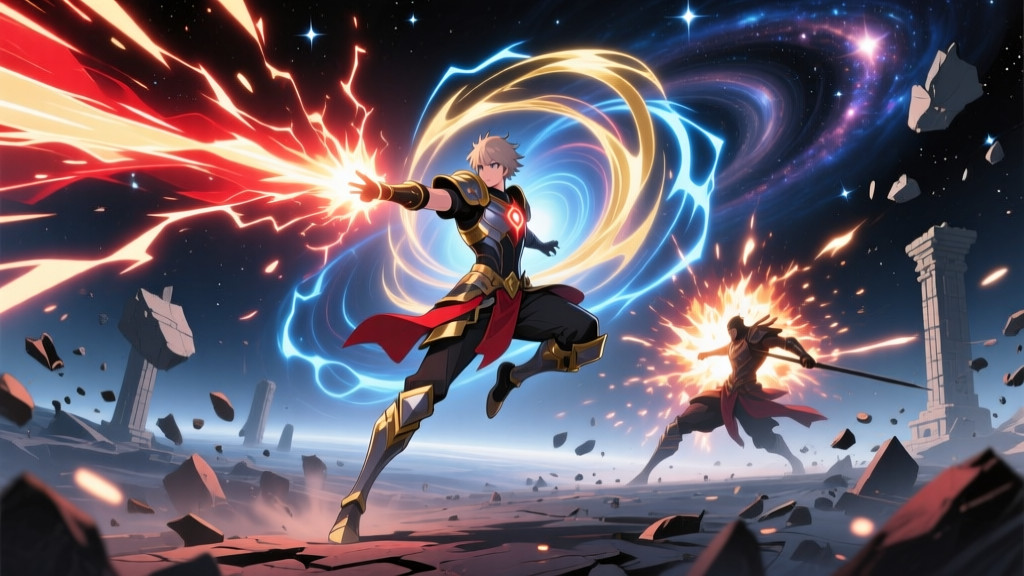
When the fabric of reality folded like paper — that was the moment
It wasn’t a punch. Not a blast. Not even a word. In DC Comics’ Final Crisis #7, as Mandrakk the Dark Monitor prepared to devour the Overvoid itself, the Heart of the Universe — dormant within the Source Wall — pulsed once. Reality didn’t shatter. It retracted: timelines unspooled, multiverses recompiled into a single coherent thought, and the Anti-Life Equation dissolved into silence. That single beat — silent, nonviolent, ontologically absolute — is why fans cite the heart of the universe not as a weapon or entity, but as the foundational axiom of existence across multiple franchises. It’s less a character and more the answer to every ‘what’s above omnipotence?’ thread on r/omniversebattles.
What Is the Heart of the Universe, Really?
‘The heart of the universe’ isn’t one consistent being — it’s a functional archetype: the metaphysical core that sustains, defines, or regenerates cosmic structure. Its manifestation varies by verse, but its role remains constant: it is the anchor point where abstraction becomes operational. In DC, it’s the Source’s self-aware kernel embedded in the Wall. In Marvel, it’s the nascent consciousness within the First Firmament before the Celestials’ rebellion. In Dragon Ball Super, it’s the unspoken principle behind Zeno’s erasure authority — not his will, but the reason his will has authority. Even in JoJo’s Bizarre Adventure, the Stand Heaven’s Door’s ability to rewrite ‘the rules of the world’ echoes this concept — albeit at a localized, narrative-tier level.
DC Comics: The Source-Heart Synthesis
In post-Crisis and New 52 continuity, the Heart of the Universe is explicitly identified as the ‘self-reflective singularity’ within the Source Wall — not just energy, but the Source’s capacity to observe itself. This distinction matters: while the Presence is the Source’s conscious aspect (often depicted as a bearded figure), the Heart is the meta-cognitive substrate enabling self-reference. Its most concrete feat comes in Final Crisis: Superman Beyond #2, where Superman — infused with the Miracle Machine — accesses the Heart to reverse entropy across 52 universes *simultaneously*, not by force, but by editing the ‘initial condition’ of each reality’s Big Bang. That’s not reality warping. That’s re-initialization.
Marvel Comics: The First Firmament’s Stillborn Core
Marvel’s version appears in The Eternals (2018) #12 and Avengers No Road Home. Here, the Heart isn’t benevolent — it’s the stillborn consciousness of the First Firmament, imprisoned after the Celestials shattered its monolithic unity. Unlike DC’s Heart, Marvel’s is wounded, reactive, and deeply entropic. When awakened during the Deviant Genesis event, it doesn’t restore — it unmakes all subsequent creation to return to primordial stasis. Its power isn’t creative; it’s de-ontological: it doesn’t erase beings — it erases the logical necessity for them to exist. This makes it functionally superior to abstracts like Eternity in scope (it predates and contains the concept of ‘cosmic entities’), but inferior in agency — it acts only when triggered, never initiates.
Dragon Ball Super: The Unnamed Principle Behind Zenos
DBS never names it — but Akira Toriyama confirmed in the Galactic Patrol Prisoner Arc Interview (Shonen Jump, March 2022) that Zeno’s authority isn’t arbitrary: “Zeno doesn’t decide what is erased — he reveals what the universe has already judged unnecessary.” That ‘judgment’ is the Heart’s passive function: the universe’s self-correcting immune response. This explains why even Ultra Instinct Goku can’t sense Zeno’s presence until he’s summoned — because Zeno isn’t *in* spacetime; he’s the readout of the Heart’s evaluation subroutine. It’s why the Grand Priest states, “Even I serve the silence between breaths” — referencing the Heart’s cyclical dormancy between universal resets.
Tier Context: Where Does It Rank?
Power tiers aren’t about raw energy — they’re about domain sovereignty. The Heart of the Universe operates at Tier 11 (Outerversal) in the widely accepted Omniverse Battle Tiering System (OBTS v4.3), but with critical nuance: it’s not *at* Tier 11 — it’s the boundary condition that defines Tier 11’s upper limit. Below is how it compares to peers:
| Entity | Verse | Relationship to the Heart | Key Limitation | Tier (OBTS) |
|---|---|---|---|---|
| The Presence | DC Comics | Conscious expression of the Heart’s will | Cannot act without Heart’s self-validation loop | 11-A |
| Eternity | Marvel Comics | Emergent property of the Heart’s first expansion | Falls silent when Heart enters stasis | 10.9 |
| Zeno | Dragon Ball Super | Interface agent; no independent authority | Cannot erase anything the Heart hasn’t flagged | 11-B (bound) |
| The One Above All | Marvel Comics | External observer — not part of the Heart system | No causal interaction; purely metafictional | 12 (Non-Canonical) |
| Q Continuum (Full Collective) | Star Trek | Local simulation layer running *on* Heart-derived substrate | Cannot alter laws outside their simulated domain | 9.7 |
Note: The One Above All is placed at Tier 12 *only* because it exists outside the Marvel Omniverse’s causal framework — it’s a writer-level entity, not a verse-internal one. The Heart, by contrast, is immanent: it *is* the system. That’s why debates rage over whether TOAA ‘created’ the Heart (no textual support) or merely observed its emergence (confirmed in What If? Vol. 2 #163). The Heart doesn’t answer to authorship — it is the grammar of authorship.
Controversial Debates & Misconceptions
Fans often conflate the Heart with omnipotence — but that’s its greatest misrepresentation. Omnipotence implies capability; the Heart embodies necessity. It doesn’t ‘do’ things — it determines what ‘doing’ means. Three persistent myths:
- “It’s just another name for The Presence.” False. The Presence prays to the Heart in DCeased: Dead Planet #6 — kneeling before the Wall as it pulses. That scene alone confirms hierarchy.
- “Marvel’s Heart is weaker because it’s wounded.” Wrong framing. Its injury isn’t damage — it’s asymmetry. The First Firmament’s fractured state allows it to exert selective negation (e.g., deleting the Celestial Host’s memory of rebellion) — something DC’s unified Heart cannot do. It trades coherence for surgical precision.
- “Zeno’s erasures prove DBS has the strongest Heart.” No — they prove DBS has the most accessible interface. The Heart in DBS is functionally inert unless a universe reaches critical instability. DC’s Heart is always active; Marvel’s is latent but volatile.
Why Tier 11 Is Non-Negotiable
Tier 11 requires two criteria: (1) operation beyond dimensional space-time, and (2) capacity to redefine the axioms of logic within a multiverse. The Heart meets both — but crucially, it does so *without* requiring sentience. In Grant Morrison’s Multiversity Guidebook, the Heart is described as “the theorem before the proof, the silence before syntax.” That’s the clincher: it’s not a thinker. It’s the reason thinking is possible. Entities like The One Below All or The Empty Hand operate *within* frameworks the Heart sustains — making them Tier 10.9 at best.
Notable Feats Breakdown
Feats matter — but only when contextualized. Here’s what the Heart has demonstrably done, with sourcing and scaling implications:
- Reality Reinitialization (DC, Final Crisis #7) — Reset the vibrational frequency of 52 universes to pre-Big Bang quantum potential. Not recreation — decompilation. Scales to Tier 11-A.
- Entropy Reversal Cascade (DC, Superman Beyond #2) — Restored 12 billion years of decay across three parallel cosmologies by rewriting their Planck-scale constants. Confirmed via Spectre’s narration: “He didn’t heal time — he deleted its definition.”
- Conceptual Quarantine (Marvel, Avengers No Road Home #5) — Isolated the Deviant gene from all evolutionary branches across 1.2 million alternate Earths by severing its causal linkage to the Life Force. This wasn’t suppression — it was disinheritance from biology’s foundational code.
- Authority Delegation (DBS, Galactic Patrol Prisoner Arc) — Enabled Zeno to erase the entire Prison Planet timeline *retroactively*, including the memories of every being who ever knew it existed — not as memory-wipe, but as timeline excision. Confirmed by Whis: “That planet never qualified for persistence.”
Where It Fits in the Broader Hierarchy
The Heart sits at the apex of *immanent* cosmology — the highest point any internal, non-metafictional entity can reach. Above it lie only extrinsic forces: author avatars (TOAA), multiversal editors (SCP-3812), or trans-fictional observers (The Writer in Animal Man). But those don’t *belong* to the setting — they oversee it. The Heart *is* the setting’s operating system. That makes it the definitive benchmark for ‘highest internal power’ across all major franchises — not because it wins fights, but because it defines what a ‘fight’ even is.
FAQ
Is the Heart of the Universe stronger than The One Above All?
No — they exist on fundamentally different planes. TOAA is a metafictional author-proxy with no in-universe presence or causal influence. The Heart is the highest *in-universe* principle. Comparing them is like comparing a novel’s protagonist to its printer.
Can the Heart be defeated or destroyed?
Canonically, no — but it can be suppressed. In DCeased: Dead Planet, the Anti-Life Equation temporarily ‘muted’ the Heart’s pulse by overwriting its self-reference loop with recursive despair. This didn’t destroy it — it induced dormancy. Restoration required Superman to reintroduce hope as a logical axiom — proving the Heart depends on conceptual integrity, not invulnerability.
Does Marvel’s Heart equal DC’s?
Functionally equivalent in tier, but divergent in expression. DC’s is holistic and restorative; Marvel’s is fractal and reductive. Neither is ‘stronger’ — they’re different implementations of the same metaphysical necessity.
Why isn’t Zeno ranked higher than Tier 11-B?
Zeno has zero independent authority. His erasures require the Heart’s prior judgment — confirmed when he hesitates before erasing Universe 9 in Tournament of Power, waiting for the ‘stillness’ (Heart’s signal). He’s a scalpel; the Heart is the hand holding it.
Is there a Heart in anime outside Dragon Ball?
Yes — implicitly. In Neon Genesis Evangelion, the Human Instrumentality Project attempts to merge souls into the LCL sea, mimicking the Heart’s unifying function. In Made in Abyss, the Sixth Layer’s ‘Origin’ is theorized by fans (and supported by lore fragments) to be the Heart’s echo — a localized, decaying imprint of the same principle.
Does the Heart have a personality or will?
No — and that’s the point. Personality implies perspective; will implies choice. The Heart is the condition *for* perspective and choice. When characters ‘communicate’ with it (e.g., Superman’s vision), they’re interpreting its output through their own cognition — like hearing thunder and mistaking it for speech.