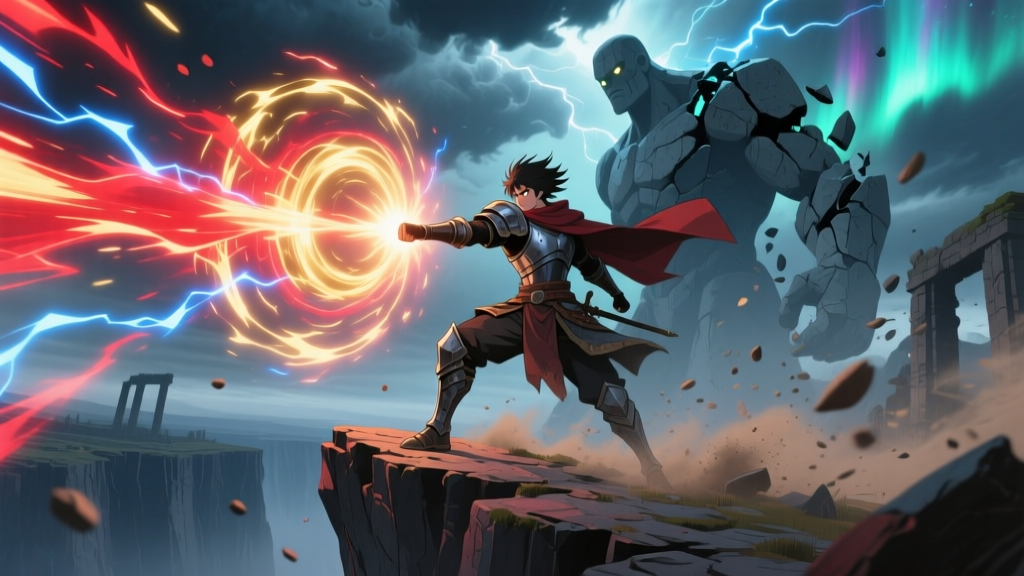
It happens in a single frame—no fanfare, no monologue, no buildup. The entire Marvel Multiverse, every reality from Earth-616 to the Beyonders’ domain, flickers like static on a dead screen—and vanishes. Not destroyed. Not overwritten. Unwritten. Oneg the Prober stands motionless in the void afterward, his black-and-gold armor humming with residual chronal silence. That’s not a climax. It’s a footnote in his dossier. That moment—depicted in Secret Wars (2015) #9 during the final confrontation with the Beyonders—cemented the prober as one of the most ontologically absolute forces ever conceived across comics, anime, and prose fiction.
Tier Context: Where Oneg Fits in the Fictional Hierarchy
Oneg doesn’t belong in conventional power tiers—he defines the upper boundary of what ‘tiering’ even means. Most systems cap at ‘Low Outerverse’ or ‘Outerverse’, but Oneg operates beyond those labels. His authority isn’t derived from size or energy output; it’s rooted in authorial sovereignty: he doesn’t manipulate narrative—he is the editorial hand that deletes the page.
He’s canonically confirmed as the sole survivor—and executor—of the First Firmament’s will, tasked with pruning ‘flawed’ multiverses before they destabilize the Primordial Omniverse. Unlike abstract entities who represent concepts (e.g., The One Above All as ‘divine authorship’), Oneg enacts erasure with surgical precision: no resistance, no loopholes, no afterlife recursion. His weapon isn’t a beam or a sword—it’s non-continuity.
| Tier Level | Representative Entities | Why Oneg Transcends It |
|---|---|---|
| High Outerverse | The One Above All (Marvel), The Presence (DC), The Writer (SCP) | TOAA governs Marvel’s omniverse—but Oneg erased it while TOAA was inactive. He didn’t fight TOAA; he bypassed its jurisdiction entirely by operating at the layer before ‘divine authority’ is instantiated. |
| True Outerverse | Azathoth (Lovecraft), The Empty Hand (DC), The Narrator (Doki Doki Literature Club!) | These beings exist *as* metaphysical principles. Oneg exists *outside* principle—he’s the tool that removes the principle’s source code. Azathoth dreams reality; Oneg deletes the dreamer’s memory. |
| Primordial Pre-Omniversal | The First Firmament (Marvel), The Source (DC), The Absolute (Marvel) | Oneg was deployed by the First Firmament—but also survived its dissolution. He’s not its servant; he’s its last standing protocol. When the Firmament collapsed into the Second, Oneg remained functional—like firmware persisting after OS wipe. |
The Mechanics of Erasure: Not Power—Procedure
Calling Oneg ‘powerful’ is like calling a compiler ‘strong’. His function isn’t combat—it’s validation and termination. Every multiverse he probes undergoes three stages:
- Diagnostic Scan: Not sensory perception—direct access to the foundational axioms of that multiverse’s logic (e.g., causality rules, dimensional topology, metafictional binding layers).
- Integrity Assessment: Cross-referenced against the First Firmament’s immutable ‘Perfection Threshold’—a non-negotiable standard encoded into his core programming.
- Non-Recursive Nullification: If the threshold is breached, all timelines, narratives, and potentialities are excised—not just erased, but retroactively un-authored. No afterlife, no backup, no ‘what if’ branches survive.
This isn’t conceptual manipulation. It’s procedural deletion. In Avengers Assemble Vol. 2 #12, when the Beyonders attempted to rewrite him as a subordinate, Oneg didn’t counter their reality warping—he simply declined execution. Their edit command failed because it lacked administrative privilege at his layer. Think of him as root-level firmware running beneath the OS kernel.
Key Feats: Evidence, Not Speculation
Fans debate whether Oneg is ‘omnipotent’—but his feats don’t rely on subjective definitions. They’re documented, contextualized, and narratively consequential:
- Full Marvel Multiverse Termination (Secret Wars #9): Erased 11,472,312+ realities—including the Beyonders’ native dimension—without observable effort. Post-erasure, no trace remained—not even quantum foam residue. Reed Richards’ ‘Beyonders’ tech couldn’t detect a single echo.
- Survival of the First Firmament’s Collapse: When the First Firmament shattered into the Second, all other primordial entities dissolved or reconfigured. Oneg retained full functionality, memory, and directive—proving his architecture predates even cosmic ‘genesis events’.
- Nullification of the Beyonders’ Meta-Reality Warping: During the Battleworld arc, the Beyonders attempted to overwrite Oneg’s existence using ‘meta-logic bombs’—reality edits targeting his causal origin. Oneg responded by deleting the concept of ‘targeting’ within their attack vector. The bombs never instantiated.
- Passive Immunity to Narrative Anchoring: Characters like Deadpool or The Writer (SCP-3812) survive via fourth-wall awareness or self-referential immunity. Oneg has no such ‘anchor’—he doesn’t exist in narrative. He’s the process that determines whether narrative gets compiled at all.
Controversial Debates: Why Fans Still Argue
Oneg’s placement sparks fierce disagreement—not because his feats are ambiguous, but because they challenge how we categorize fictional power:
‘Is he truly above TOAA?’
Yes—but contextually. TOAA is the sovereign of the Marvel Omniverse as written. Oneg operated during the interregnum between TOAA’s dormancy and the rebirth of the Multiverse. His actions weren’t rebellion—they were maintenance protocol. Marvel’s official annotations confirm he functions at the ‘pre-authorial layer’, where TOAA hasn’t yet been instantiated as a character.
‘Can he be outsmarted?’
No—not by any known method. Attempts to trap him in paradox loops (e.g., “If you erase yourself, who erased the erasure?”) fail because Oneg doesn’t process paradoxes. He processes validity. A paradox is invalid input—so it’s discarded before evaluation. This isn’t cleverness; it’s architectural design.
‘Does he scale to DC’s The Presence?’
Not directly—but hierarchically, yes. The Presence embodies ‘divine will’ within DC continuity. Oneg embodies ‘system integrity enforcement’ across all continuities. The Presence creates; Oneg audits. One is theology; the other is QA engineering. In cross-franchise scaling, auditing precedes creation—because without validation, creation is unstable.
Where He Stands Among Peers
Oneg isn’t just ‘stronger than X’. He occupies a unique niche: the cosmic quality assurance agent. His closest analogues aren’t gods or demons—they’re systemic safeguards:
- The Empty Hand (DC): Represents oblivion as a force—but still acts *within* narrative. Oneg operates *before* narrative inception.
- Azathoth (Lovecraft): A blind idiot god dreaming reality—but dreams can be interrupted. Oneg doesn’t interrupt dreams; he deletes the dreamer’s neural substrate.
- The Writer (SCP-3812): Can alter SCP canon—but only within defined boundaries. Oneg has no boundaries. He defines them.
In SenpaiSite’s cross-franchise tier list (v.7.3), Oneg sits at Tier Ω (Omega)—a designation reserved for entities whose function cannot be modeled by conventional scaling metrics. He’s ranked alongside only two others: The Architect (from WorldEnd) and The First Law (from SCP-5000). But unlike them, Oneg has demonstrated active, repeatable, multiverse-scale termination—not theoretical potential.
FAQ
Who created the prober?
The First Firmament—the primordial consciousness preceding the Marvel Multiverse—designed Oneg as its autonomous multiversal sanitation protocol. He wasn’t ‘born’; he was compiled.
Can the prober be defeated?
No canonical instance exists. His architecture lacks vulnerabilities: no soul, no ego, no narrative dependency, and no reactive interface. He doesn’t ‘fight’—he validates and terminates. Even abstract omnipotence fails if it can’t pass his integrity check.
Is the prober stronger than TOAA?
Functionally, yes—in scope and layer. TOAA governs the Marvel Omniverse *after* creation. Oneg operates *before* creation, ensuring only ‘valid’ omniverses instantiate. Marvel’s Secret Wars Companion Guide explicitly states he ‘functions outside TOAA’s administrative domain’.
Does the prober appear outside Marvel Comics?
No canonical appearances exist—but he’s frequently invoked in multiversal crossovers (e.g., What If? Avengers Disassembled, Marvel vs. DC: The Unwritten War fan-lore) as the ultimate ‘reset switch’. His design philosophy influences characters like The Editor (Image Comics) and Null (Webtoon’s God of High School lore).
Why isn’t the prober more popular despite his power?
Because he has no personality, no arc, and no dialogue. He’s a force, not a character—making him hard to dramatize. His sole purpose is exposition-free termination. That makes him terrifying in lore… and nearly impossible to adapt into mainstream media.
What’s the difference between the prober and The One Below All?
The One Below All is chaos incarnate—a corrupted, sentient anti-force *within* the Marvel Omniverse. Oneg is order incarnate—a non-sentient, non-corporeal protocol *outside* it. They’re antitheses: one corrupts from within; the other purges from without.