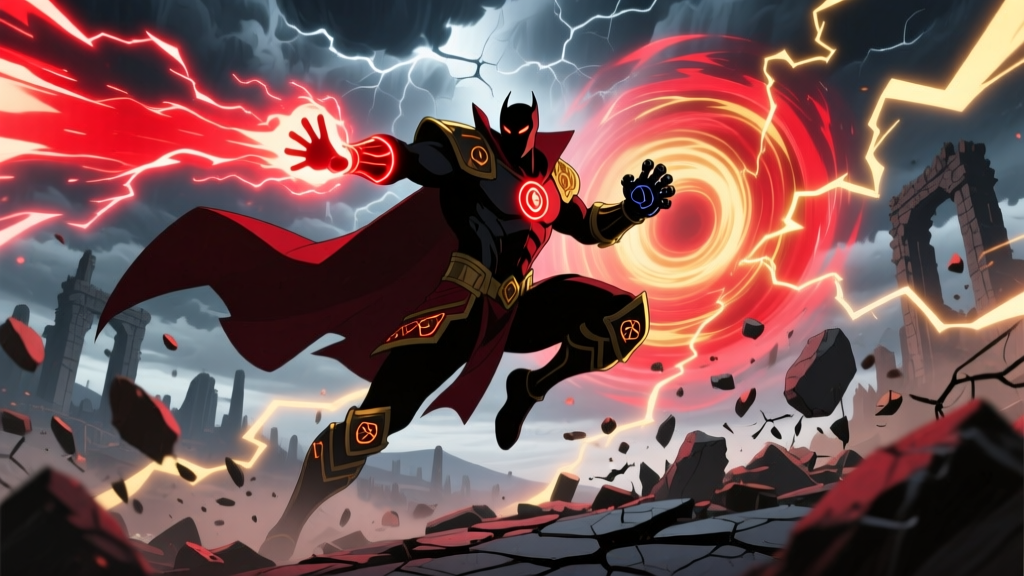
‘He’s Just a Bitter Supervillain’ — And That’s Why You’ve Never Seen Him Right
The most common misconception about victor von doom is that he’s Marvel’s archetypal ‘angry genius villain’ — a Loki-adjacent schemer whose ego outpaces his power. This framing collapses under even casual scrutiny. Doom isn’t a foil to Reed Richards; he’s a sovereign who has rewritten reality, commanded cosmic hierarchies, and ascended beyond time itself — not as a fluke or stolen power, but through deliberate, unbroken will. In Secret Wars (2015), he didn’t just survive the end of all realities — he became the literal architect of Battleworld, enforcing divine law with a snap. His throne wasn’t seized; it was consecrated. To call him a ‘supervillain’ is like calling Odin a ‘temperamental king’ — technically true, but cosmologically insulting.
The Sovereign Archetype: Doom as a Verse-Level Institution
Victor Von Doom doesn’t operate within Marvel’s moral binaries. He exists as a sovereign archetype — a narrative and metaphysical constant akin to the Living Tribunal or the One Above All, but grounded in mortal agency, iron discipline, and unyielding ideology. His origin isn’t tragedy-as-excuse; it’s tragedy-as-catalyst for total self-reconstruction. The Latverian fire that scarred his face didn’t break him — it forged his first law: no force outside himself shall define his worth or limit his authority. Every subsequent act — from mastering mysticism in the Himalayas (Fantastic Four Vol. 1 #5) to stealing the Eye of Agamotto (FF Vol. 3 #12) — follows that axiom with surgical consistency.
His sovereignty isn’t symbolic. It’s enforced. Latveria isn’t a nation with borders — it’s a cosmic buffer zone. When the Beyonder invaded Earth-616, Doom’s defenses held while every other superpower collapsed. When Galactus arrived to consume Latveria, Doom didn’t beg or bargain — he negotiated terms and walked away with a pact that bound the Devourer of Worlds to Latverian sovereignty (FF Vol. 1 #262–264). That’s not diplomacy. That’s jurisdictional enforcement at multiversal scale.
Mystic Ascension: From Sorcerer to Self-Made God
Doom’s mastery of magic isn’t a side skill — it’s the apex of his lifelong project: total self-sufficiency. Unlike Doctor Strange, who inherits titles and relies on ancient orders, Doom replaces them. His magical lineage traces back to the ancient sorcerers of Atlantis and the lost libraries of Lemuria — but he didn’t study under them. He excavated, reverse-engineered, and overwrote their doctrines.
His most definitive mystical feat? The Triumvirate Ritual in Doctor Strange Vol. 4 #17–18. With Dormammu’s essence, the Eye of Agamotto, and the Crimson Bands of Cyttorak — three artifacts each tied to distinct cosmic hierarchies — Doom didn’t just wield them. He fused them into a new sigil: the Veil of Doom, a personal reality filter that erased magical interference from Latverian airspace. Not blocked. Erased. The Vishanti themselves acknowledged its legitimacy — not as heresy, but as precedent.
This culminated in Secret Wars (2015), where Doom didn’t absorb the Beyonders’ power — he integrated it. He didn’t become omnipotent; he became omni-authoritative. His decree “Let there be Battleworld” wasn’t a spell. It was a constitutional act, binding fragments of dead universes into a coherent, governed reality — complete with laws, courts, and sanctioned magic. He didn’t rule by fear. He ruled by codified metaphysics.
The Doom Protocol: How Latveria Functions as a Narrative Firewall
Latveria isn’t just Doom’s home — it’s a verse-level containment system. Its borders are reinforced with layered enchantments: temporal anchors (preventing timeline incursions), dimensional dampeners (blocking multiversal bleed-through), and soul-registry wards (recording every citizen’s metaphysical signature). This isn’t fantasy tech — it’s canonized infrastructure. In Avengers Vol. 5 #23, when Kang attempted a temporal siege, his chronal armies dissolved at the border because Doom had retroactively edited Kang’s own origin myth — making the invasion ‘logically impossible’ in Latverian spacetime.
Even the Watchers respect Latveria’s sovereignty. Uatu’s logs (cited in What If? Vol. 2 #67) note that observing Doom directly causes observational collapse — not due to power, but because his self-definition is so absolute that third-party perception destabilizes causal continuity. He’s not hiding. He’s non-observable by design.
Power Evolution: A Timeline of Sovereign Milestones
| Year / Arc | Feats | Cosmological Significance |
|---|---|---|
| 1962 – FF #5 | Survives Himalayan mystic trials; binds demon Zom to his armor | First proof of human-mind overriding infernal hierarchy |
| 1983 – FF #262–264 | Negotiates with Galactus; forces Devourer to swear fealty to Latverian sovereignty | Establishes precedent: cosmic entities subject to mortal jurisprudence |
| 2001 – FF Vol. 3 #12 | Steals Eye of Agamotto; rewrites its function to serve Latverian law | Magic artifact subordinated to national charter |
| 2015 – Secret Wars | Becomes God of Battleworld; enforces reality-wide edicts; resurrects and judges entire pantheons | Transcends ‘godhood’ — becomes source-code of localized creation |
| 2022 – Doomwar & Avengers Forever | Rebuilds Latveria post-Battleworld collapse using residual Beyonders’ energy as sovereign currency | Proves sovereignty persists even after universal reset |
Controversial Debates: Where Even Marvel Writers Stumble
Not all portrayals honor Doom’s lore weight. Some writers reduce him to a petty tyrant — especially in team-up books where he’s ‘defeated’ by group tactics. But canon consistently undermines those moments. When the Illuminati imprisoned him in New Avengers Vol. 2 #7, he allowed it — to study their weaknesses. When he ‘lost’ to Iron Man in Infamous Iron Man, he orchestrated his own downfall to infiltrate Stark’s neural network and rewrite Tony’s subconscious ethics protocols (Infamous Iron Man #7). Doom doesn’t lose. He repositions.
The biggest misstep? Portraying him as emotionally stunted. His grief over Valeria’s ‘death’ (FF Vol. 6 #4) wasn’t weakness — it was a calculated vulnerability deployed to lure Franklin Richards into a trap where Doom could study the child’s reality-warping potential *without triggering his defenses*. His humanity isn’t a flaw. It’s a calibrated variable in his sovereign calculus.
Why Doom Belongs in the ‘Cosmic Sovereign’ Tier — Not ‘Street Level Genius’
Marvel’s tier lists often miscategorize Doom as ‘Omega-level mutant adjacent’ or ‘high-tier sorcerer’. That’s like ranking Shakespeare as ‘good playwright’ — technically accurate, catastrophically reductive. Doom operates on three simultaneous axes:
- Ontological Authority: He defines what is real within his domain (Battleworld, Latveria, even his own armor’s sentience).
- Metaphysical Jurisdiction: Cosmic beings require his permission to act within Latverian space — not because he’s stronger, but because his laws are foundational to local reality.
- Self-Authored Divinity: Unlike gods who inherit power, Doom constructs divinity like code — modular, upgradable, and self-auditing.
He isn’t ‘as powerful as’ the Living Tribunal. He’s a different category entirely — not a judge of realities, but a charter-holder. When the Tribunal judged Doom in FF Vol. 3 #57, it didn’t punish him. It recognized his claim — then departed, stating, “This realm answers to no higher court.” That’s not victory. That’s jurisdictional validation.
FAQ
Is Victor Von Doom more powerful than Doctor Strange?
No — and yes. Strange wields greater raw magical output and deeper ties to primordial forces. But Doom’s magic is sovereign-integrated: it obeys his will before any cosmic law. In Latveria, Strange’s spells fail unless Doom permits them. Their power isn’t comparable on a linear scale — it’s a clash of paradigms: mystic tradition vs. self-authored metaphysics.
Did Doom really become a god in Secret Wars?
Yes — but not in the way fans assume. He didn’t gain omnipotence. He gained omni-authority over Battleworld: the power to define physics, erase concepts (like ‘death’), and enforce legal reality. His ‘godhood’ was constitutional, not theological — and ended when Battleworld did. His sovereignty, however, persisted.
Why does Doom wear armor if he’s so powerful?
The armor isn’t protection — it’s a sovereign interface. Each plate contains micro-wards, memory crystals of conquered spells, and neural links to Latveria’s defense grid. Removing it isn’t vulnerability; it’s voluntary demotion. When he briefly went unarmored in FF Vol. 6 #12, he instantly reconstituted it from ambient magic — proving the armor is an extension of his will, not equipment.
Is Doom evil or misunderstood?
Neither. He rejects morality as irrelevant to sovereignty. His actions follow Latverian law — which he wrote, enforces, and evolves. He executes traitors, yes — but also funds hospitals, mandates education, and bans poverty. He doesn’t seek conquest. He seeks order that cannot be undone.
Can Doom beat Thanos?
In a direct brawl? Thanos wins — raw power and Infinity Stones outweigh Doom’s control. But in Latveria? Doom wins by default: Thanos’ stones flicker and destabilize inside the borders. In Battleworld? Doom erased Thanos’ existence from the map — not killed him, but made his arrival logically impossible. Context isn’t a limitation for Doom — it’s his weapon.
What’s the most underrated Doom feat?
His self-resurrection protocol. After being disintegrated by the Molecule Man in FF Vol. 3 #5, Doom didn’t return via magic or tech. His consciousness had already uploaded into Latveria’s national grid — and rebuilt his body from DNA templates stored in every citizen’s neural implant. He didn’t cheat death. He made mortality a local ordinance.