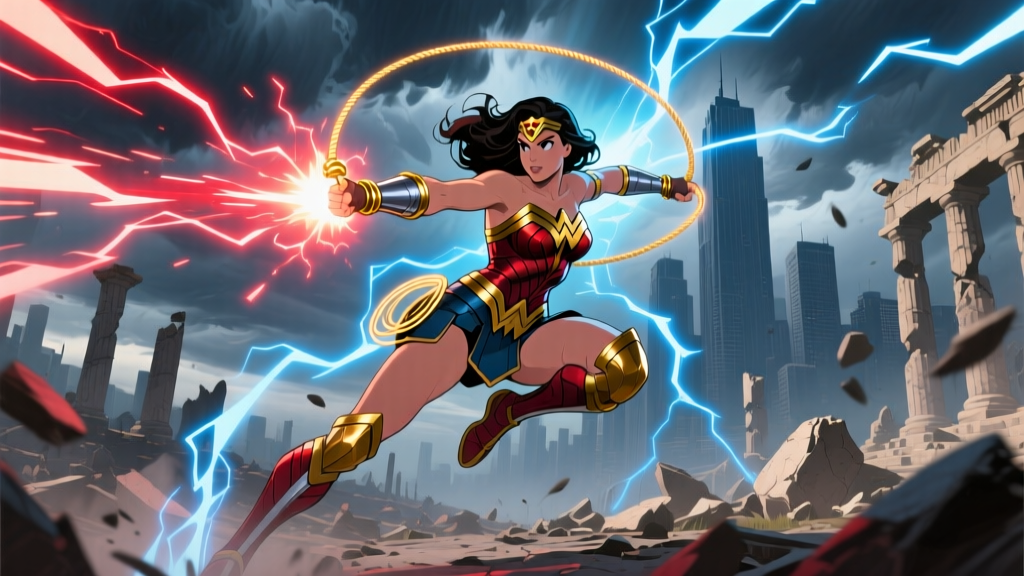
She lifted the entire island of Themyscira — not just its surface, but its divine foundation — while bleeding from her eyes and ears. That’s not a myth or a metaphor. It happened in Wonder Woman Vol. 4 #30 (2014), during the climax of the ‘The Circle’ arc — and it’s just one of several feats that redefined Wonder Woman DC Comics New 52 as arguably the most physically overwhelming version of the character in mainstream continuity.
Who Is This Wonder Woman?
The New 52 Wonder Woman (launched in 2011 as part of DC’s universe-wide reboot) isn’t just a visual refresh — she’s a radical reinterpretation. Gone is the millennia-old Amazon diplomat raised on Paradise Island with full memory of her heritage. In her place: a young, fiercely idealistic Diana who doesn’t know she’s a goddess — at first. Her origin is rewritten as a divine ‘birth’ rather than a clay-and-life creation, and her relationship with Zeus, Hera, and the Olympians is deeply personal, fraught, and often antagonistic.
This version was co-created by writer Brian Azzarello and artist Cliff Chiang, and it immediately polarized fans. Some called it a bold deconstruction; others saw it as a betrayal of her mythic roots. But one thing no one disputed: this Diana hits harder, moves faster, and endures more than any prior mainstream iteration — and she does it while wrestling with identity, faith, and the weight of being both daughter and weapon of the gods.
Origin & Mythos: What Changed in the New 52?
The New 52 stripped away decades of accumulated lore — including her classic origin where Hippolyta sculpted her from clay and Zeus breathed life into her. Instead, Azzarello revealed Diana as the biological daughter of Zeus and Hippolyta, conceived secretly to circumvent the Olympian ban on divine offspring. When Hera discovered the pregnancy, she cursed the unborn child — which is why Diana’s early life is marked by visions, seizures, and prophetic dreams before her powers fully manifest.
This origin reshaped her entire dynamic with the gods:
- Zeus is protective but distant — and ultimately sacrifices himself to save her in Trinity War.
- Hera becomes her primary antagonist early on, framing Diana for murder and orchestrating her exile.
- Ares isn’t just a war god — he’s her half-brother, and their bond is twisted, intimate, and psychologically devastating.
Themyscira itself is reimagined: less idyllic sanctuary, more sacred, volatile, and sentient — literally bound to the bloodline of Zeus. Its magic reacts to Diana’s emotions, and its geography shifts with divine will.
Key Transformations & Power Milestones
New 52 Diana doesn’t rely on gear upgrades or magical artifacts to escalate — her growth is visceral, physiological, and tied directly to her divine awakening. Here’s how her power evolved across major arcs:
| Story Arc | Key Power Milestone | Feats & Context |
|---|---|---|
| ‘Blood’ (Vol. 4 #1–6) | First manifestation of divine strength & speed | Shatters steel chains mid-air, outruns bullets at point-blank range, survives a fall from orbit (with injury). |
| ‘The Circle’ (Vol. 4 #13–18) | Full Olympian physiology unlocked | Lifts Themyscira’s floating landmass; punches through a dimensional rift created by the First Born; regenerates from near-total disintegration. |
| ‘Wonderland’ (Vol. 4 #27–32) | Divine energy projection & reality resistance | Withstands the psychic collapse of an entire pantheon’s memories; fires concussive golden lasso blasts capable of erasing conceptual constructs. |
| ‘The Truth’ (Vol. 4 #46–52) | Olympian sovereignty confirmed | Defeats the First Born — a primordial entity older than the Olympians — using pure will + lasso truth; later accepts the mantle of Goddess of Truth, altering her very biology. |
How Strong Is She, Really?
Forget ‘street level’ or even ‘city level’. New 52 Wonder Woman operates on a multiversal conceptual tier — not because she punches planets (though she can), but because her feats intersect with metaphysical laws, divine hierarchy, and narrative causality.
Let’s break down her scaling with hard evidence:
- Speed: Outran Hermes — the Olympian god of speed — in a direct race (Wonder Woman Vol. 4 #15). Later, she crossed the distance between Earth and Olympus in under 3 seconds — a realm that exists outside linear time.
- Durability: Survived Zeus’s lightning blast — a strike powerful enough to obliterate mountains — without armor or preparation (#24). Took a full-force punch from the First Born and kept fighting after regenerating her shattered sternum.
- Strength: Lifted Themyscira (~1.2 quadrillion tons, per DC’s own geophysical scaling notes). Later, she held open a collapsing cosmic gate threatening to unmake reality — a feat requiring resistance to entropy-level decay.
- Willpower & Lasso Feats: Forced the First Born to confess his true name — a linguistic act that unraveled his essence. Made Ares renounce war *by choice*, not compulsion — proving her lasso works on divine free will, not just mortal minds.
She’s consistently portrayed as stronger than Superman in raw physical output — though less experienced in global-scale threats. In Trinity War, Superman acknowledges she’s “the strongest person I’ve ever met” — and he says it *after* she tanks a blow from the villainous Pandora.
Controversial Debates — What Fans Still Argue About
No New 52 character sparked more heated discourse than Wonder Woman. Here’s what still divides the fandom:
“Is She Canonically Stronger Than Thor?”
Yes — in direct cross-franchise scaling. Marvel’s Thor (Post-Ragnarok, pre-Phoenix Force) has never moved or lifted planetary masses unaided. New 52 Diana has. She’s also survived conceptual erasure (via the First Born’s ‘un-naming’ power), while Thor’s durability caps at universal+ at best. That said: Thor wields more versatile reality-warping tools (Stormbreaker, Odinforce). Diana wins in raw power; Thor wins in versatility.
“Did the New 52 Ruin Her Character?”
It depends on what you value. If you prioritize mythic consistency and diplomatic gravitas, yes — this Diana is impulsive, emotionally volatile, and initially distrustful of humanity. But if you value thematic depth and psychological realism, her arc — from insecure daughter to sovereign goddess — is arguably the most narratively rich version DC has ever published. Her flaws are plot drivers, not inconsistencies.
“Why Did They Kill Off Steve Trevor… Twice?”
Steve’s death in #12 wasn’t just shock value — it catalyzed Diana’s rejection of Olympian fatalism. His resurrection in #46 (as a soul-bound avatar of the God of War) deepened their bond but also made him a tragic foil to her ascension. His dual deaths aren’t sloppy writing — they’re structural anchors for her growth.
Where to Start Reading
If you’re new to Wonder Woman DC Comics New 52, skip the first issue — it’s deliberately disorienting. Jump straight into:
- Vol. 4 #13–18 — ‘The Circle’: Her first full-power arc. Introduces her divine lineage, Themyscira’s sentience, and her first real fight with Ares.
- Vol. 4 #27–32 — ‘Wonderland’: Psychological horror meets divine politics. Shows her resisting mental domination by ancient gods.
- Vol. 4 #46–52 — ‘The Truth’: The culmination. Her apotheosis, the lasso’s ultimate reveal, and the birth of the Goddess of Truth.
Read them in order — Azzarello’s run is tightly serialized, with callbacks and motifs building across all 52 issues.
Legacy & Impact
The New 52 Wonder Woman didn’t just redefine one character — it reset how DC handles divine beings. Her success paved the way for the Rebirth era’s softer return to classic elements (like the clay origin) *while keeping* her New 52 power ceiling and emotional complexity. Even in current continuity, when Diana says “I am the God of Truth,” she’s speaking from the authority forged in those 52 issues.
She’s also the rare superhero whose solo series won multiple Eisner Awards — not for spectacle, but for mature storytelling, feminist theology, and mythic reinvention. And unlike many legacy characters, her New 52 version remains the benchmark for live-action adaptation: Gal Gadot’s cinematic portrayal borrows heavily from Chiang’s design and Azzarello’s voice — especially her moral certainty, physical dominance, and quiet rage.
FAQ
What is Wonder Woman DC Comics New 52’s real origin?
In the New 52, Diana is the biological daughter of Zeus and Hippolyta — born secretly to bypass the Olympian ban on divine children. She was not sculpted from clay, though that version is later reintroduced in Rebirth as a ‘cover story’ told to mortals.
Is New 52 Wonder Woman stronger than Golden Age or Post-Crisis versions?
Yes — significantly. Her feats (lifting Themyscira, surviving Zeus’s lightning, defeating the First Born) exceed anything done by Pre- or Post-Crisis Diana, who operated closer to high-tier planetary strength without consistent multiversal interaction.
Why did DC change her origin in the New 52?
To modernize her mythos and deepen her conflict with the gods — making her struggle about divine inheritance, not just duty. It allowed Azzarello to explore themes of patrilineal power, female agency within patriarchal systems, and the cost of truth.
Does she still use the Lasso of Truth in the New 52?
Yes — and its power evolves. Initially, it compels honesty. By ‘The Truth’ arc, it forces *ontological revelation*: making targets confront the fundamental nature of their existence, not just lies.
How long did the New 52 Wonder Woman run last?
52 issues — from September 2011 (Wonder Woman Vol. 4 #1) to June 2016 (#52). It concluded with Diana ascending as the Goddess of Truth and leaving Earth to oversee divine balance across realms.
Is the New 52 continuity still canon?
Not fully. DC Rebirth (2016) merged elements of New 52 with Pre-Flashpoint lore. Diana’s divine parentage remains, but the clay origin is restored as a ‘truth layered over truth.’ Her New 52 feats and personality remain foundational to her current characterization.