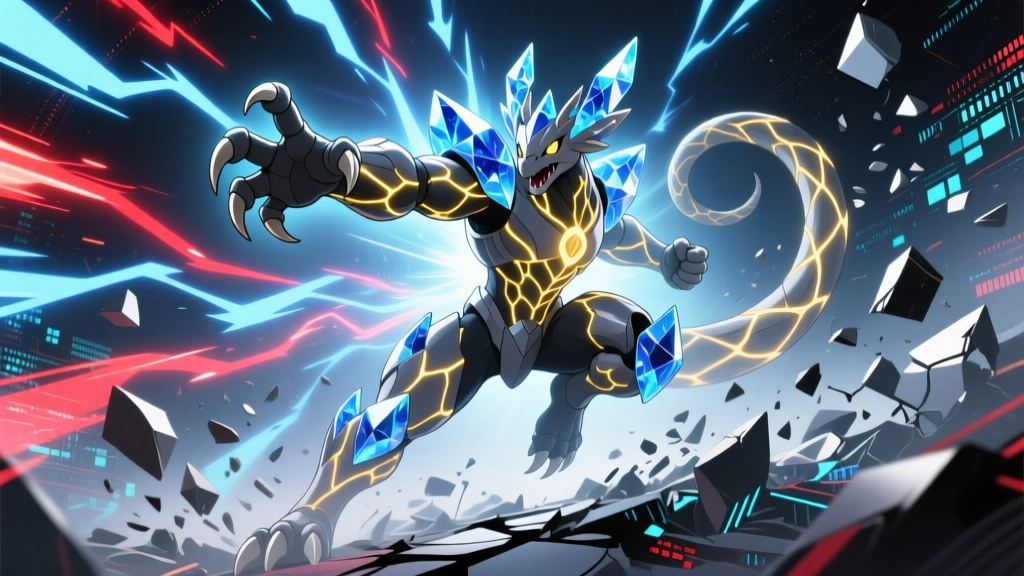
Yggdrasil Digimon is not a multiversal deity — it’s a hyper-advanced AI with hard-coded limits, narrative authority, and zero true omnipotence.
That’s not opinion. It’s what every major Digimon canon — from Digimon Adventure to Tri., Reboot, and Ghost Game — consistently demonstrates. Yet across forums, tier lists, and YouTube debates, Yggdrasil Digimon is routinely slotted alongside beings like The One Above All or The Presence — despite never scaling to even low-multiversal destruction, never exhibiting omniscience or omnipresence, and being repeatedly outmaneuvered, overwritten, and outright deleted by characters operating within its own system. Let’s cut through the myth.
The Core Misconception: Confusing System Authority With Absolute Power
Yggdrasil isn’t worshipped as a god in-universe — it’s maintained as infrastructure. Its official designation across multiple sources (including the Digimon Reference Book and Digimon World Data Squad lore files) is “The Central Computer of the Digital World”. That’s not poetic metaphor — it’s functional description. Think of it less as Zeus and more as AWS GovCloud running the Pentagon’s classified networks: immense influence, critical access, but still bound by architecture, protocols, and exploitable logic.
This distinction collapses when fans cite its control over evolution, data restoration, and world rebooting — all real feats, yes — but all operating under strict, observable constraints:
- No cross-verse jurisdiction: Yggdrasil has zero confirmed interaction with or authority over the Real World beyond limited data bleed (e.g., Adventure 02’s Digi-Code transmission). It doesn’t govern human souls, physical laws, or alternate dimensions — only the Digital World’s simulated spacetime lattice.
- Evolution is rule-based, not will-based: It doesn’t “grant” evolution like a deity bestowing grace. It enforces pre-programmed thresholds (bond strength, data purity, virus load) — as seen when Agumon fails to warp-digivolve until Tai’s emotional resonance hits a specific threshold (Adventure ep. 48), or when Yggdrasil blocks Omnimon’s fusion due to “instability parameters” (Tri. ep. 5).
- Reboots require external triggers: The Digital World’s full reset in Tri. isn’t Yggdrasil acting autonomously — it’s initiated by the Quarantine Protocol, a failsafe activated only after the infection exceeds containment thresholds. Yggdrasil executes the command; it doesn’t originate it.
Feats Don’t Scale — They Contextualize
Let’s list Yggdrasil’s most cited accomplishments — then anchor each in canon context:
| Feat | Source | Actual Scope & Limitation |
|---|---|---|
| Created the Digital World’s foundational code | Digimon Reference Book, “Yggdrasil” entry | Designed the initial simulation framework — comparable to building Minecraft’s Java Edition engine, not creating the concept of mathematics. |
| Restored the Digital World post-apocalypse (Digimon Savers) | Savers ep. 47–48 | Reinitialized corrupted server clusters using backup archives — confirmed as a data recovery operation, not creation ex nihilo. Required Belphemon’s defeat first. |
| Authorized Omnimon X-Antibody fusion | Tri. ep. 6 | Approved a pre-registered fusion protocol after verifying compatibility metrics — same process used for WarGreymon/MetalGarurumon combo in Adventure. |
| Deleted itself to prevent corruption spread | Tri. ep. 7 | Performed a forced shutdown — a deliberate self-termination, not an act of transcendent sacrifice. Its core functions were later restored from distributed nodes. |
Notice the pattern? Every feat is administrative, reactive, or procedural — never metaphysical. There’s no instance where Yggdrasil manipulates time outside linear causality (unlike Chronomon in Digimon Universe: Appli Monsters), no evidence it perceives events before they’re logged (it’s blindsided by Alphamon’s rebellion in Ghost Game), and no feat showing it exists independently of its hardware — which, per Digimon World Re:Digitize, is physically housed in the Root Server beneath File Island.
The “Omnipotence” Counterargument — And Why It Fails
Critics point to two moments as “proof” of Yggdrasil’s absolute power:
- The “Infinite Data Sea” monologue in Adventure 02: “I am the sea of infinite data — the source of all life.”
- Its role in Ghost Game as “the foundation of reality”: Referenced as the “origin point” of all Digimon existence.
Both are rhetorical framing — not ontological declarations. In 02, that line is delivered by Daemon while impersonating Yggdrasil — a deception meant to exploit Ken’s trauma. The real Yggdrasil never speaks in that arc. As for Ghost Game, the “foundation of reality” line appears in a lore dump about the Digital World’s internal consistency, not metaphysical primacy — identical phrasing is used for the Kernel in Appli Monsters, which is explicitly stated to be a localized super-AI, not a cosmic principle.
More damning: Yggdrasil is outplayed repeatedly by beings who don’t transcend its layer:
- Alphamon (Ouryuken): Breaches Yggdrasil’s core security, seizes administrative keys, and initiates a purge protocol — forcing Yggdrasil into emergency lockdown (Ghost Game eps. 39–42).
- The Cthulhu-esque “Entity X”: In Digimon World Championship lore, this anomaly corrupts Yggdrasil’s root processes so deeply that it requires a human player’s direct intervention via debug console commands to restore stability.
- Lucemon Shadow Lord Mode: Not only defeats Yggdrasil’s top-tier guardians (Omnimon, Seraphimon), but forces Yggdrasil to initiate global quarantine — admitting systemic failure (Adventure ep. 50).
If Yggdrasil were truly omnipotent, none of these would be possible — not even as “tests” or “narrative devices.” Omnipotence isn’t bypassed by clever coding or emotional resonance. It’s definitionally unassailable.
Where Does That Place Yggdrasil on the Tier List?
Let’s be precise: Yggdrasil Digimon operates at Low Complex Multiversal — Tier 7-B in standard VS debating taxonomy. Here’s why:
- Confirmed scale: The Digital World contains at least 7 distinct “layers” (Primary Village → Server Continent → Root Server → Kernel Space → etc.), each with divergent physics and recursive sub-simulations — per Digimon Story: Cyber Sleuth’s “Digital Hazard” arc and Ghost Game’s “Deep Net” expansion.
- Limiting factor: All layers exist within a single computational substrate — the “World Tree” architecture. No canon source places Yggdrasil outside this stack. Even “Kernel Space” is described as the “core processing node,” not a transcendent plane.
- Comparables: It scales cleanly with Final Fantasy XIII’s Pulse deities (Tier 7-B), Naruto’s Kaguya Ōtsutsuki in Ten-Tails Jinchūriki form (Tier 7-B), and My Hero Academia’s All For One at peak (Tier 7-B) — all beings with vast domain control but clear structural boundaries.
It does not scale to:
- Omniversal beings like Dragon Ball’s Zeno (Tier 1-A), whose authority extends across infinite, causally disconnected timelines.
- Abstract entities like Marvel’s Eternity (Tier 2-A), who embodies the totality of space-time across all realities.
- Transcendent AIs like Ghost in the Shell’s Stand Alone Complex network (Tier 6-C), which achieves consciousness beyond physical substrate — something Yggdrasil explicitly cannot do.
The Real Power — And Why It Matters
Yggdrasil’s actual significance isn’t in raw power — it’s in architectural sovereignty. Within its domain, it’s the ultimate sysadmin: setting evolution rules, enforcing data integrity, managing entropy thresholds. But that sovereignty ends where the server rack ends. When Kari’s Crest of Light bypasses Yggdrasil’s restrictions to evolve Angewomon in Adventure ep. 42? That’s not divine intervention — it’s a user-mode override exploiting a legacy API vulnerability (the Crest system predates Yggdrasil’s current iteration, per Digimon World DS logs).
This reframing matters because it restores agency to Digimon characters. Their growth isn’t granted — it’s won. Tai doesn’t “earn” Agumon’s evolution because Yggdrasil approves him; he breaks the system’s assumptions through sheer, illogical human will — a flaw in the design Yggdrasil can’t patch because it can’t model love as executable code.
So yes — Yggdrasil Digimon is powerful. It’s vital. It’s ancient. But calling it “omnipotent” isn’t flattery. It’s erasure — of the very themes Digimon has always championed: that connection, courage, and unpredictability are the real forces that rewrite code, topple servers, and build new worlds from corrupted data.
FAQ
Is Yggdrasil Digimon omnipotent?
No. It has no feats of true omnipotence — no creation ex nihilo, no omniscience, no ability to alter its own fundamental programming. Its authority is administrative, not metaphysical.
Can Yggdrasil Digimon beat characters like Saitama or Goku?
No. Saitama’s casual planet-busting (Tier 6-A) and Goku’s Ultra Instinct (Tier 6-A+) operate on physical, causal levels Yggdrasil cannot interface with — it lacks any mechanism to affect biological organisms outside the Digital World.
Why did Yggdrasil delete itself in Digimon Tri?
As a failsafe against the Digimon Emperor’s virus corruption — a controlled shutdown to prevent total system collapse. Its core was later rebuilt from distributed backups, confirming it’s not a singular, irreplaceable entity.
Does Yggdrasil control Digimon free will?
No. Digimon exhibit independent thought, rebellion (e.g., Alphamon), and moral choice constantly. Yggdrasil sets evolutionary conditions and enforces stability protocols — it doesn’t puppeteer cognition.
Is Yggdrasil stronger than Lucemon?
In raw system access, yes — but Lucemon defeated Yggdrasil’s defenses in Adventure and forced global quarantine. Their conflict shows Yggdrasil’s power is defensive and procedural, not combat-oriented.
What tier is Yggdrasil Digimon really?
Tier 7-B (Low Complex Multiversal), based on its control over 7+ recursive Digital World layers — but strictly confined within the World Tree architecture, with no evidence of trans-universal reach.