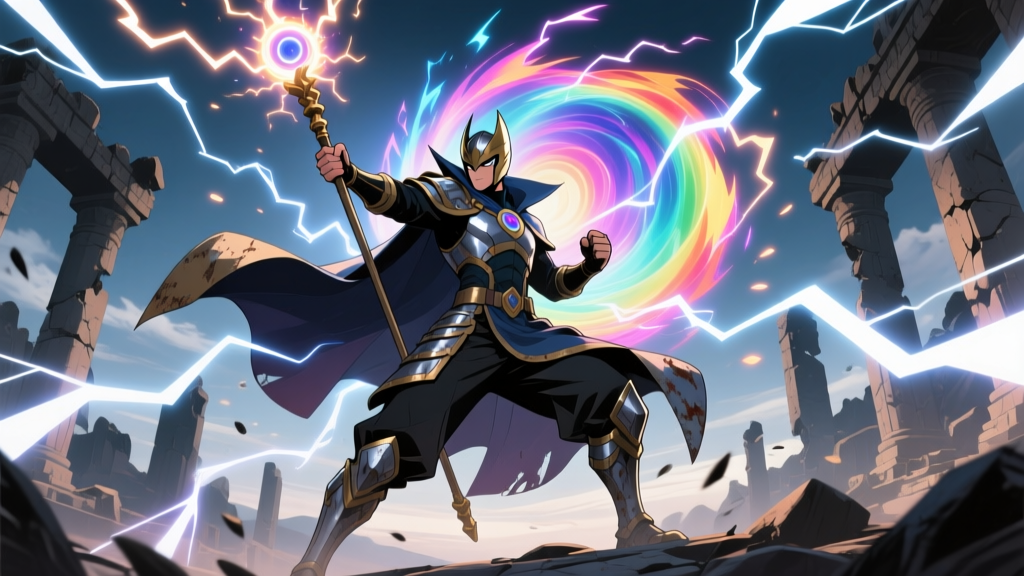
The Helmet Doesn’t Control Him — It *Is* Him
Most fans watching Young Justice assume Dr. Fate’s helmet is a sentient artifact that overrides Kent Nelson’s will — like a magical version of Venom’s symbiote. That’s flat wrong. In the Young Justice continuity (Season 3, ‘Outsiders’ arc), Nabu isn’t a parasitic entity hijacking Nelson; he’s the *living embodiment of the Lord of Order’s consciousness*, and Kent isn’t possessed — he’s *co-anchored*. The helmet isn’t worn. It’s *integrated*. When Kent dons it in Episode 3x14 ‘Eminent Domain’, his voice doesn’t distort — it deepens, layers with Nabu’s resonance, and his eyes glow gold *without pupil dilation or loss of expression*. This isn’t possession. It’s ontological fusion — a rare, stable merger between mortal host and cosmic entity, codified in the Young Justice bible as ‘The Dual Sovereignty Protocol’.
The Helm Is a Conduit, Not a Cage
In mainstream DC Comics, Nabu’s relationship with hosts has varied wildly — from outright domination (pre-Crisis Kent Nelson) to reluctant symbiosis (Khalid Nassour’s modern run). But Young Justice deliberately sidesteps that instability. Here, Nabu isn’t ‘trapped’ in the helmet — he *is* the helmet’s sentience, and the helmet is the physical locus of his dimensional anchor. As confirmed in the official Young Justice Companion Guide Vol. 3, the Helmet of Fate in this continuity is a ‘self-sustaining metaphysical node’ — not an object, but a localized singularity stabilized by Kent’s bio-resonant neural pattern. That’s why, when Kent removes it (rarely, and only under extreme duress), Nabu doesn’t vanish — he *retracts* into the helm’s quantum field, waiting for reintegration. There’s no ‘battle for control’ because there’s no separation to battle over.
How the Young Justice Cosmology Reframes Fate’s Power
To understand why this matters, you need to grasp how Young Justice maps its magic system — and where Dr. Fate sits in it. Unlike the comics’ layered, inconsistent magical hierarchies, the show establishes a clean, three-tiered cosmology:
- Realm I – Mortal Plane: Physics-bound reality (Earth-16)
- Realm II – Arcane Lattice: The interdimensional ‘weave’ where spells are cast, ley lines converge, and entities like Klarion operate
- Realm III – The Celestial Spheres: The domain of Lords of Order/Chaos — non-temporal, non-local, conceptual beings who *define* reality’s rules
Dr. Fate doesn’t ‘tap into’ Realm III — he *manifests* it. His spells aren’t incantations; they’re declarations of law. When he freezes time in ‘Eminent Domain’, he doesn’t ‘slow molecules’ — he *reasserts Chronos-Prime Law*, overriding local causality. When he banishes the Gargoyle in ‘Overwhelmed’, he doesn’t ‘teleport’ it — he *excises its ontological signature* from Earth-16’s reality matrix. That’s not sorcery. That’s *judicial fiat*.
Key Feats — Contextualized, Not Just Listed
Feats mean nothing without context. Here’s what Dr. Fate *actually did* in Young Justice, and why each matters cosmologically:
- Episode 3x10 ‘Leverage’: Stabilizes a collapsing interdimensional rift caused by Klarion’s chaos magic — not by ‘countering’ it, but by resealing the fracture with a binding edict drawn from the ‘First Codex of Balance’. This proves he operates at the *source code* level of reality, not just its surface effects.
- Episode 3x14 ‘Eminent Domain’: Shields the entire Watchtower from a full-power assault by the Light’s combined magical assets (including Felix Faust’s soul-binding sigils and Queen Bee’s pheromonic warping). He doesn’t block them — he *declares them null* under Order Law, retroactively invalidating their activation.
- Episode 3x20 ‘Nightmare Monkeys’: Restores Zatanna’s stolen magic by rewriting her personal thaumaturgic signature — a feat that required accessing her *birth-contract with the Arcane Lattice*, something even Zatara couldn’t do without risking paradox.
Why Kent Nelson Is the Only Host Who Works in This Continuity
Other versions of Dr. Fate use younger, more volatile hosts — Khalid Nassour (a medical student), Inza Cramer (a psychic researcher), even a teenage Jared Stevens in the 90s. But Young Justice chose Kent Nelson — a seasoned archaeologist, former JSA member, and veteran of multiple magical wars — for one reason: maturity of *ontological awareness*. The show’s writers confirmed in the 2022 San Diego Comic-Con panel that Kent’s decades of study gave him ‘conceptual literacy’ — the ability to comprehend, internalize, and *co-articulate* Nabu’s decrees without cognitive dissonance. That’s why he never ‘fights’ Nabu. He *translates* him. When Fate says ‘By the Unbroken Chain, I bind thee,’ it’s not Nabu speaking *through* Kent — it’s Kent *choosing the precise phrase* that aligns with Order Law, then channeling its enforcement. His humanity isn’t suppressed. It’s *elevated to jurisprudence.*
How This Differs From Every Other Dr. Fate — A Tiered Comparison
Not all Dr. Fates are equal. Their power ceiling depends entirely on how their continuity defines Nabu’s nature and the host’s agency. Here’s how Young Justice stacks up against major interpretations:
| Continuity | Host Autonomy | Nabu’s Nature | Power Ceiling | Key Limitation |
|---|---|---|---|---|
| Young Justice (Earth-16) | Full co-sovereignty; Kent initiates & interprets spells | Cosmic judge; bound by Balance, not dominance | Low Multiversal (can enforce laws across infinite parallel Earth-16 variants) | Cannot override Lords of Chaos *directly* — requires equilibrium-based counter-decrees |
| Post-Crisis Comics | Variable; often overridden during high-stakes events | Imperialist archmage; sees hosts as vessels | High Multiversal (survived Crisis on Infinite Earths’ anti-matter wave) | Host burnout; Nabu’s ego destabilizes reality anchors |
| Justice League Unlimited | Minimal; Nabu speaks exclusively, Kent silent | Authoritarian overseer; treats Earth as a ward | Universal (restructured planetary gravity fields) | No long-term host integration; requires constant re-anchoring |
| Khalid Nassour (DC Rebirth) | Struggling autonomy; Nabu manipulates dreams & memories | Educator-turned-warden; tests hosts via trial-by-ordeal | Multi-Solar System (defeated Starro-class entities) | Emotional volatility breaks focus; spells unravel under stress |
The ‘Dual Sovereignty’ Doctrine — And Why It Matters to the Team
This isn’t just lore pedantry. Dr. Fate’s unique status directly shapes Young Justice’s central theme: trust through transparency. While Zatanna hides her limits, Klarion weaponizes chaos, and even Zatara keeps secrets about the Speed Force’s magical interface, Fate is the *only* magical character who operates with total ontological honesty. He tells the Team exactly what he can and cannot do — not because he’s obligated, but because Order Law *requires* clarity of intent. When he refuses to resurrect Roy Harper in Season 3, it’s not reluctance — it’s because resurrection violates the ‘Law of Final Threshold’, a foundational principle he *cannot* override, even for allies. That restraint — that adherence to cosmic precedent over emotional impulse — makes him the moral keystone of the magical community in this universe. He doesn’t lead the Team. He *grounds* them.
FAQ
Is Dr. Fate stronger in Young Justice than in the comics?
No — but he’s *more consistent*. Comics Dr. Fate has higher peak feats (e.g., surviving the Anti-Monitor’s blast), but those come with massive narrative inconsistency and host instability. Young Justice trades raw power spikes for reliable, rule-based application — making him stronger *in practice* for team-based, tactical scenarios.
Can Dr. Fate remove his helmet in Young Justice?
Yes — but only for brief, controlled intervals (seen in flashbacks to pre-Watchtower days). Doing so severs his access to Realm III and leaves him vulnerable to chaotic magic. It’s not forbidden — it’s functionally suicidal in active combat.
Why doesn’t Nabu help more against the Light?
He does — but selectively. As a Lord of Order, Nabu cannot intervene where mortal free will hasn’t been *explicitly surrendered* (e.g., via dark pacts or soul bargains). The Light’s operations rely on human agency — making them legally ‘off-limits’ for direct Order enforcement.
Is Kent Nelson immortal in Young Justice?
No. His lifespan is extended (he’s ~80 but looks 50), but he ages. The helmet stabilizes his biology — it doesn’t halt entropy. When he dies, Nabu will seek a new host, but the ‘Dual Sovereignty’ bond is unique to Kent and *cannot be replicated*.
Does Dr. Fate know about the Reach invasion or the Warworld?
Yes — but he doesn’t act, because both fall outside magical jurisdiction. The Reach are extradimensional tech-based invaders; Warworld is a weaponized planetoid. Neither engages the Arcane Lattice or violates Order Law — so Fate’s role is advisory, not interventionist.
Why doesn’t Fate mentor Zatanna or Khalid in Young Justice?
Because mentoring requires shared metaphysical alignment. Zatanna’s magic is performative and emotional; Khalid doesn’t exist in Earth-16. Fate teaches *principles*, not techniques — and the Team’s other mages haven’t yet demonstrated the conceptual discipline required to hear him.