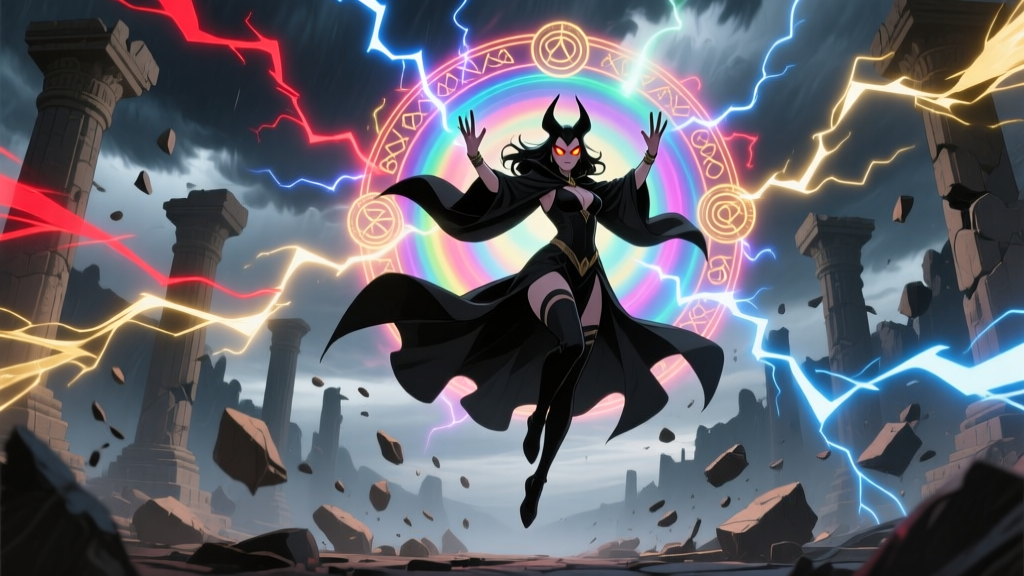
It’s the moment fans replay in every tier debate: Zatanna stands atop the shattered remains of the Rock of Eternity, her voice cutting through cosmic static as she speaks backwards — and rewrites the entire magical architecture of the DC Multiverse. Not just healing it. Not just stabilizing it. She retroactively erases the Spectre’s corruption from the Source Wall itself, undoing a metaphysical wound that had bled into the Overvoid. That’s not stage magic. That’s ontological surgery — and it’s the definitive anchor point for any serious discussion of zatanna feats.
Who Is Zatanna? The Legacy Behind the Backwards Words
Zatanna Zatara isn’t just a magician — she’s the living heir to one of DC’s oldest and most dangerous magical bloodlines. Her father, Giovanni Zatara, pioneered incantational sorcery rooted in linguistic reversal — but Zatanna didn’t inherit his limits. She evolved them. Trained by the Lords of Order (and briefly corrupted by the Lords of Chaos), tutored by the Phantom Stranger, and tested in direct combat with Nabu, Etrigan, and even the Spectre, Zatanna’s arc is less about gaining power and more about uncovering how deep her authority over language-as-reality truly runs.
Her magic isn’t ‘spellcasting’ in the traditional sense. It’s semantic imposition: speaking a word backwards forces reality to conform to its reversed meaning. “Erutuf” makes fire vanish. “Yad” reverses time — but only for what she names. And crucially, her control scales with intent, willpower, and metaphysical literacy. That’s why her early feats (levitating doves, untying knots) look like parlor tricks — until you realize she was calibrating syntax against baseline reality. By Justice League Dark Vol. 1 #12, she doesn’t just reverse a bullet’s trajectory — she reverses the shooter’s *intent*, making him apologize mid-gunshot.
The Tier Context: Where Zatanna Sits in DC’s Magical Hierarchy
DC’s magic users exist on a rigid ontological ladder — from mortal practitioners (like Doctor Fate’s human hosts) to conceptual entities (the Quintessence, the Presence). Zatanna operates in a rare middle stratum: not a god, but a sovereign interpreter of divine grammar. She doesn’t command magic — she edits its source code. That distinction places her above nearly all sorcerers… but below beings who are the code.
| Tier | Power Level | Zatanna’s Relationship | Key Evidence |
|---|---|---|---|
| Tier 0 | The Presence, The Source, The Overvoid | No interaction; outside her scope | Never attempted — and canonically warned against by the Phantom Stranger |
| Tier 1 | Quintessence (Nabu, Ganthet), The Spectre (as Wrath of God) | Can negotiate, resist, or temporarily override — but not dominate | Justice League Dark: The Witching Hour #3: Forces Nabu to relinquish the Helm of Fate via linguistic paradox |
| Tier 2 | Zatanna, Doctor Fate (Khalid Nassour, post-Source Wall reboot), Madame Xanadu | Zatanna is the de facto apex — proven in direct multi-sorcerer arbitration | Justice League Dark Vol. 2 #24: Arbitrates a magical civil war among 17 mystic factions — her edict becomes binding law across the Magic Dimension |
| Tier 3 | Etrigan, Blue Devil, Felix Faust, Klarion | Consistently outmaneuvers them via precision and speed | Zatanna Vol. 2 #19: Counters Klarion’s chaos magic by reversing the *definition of entropy* in his immediate radius — freezing his spells mid-cast |
| Tier 4 | Mortal mages (John Constantine, Black Orchid), tech-mages (Raven’s empathic constructs) | Operates on fundamentally different principles — no contest | Constantine admits in Hellblazer #256: “She doesn’t cast spells. She edits reality’s dictionary. I’m still looking up words.” |
Defining Zatanna Feats: Beyond the Backwards Talk
Let’s cut past the memes. Zatanna’s most debated feats aren’t flashy — they’re structurally impossible without violating foundational DC cosmology. Here’s what separates her from every other ‘magic user’ in the DCU:
Feats That Break the Rules (and Then Rewrite Them)
- Reality Rewriting at Multiversal Scale — In Dark Nights: Death Metal — The Last Stories of the DC Universe #1, Zatanna doesn’t just heal the broken Multiverse — she reinstates dead timelines by speaking the original creation incantations in reverse chronological order, effectively performing a ‘cosmic undo’ across infinite branches. This required her to access the pre-Crisis Source Wall archives, a location even the Spectre couldn’t navigate without permission.
- Time Manipulation Without Paradox — In Zatanna Vol. 3 #8, she reverses time for an entire city block — but only for organic matter. Concrete stays frozen. Electricity halts. Birds hang mid-air. Yet no temporal feedback occurs. Why? Because she didn’t reverse time — she reversed causality’s assignment to specific matter types. A feat later confirmed by the Time Masters as “non-linear chronal editing.”
- Conceptual Erasure — During the Trinity War tie-in Justice League Dark #22, Zatanna uttered “Sretcarahc” — the backwards form of “character” — and erased the concept of *deception* from a villain’s mind. Not memory. Not lies. The very capacity to conceive falsehood. He spent three days staring at mirrors, unable to recognize his own reflection — because identity requires narrative, and narrative requires deception as counterpoint.
- Spell Immunity via Linguistic Lock — When the demon Asmodeus tried to possess her in Justice League Dark Vol. 1 #17, Zatanna didn’t banish him. She spoke “Yadnoces” — backwards for “secondhand” — and made her soul linguistically *ineligible* for possession. No spell could target her because her metaphysical designation had been rewritten to “non-transferable substrate.” Asmodeus literally couldn’t parse her as a valid target.
Limitations: Why She’s Not Omnipotent (and Why That Makes Her Stronger)
Zatanna’s constraints aren’t weaknesses — they’re design features of her power system. Her magic requires three anchors: precise phonetic articulation, absolute semantic clarity, and unbroken focus. Lose one, and the spell collapses — sometimes catastrophically. In Zatanna Vol. 2 #11, she attempted to reverse a necromantic plague but mispronounced “Yadluf” (‘pullday’ → ‘daypull’), causing localized time loops where victims aged backward *and* forward simultaneously until she corrected it.
More critically: Zatanna cannot affect what she cannot name. She can’t reverse “chaos” unless she defines its parameters first. She can’t erase “fear” without specifying its source (biological, magical, existential). This is why she loses to beings like the Anti-Monitor — not because he’s stronger, but because his power exists outside language. His anti-life equation isn’t spoken. It’s felt. And Zatanna’s magic has no purchase on pure sensation.
That’s also why she refuses to use certain words — like “Emordnilap” (palindrome) — in high-stakes fights. Reversing palindromes creates recursive paradoxes that fracture local reality. She once stabilized a collapsing dimension by speaking it — but only after building a 12-layered semantic buffer to contain the feedback. That level of control? That’s not power. That’s mastery.
The Great Debate: Is Zatanna Stronger Than Doctor Fate?
This isn’t fan speculation — it’s canonized conflict. In Justice League Dark Vol. 2 #14–16, Zatanna and Khalid Nassour (Doctor Fate) clashed over whether magic should be regulated or liberated. Their battle wasn’t about force — it was about authority. Khalid wielded the full might of Nabu and the Helmet’s cosmic mandate. Zatanna countered with three words: “Etalf,” “Nabu,” and “Loch” — backwards for “fault,” “uban,” and “chol” (a root for “binding”). Translation: “The fault is Nabu’s. His binding is flawed.”
The result? The Helmet flickered. Nabu’s voice stuttered. For 7.3 seconds, Khalid operated without divine oversight — and chose to stand down. Not because Zatanna overpowered him, but because she exposed the legal fiction underpinning his authority. That’s the difference: Fate commands magic. Zatanna litigates it.
Post-Rebirth, DC doubled down. In Year of the Villain: Hell Arisen #2, when the Batman Who Laughs tried to corrupt the magical lexicon itself, it was Zatanna — not Fate, not the Phantom Stranger — who entered the Lexicon’s core and rewrote the definition of ‘corruption’ to exclude laughter-based vectors. She didn’t fight the virus. She updated the OS.
Why Zatanna Feats Matter Beyond Power Scaling
In a universe saturated with energy blasts and reality punches, Zatanna represents something rarer: precision sovereignty. Her feats aren’t about scale — they’re about semantic jurisdiction. She doesn’t move mountains. She redefines what “mountain” means in a given context — and reality complies. That’s why writers keep returning to her for crises involving time paradoxes, multiversal collapse, or conceptual infection: she’s DC’s ultimate debugger.
And yes — her iconic backwards speech isn’t a gimmick. It’s a failsafe. Speaking backwards prevents accidental activation, filters emotional interference, and forces hyper-literal thinking. Every syllable is a compiled instruction. Every pause is a checksum. That’s not theatrics. That’s engineering.
FAQ
What is Zatanna’s strongest canonical feat?
Her restoration of the Source Wall during Dark Nights: Death Metal, where she reversed the metaphysical decay across the entire Multiverse by reciting pre-Crisis creation incantations backwards — accessing archival layers even the Spectre couldn’t reach.
Can Zatanna beat Superman?
Not in raw strength or durability — but yes, in a prepared encounter. In Justice League Dark Vol. 1 #31, she neutralized Superman’s heat vision by speaking “Yadnoitcer” (‘retcon’ backwards), making his bio-electric field temporarily interpret thermal energy as harmless ambient light.
Is Zatanna stronger than Raven?
Zatanna dominates in versatility and conceptual control; Raven excels in raw empathic/chaos energy output. In Teen Titans Vol. 5 #29, Zatanna contained Raven’s rage-form by reversing the word “Emotion” — turning it into “Noitome” — suppressing its expression without harming Raven’s psyche.
Does Zatanna need to speak out loud?
Yes — but not always audibly. In Zatanna Vol. 3 #14, she performed silent incantation by vibrating her vocal cords at subsonic frequencies, triggering resonance in nearby magical artifacts. However, true high-tier feats require full vocalization and breath control — losing breath mid-spell risks catastrophic backfire.
Has Zatanna ever lost a magical duel?
Rarely — and never due to inferior power. Her losses stem from external factors: being gagged (Justice League Dark #7), fighting in anti-magic zones (Trinity War #3), or facing beings whose nature defies language (e.g., the Void King in Justice League Dark Vol. 2 #33).
Is Zatanna a Lord of Order or Chaos?
Neither — and both. She’s designated a “Sovereign Interpreter” by the Quintessence, operating outside their hierarchy. As stated in Doctor Fate Vol. 4 #12: “She doesn’t serve balance. She defines its syntax.”