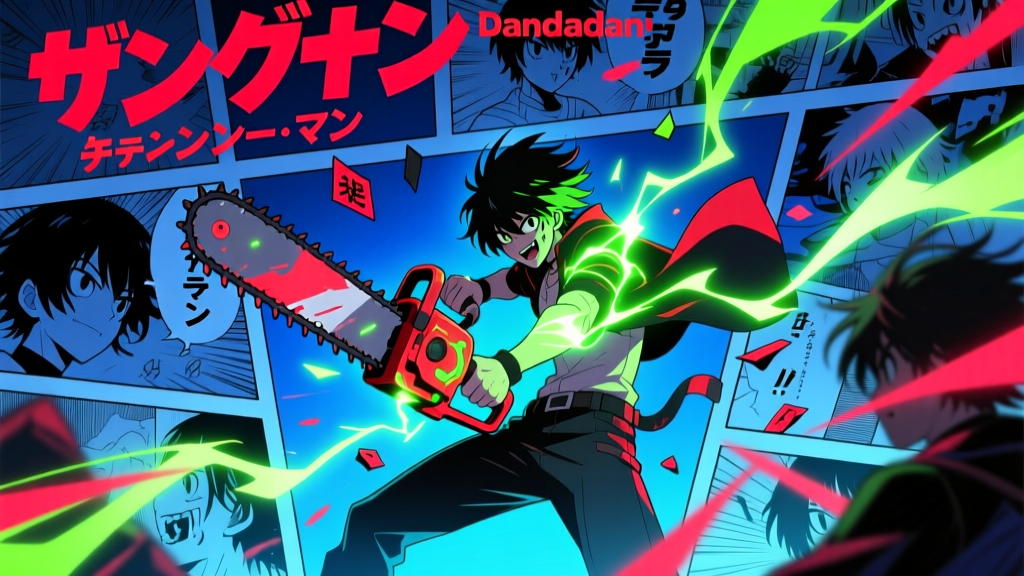
The 'Anime-as-Source-Material' Trend: How 'Dandadan' S2 and 'Chainsaw Man' S2 Are Rewriting Their Own Manga Panels in Real Time
Here’s the misconception you’ve probably heard repeated in Discord servers and comment sections since April: “The anime is just adapting the manga—faithfully, even.” Nope. Not anymore. Not with Dandadan Season 2 or Chainsaw Man Season 2. What we’re watching isn’t adaptation. It’s re-authoring. These shows aren’t translating panels into motion—they’re deconstructing them, then rebuilding the same emotional beats using tools the manga literally couldn’t access: time, perspective, layered sound design, and the visceral grammar of camera movement.
I remember watching Episode 3 of Dandadan S2—the “Tengu’s Fall” sequence—and pausing mid-scene because my brain short-circuited. The manga (Chapter 47, page 18) shows Momo slamming her fist into the tengu’s chest in one static, diagonal splash panel—blood misting, feathers scattering, her eyes wide but silent. In the anime? That single panel explodes across eleven seconds. The camera doesn’t orbit Momo—it dives through her knuckles, then whips around the tengu’s spine as it cracks, then freezes mid-air on a single falling feather while the bass drops out for half a beat before the impact hits. That’s not fidelity. That’s forensic reinterpretation.
Let’s name what’s happening: this is the rise of the “anime-as-source-material” trend—not as marketing buzzword, but as creative methodology. The manga remains the blueprint, yes. But the anime staff aren’t asking, “How do we animate this page?” They’re asking, “What does this page *withhold*? What silence does it leave that motion can fill? What rhythm does its stillness imply—but never deliver?” And then they answer those questions with storyboard choices so deliberate, they feel like citations.
Dandadan S2: Temporal Dilation as Emotional Archaeology
Look at the OLM storyboard PDF for Episode 5 (released June 12th), specifically pages 42–45 covering the rooftop confrontation between Okarun and the Kappa emissary. In the manga (Chapter 49, pp. 6–9), the exchange is tight, snappy—three speech bubbles per panel, rapid cuts between faces, kinetic but emotionally compressed. You *feel* the tension, but you don’t *inhabit* the hesitation.
The anime stretches those same six manga panels across 87 seconds—and adds something radical: micro-pauses anchored to breath. When Okarun blinks—just once—the animation holds for 0.8 seconds *after* his eyelid closes. No music. Just city wind and distant train rumble. Then the blink completes—not with a cut, but with a subtle lens flare bloom as light catches his wet lower lash. That blink isn’t in the manga. It’s not “added flavor.” It’s a direct response to the manga’s visual economy: the manga gives us Okarun’s line (“I’m not scared of you”) and his smirk. The anime asks: What does the body do right before a lie like that? And answers with a physiological truth the static page can only suggest.
This works because OLM treats manga panels not as endpoints, but as pressure points—moments where the original medium’s limitations created unintentional ambiguity. Chapter 47’s final panel of Momo’s scream? In manga, it’s raw, unfiltered, almost abstract. In anime, that same scream is delayed by two full seconds after the trigger—a quiet shot of her trembling fingers gripping the railing, then a slow push-in to her throat vibrating *before* the sound emerges. The manga screams *at* you. The anime makes you wait for it—and in that wait, you become complicit in her fear.
Chainsaw Man S2: Split-Screen as Moral Fracturing
Now flip to MAPPA’s Chainsaw Man S2 storyboard PDF for Episode 4—the Aki/Power/Devil confrontation in the ruined apartment (based on Chapter 89). The manga’s most infamous moment here is the double-page spread on p. 17: Aki’s hand reaching toward Power’s disintegrating form, while his face stays eerily blank—no tears, no shout, just hollow eyes staring past her. It’s devastating *because* it refuses catharsis. Fujimoto denies us the release of visible grief.
MAPPA responds not by “animating the sadness,” but by splitting the frame—literally. For 14 consecutive seconds, the screen divides vertically: left side shows Aki’s hand extending in real-time motion (slowed 30%), right side shows Power’s dissolution in stop-motion flicker (each frame held for 3 frames, then skipped). Between them? A hair-thin black seam, pulsing faintly with low-frequency vibration. There’s no dialogue. Just the wet *shhhk* of Power’s fading form and the dry scrape of Aki’s palm dragging across splintered floorboard.
This isn’t just “cool editing.” It’s structural ethics. The manga forces you to hold both images in your mind simultaneously—you choose where to look. The anime forces you to *see the impossibility of choosing*. Your eye darts left, then right, then back—and each time, the seam pulses, reminding you: these aren’t parallel timelines. They’re two irreconcilable truths occupying the same moral space. Aki’s action and Power’s erasure are happening in the same second, yet they exist in utterly different temporal logics. The manga implies fragmentation. The anime *enacts* it.
And MAPPA doubles down in Episode 7’s “Yoru’s Lullaby” sequence (adapted from Ch. 94’s silent 3-panel montage). Manga shows Yoru’s fingers brushing Denji’s hair → Denji’s sleeping face → a close-up of his tear-streaked cheek. Three clean, sequential beats. MAPPA renders it as a single, unbroken 32-second take: the camera starts tight on Yoru’s fingertips, then glides *over* Denji’s shoulder, *around* his ear, *under* his jawline—all while his breathing deepens and his tear swells, refracting light off the ceiling fan’s slow spin. The manga’s power is in its restraint. The anime’s is in its unbearable intimacy—the kind you’d never get away with in print, because it would break pacing. Here? It’s the point.
Why This Isn’t “Just Better Animation”—It’s Medium Literacy
Critics and fans alike have spent years praising “faithful adaptations” as the gold standard. But fidelity to what? To layout? To panel count? To the author’s stated intent (which, let’s be real, is often “draw this cool fight and move on”)? The breakthrough here is recognizing that manga and anime operate under fundamentally different contracts with attention.
- Manga demands active reconstruction: your eyes jump, your brain fills gaps, you control pace.
- Anime demands passive immersion: your nervous system syncs to its rhythm, your breath matches its cuts, your empathy is guided—not invited.
So when OLM lingers on Momo’s blink, or MAPPA splits Aki’s grief across dual timelines, they’re not “improving” the source. They’re honoring its spirit by translating its *intent* into the language the medium actually speaks. Fujimoto didn’t draw Aki’s blank face to withhold emotion—he drew it to make you *feel the weight of withheld emotion*. MAPPA delivers that weight not with a closer look, but with spatial division. Tanaka didn’t draw Momo’s scream as a single burst to maximize shock—he drew it that way because manga can’t sustain vocal texture. OLM sustains it—and makes the scream land deeper because of it.
This shift matters most for manga purists—the ones who flinch at “unnecessary changes.” I was one of them. I re-read Chapter 47 three times before watching Dandadan S2 Episode 3, convinced the anime would dilute its fury. Instead, I sat frozen for a full minute after the credits rolled—not because the scene was “better,” but because it had excavated a layer of physical vulnerability the manga’s stylized intensity had buried under bravado. The manga says: *She’s powerful.* The anime whispers: *She’s shaking.* Both are true. Neither replaces the other.
The Risk—and Why It’s Worth Taking
Of course, this approach carries real danger. Over-dilation kills momentum. Over-splitting confuses. And if the staff misread the manga’s subtext? You get hollow spectacle—pretty but empty. We saw it in early Jujutsu Kaisen S2, where the anime stretched Gojo’s “Hollow Purple” reveal across 45 seconds of swirling particles… but forgot to anchor it to *character*. It looked amazing. It meant nothing.
What saves Dandadan and Chainsaw Man is their staff’s obsessive attention to what the manga’s silence is doing. Not just “what’s missing,” but “what is this silence *for*?” In Chapter 89, Fujimoto’s blank-faced Aki isn’t avoiding emotion—he’s depicting dissociation as armor. MAPPA’s split-screen doesn’t “add” grief; it visualizes the cognitive fracture *behind* the blankness. In Chapter 47, Tanaka’s screaming Momo isn’t just venting rage—she’s hitting the limit of her human body’s capacity to process trauma. OLM’s delayed scream isn’t dramatizing pain; it’s dramatizing the *lag between stimulus and survival response*.
That’s the difference between adaptation and re-authoring. One serves the page. The other serves the *human experience the page points toward*—then uses every tool animation has to get you closer to it than ink ever could.
A Side-by-Side That Says It All
Let’s ground this in concrete comparison. Below is how both series handle near-identical narrative functions—using the exact same manga reference points—but with radically divergent anime strategies:
| Element | Dandadan S2 (Ch. 47) | Chainsaw Man S2 (Ch. 89) |
|---|---|---|
| Manga Moment | Momo’s scream upon seeing Okarun injured—single, jagged splash panel, no sound effects | Aki’s hand reaching as Power dissolves—double-page spread, zero facial expression |
| Anime Strategy | Temporal dilation + physiological anchoring (blink, throat vibration, delayed audio onset) | Split-screen + tactile sound design (seam vibration, floorboard scrape, decaying flicker) |
| What the Manga Withholds | The body’s pre-scream tremor—the biological lag before explosion | The simultaneity of action and erasure—the impossibility of holding both truths |
| What the Anime Adds | A 0.8-second blink that turns rage into vulnerability | A pulsing black seam that turns grief into structural paradox |
| Why It Works | It honors Tanaka’s theme: power isn’t absence of fear—it’s the body moving *through* it | It honors Fujimoto’s theme: love isn’t protection—it’s witnessing collapse without collapsing yourself |
Neither show is “better” than its source. They’re companions. Parallel texts speaking the same truth in different tongues—one carved in stillness, the other carved in time.
So next time someone says, “It’s just the manga, but animated,” smile politely—and then show them that blink. That seam. That 32-second glide over Denji’s sleeping face. Because what we’re watching isn’t adaptation.
It’s conversation.
And for the first time in years, the anime isn’t just listening to the manga.
It’s answering back—in its own voice, on its own terms, with its own grammar.