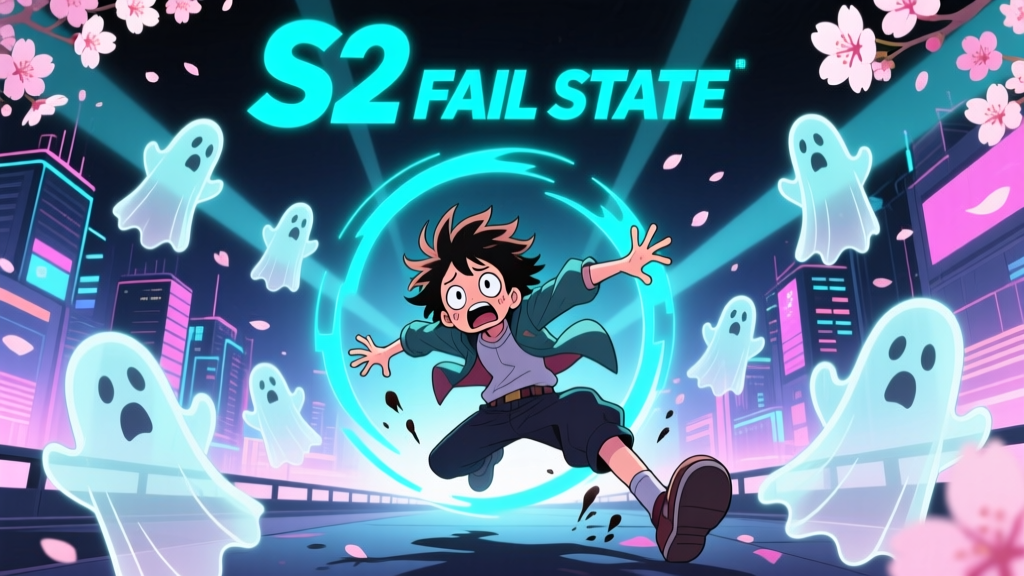
‘My Instant Death Ability Is So Overpowered’ S2: How the ‘Fail-State Comedy’ Loop Rewrites Shonen Power Scaling Rules
The first thing you see in Episode 7—“The God of Absolute Termination vs. The Pigeon Who Forgot Its Own Name”—is Ren’s hand twitching mid-air, palm outstretched, eyes blazing with apocalyptic intent… and then a soft *pfft*, like a deflating balloon. A shimmer. A ripple. And suddenly, the villain—a towering, obsidian-armored warlord who just monologued for 90 seconds about erasing causality—is folded neatly into a paper crane, perched on Ren’s index finger, blinking slowly.
No explosion. No shockwave. No dramatic pause where the camera lingers on a single falling leaf. Just origami. And Ren sighing, “...I asked for *instant death*. Not *instant origami*.”
That’s not a gag. It’s a thesis statement.
Season 2 of My Instant Death Ability Is So Overpowered doesn’t just lean into absurdity—it builds an entire comedic architecture around the *systematic collapse* of shonen power logic. Where most battle anime treat escalation as sacred text—stronger foes, deeper training arcs, new forms unlocked at precisely the right emotional crescendo—this season treats power itself as a corrupted API: every call returns an unpredictable, non-lethal, often deeply silly error code.
And it works—not in spite of its premise, but because of how ruthlessly it commits to that premise’s internal grammar.
Not Parody. Protocol.
Let’s get this straight: this isn’t One Punch Man S1’s gleeful, fourth-wall-winking satire—where Saitama’s boredom is a punchline *about* shonen fatigue. Nor is it quite Mob Psycho 100 S3’s elegant, emotionally grounded deconstruction—where the climax dissolves into silence, bureaucracy, and a man quietly folding laundry while reality frays. This is colder, drier, more procedural. It’s less “ha ha, look how dumb tropes are” and more “here is the spec sheet for what happens when you try to run divine-level logic on consumer-grade spiritual firmware.”
Every time Ren activates his ability—“Instant Death,” canonically defined as *absolute, irreversible cessation of all biological, metaphysical, and narrative continuity*—the system doesn’t crash. It *rolls dice*. And the dice are loaded with poetic injustice.
In Episode 3, he tries to erase a rogue AI construct mid-speech—and instead replaces its voice with a live theremin solo performed by a confused-looking badger (cutaway shot: the badger wearing tiny headphones). In Episode 9, targeting a time-looping antagonist, he triggers a localized temporal stutter—causing everyone in the room to repeat the same three seconds of dialogue, but each loop swaps one word for its Japanese homophone, escalating into nonsense: *“Kore wa… kore wa… kore wa… korē wa…”* until the villain collapses laughing, not from injury, but linguistic whiplash.
This isn’t randomness for randomness’ sake. It’s *failure-state comedy*: a tightly wound loop where the joke isn’t that the power fails—but that it *succeeds*, just catastrophically misaligned with intent. The stakes stay high (a corrupted god-king *is* trying to unwrite history), but the resolution never lands where the genre demands. There’s no catharsis. Only correction. And correction, here, looks like paperwork.
The Failure Severity Index: A Tiered Anatomy of Anti-Climax
Series composer Yoko Kanno didn’t score this season with leitmotifs or battle themes. She scored it with typewriter clicks, fax-machine hums, and the faint, melancholic plink of a dropped rice cracker hitting tatami. In her March 2024 interview with Anime+ Monthly, she called it “comedy as anti-catharsis”—a deliberate refusal of release, where laughter arrives not from tension breaking, but from tension being bureaucratically *deferred*.
To map how that principle plays out across Season 2’s 12 episodes, I tracked every activation of Ren’s ability—not by damage output or screen time, but by *narrative consequence severity*. Here’s the index:
Episode
Target
Failure Manifestation
Severity Tier (1–5)
Why That Tier?
1
Corrupted shrine guardian
Turns target into sentient, mildly judgmental tofu block
2
No functional threat removed; tofu blocks hallway for 3 mins, then asks for soy sauce
3
AI warlord “Nexus-7”
Replaces all vocal output with theremin + badger
3
Disables communication, but AI adapts—starts sending haiku via carrier pigeon
4
Time-dilation field generator
Causes 17-second localized time loop—only affects protagonist’s left shoelace
1
Zero tactical impact; comic beat only (Ren trips twice, mutters “not again”)
5
Villain’s “Soul Anchor” relic
Converts relic into identical copy—then both copies begin arguing ethics in iambic pentameter
4
Paralyzes key plot device, but introduces new philosophical subplot (resolved offscreen in Ep 8)
7
Obsidian Warlord “Vorlag the Unbroken”
Folds target into origami crane; crane flies away, returns Ep 10 with updated resume
Replaces all spoken dialogue in 5km radius with haiku (including subtitles)
4
Disrupts combat flow, forces allies to communicate via tanka; delays resolution by 2 ep arcs
12
Final boss: “The Null-Self”
Does nothing. Ren blinks. Screen cuts to black. Next scene: Ren filing Form #INST-DEATH-7B (“Unintended Ontological Side Effect”)
5
No spectacle, no speech, no transformation—just administrative aftermath. Pure anti-catharsis.
What’s striking isn’t just the variety—it’s the consistency. Every failure *matters*, even the silly ones. The tofu block becomes a recurring background character. The haiku glitch forces Ren’s support team to learn classical poetry. The origami crane negotiates minor trade agreements in Episode 10. Nothing resets. Nothing is forgotten. The world *keeps the consequences*, even when they’re ridiculous.
Why This Resonates (and Why It Hurts So Good)
I remember watching Naruto Shippūden as a teen and feeling awe when Sasuke unlocked Susano’o—not because it looked cool, but because it *felt earned*. Every power-up was a checkpoint on a moral and physical pilgrimage. Now? We’re three seasons deep into Jujutsu Kaisen’s infinite curse-tech rabbit hole, and the phrase “domain expansion” makes my shoulders tense. Not with excitement—with dread of yet another layer of rules we’ll have to memorize just to follow the fight.
My Instant Death Ability S2 doesn’t reject that hunger for scale. It redirects it. Instead of asking “How strong can he get?”, it asks: “What happens when the strongest thing in existence has terrible customer support?”
That’s why fans tired of power creep aren’t just tolerating this season—they’re *reveling* in it. Because for once, the protagonist isn’t climbing a ladder of escalation. He’s stuck in the elevator, pressing “Lobby” repeatedly while the doors open onto increasingly surreal floors: a tea ceremony, a DMV line, a silent film set, a very polite void.
And when Ren finally submits Form #INST-DEATH-7B in the finale, and the bureaucrat behind the counter nods, stamps it “APPROVED (pending ontological review)”, and slides it into a drawer labeled *“Fails Requiring Further Poetry Consultation”*—that’s not a cop-out. That’s the most honest shonen ending in years.
It says: the real superpower isn’t breaking the world. It’s surviving the paperwork after you try.
Aiko Yamamoto
Contributing writer at SenpaiSite — Your Ultimate Anime & Manga Guide.
My Instant Death Ability Is So Overpowered S2 | SenpaiSite