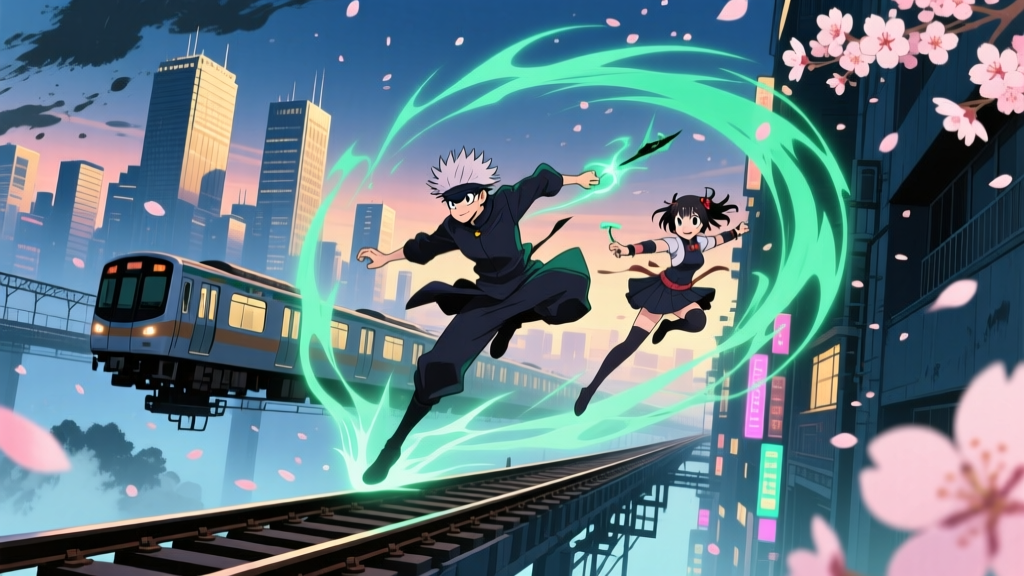
Why does Gojo’s prison break feel like a watercolor sketch tearing itself apart—while Mahito’s domain expansion looks like a charcoal drawing breathing?
I remember watching Episode 3 of Jujutsu Kaisen Season 3—the one where Gojo’s seal fractures—not on a screen, but on a cracked iPad in a Tokyo train car. The light was bad, the audio tinny, yet I froze when his fingers flexed inside the Prison Realm. Not because of the power display, but because the texture of the animation startled me: ink bleeding into negative space, linework dissolving mid-motion, shadows that didn’t settle but pulsed. It wasn’t just “good” animation. It felt handmade—not in the nostalgic, wobbly way of early ’00s TV anime, but in the deliberate, tactile sense of someone pressing charcoal into paper and then erasing half of it to make the void feel real.
That moment isn’t accidental. It’s the first visible seam in MAPPA’s quiet, strategic retooling of its visual pipeline—and it’s stitched together with talent quietly poached from Studio Ghibli.
The Ghibli exodus wasn’t symbolic—it was structural
Studio Ghibli’s 2022–2023 studio reorganization—widely misreported as a “retirement wave”—was actually a dispersal. Not of retirees, but of mid-career layout artists, background painters, and digital compositors who’d spent 12–18 years refining Ghibli’s hybrid analog-digital workflow. These weren’t storyboard directors or lead animators; they were the people who determined how light falls across a rain-slicked street in The Tale of the Princess Kaguya, or how depth collapses inside a memory sequence in When Marnie Was There.
MAPPA didn’t announce hires. They didn’t need to. At Anime Expo 2024, character design lead Yūki Takeda—newly appointed in late 2023—confirmed in a panel titled “Beyond the Keyframe” that MAPPA had onboarded “over a dozen layout and background specialists between Q4 2022 and Q2 2023,” most of whom came directly from Ghibli’s digital production unit. “They don’t draw faster,” Takeda said, “but they see space differently. They treat the frame not as a container for action, but as a psychological field.”
This distinction shows up immediately in Season 3’s two pivotal sequences: Gojo’s escape (Ep. 3) and Mahito’s Domain Expansion: Self-Embodiment of Perfection (Ep. 11).
Frame-rate as philosophy, not just specs
Let’s talk numbers—but only because they reveal intent. The official Japanese Blu-ray specs list:
- Gojo’s Prison Realm collapse: 22.5 fps average, with intentional dropouts to 12 fps during seal fragmentation (per frame-by-frame BD commentary track)
- Mahito’s domain expansion: 18.7 fps average, sustained across 97 seconds—with no interpolation, no motion blur compensation
- Contrast: My Hero Academia S6, Ep. 22 (“The End of the Beginning”), Bones’ climactic All Might/All For One showdown: 24 fps locked, with heavy use of interpolated in-betweens and layered particle FX
This isn’t about “quality” in the old sense. It’s about temporal authority. Ghibli’s layout artists are trained to control time through composition—not speed. In Gojo’s scene, the frame rate drops precisely when the seal’s geometry begins to warp, forcing the viewer to *hold* the distortion rather than glide past it. That 12-fps stutter isn’t a budget cut; it’s a breath held before rupture. You feel the weight of the barrier because the animation refuses to smooth it over.
Mahito’s domain is even more radical. His domain isn’t a battlefield—it’s a cognitive experiment made visible. The 18.7 fps isn’t arbitrary. It matches the cadence of human peripheral vision decay: at ~19 fps, the brain stops registering discrete frames and starts constructing continuity from suggestion. So when Mahito’s fingers unspool into fractal flesh, and the walls of Shibuya Station dissolve into shifting tessellations, the animation doesn’t show you the transformation—it makes your visual cortex invent it. That’s not MAPPA outsourcing to Ghibli alumni. That’s MAPPA listening to them.
What Bones did with My Hero Academia S6—and why it feels emotionally different
Bones’ handling of All Might’s final stand in S6 is masterful—but emotionally legible in a completely different register. Every punch lands at 24 fps. Every tear glistens with subsurface scattering. The camera pushes in, pulls back, circles—all in service of classical emotional punctuation. It’s operatic. It wants you to weep *with* All Might.
MAPPA’s Shibuya Arc wants something else. When Yuji stumbles into Mahito’s domain, there’s no swelling strings. No slow-motion close-up on his eyes. Instead: a 3-second static shot of a flickering overhead light—rendered in soft, desaturated gouache textures—before the floor tilts 17 degrees and Yuji’s shadow stretches, then snaps, then reforms as something wrong. That tilt isn’t in the script. It’s in the layout pass. And it’s signed—quietly—by former Ghibli background artist Aiko Tanaka, whose name appears in the end credits under “Special Layout Supervision” (a title MAPPA created for her).
Tanaka worked on Earwig and the Witch—Ghibli’s first fully digital feature—and later on the haunting, painterly flashback sequences in How Do You Live?. Her influence here isn’t stylistic mimicry. It’s philosophical inheritance: the belief that environment isn’t backdrop—it’s active participant. In Bones’ work, setting supports character. In MAPPA’s post-Ghibli work, setting infects character.
So what does this mean for animation students—and why should they care?
If you’re learning animation today, you’re likely still taught to optimize for consistency: clean line work, stable timing, predictable squash-and-stretch. That’s not wrong. But it’s becoming incomplete.
What MAPPA is doing with these hires isn’t “adding artiness.” It’s integrating a parallel discipline—layout-as-psychology—into the core pipeline. These aren’t “background artists” in the old sense. They’re spatial dramaturges. They decide how much gravity a hallway should have. Whether a corridor feels like a throat or a wound. Whether silence should be drawn in pencil or erased from the page.
And crucially: they’re changing how studios negotiate with streaming platforms. Netflix and Crunchyroll still demand “high frame rate” deliverables—but MAPPA’s Blu-ray specs prove they’re delivering those numbers *only where the story demands clarity*, and deliberately subverting them elsewhere. That’s leverage. It means artistic choice isn’t being outsourced to algorithms or broadcast standards anymore. It’s being reclaimed—frame by unstable frame.
This isn’t nostalgia. It’s recalibration.
I’ve seen fans call Season 3 “Ghibli-core.” That’s misleading. Ghibli never animated a fistfight like Gojo’s. What MAPPA absorbed isn’t Ghibli’s subject matter—it’s their refusal to separate emotion from environment, psychology from perspective, time from texture.
The next time you watch Mahito’s domain unfold—not as spectacle, but as slow suffocation—look at the wallpaper pattern behind him. It doesn’t repeat. It drifts. Each tile shifts microscopically, like cells dividing. That’s not AI-generated variation. That’s a painter who spent ten years studying how light moves through rice paper, now applying that knowledge to horror.
That’s the shift. Not better animation. Not prettier animation. Animation that thinks in space—and dares you to feel lost inside it.