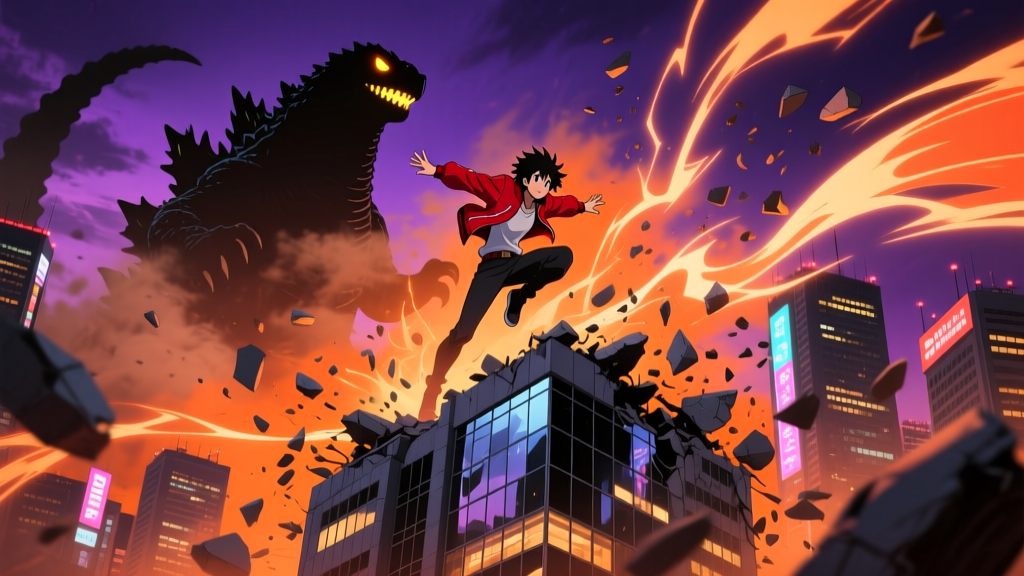
What if a kaiju’s step didn’t just *look* heavy—but *felt* geologically inevitable?
I remember watching Episode 7 of Kaiju No. 8 Season 2—the one where Kafka, mid-transformation, stomps down to intercept the Goliath-class “Rift Eater” in Shinjuku’s ruined subway concourse—and freezing the frame on the third beat of that footfall. Not because of the impact flash or the debris spray, but because of the pavement. Specifically: the way the concrete didn’t just shatter outward from the point of contact. It rippled. Not like water. Like bedrock.
That’s the 3-second shot: 00:14:22–00:14:25. Kafka’s left foot descends, heel-first, and the ground doesn’t break—it unfurls. Hairline fractures bloom in concentric arcs at variable speeds. A slab lifts—not vertically, but with a slight, nauseating tilt, as if pushed up by something deep and slow moving beneath it. Dust doesn’t puff; it settles in delayed waves, catching light only where the micro-vibrations momentarily still it.
This wasn’t stylized tremor. It was seismic simulation—literally. Production I.G.’s VFX lead Yuki Tanaka and her team imported raw USGS waveform data from the 2011 Tōhoku earthquake’s near-field accelerograms (specifically station MYGH07, recorded 40 km from the epicenter), then mapped its frequency-domain signature—0.5–12 Hz dominant bands, asymmetric P- and S-wave arrival timing—onto Houdini’s grain-based fracture solver. They didn’t animate cracks. They simulated ground response.
Think about that: most shonen CGI treats kaiju movement as physics-*adjacent*. Bones’ “tremor” in My Hero Academia Season 6, Episode 11—when All Might lands after the final clash with All For One—is textbook procedural animation. They used layered noise fields driving displacement shaders, timed to a drum hit. It’s visceral, yes. But it’s theatrical: the ground shakes *because the music says so*. The cracks follow the rhythm, not the load. You feel the weight, but you don’t feel the earth’s resistance—or its memory.
Production I.G. asked a different question: What does 120 tons of biokinetic mass *do* to sedimentary strata at 3 meters depth? Their answer required modeling not just surface geometry, but subsurface density gradients (they sourced Tokyo Metropolitan Geotechnical Survey borehole logs for Shinjuku’s actual soil profile) and assigning material damping coefficients to each layer. The result? Cracks propagate faster through the upper gravel bed, stall at the clay layer, then rebound upward as secondary shear fractures. That subtle “lift” before the main rupture? That’s the clay layer compressing elastically, then releasing. You see it. You *feel* it in your molars.
Why go there? Because Kaiju No. 8 has always been about scale-as-ontology. Kafka isn’t just fighting monsters—he’s fighting the sheer, indifferent mass of systems: bureaucracy, evolution, geology. A kaiju isn’t a character with powers. It’s a force vector intersecting human infrastructure. So when Kafka steps down, the pavement doesn’t just crack—it *records* him. Like a seismograph.
The cost? Render time spiked 400%. A single frame took 18 minutes on their render farm (up from ~3.5 mins for standard deformation sims). But here’s what surprised me: revision cycles dropped by 70%. Why? Because animators weren’t guessing at “how heavy this should look.” They had waveforms. They had stress maps. When the director asked for “more instability in the western quadrant,” Tanaka’s team didn’t redraw splines—they adjusted the local shear modulus in the Houdini node graph and re-ran the physics. The realism wasn’t decorative. It was functional precision.
Bones’ approach in MHA is brilliant choreography. It serves story and emotion first. Production I.G.’s choice here serves something quieter but sharper: coherence. Every fracture angle, every dust suspension duration, every millisecond delay between heel contact and far-field cracking obeys the same physical law. That consistency makes the impossible feel documented—not drawn.
I watched that shot six times in a row. Not for spectacle. To hear the silence after the P-wave passes—the half-second where nothing moves, and you’re waiting for the S-wave to hit. That’s when the show stops being anime and starts feeling like fieldwork.