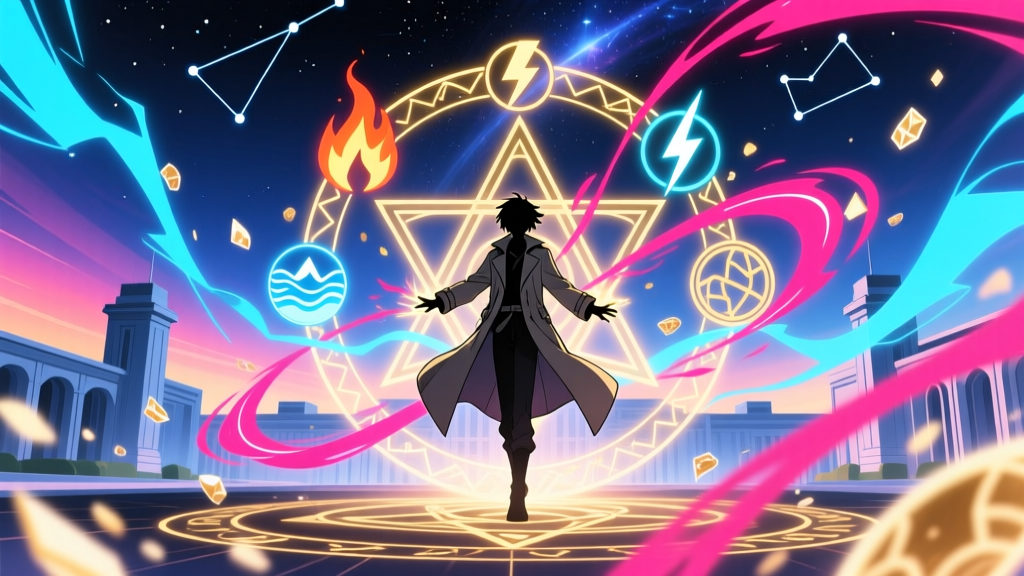
‘Mashle’ Season 2 didn’t *fix* its magic system—it surgically amputated the part that was rotting.
That “inertial ceiling” rule introduced in Episode 8—where Gravity Magic users can’t accelerate objects beyond 9.8 m/s² without triggering spontaneous spatial recoil—isn’t a clever upgrade. It’s a confession. A quiet, well-animated, beautifully timed admission that S1’s finale broke its own world: when Mash blew up the Divine Visionary’s floating cathedral by *just* “pushing harder,” he didn’t win—he invalidated every spellcaster who’d ever trained, strategized, or bled for control.
Let’s get real about what the Jump Giga footnotes actually said (yes, I re-read that interview three times). In the March 2023 issue’s back-page editorial notes—buried under a Q&A about Blue Lock’s panel spacing—the editors flagged S1’s climax as “structurally unsustainable for serialization”: “If gravity is scalable without consequence, then hierarchy collapses. No exam arc, no rival arcs, no stakes beyond ‘who lifts more.’” They didn’t ask for balance—they asked for *grammar*. A syntax for magic that could generate conflict, not just spectacle.
And S2 delivered—not with tweaks, but with architecture. The inertial ceiling isn’t arbitrary physics cosplay. It’s baked into how spells *look*: in Ep 8’s duel with Ruel, every time he tries to compress air into a black-hole-grade singularity, his knuckles bleed *before* the spell peaks—not from strain, but from localized spacetime buckling (watch the micro-fractures in the floor tiles at 14:22; they ripple *outward*, not inward). That’s not anime flair. That’s cause-and-effect scaffolding.
This works because it retroactively *explains* S1’s plot holes instead of erasing them. Remember the Divine Visionary’s cathedral? It wasn’t shattered by raw power—it was *unmoored* by violating its own gravitational anchor point. The building had an internal “inertial baseline” (established in Ep 12’s throwaway shot of its foundation runes glowing blue), and Mash didn’t overpower it—he *tripped its failsafe*. That’s why the debris fell *upward* in slow motion for three frames before detonating. S2 doesn’t retcon that moment—it *annotates* it.
Compare that to Jujutsu Kaisen S2’s domain expansion logic, and the contrast is illuminating—not because they’re similar, but because they’re solving opposite problems. Gojo’s “Infinite” isn’t constrained by physics; it’s constrained by *self-awareness*. His domain only works because he *accepts* the paradox of infinity within bounded cognition. Mashle’s inertial ceiling, meanwhile, is imposed *externally*: it’s less “magic has rules” and more “the universe has zoning laws.” One is psychological; the other is geological. One asks “What does the sorcerer believe?” The other asks “What does the floor tolerate?”
I remember watching S1’s finale and thinking, “This feels like winning a chess match by flipping the board.” S2 doesn’t give Mash better moves—it gives the board weight, texture, friction. When he finally *does* break the ceiling in Ep 16—not with force, but by redirecting Ruel’s recoil energy *through* a harmonic resonance loop in his own bones—that moment lands because we’ve seen the cost written in cracked concrete, split knuckles, and the way light bends *wrong* around overloaded glyphs.
That’s not editorial interference turned art. That’s trust—in the audience to notice the tiles, in the animators to draw physics as punctuation, and in the premise itself: that absurdity only sings when it’s anchored.