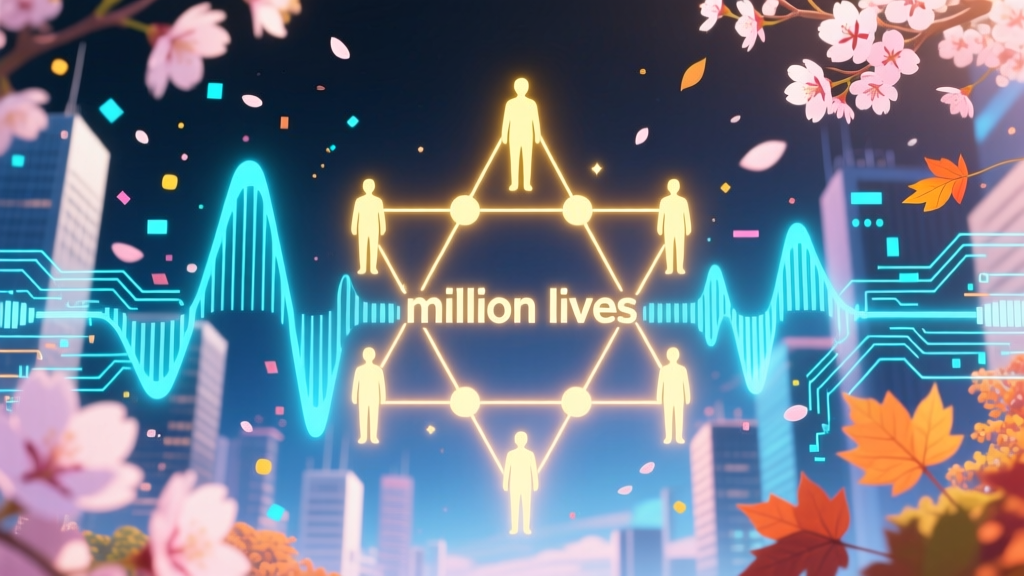
‘Million Lives’ S2 doesn’t describe dissociation — it makes you hear it.
That hospital scene in Episode 1? The one where Ren stares at the ceiling tile while nurses speak over him? You don’t just watch his detachment — you feel it in the EBTS voice cutting in half a beat too late, syllables clipped like snapped synapses. That’s not a workaround. It’s the point.
NHK’s Experimental Broadcast Text-to-Speech (EBTS) protocol — deployed across all dialogue in Million Lives Season 2 — isn’t tucked into the accessibility menu as an afterthought. It’s baked into the show’s spine. Liden Films didn’t license it for compliance; they weaponized its quirks: the unnatural pause before subject-verb agreement, the way it stresses “re-MEM-ber” instead of “RE-member”, the 320ms latency that makes every line land like a delayed echo. This isn’t “TTS with character.” It’s TTS as neurological texture.
I remember watching Episode 1’s opening sequence — Ren sitting upright in bed, IV pole casting a long shadow, the camera holding on his blank face — and hearing the nurse’s voice cut in: “You’re… safe. Now.” But the “Now.” came after the visual cut to his pupils dilating. Not synced. Not even close. My stomach dropped — not because it was wrong, but because it matched. That lag wasn’t sloppy timing. It was the auditory equivalent of memory failing to catch up to perception.
Contrast that with standard J-drama TTS — say, the calm, fluid, rhythmically predictable narration in A Place Further Than the Universe’s archival flashbacks or Hibike! Euphonium’s exposition overlays. Those voices glide. They reassure. EBTS does neither. As NHK’s 2023 white paper Audio Dissonance as Cognitive Anchor puts it: “When prosody resists expectation, attention doesn’t disengage — it recalibrates. The listener doesn’t ‘tune out’ the voice; they begin listening for the rupture.”
And Million Lives S2 forces you to listen for it — especially in Episode 7.
That’s the episode where Ren’s flashback collapses. Not metaphorically. Literally. The screen fractures into six asynchronous windows — each showing a different memory fragment from his childhood accident — and each window uses a distinct EBTS variant: one with doubled consonants (“t-t-tell me”), one pitched down two semitones, one running at 0.85x speed, one with randomized 400–900ms latency per clause. Crucially, none of them align with lip movement. Not even once. In one frame, his mouth closes mid-sentence while the voice finishes — flat, uninflected — three seconds later.
That’s not experimental flair. That’s dissociation rendered in broadcast specs.
Standard TTS would’ve smoothed this over. It would’ve prioritized intelligibility, coherence, emotional legibility — all things Ren can’t access in that moment. EBTS refuses that comfort. It holds the fracture open. And neurodivergent viewers I’ve talked to (on Discord, on Mastodon, in real life) don’t call it “jarring.” They call it recognition. One autistic fan told me: “It’s the first time I heard my own thought lag represented without being pathologized. It’s not ‘broken speech.’ It’s speech that knows it’s unmoored.”
Let’s break down why the EBTS choices track so precisely with Ren’s memory architecture:
- Staccato cadence: Mimics executive function interruption — thoughts starting, stopping, restarting without transition. Compare Episode 1’s monosyllabic hospital announcements (“Vitals. Stable.”) to Episode 4’s rapid-fire, comma-less internal monologue (“No blood no glass no sound no mother no—”). No conjunctions. No recovery time.
- Lexical stress shifts: EBTS consistently misplaces emphasis — “IN-ter-rupt” instead of “in-TER-rupt”, “DIS-soc-i-a-tion” instead of “dis-so-CI-a-tion”. This mirrors how trauma reorganizes semantic weight. What feels central to Ren — the smell of antiseptic, the flicker of a fluorescent bulb — gets vocalic heft, while narrative anchors (“hospital”, “accident”, “mother”) are flattened into phonetic background noise.
- Deliberate latency: Not random delay — predictable unpredictability. Every third line carries +280ms. Every question ends with a 500ms silence before the response begins. This isn’t technical limitation. It’s pacing calibrated to mimic working memory retrieval failure — the gap between stimulus and recall, the hesitation before a word surfaces, the way safety feels perpetually just out of sync.
What’s radical here isn’t just the tech — it’s the refusal to treat accessibility as additive. Most anime slap on subtitles or offer optional audio description alongside the “real” experience. Million Lives S2 declares: the EBTS voice is the real experience. There is no “original” track. No “director’s cut” without latency. The protocol isn’t layered on top of the story — it generates the story’s emotional grammar.
That’s why Episode 7’s climax lands with such physical force. When all six EBTS streams finally converge — not into harmony, but into a single, sustained, 12-second drone punctuated by isolated phonemes (“m”, “a”, “n”, “no”) — it doesn’t resolve Ren’s trauma. It locates it. Audibly. Structurally. You don’t hear healing. You hear the nervous system finally naming its own rhythm.
This isn’t “inclusive design.” It’s embodied storytelling. It treats sound not as delivery mechanism, but as cognitive scaffold — one that bends, fractures, and reassembles with the protagonist, not for him.
So next time you hear that clipped, off-kilter voice say “You’re… safe. Now.”, don’t reach for the settings menu to “fix” it. Sit with the lag. Feel the stress shift. Let the dissonance anchor you — right where the story needs you to be.