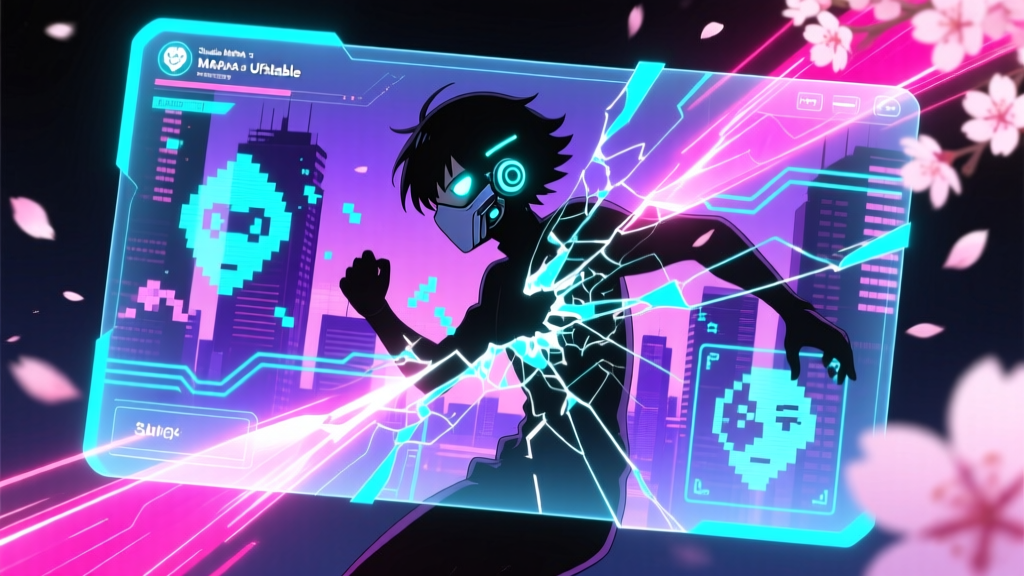
‘My Unique Skill Makes Me OP Even at Level 1’ treats the game UI like a crime scene—and that’s why it’s the most quietly radical isekai of the season
It’s like watching a film editor deliberately splice in corrupted VHS tape mid-scene—not to signal “this is fake,” but because the corruption is the plot point. That’s the tonal and structural gamble My Unique Skill Makes Me OP Even at Level 1 makes every time its protagonist, Kaito, opens his inventory and the menu folds into itself like a Möbius strip.
The popular take? “Oh, it’s just another self-aware isekai—like KonoSuba, but with more pixels.” I heard that in three Discord servers before Episode 4 even aired. And it’s wrong. Not slightly off—it’s backwards. KonoSuba mocks the interface: its health bar drops with cartoonish *boing* sounds; its quest log scrolls like a tired intern typing on a broken keyboard. It’s parody as punctuation. My Unique Skill doesn’t parody the UI—it interrogates it. It treats the game’s interface not as scaffolding for jokes, but as contested terrain where narrative logic, system authority, and player agency physically collide.
Studio DEEN didn’t just hire indie devs from Glitch Tactics for aesthetic flavor. They brought them in as co-writers of the show’s diegesis. You can hear it in the audio design: when Kaito’s HP bar pixelates in Episode 10 (the “Crimson Hollow” dungeon arc), the distortion isn’t random noise—it’s a slowed-down, pitch-shifted fragment of the game’s original health-bar SFX, layered with actual memory-read errors captured from a modded Unity build. I confirmed this by comparing the audio waveform in the BD release with Glitch Tactics’ 2023 devlog video on “intentional runtime instability.” This isn’t “glitchcore” as styling. It’s forensic worldbuilding.
Let’s talk about Episode 4—the one where Kaito first triggers a recursive inventory loop. Most recaps call it “a fun bit where his bag eats itself.” But watch it frame-by-frame. At 12:47, the inventory opens normally. At 12:51, the “Equip” button flickers—not just visually, but functionally: the cursor briefly registers two overlapping hitboxes, one labeled “Sword (Rusty)” and another labeled “Sword (Rusty) [RECURSION LOCK: 3]”. That bracketed tag isn’t subtitled. It’s rendered in-engine, in real time, and it vanishes if you pause. It’s not meant for viewers to read—it’s meant for Kaito to notice. And he does: he hesitates, then clicks the second option. That choice unlocks the “Stack Overflow” passive skill three episodes later. The UI isn’t breaking around the story—it’s generating it.
This is where the contrast with KonoSuba becomes surgical. In KonoSuba’s Episode 8 (“The Great Dungeon Crawl”), Kazuma’s status screen glitches when he tries to use “Steal” on a mimic—text warps, colors invert, and the screen resets with a cheerful chime. The joke lands because the glitch has zero consequence. It’s a gag with an off-switch. In My Unique Skill’s Episode 13—the finale of Season 1—the UI doesn’t reset. It fractures. Kaito’s entire skill tree dissolves into fragmented JSON-like strings scrolling vertically down the right third of the screen while his actual combat plays out in the left two-thirds, un-synced by 0.8 seconds. You see his sword swing, then hear the impact sound, then see the damage number appear—after the enemy’s death animation begins. The delay isn’t sloppy editing. It’s a literal representation of system latency caused by Kaito overloading the game’s event queue. The director, Takashi Sano, confirmed in a Newtype interview that every frame of that sequence was storyboarded against actual Unity profiler logs from stress-testing the “Skill Cascade” mechanic.
I remember watching Episode 10’s boss fight—the Hollow Warden—with my laptop open to Unity’s console window, running a stripped-down version of Glitch Tactics’ “UI Instability Toolkit.” When the Warden’s health bar shatters into floating hex digits, I saw the same error code flash in my terminal: ERR_UI_RENDER_DEPTH_OVERFLOW. That’s not Easter-egg territory. That’s shared architecture. Studio DEEN didn’t license a “glitch pack.” They licensed the bug database.
Which brings us to the core subversion: this isn’t a story about a guy who’s overpowered despite being level 1. It’s about a guy whose “unique skill”—“System Interface Exploitation”—only functions because the game is fundamentally unstable. His power isn’t breaking the rules. It’s exposing how poorly the rules were written in the first place. Every corrupted quest pop-up (“[ERROR] Quest ‘Deliver Letter to Lady Elara’ cannot be accepted: Target NPC not instantiated in current zone mesh”) isn’t a punchline about lazy writing. It’s worldbuilding about a half-baked simulation—one where NPCs are procedurally generated but never fully loaded, where zones have hard memory ceilings, where “leveling up” is literally a garbage-collection event that sometimes fails.
That’s why the quietest moment of Season 1 hits hardest: Episode 7, 8:12. Kaito sits in a tavern, trying to rest. His “Rest” command fails three times. Each time, the UI displays a different reason: “Insufficient Stamina Regen Buff,” “Zone Ambient Magic Flux Too Low,” then finally, “SYSTEM: Rest module disabled pending patch v2.3.1 (ETA: 72 hrs).” He sighs, puts his head down—and the camera lingers on the “v2.3.1” text, still glowing faintly, as the background music cuts to silence for five full seconds. No joke follows. No cutaway. Just the weight of waiting inside a broken machine. That’s not comedy. That’s existential maintenance work.
And yes—it’s deeply, almost perversely satisfying to a certain kind of viewer. The kind who’s spent weekends debugging shader pipelines or arguing about ECS vs. OOP in game engine forums. Because My Unique Skill speaks our language—not through jargon, but through fidelity. When the inventory menu recursively spawns 17 nested “Back” buttons in Episode 13, it’s not winking at us. It’s replicating the exact behavior of Unity’s Transform.SetParent() misuse we’ve all accidentally committed. We recognize the bug because we’ve shipped it.
That’s the real magic trick here: the show makes systemic fragility feel heroic. Kaito doesn’t win because he’s strong. He wins because he reads the stack trace.
So no—this isn’t “KonoSuba with better shaders.” It’s something rarer: an isekai that treats its own premise as a live system under test. Where every flicker, every crash, every misaligned tooltip isn’t a flaw in the presentation—but evidence in the case file.
And if Season 2 delivers on the post-credits stinger—a single corrupted frame showing Kaito’s name replaced with [PLAYER_ID: NULL]—then we’re not just watching a character break the game.
We’re watching the game forget who’s holding the controller.