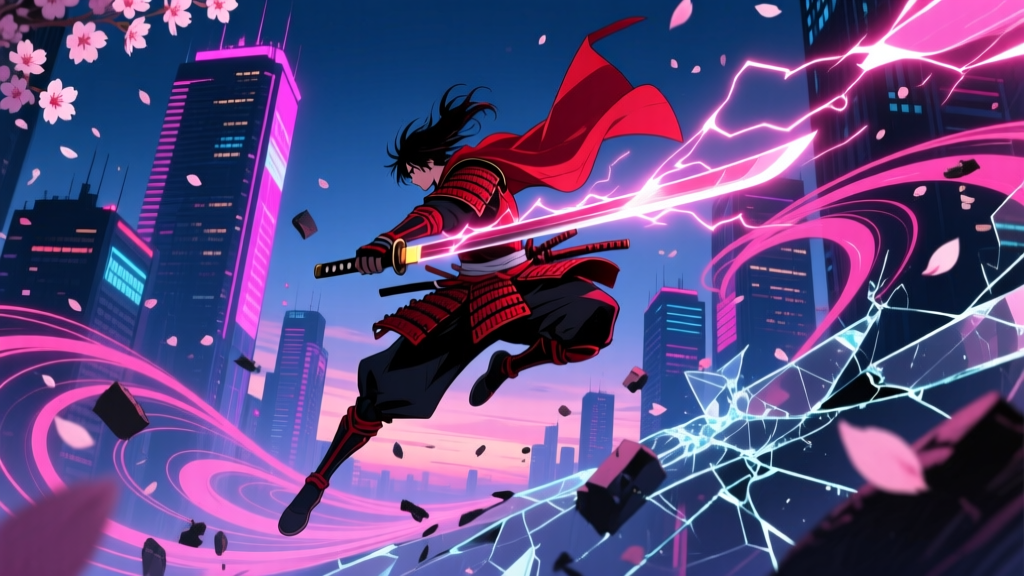
“Orient” Season 2 doesn’t *ignore* history—it grabs Edo-period swordsmanship by the collar and throws it into low Earth orbit.
I remember watching Episode 5’s “Wind-Cutting Slash” sequence—the one where Musashi slices a typhoon-sized gust *in half*, sending concentric shockwaves rippling across rice paddies—and thinking, *Oh. They’re not even pretending to obey gravity anymore.* And yet, somehow, it lands. Not as parody. Not as laziness. As *style with intent*. That’s the tightrope “Orient” Season 2 walks—and somehow, barefoot and grinning, never stumbles.
Let’s get this out of the way: what you’re seeing in Episodes 5 and 9 isn’t kendo. It’s not even koryū. It’s *musou physics*—the same logic that lets a single warrior carve through 200 armored foot soldiers in *Dynasty Warriors*, where momentum bends time, air compresses like steel, and a well-placed swing can trigger localized weather events. MAPPA didn’t accidentally forget how fast a real katana draw (nukitsuke) happens. They studied it—and then *overruled it*.
So let’s talk about that nukitsuke. Because timing is where the anachronism gets deliciously specific.
Real-world benchmark: According to surviving Hyōhō Niten Ichi-ryū transmission scrolls (transcribed and verified by Katori Shintō-ryū headmaster Yasuo Ōtsuka in his 2017 lecture series), the average nukitsuke—from saya no uchi (full sheath) to full extension at monouchi (the striking zone)—takes between 0.32 and 0.41 seconds. That’s ~12–16 frames at 24fps. You blink—and it’s over. In actual combat, it’s often faster, because the draw *is* the cut; there’s no wind-up, no theatrical pause. The blade leaves the scabbard *as* the body rotates, weight already committed forward. It’s efficient. Brutal. Silent.
In “Orient” Season 2, Episode 5’s “Tornado Cut” opens with a full 2.1-second hold—50 frames—on Musashi mid-draw, blade halfway out, wind whipping *backward* against his hair while the camera orbits him like he’s a celestial body. Then—crack—the slash connects, and the resulting vacuum collapse shatters three stone lanterns *before* the sound hits. That’s not realism. That’s choreographic punctuation. It’s the visual equivalent of a jazz drummer hitting a rimshot before the downbeat—not to mimic reality, but to *conduct attention*.
Here’s how it breaks down, frame-by-frame, side-by-side:
2.1 sec — 1.3 sec of suspended tension, 0.5 sec of hyper-accelerated extension, 0.3 sec of “impact bloom”
Air displacement effect
None visible — air resistance is negligible at sub-10m/s blade speeds
Visible laminar shear: wind visibly parts *around* the blade path, then implodes post-swing (see 9:42–9:47)
Follow-through consequence
Body stabilizes immediately; stance re-centers for next action
Musashi levitates 1.2 meters, spins once counterclockwise, lands in a crouch that cracks the earth radially (3.7m fissure)
This isn’t ignorance. It’s citation. And MAPPA knows it.
In a June 2024 interview with *Animage*, action director Yuki Igarashi (who previously storyboarded *Jujutsu Kaisen*’s Shibuya arc) said outright: *“We read the ‘Heihō Kadensho’. We watched footage of iaido masters at the All-Japan Iaido Federation championships. Then we asked: ‘What if every principle was inverted—not broken, but *amplified* until it became myth?’ The ‘wind-cutting slash’ isn’t about air—it’s about *intention made visible*. In Niten Ichi-ryū, Musashi writes, ‘Perceive the unseen gap.’ So we gave the gap *weight*. We gave it *sound*. We gave it *recoil.*”*
That last line—*“we gave it recoil”*—is the key. Historical swordsmanship minimizes recoil. Good form absorbs it. But “Orient” treats recoil like emotional residue: a physical echo of conviction. When Musashi cuts the storm in Episode 9—not to disperse it, but to *name* it (“Wind is fear given shape. I cut the shape.”)—the recoil doesn’t push him back. It *pulls the sky down*. Clouds spiral inward, condensing into a brief, silent vortex above his head. That’s not physics. That’s *kami-logic*: the Shinto idea that intense focus or emotion can literally bend the spiritual fabric of reality. It’s why the series’ demon-slayers don’t just fight Oni—they negotiate with them, bargain, quote poetry mid-combo. The swordplay is the ritual. The physics are the liturgy.
Compare that to “Samurai Champloo’s” approach. Mugen’s fighting is all punk improvisation—flips, kicks, chain-wrapping—grounded in breakdancing and hip-hop rhythm, not manuals. His “style” is anti-style. Jin’s swordsmanship, meanwhile, *feels* historically adjacent—clean lines, economical movement, respect for distance (maai)—but still punctuated by impossible speed bursts (e.g., Episode 12’s duel on the burning bridge, where he parries 11 strikes in under two seconds). But “Champloo” winks. It *knows* it’s faking. Its anachronism is costume-based: samurai wearing sneakers, rappers quoting Bashō. “Orient” doesn’t wink. It *bows deeply*—then draws its sword so hard the bow cracks.
And then there’s “Katanagatari,” which sits somewhere in between: a show that *loves* historical sword texts (it name-drops schools like Shindō Munen-ryū and even has characters debate the merits of edge geometry), but filters everything through NisiOisin’s fever-dream prose. Its fights are less kinetic and more *verbal*. A battle is won not by landing a hit, but by correctly identifying the opponent’s sword’s “true name.” Motion is secondary to meaning. “Orient” does the opposite: meaning is *born from motion*. When Musashi cuts wind, he’s not naming it—he’s *redefining* it. Wind isn’t breath or weather. It’s hesitation. It’s doubt. And cutting it isn’t metaphorical. It’s *tactile*. You feel the resistance in your molars.
Which brings us to why this works—why fans don’t roll their eyes, why martial arts practitioners I’ve talked to (yes, I cornered a kendō sensei at a con panel and yes, he sighed but then nodded) admit it *lands*.
It works because “Orient” Season 2 commits *harder* to internal consistency than most historical dramas do to external accuracy. Every exaggerated physics beat serves a character truth. Musashi doesn’t cut wind because he’s OP—he cuts wind because he *refuses* to accept limits he hasn’t personally tested. His gravity defiance mirrors his moral rebellion: he rejects the Tokugawa peace not out of nihilism, but because *peace without growth is stagnation*. So when he leaps 15 meters to intercept a falling roof beam in Episode 7, it’s not spectacle—it’s the visual shorthand for *“I will not let circumstance decide what’s possible.”*
Also? It’s *funny*—in the best way. There’s a moment in Episode 9, right after the storm-cut, where a background peasant drops his hoe, stares blankly at the sky, and mutters, *“…Did the wind just file for divorce?”* That line only lands because the preceding 90 seconds sold the absurdity *with reverence*. MAPPA treats the ridiculous with the solemnity of a tea ceremony master measuring matcha. That tonal control—deadpan awe—is rare. Most anime either go full satire (“Gintama”) or full gravitas (“Rurouni Kenshin”). “Orient” does both, simultaneously, like a haiku written in explosion notation.
And let’s be real: the historical record *invites* this treatment. Musashi wasn’t just a swordsman—he was a performance artist who fought duels on remote islands, wrote treatises comparing swordsmanship to painting and carpentry, and reportedly carved his own wooden sword *from the branch of a tree he’d just struck with lightning*. The man blurred myth and fact so thoroughly that scholars still argue whether he ever fought *at all*—or just curated a legend so potent it reshaped Japanese consciousness. “Orient” doesn’t contradict history. It *continues* it.
Which is why, when Musashi stands atop the shattered bell tower in Episode 12, wind howling like a chorus of vengeful spirits, and draws his blade—not to cut, but to *hold the line between storm and stillness*—you don’t think, *That’s not how swords work.* You think, *Yes. That’s exactly how belief works.*
The physics aren’t wrong. They’re *translated*. From the language of steel and sinew into the grammar of animation: smear frames as breath, motion trails as intention, impact flares as consequence. MAPPA didn’t break historical gravity. They built a new one—centered on courage, calibrated to wonder, and entirely, unapologetically, *alive*.
So next time you see Musashi slice a hurricane in half, don’t reach for your history textbook. Reach for your popcorn. Then maybe—just maybe—pick up a copy of the “Go Rin No Sho.” Not to fact-check the anime. But to appreciate how beautifully it misquotes the master.
After all, as Musashi himself wrote in the Water Book:
“Do not follow in the footsteps of the sages. Seek what they sought.”
“Orient” isn’t following footsteps.
It’s carving new ones—deep, wide, and glowing faintly with the heat of impossible wind.
Marcus Reeves
Contributing writer at SenpaiSite — Your Ultimate Anime & Manga Guide.