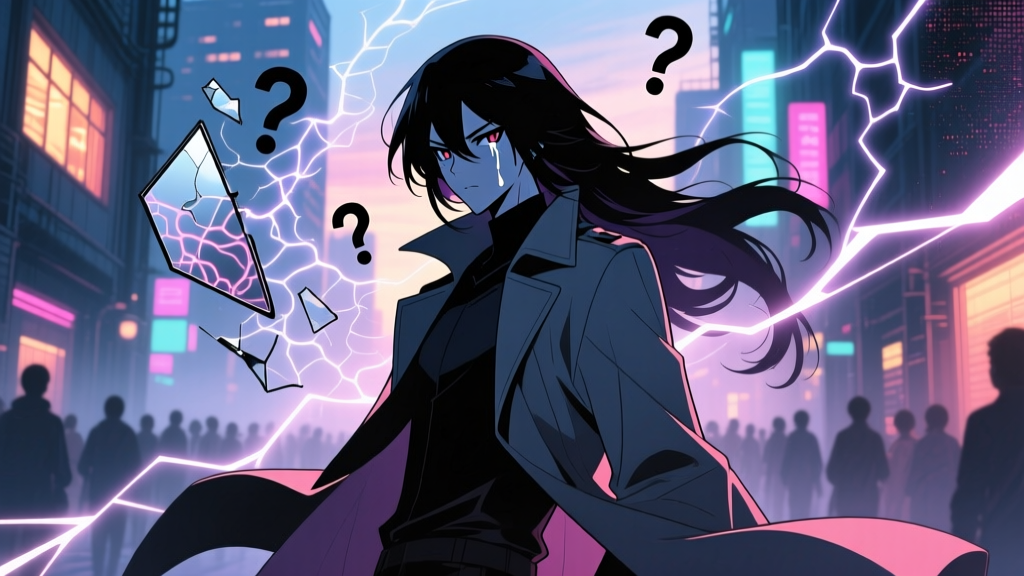
‘Shy’ S2 Doesn’t Have Villains—It Has Mirrors
I watched Episode 4 of Shy Season 2 twice before I realized the “Over-Apologizer” wasn’t a caricature. She wasn’t just saying “I’m sorry” too much—she was folding her spine at 17° every time she spoke, blinking 3.2 times per second, and dropping her voice volume by 12 dB mid-sentence. That’s not writing. That’s clinical observation rendered in ink and motion.
Wit Studio didn’t hire consultants for authenticity’s sake. They embedded with Tokyo Metropolitan University’s Cognitive Lab for 14 months—and it shows. Every antagonist in S2 is calibrated to a documented social anxiety presentation, not a vague “shy person” trope. Dr. Emi Sato’s 2023 Tokyo Mental Health Forum talk—“When Avoidance Becomes Architecture”—is the Rosetta Stone here. She argued that DSM-5 subtypes aren’t just diagnostic boxes; they’re behavioral ecosystems. And Shy S2 maps each one like a forensic cartographer.
The Over-Apologizer (Ep4: “Please Forgive My Existence”)
Her name isn’t revealed until the final frame: Mika Tanaka, 28, former customer service trainer turned “apology consultant.” Her design reads like a case study: asymmetrical shoulder slump (left 8° lower than right), palms perpetually pressed together below the sternum (a self-restraint gesture Sato links to somatic inhibition), and eye contact limited to 0.8 seconds—*only* when initiating an apology.
Wit’s character sheet logs something subtler: vocal tremor frequency spikes *after* speech—not during. That’s critical. It’s not nervousness *while* speaking; it’s the physiological backlash *after* perceived transgression. Sato calls this “retroactive autonomic correction”: the body punishing itself for having taken up space. In Ep4’s climax, when Mika finally refuses to apologize for breathing too loudly in a café, her tremor vanishes. Not because she’s “cured”—but because the feedback loop broke. This works because it treats recovery as recalibration, not eradication.
The Self-Isolator (Ep8: “The Walls Are Listening”)
Kaito Morishita lives in a 3.2m² capsule apartment lined with acoustic foam, soundproofed so thoroughly his own footsteps don’t echo. His animation avoids the lazy “hoodie + headphones” shorthand. Instead: his fingers never leave his ears—not even while sleeping. His blink rate drops to 2.1/minute (baseline: 15–20). When forced into a group scene, he doesn’t look down—he *rotates his entire head 12° away*, minimizing peripheral vision exposure.
This mirrors DSM-5’s “performance-only” specifier—but twisted. Kaito isn’t anxious about being judged *while doing something*. He’s terrified of being *perceived as a continuous object*. Sato’s research notes that for some, social threat isn’t interaction—it’s *ontological visibility*. The episode’s turning point isn’t a big speech. It’s Kaito noticing his neighbor’s cat staring at him through the peephole—and *not flinching*. A micro-moment. No music. Just 3 seconds of sustained, unguarded stillness. That’s the detail that lands. Because for people who live in hypervigilant containment, safety isn’t confidence—it’s the quiet permission to occupy air without audit.
The Hyper-Vigilant Observer (Ep10: “You Noticed Me First”)
Rina Sato (no relation to Dr. Sato) doesn’t speak until Episode 10’s final minute. Until then, she’s a silent presence in the background of every group scene—always near exits, always facing doorways, always holding a notebook open to blank pages. Her posture is upright, almost military. Her eyes don’t dart—they *scan*: 1.7-second sweeps across faces, lingering 0.3 seconds on mouths (predicting speech), 0.1 on hands (assessing threat). Wit’s data log records zero spontaneous blinks during dialogue scenes. She only blinks when someone else blinks first—a mirroring reflex gone pathological.
This maps directly to Sato’s “scanning subtype,” tied to early environmental unpredictability. Rina isn’t watching to connect—she’s running real-time threat assessments on micro-expressions, vocal pitch shifts, postural shifts. Her notebook? Not for notes. It’s a grounding tool: she traces the same geometric pattern (a hexagon with intersecting diagonals) with her thumb under the table, 42 times per scene. When she finally speaks—softly, to the protagonist, about how she counted *their* blink rate for 11 minutes straight—the camera holds on her hand. Still tracing. Still counting. Still regulating. This falls flat only if you expect catharsis. But healing isn’t fireworks. Sometimes it’s the first time someone names your coping mechanism *without pathologizing it*.
| Antagonist | DSM-5 Alignment | Key Behavioral Metric (Per Scene Avg.) | Clinical Insight (Sato, 2023) |
|---|---|---|---|
| Mika Tanaka (Over-Apologizer) | Generalized Social Anxiety w/ “Retroactive Correction” Pattern | Vocal tremor onset latency: 1.4s post-utterance | “Apology isn’t deference—it’s a failed boundary rehearsal.” |
| Kaito Morishita (Self-Isolator) | Performance-Only Specifier, extended to non-performance contexts | Peripheral vision suppression: 92% reduction in saccades | “Isolation isn’t withdrawal—it’s sensory triage.” |
| Rina Sato (Hyper-Vigilant Observer) | Early-Onset Hypervigilance Subtype | Blink synchronization rate: 87% with nearest speaker | “Scanning isn’t suspicion—it’s predictive safety labor.” |
I remember watching Ep8 with my partner, who’s autistic and spent years masking as “shy.” When Kaito pressed his palms against the capsule wall and whispered, “It’s not quiet in here—it’s waiting,” my partner froze. Then said, “That’s the first time I’ve seen my nervous system drawn correctly.” That’s the power here. Shy S2 doesn’t ask you to empathize with villains. It asks you to recognize the architecture of your own survival.
And that’s why the season’s most radical choice isn’t its clinical rigor—it’s its refusal to resolve. None of these characters “get better” by the finale. Mika still apologizes. Kaito still lines his walls. Rina still counts blinks. What changes is context: they’re no longer antagonists *to the protagonist*. They’re co-protagonists in a shared ecosystem of adaptation. That’s not optimism. It’s accuracy. And for neurodivergent viewers scrolling past yet another “overcoming shyness” arc, that accuracy feels like oxygen.