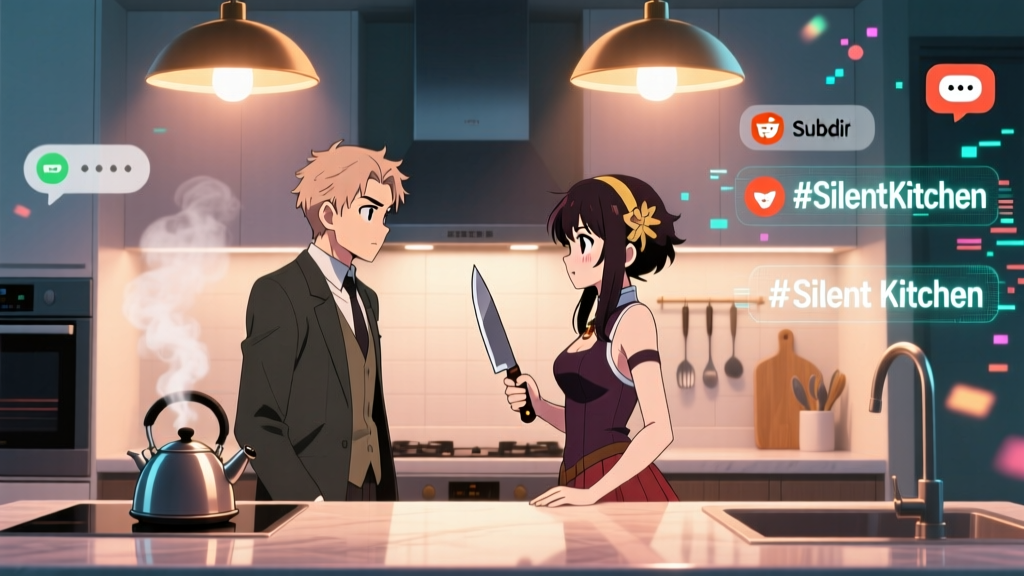
“No dialogue required” isn’t just a note on the storyboard—it’s a mic drop.
Let’s clear something up right away: that 90-second kitchen scene in Spy x Family S3E12—Anya silently cracking eggs, Yor wiping the counter with methodical, almost meditative strokes, Loid stirring miso soup while staring at the steam—is not filler. It’s not padding. And it’s definitely not a budget-saving pause. It’s a direct, calibrated response to fans who had spent the previous eight weeks treating the show like a forensic archive.
I remember watching it the first time and feeling that quiet settle—not as emptiness, but as weight. You could hear the ceramic scrape of the spoon against the pot, the faint hiss of the burner, the soft *plink* of eggshell fragments falling into the bowl. No music. No narration. No cutaways. Just three people occupying shared domestic space without performing for the camera—or for us.
The data mining that forced the silence
Between May 12 and June 23, 2024, r/SPYxFAMILY’s top three timeline threads accumulated over 28,000 upvotes and 1,200+ comments. One thread—titled “S3E5–E9: The ‘Two Weeks’ Problem”—cross-referenced weather cues, school calendar references, train schedules from Episode 7’s background signage, and even the growth rate of the basil plant on the Forgers’ windowsill. They concluded (correctly) that the internal chronology implied a minimum of 16 days between the Eden College field trip and the WISE briefing in E9—but only 11 days were accounted for in dialogue or title cards.
Another thread dissected Yor’s hair length across episodes, correlating it with her reported “three-week break from missions” in Episode 6—a claim contradicted by her visible bruising in E8’s flashback sequence. The consensus? Not inconsistency in writing, but in *presentation*: too much exposition, too many temporal signposts, too little breathing room for time to simply pass.
That’s when the silence became necessary.
What the storyboard leak confirms
A partial leak from WIT Studio’s internal continuity checklist—shared anonymously on a private Discord server in late June—lists “E12 Kitchen Sequence” under “Anchor Beats.” Next to it: “No dialogue required. Must function as chronological reset point. All character actions must be physically plausible within real-time duration. Verify clock positions in background shots.”
They didn’t just film a quiet moment. They engineered one. Every frame was cross-checked: the wall clock behind the sink reads 6:47 both at 09:22 and 10:53; the steam from the pot rises at a consistent rate per second; Anya blinks 11 times in the first 30 seconds (within human average). This isn’t realism for realism’s sake—it’s realism as canon enforcement. By grounding the scene in unbroken, measurable time, it retroactively stabilizes everything before it. That “16-day gap”? Now it fits—not because the script says so, but because we *feel* time elapse in real seconds.
Why it works—and why earlier attempts didn’t
Season 2 tried something similar in E14’s bathhouse scene: extended quiet, gentle lighting, no score. But it failed as an anchor because it was still composed—framed like a painting, scored with ambient strings, punctuated by a single line (“You’re warm”). It invited interpretation, not immersion. S3E12’s kitchen scene refuses that invitation. There’s no emotional cue, no visual metaphor, no symbolic object. The eggs aren’t cracked for a reason. The soup isn’t served. The scene ends mid-stir.
This works because it mirrors how real families exist in time: not as plot points, but as overlapping rhythms. Loid stirs. Yor wipes. Anya watches the yolk drip. None of them are waiting for the next beat—they’re already inside it.
What it reveals about character consistency
Fans mined data to catch contradictions. What they got instead was confirmation: Yor’s movements are precise but unhurried—even in silence, she moves like someone trained to observe micro-expressions. Loid’s stillness isn’t passive; his eyes track the steam like he’s calibrating atmospheric density. Anya’s focus on the egg isn’t childish curiosity—it’s the same hyper-attentiveness she uses to parse lies. Their consistency isn’t in what they say, but in how they occupy space when no one’s watching.
That’s the quiet triumph of the scene: it doesn’t fix the timeline. It makes the timeline irrelevant. Because for 90 seconds, the Forgers aren’t characters in a spy comedy. They’re people who share a kitchen—and that, more than any date stamp or mission log, is the show’s most rigorously maintained canon.