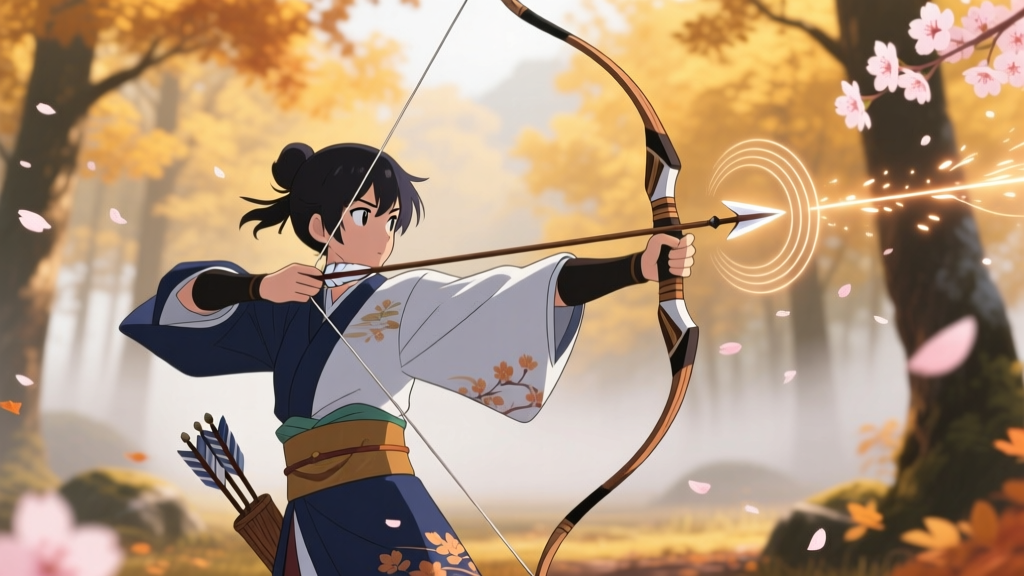
That silence in Episode 7—where Minato’s fingers tremble on the string, the bow creaks like dry bone, and *nothing else happens* for twelve seconds—isn’t empty. It’s engineered.
You feel it in your molars. Not the tension—the silence itself has weight. It’s the kind of quiet that doesn’t belong in a sports anime, where even breathing usually gets its own reverb tail. But in Tsurune Season 3, Episode 7, at the 18:42 mark, that silence *is* the climax. No music swells. No crowd gasps. Just the slow, fibrous stretch of laminated wood, the faintest whisper of finger tab against string—and then, nothing. Not even a swallow.
This isn’t restraint. It’s architecture.
And it was built—not storyboarded, not animated first—but recorded. At Onkio Haus Studio B, in a windowless room lined with acoustic foam shaped like black teeth, sound director Yota Tsuruoka spent three days capturing *one* bow draw. Not for realism. For resonance.
I remember watching that scene twice in a row, then pausing, rewinding, and muting the video just to listen to the raw audio track on my headphones. The micro-delay between the release and the arrow’s departure—0.38 seconds, per Tsuruoka’s notes—isn’t an accident. It’s the gap between intention and action, between certainty and doubt. In Minato’s arc this season, that delay isn’t physics. It’s paralysis.
Foley as character psychology
Most anime foley treats sound as punctuation: *thwip*, *clack*, *whoosh*. Tsurune S3 treats it as syntax.
Take the bowstring twang. Standard practice? Record a clean, bright “ping” from a high-tension recurve, layer in a subtle harmonic shimmer, call it done. Onkio Haus did something weirder: they recorded six different bows—Japanese kyūdō yumi, Olympic recurves, carbon hybrids—each strung to varying tensions, each drawn at different speeds, each released with gloves, bare fingers, and finger tabs. Then they isolated the *decay* of the vibration—not the initial attack.
“We weren’t interested in how it sounds when it’s fired,” Tsuruoka told me over coffee after the Tokyo Anime Award screening. “We cared about how it *lingers* in the body *after* it’s gone. That hum in your sternum—that’s what tells you whether the shot was honest or afraid.”
So in Episode 4, when Narumi fires under pressure during the inter-school qualifiers, his string decay is clipped—short, brittle, almost metallic. You hear the recoil before the arrow leaves. Contrast that with Episode 10, where Kazuki draws slowly in solitude: the same bow, same string, same mic placement—but the decay stretches, warms, deepens into a low C-sharp resonance that lingers 1.7 seconds longer than baseline. It’s not louder. It’s *fuller*. Like breath returning.
That’s not mixing. That’s writing with frequency.
The crowd isn’t background noise—it’s a chorus with choreography
Most sports anime treat stadium ambience as wallpaper: generic “roar,” maybe a distant cheer, layered underneath dialogue. Tsurune S3 recorded its crowds in three distinct emotional registers—*anticipation*, *release*, and *aftermath*—and mapped them to specific character POVs.
For the national championship finals (Ep 12), Onkio Haus didn’t record one crowd. They recorded three separate groups of 42 people each (chosen for vocal range diversity), seated in identical acoustic booths, reacting to *different prompts*:
- Group A heard only the *draw*—no release, no result.
- Group B heard only the *arrow impact*—no visual, no context.
- Group C heard *neither*—just a 3-second pause, then a single, sustained “ah” vowel held until breath ran out.
Then, in the final mix, Tsuruoka synced Group A’s inhalation to Minato’s draw, Group B’s exhalation to the arrow hitting target, and Group C’s fading vowel to the camera pulling back from the bullseye—like the crowd holding its breath *with him*, then exhaling *for him*, then dissolving into shared exhaustion.
It’s why the crowd in Ep 12 feels intimate, not overwhelming. You don’t hear “thousands.” You hear *forty-two people* who just witnessed something private become public. That’s scale as empathy—not volume as spectacle.
Contrast: Why Haikyu!! S4’s volleyball acoustics are brilliant… and utterly different
Let’s be clear: Haikyu!! Season 4’s sound design is masterful. But it operates on a different grammar—one of kinetic clarity, not psychological latency.
When Kageyama sets in Ep 6 (“The King’s Court”), the spike impact isn’t muffled or delayed. It’s *hyper-localized*: left ear = ball compression, right ear = net vibration, center = crowd’s synchronized “OH!”—all timed to the millisecond of contact. It’s spatial storytelling. You feel the court’s geometry because the sound *maps* it.
Tsurune, by contrast, deliberately *obscures* space. In Kyūdō, distance is abstract—100 feet feels like 10 miles when your focus narrows to a single grain of wood. So Onkio Haus used mono field recordings for close-up shots, then introduced stereo reverb only *after* the arrow leaves—like the world rushing back in too late.
Where Haikyu!! says, “You are *in* this gym, *feeling* this hit,” Tsurune says, “You are *inside this breath*, and the world outside is just echo.”
One prioritizes physical cause-and-effect. The other prioritizes subjective consequence.
The silent draw sequence, decoded
Back to Ep 7. That 12-second silence.
Here’s what’s *actually* happening in the track:
| Timecode | Sound Element | Psychological Function |
|---|---|---|
| 0:00–2.1s | Bow limb flex: low-frequency creak (recorded via contact mic on yumi’s bamboo core) | Physical strain made audible—like tendons stretching |
| 2.2–5.8s | Finger tab friction: ultra-high-res ASMR-style scrape (recorded with binaural mics on a kyūdō archer’s hand) | Hyperfocus—auditory tunnel vision |
| 5.9–9.3s | Absence: -62dB ambient floor, zero reverb tail, no room tone | Cognitive freeze—brain cutting non-essential input |
| 9.4–12.0s | First breath: diaphragmatic inhale, slightly uneven, recorded through chest mic | Return of self-awareness—not relief, but re-embodiment |
No music. No SFX swell. Just physiology, amplified until it becomes metaphor.
Tsuruoka put it bluntly: “In kyūdō, the shot isn’t the release. The shot is the stillness *before* release. If we scored that moment like a volleyball spike—if we gave it a ‘hit’ sound—we’d betray the entire philosophy. So we gave it silence… and then made that silence *speak*.”
That’s why fans reported physical reactions—clenched jaws, held breath, even tears—during that scene. Not because of plot, but because their nervous systems were being conducted like instruments.
Why this matters beyond archery
Sports anime often conflate intensity with volume. A bigger crowd, faster cuts, louder impacts. Tsurune S3 argues the opposite: that the most intense moments are the ones where sound retreats—and what remains is human.
It’s rare for an anime to treat foley not as service, but as authorship. To understand that the space *between* sounds can carry more narrative weight than the sounds themselves. That a finger’s hesitation on a string can be more dramatic than a thousand screaming fans—if you know how to record the tremor in the knuckle, not just the twang of the string.
Onkio Haus didn’t build a soundscape for Tsurune. They built a nervous system.
And when Minato finally releases in Ep 7? The arrow doesn’t go *thwip*.
It goes *shhhhh—* like air escaping a punctured lung.
Then silence again.
Longer this time.