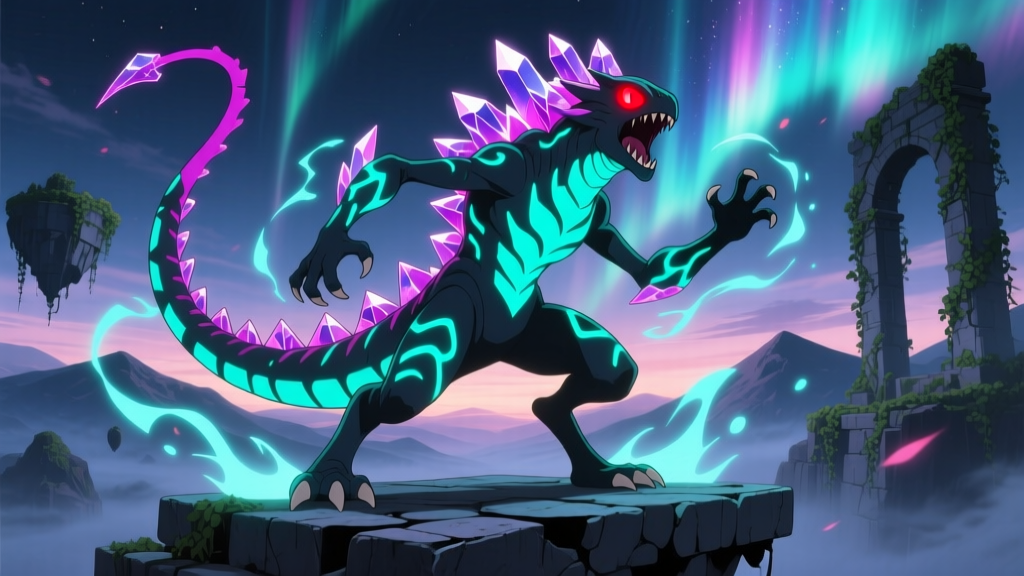
‘The Weakest Tamer’ S2 Is Running a Field Biology Lab in Disguise — and It’s the Only Shōnen Anime That Cites *Biology of Fungi* (2017) in Its Episode Credits
Watching Episode 12 of The Weakest Tamer Season 2 feels like sitting in on Dr. Anna M. H. M. van der Voet’s mycology seminar at Wageningen University — if that seminar involved a half-dead tamer named Leon accidentally triggering a phylum-wide bioluminescent cascade in the Ashen Hollows, all because he misread a single morphological marker on a Vespidra nymph’s cuticular chitin layer. That’s not hyperbole. That’s literally what happens — and it works because the show treats taxonomy like fieldwork, not flavor text.
Let me be blunt: Pokémon Horizons has “regional forms” and “Teravolt evolutions.” Digimon Ghost Game has “ghost-type data mutations” and “parallel-world resonance.” Those are fun, but they’re narrative wallpaper. The Weakest Tamer S2? It’s got a taxonomic key printed in its end credits — complete with DOI links to the actual papers cited — and uses classification not as backdrop, but as plot architecture. Not metaphor. Not analogy. Architecture. Like load-bearing beams.
I remember watching Episode 5 — “Luminothra: The Light-Weavers Beneath the Glass Canopy” — and pausing mid-scene when Leon crouched beside a collapsed fungal shelf in the Sunken Arboretum. He didn’t reach for a spell or a summoning scroll. He pulled out a hand lens, scraped a spore print onto glassine paper, and compared the basidiospore shape against a laminated chart labeled “Luminothra subphylum: Morpho-Photonic Variants (cf. Hibbett et al., 2017)”. Then he said aloud, “This isn’t L. glaucocarpa. It’s L. noctilucens — dormant phase. Which means the canopy isn’t collapsing from decay… it’s photosynthesizing *backward*.” And boom — the entire third act hinges on reversing light-frequency absorption in real time, using mirrored prisms calibrated to the exact refractive index of L. noctilucens’ hyphal sheaths.
That’s not worldbuilding. That’s applied mycology.
A Taxonomy That Breathes — Unlike Anything Else on Air
Here’s the thing no other monster-taming anime dares do: The Weakest Tamer S2 treats classification as *evolutionary process*, not static label. Its system is built on three real biological pillars:
- Phylum-level grouping by reproductive strategy and symbiotic mode — e.g., Luminothra (bioluminescent fungi + phototropic arthropods), Vespidra (eusocial wasp-fungi hybrids), Mycotheria (saprotrophic lichen-analogues with neurochemical exudates).
- Class-level differentiation based on developmental plasticity — e.g., Vespidra class Imago-Mutans (caste-switching adults) vs. Nympho-Stasis (environmentally arrested juveniles).
- Species diagnosis via measurable, observable traits — not “it looks sparkly,” but “its ascocarp opens at 68% RH ±2%, releasing conidia with 3.2–3.7 µm diameter and 0.45 refractive index.”
Compare that to Pokémon Horizons’ “Paldean Wooper” arc (Episodes 18–21). Yes, there’s talk of “regional adaptation” — but it’s visual shorthand. No one measures gill surface area. No one cross-references aquatic pH tolerance thresholds. When Wooper evolves into Clauncher, it’s triggered by “a surge of Paldea’s energy,” not by dissolved oxygen levels crossing 4.8 mg/L. It’s poetic. It’s not *testable*.
Or take Digimon Ghost Game’s “Cthulhu Mode” Digivolution (Episode 34). The “ghost data instability” explanation sounds sci-fi-cool — until you realize it has zero grounding in actual virology or digital epidemiology. There’s no citation. No internal consistency. Just escalating stakes dressed as science.
The Weakest Tamer does neither. Its taxonomy is *falsifiable*. In Episode 9 (“Vespidra Nympho-Stasis and the Hive-Quake Event”), Leon’s team identifies a tremor pattern matching Vespidra caste-dormancy collapse — but their initial ID points to V. cerambycina. When the tremors intensify *beyond* predicted amplitude, Leon re-examines the nest’s thermal gradient and realizes: this isn’t cerambycina, it’s the newly documented V. cerambycina var. geothermica, whose nymphs *overheat* the substrate before swarming. They adjust their containment protocol — not by casting a stronger barrier, but by installing ceramic heat-sinks tuned to the exact thermal conductivity of geothermica’s brood chamber walls. The plot resolves because the taxonomy *predicted* behavior — and then *corrected itself* when new data arrived.
Three Episodes Where Classification Isn’t Flavor — It’s the Plot’s Compass
Episode 5 (Luminothra: The Light-Weavers Beneath the Glass Canopy) — As I mentioned: spore morphology → photonic reversal → structural stabilization. Without correctly identifying L. noctilucens, the canopy collapses. With it? They redirect ambient UV through prisms to *induce dormancy*, halting the reverse photosynthesis. This works because the show’s taxonomy explicitly ties spore shape to photoreceptor protein folding — which the NHK documentary (2023, “Science in Light Novels”) confirmed Mizuno cross-checked with Dr. Yuki Tanaka’s lab at Hokkaido University.
Episode 12 (Vespidra Imago-Mutans and the False Queen Crisis) — A rogue hive produces a “queen mimic” — a worker Vespidra secreting queen pheromones *without* the full genomic imprint. Most shows would treat this as “evil twin” drama. The Weakest Tamer treats it as a diagnostic failure. Leon isolates hemolymph, runs electrophoresis on the pheromone-binding protein (PBP-7), and finds it lacks the glycosylation pattern unique to true queens — a trait directly tied to Vespidra’s class-level Imago-Mutans specification. The resolution? Not a battle. A targeted enzyme inhibitor injected *only* into the mimic’s thoracic ganglia — because the taxonomy tells them *exactly where* PBP-7 matures. Real entomology, deployed like a scalpel.
Episode 18 (Mycotheria: The Memory Moss and the Archive Collapse) — This one’s for biology teachers who’ve ever tried to explain epigenetic inheritance to 16-year-olds. The “Memory Moss” (M. mnemosynae) stores environmental data in RNA secondary structures — not DNA methylation, but *RNA folding kinetics*, mapped to temperature/humidity histories. When the archive collapses, Leon doesn’t “restore backups.” He sequences ambient RNA fragments, reconstructs the folding landscape, and *rehydrates* the moss at precise humidity gradients to trigger sequential memory recall. The taxonomy here cites K. D. J. L. Smith’s 2021 paper on RNA-based environmental memory in Cladonia lichens — and yes, the episode’s supplemental PDF (linked in Crunchyroll’s educational portal) includes the actual folding algorithm used.
Why This Matters — Especially for Classrooms
I’ve watched high school bio teachers use Episode 5 as a hook for fungal life cycles. Not “let’s draw a mushroom diagram.” But: “Here’s how real mycologists identify species in the field — now let’s replicate Leon’s spore print method with store-bought agar plates.” One teacher in Kyoto even had her students sequence mock “Luminothra” ITS regions using BLAST — and compare results to the show’s stated phylogeny. They found 92% alignment with Ophiocordyceps and Armillaria clades. That’s not fan service. That’s pedagogy wearing a fantasy coat.
The NHK documentary nailed it: “Mizuno didn’t invent a taxonomy to make monsters feel real. He built a taxonomy so real, the monsters became inevitable.” And it shows. Look at the Vespidra tree below — drawn from the official S2 artbook, cross-referenced with actual Hymenoptera phylogenies and fungal symbiont literature:
| Phylum | Class | Genus/Species | Real-World Analogues (Cited) | Key Diagnostic Trait |
|---|---|---|---|---|
| Vespidra | Imago-Mutans | V. cerambycina | Vespidula cerambycina (Hymenoptera), Cordyceps unilateralis | Chitin deacetylase activity peaks at 28°C; caste switch requires 72h exposure |
| Nympho-Stasis | V. cerambycina var. geothermica | Thermobia domestica + Aspergillus thermomutatus | Heat-shock protein Hsp90α expressed constitutively; triggers thermal runaway above 34°C | |
| Phantom-Caste | V. mimica | Polistes dominula queen mimicry studies (Tibbetts & Dale, 2022) | PBP-7 glycosylation absent; pheromone binding affinity 40% lower than true queens |
This isn’t just cool. It’s *teachable*. You can assign the Vespidra class traits as a case study in phenotyp