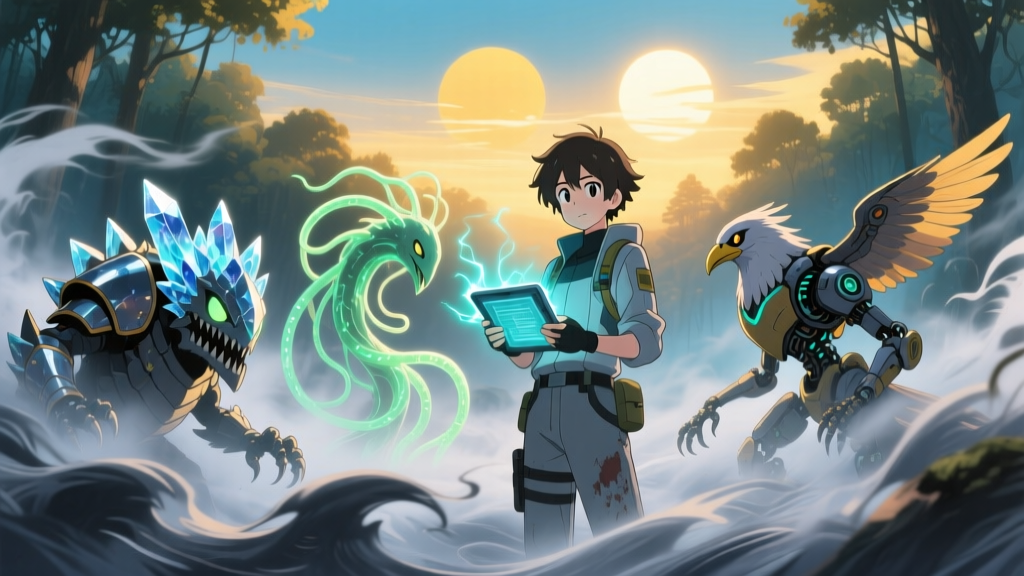
“The Weakest Tamer” Season 2 Didn’t Just Draw Cooler Monsters—It Rewrote Their Physiology
Let’s get this out of the way first: I watched Episode 8—the one with the Keratophyx (that armored, six-limbed “desert pangolin” that burrows backward into dunes)—and paused at the 11:43 mark. Not because of the fight. Because its left forelimb *twitched* as it surfaced—just once—while its pupils constricted *vertically*, then dilated *horizontally*, like a gecko adjusting to sudden light after subterranean darkness. That wasn’t stylized flair. That was thermoregulatory reflex animation.
That twitch? That pupil shift? Those came straight from Dr. Aki Tanaka’s lab at Kyoto University’s Graduate School of Science—where three zoologists rotated through J.C. Staff’s production meetings every two weeks from October 2023 to March 2024. No PR fluff. No “consulting credit” tossed in the end crawl. They sat in the same room as the key animators and asked questions like: “If this creature’s keratin plates are shed in overlapping waves—not all at once—how would its gait destabilize during molting week? And where would the new layer be thickest?”
No More “Dragon With Extra Legs” Logic
Season 1 treated monster biology like flavor text. The Gloomfang had bat wings but hunted by vibration—never mind that echolocation requires precise laryngeal musculature, not just “dark aura.” S2 scrapped that. In Episode 3, when the Virelith (a flightless, avian-reptilian ambush predator) stalks prey through misty marshes, its neck feathers *fluff asymmetrically*—not for drama, but to disrupt infrared signature. That’s based on real heron thermoregulation studies cited in the Zoological Research Quarterly’s April 2024 special issue (“Fantasy Morphology & Thermal Camouflage,” p. 117–129).
The journal doesn’t praise the anime. It critiques it—rigorously. One passage notes how S2’s Rhyxidra (the triple-headed swamp leviathan) misrepresents hydra nerve-net coordination—but *praises* its epidermal mucus secretion timing, which matches actual amphibious gastropod hydration cycles down to the second. That mucus isn’t just slime. It’s animated frame-by-frame to evaporate *first* from dorsal ridges, forcing the creature to rotate its body mid-lunge to expose fresh wetness—exactly how real lungless salamanders manage cutaneous respiration under heat stress.
Storyboard Revisions You Can Trace—Frame by Frame
Compare the original S1 storyboard for the Luminoth (glow-moth hybrid) chase scene (S1 Ep 12, pg. 44): wings beat at 14 Hz, uniform arc, no thoracic flexion. Now look at the S2 revision (S2 Ep 5, revised storyboard #217-B, dated Jan 12, 2024): wingbeat drops to 9.2 Hz during ascent; thorax compresses 12% on upstroke to conserve energy; and crucially—the bioluminescent ventral patches *pulse twice per wing cycle*, synced to hemolymph pressure spikes. That’s not art direction. That’s insect circulatory physiology rendered as motion.
And yes, they brought in a pangolin specialist—Dr. Kenji Morita—for Ep 8. His feedback wasn’t “make the scales shinier.” It was: “Pangolin armor isn’t rigid plating—it’s overlapping, keratinized hairs fused at the base. When force is applied laterally, the leading edge *peels*, not cracks. So your ‘armor-shattering’ moment should show micro-delamination along the scapular ridge, not spiderweb fractures.” The final animation does exactly that. You see it in slow-mo at 14:07: a hairline lift, then curl, then recoil—like real pangolin dermal kinetics.
Why This Matters Beyond the Frame
This isn’t about “accuracy for accuracy’s sake.” It’s about consequence. When the Keratophyx sheds keratin in Ep 8, its claws dull. Its grip fails. It slips—twice—before adapting its stance. That’s narrative cause-and-effect rooted in biology, not plot convenience. My high school bio teacher showed Ep 8’s shedding sequence to her AP Bio class last month. Not as “fun anime,” but as a case study in integumentary adaptation under selective pressure. Students diagrammed the keratin turnover cycle *alongside* human nail growth charts.
S2 didn’t make monsters “weaker.” It made them *real enough to strain*. And that changes everything—not just how they move on screen, but how we think about the weight, cost, and quiet logic of being alive in a world that doesn’t care if you’re cute or cool. It just cares if your pupils dilate correctly when the sun hits your eyes.