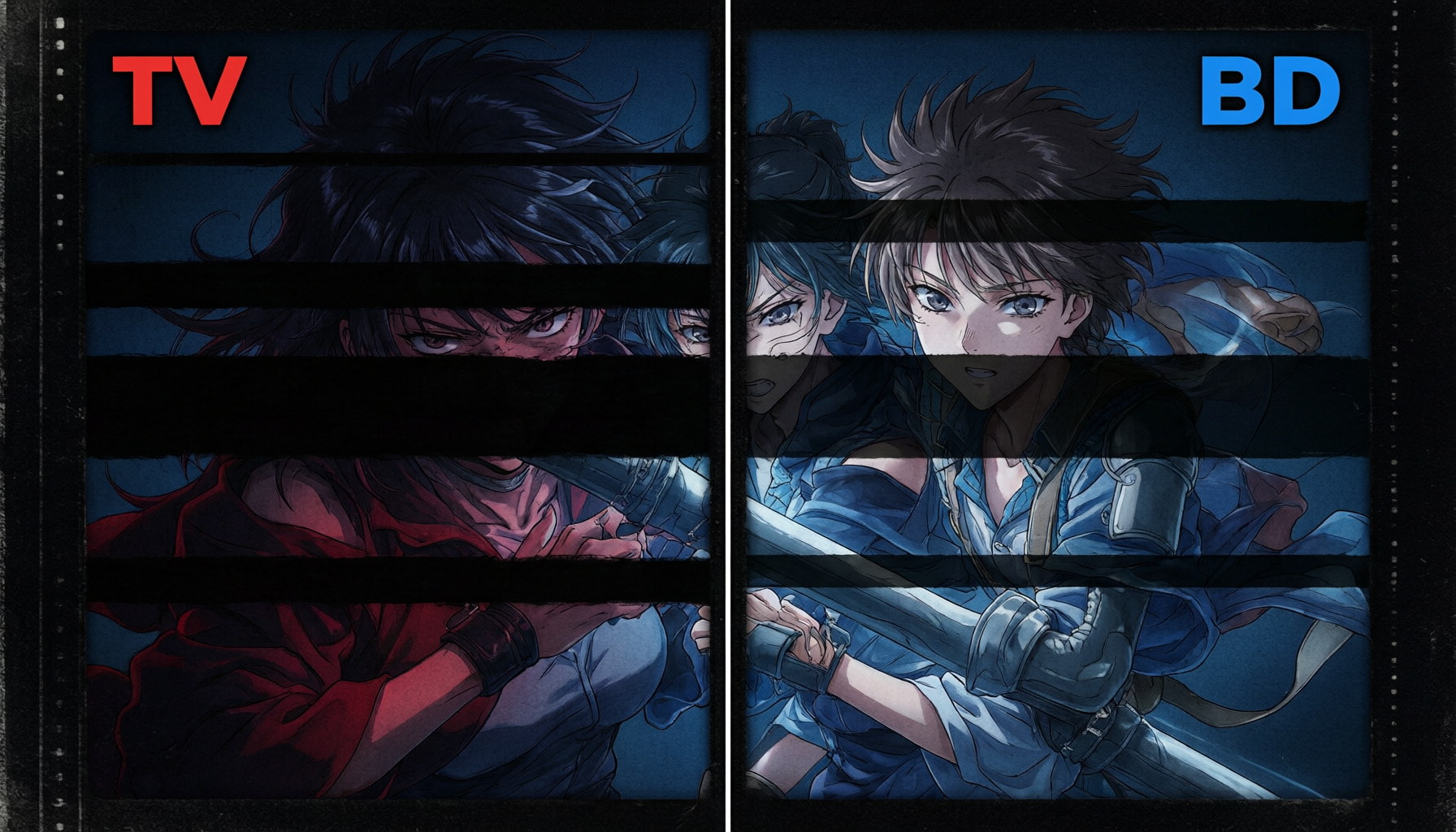
You sat through the entire broadcast season. You thought you saw everything. You were wrong. The anime industry has a long, chaotic history of quietly altering scenes between the TV broadcast and the Blu-ray/DVD release. Sometimes it's extra animation polish. Sometimes it's a full scene the censors refused to air. And sometimes... it's an entire ending that got swapped out because the manga author had a last-minute change of heart.
Below, we break down 10 of the most fascinating BD vs TV anime differences ever recorded, complete with censorship ratings, context, and just enough outrage to make your next anime forum debate very spicy.
The Cut Room Floor
1. High School DxD
Censorship Level: ModerateWhat Changed: The TV broadcast of DxD's later seasons infamously scaled back several fight sequences and "power-up" scenes that the light novels depicted in far more... detail. The BD version restored extended transformation sequences, added new animation cuts during Issei's critical moments, and re-animated several scenes where the TV version had relied on awkward cropping and conveniently placed light beams.
The real crime wasn't the censorship. It was the PowerPoint-style still frames they used during what should have been epic battles. The BD at least gave us moving animation. Small mercies.
2. Kill la Kill
Censorship Level: HighWhat Changed: Trigger's masterpiece of fabric-based warfare had several scenes altered for broadcast, particularly around the Kamui transformation sequences. The BD release restored full, uncut animation to Ryuko and Satsuki's outfit changes, added new in-between frames to fight scenes in episodes 3 and 15, and most notably included the infamous Episode 25 OVA, which was never part of the original broadcast run at all.
An entire episode just... appeared on the disc. Imagine finishing a show, buying the Blu-ray months later, and finding out there was a whole bonus chapter. That's the Trigger way.
3. Berserk (2016)
Censorship Level: Low (but Quality Level: Contested)What Changed: Berserk 2016's TV broadcast became the poster child for "please stop using that CGI." The BD version attempted damage control by smoothing out some of the most jarring 3D model animations, improving texture work on character faces, and re-rendering several crowd scenes that had become internet memes for how uncanny they looked. The overall art direction remained identical, but the BD at least tried to make Guts' armor look less like a PS2-era video game render.
Could you fix the sound design too? That iconic CLANG deserved better. The BD did not, in fact, fix the CLANG. Some wounds run too deep.
4. Tokyo Ghoul
Censorship Level: Extreme (Structural Rewrite)What Changed: This is less about censored scenes and more about an entirely different narrative trajectory. Studio Pierrot's anime adaptation of Tokyo Ghoul deviated so heavily from the manga in its later seasons that the BD couldn't simply "uncensor" things. The BD did restore some gore that was blurred or dimmed during broadcast, and added extra keyframe animation to select fight scenes, but the fundamental story changes, including the compressed Jack arc and the Root A divergence, remained intact. Fans still haven't forgiven the ending situation.
The real "deleted scene" was the entire second half of the manga that the anime pretended didn't exist until :re reluctantly adapted it. Buy the manga. Just buy the manga.
5. Attack on Titan
Censorship Level: HighWhat Changed: Attack on Titan's TV broadcast in Japan dealt with some of the most aggressive gore censorship in modern anime history. The BD releases restored extensive blood and dismemberment detail that broadcast standards had sanitized. Titans losing limbs on TV got the "convenient shadow" treatment; on BD, you saw every sinew. The Female Titan chase sequence in Season 1, the Beast Titan battle in Season 3, and the Rumbling sequences in the Final Season all received substantial restoration work that made the action feel genuinely more impactful.
Wit Studio and MAPPA both poured insane effort into these scenes. Watching the TV version after seeing the BD is like watching a movie trailer with all the good parts cut out.
6. One-Punch Man (Season 2 vs Season 1)
Censorship Level: Not Censorship, Just... DifferentWhat Changed: The elephant in the room. When J.C. Staff took over from Madhouse for Season 2, the animation quality drop was immediate and widely documented. The BD release of Season 2 did include re-animated scenes, improved compositing, and cleaner linework compared to the TV broadcast, but it couldn't fully bridge the gap between what Madhouse delivered in Season 1 and what J.C. Staff produced. The BD made S2 better than its TV version. It did not make it S1.
Season 1 had scenes so well-animated they belong in a museum. Season 2 BD had scenes that belonged on a TV. There is a difference. A painful difference.
7. Neon Genesis Evangelion (Director's Cuts)
Censorship Level: Director's Vision OverrideWhat Changed: Hideaki Anno didn't just tweak Evangelion for the home video release. He fundamentally reworked episodes 21 through 24, adding entirely new scenes, re-editing existing footage, inserting new character interactions, and reshaping the narrative in ways that altered how audiences understood the story. These "Director's Cut" versions became the definitive Evangelion experience and directly set up End of Evangelion. If you only watched the TV broadcast, you watched a different show.
Anno essentially looked at his own finished anime and said, "Yeah, that's not what I meant." Maximum respect. Maximum confusion for first-time viewers.
8. Fairy Tail
Censorship Level: ModerateWhat Changed: Fairy Tail's TV broadcast regularly trimmed or softened fan-service scenes involving Juvia, Lucy, and other characters. The BD releases restored these sequences, including extended bathhouse conversations, more complete transformation scenes during the Grand Magic Games arc, and several comedic bits that were cut for time during broadcast. The BD also fixed some of the more egregious animation inconsistencies in the later arcs where characters would occasionally change proportions between cuts.
Juvia's screen time got a significant boost on BD. Gray's fanbase was pleased. The internet, predictably, had thoughts.
9. Prison School
Censorship Level: Very HighWhat Changed: Prison School's BD release was essentially the "real" version of the show. The TV broadcast had blurred, cropped, or outright removed several scenes that the manga presented unfiltered. The BD restored all of this content, including extended underground student council sequences, complete punishment game scenes, and additional comedic moments that made the show's particular brand of absurdity fully land. Several episodes felt like they had a different runtime on BD because so much material was added back in.
The TV version of Prison School was a comedy with the punchlines removed. The BD version was the comedy the manga readers had been waiting for. Night and day.
10. My Hero Academia
Censorship Level: Low to ModerateWhat Changed: My Hero Academia's BD releases have consistently polished animation quality, but the most talked-about changes involve Bakugo. Several scenes featuring Bakugo's more aggressive moments were slightly toned down during TV broadcast, with the BD restoring sharper explosion effects, more intense facial expressions, and in some cases, additional dialogue lines that made his character arc hit harder. The Kamino Ward battle and the later war arc battles received the most significant BD upgrades, with added keyframes and enhanced impact frames.
Bakugo was already intense on TV. The BD made him look like he was about to explode out of the screen. Appropriately on-brand, really.
Quick Reference Summary
| Anime | Key BD Change | Censorship | Worth Buying? |
|---|---|---|---|
| High School DxD | Restored fight scenes & transformations | Moderate | Yes |
| Kill la Kill | Full uncensored scenes + bonus OVA episode | High | Absolutely |
| Berserk (2016) | Improved CGI textures & re-rendered scenes | Low | Maybe |
| Tokyo Ghoul | Restored gore; story issues remain unchanged | Extreme | Read the manga |
| Attack on Titan | Massive gore restoration across all seasons | High | Must-own |
| One-Punch Man S2 | Polished animation; still not S1 quality | N/A | For fans only |
| Evangelion | Entire episodes reworked (Director's Cut) | Override | Essential |
| Fairy Tail | Restored fan-service & fixed proportions | Moderate | Yes |
| Prison School | Massive content restoration; near-complete show | Very High | Absolutely |
| My Hero Academia | Enhanced Bakugo scenes & impact frames | Low-Mod | Yes |
Final Thoughts
The BD vs TV gap in anime is one of those industry quirks that simultaneously frustrates and fascinates fans. On one hand, it feels unfair that the "real" version of a show is locked behind a paywall. On the other hand, the BD versions often represent what the creators actually wanted you to see, unfiltered by broadcast time slots and content rating boards. Whether you're a collector, a rewatcher, or someone who just wants to see what the censors were so afraid of, the Blu-ray shelf is where the truth lives.
Pro tip: Always check if a BD release exists before declaring a show "mid." You might be watching the director's rough draft.
Know someone who only watched the TV version?
Save them from their ignorance. Share this article.