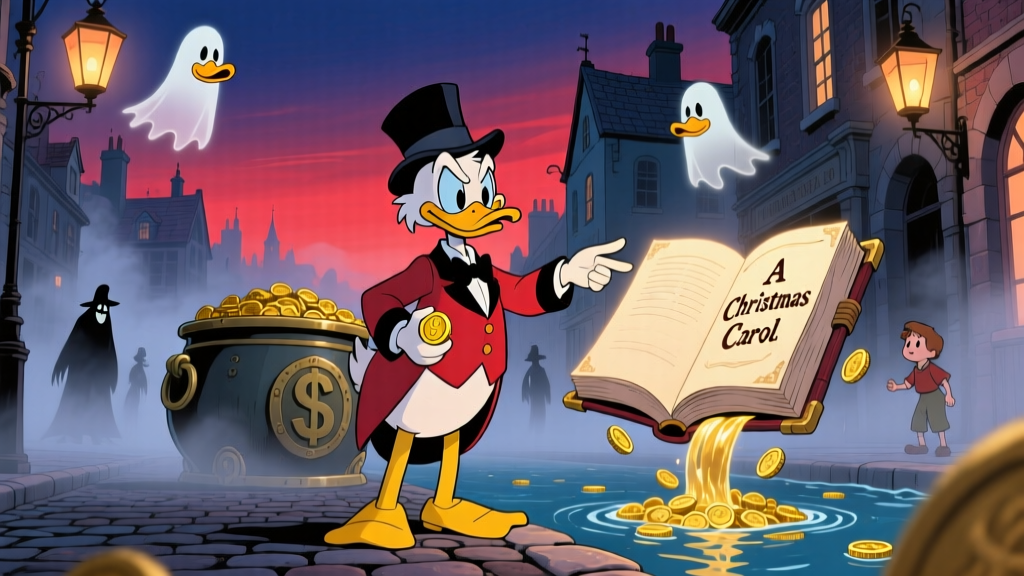
On a cold December night in 1951, a cartoonist named Carl Barks sat in a theater in Beaumont, California, watching Alastair Sim hobble across the screen as Ebenezer Scrooge. The film was Brian Desmond Hurst's adaptation of A Christmas Carol, and it left Barks with an idea that would reshape Disney comics for the next seven decades. Before the credits finished rolling, he had already begun sketching a duck. Not just any duck — a wealthy, cantankerous, top-hat-wearing waterfowl who would inherit Scrooge's name, his money obsession, and, crucially, his capacity for redemption.
That duck became Scrooge McDuck, and the Christmas Carol connection runs far deeper than a borrowed surname. From his very first appearance in a holiday story to animated specials that retold Dickens' plot panel for panel, Scrooge McDuck has served as one of the most sustained and inventive explorations of the Christmas Carol archetype in American popular culture. This is the story of that connection — the literary roots, the comic panels, the celluloid frames, and the die-cast collectibles sitting on shelves right now.
❦ ❧The Night Carl Barks Met Ebenezer Scrooge
Carl Barks had been drawing Donald Duck stories for Dell Comics since 1943, and by the late 1940s he was growing restless with Donald's one-note temper. He needed a foil — someone who could pull Donald into adventures against his will, someone with resources, ambition, and a worldview that clashed with Donald's laid-back incompetence. The character Barks imagined was Donald's uncle: impossibly rich, emotionally guarded, and haunted by a long and complicated past.
The 1951 film Scrooge (the British release title; it appeared as A Christmas Carol in the United States) gave Barks the personality template he needed. Alastair Sim's portrayal was notable for its psychological depth — this was not a cartoon villain but a wounded man whose cruelty masked genuine grief. Barks later told interviewer Donald Ault in 1974 that Sim's performance "showed me that a miser could be sympathetic, that you could laugh at him and feel for him at the same time." That duality became the foundation of Scrooge McDuck.
Barks was not the only Disney artist drawing inspiration from Dickens during this period. The studio itself had produced an animated short, Mickey's Good Deed (1932), with clear Carol overtones. But Barks was doing something different: he was building a permanent character whose entire identity was filtered through a Dickensian lens. The name was direct — no subtle homage or clever wordplay. Scrooge McDuck was Ebenezer Scrooge, reimagined as a Scottish-descended American tycoon who swam in his own money.
The first appearance matters: Scrooge McDuck debuted in Christmas on Bear Mountain, published in Dell's Four Color Comics #178, cover-dated December 1947. His very first story was a Christmas story — and the plot revolved around Donald trying to convince his reclusive uncle to join the family for the holidays. Sound familiar?
The Parallels Are Not Accidental
Strip away the feathers and the beak, and the structural parallels between Scrooge McDuck and Ebenezer Scrooge are striking enough to fill a literary comparison essay. Both characters organize their lives around the accumulation and protection of wealth. Both live alone, isolated by choice from family and community. Both carry the scars of a formative past that the reader discovers gradually, in fragments. And both, when confronted with the right circumstances, reveal a capacity for generosity that surprises everyone — including themselves.
The Counting House and the Money Bin
Ebenezer Scrooge conducts his business from a counting house in London's financial district, surrounded by ledgers and iron safes. Scrooge McDuck's equivalent is the Money Bin — a massive cubic fortress sitting atop Killmotor Hill in Duckburg, containing precisely three cubic acres of cash. The Bin first appeared in Barks' comics in 1951 and has since become one of the most recognizable fictional buildings in comics. Like Scrooge's counting house, the Money Bin is both a symbol of wealth and a prison of solitude. Scrooge McDuck literally swims and dives in his money, a physical intimacy with cash that mirrors Ebenezer's habit of keeping the door to his chambers always within reach.
The Nephew Dynamic
Ebenezer Scrooge's nephew Fred serves as the persistent voice of warmth and invitation — the one person who refuses to let his uncle's bitterness go unanswered. Every Christmas, Fred extends a dinner invitation; every Christmas, Scrooge refuses. In the McDuck universe, this role is split between Donald Duck and the triplets Huey, Dewey, and Louie. Donald is the reluctant nephew, often dragged into his uncle's schemes. But it is the triplets — curious, resourceful, and morally grounded — who function as Scrooge's real conscience. They challenge him, argue with him, and occasionally save him from his own worst instincts.
The Ghost of Christmas Past
Dickens' Ghost of Christmas Past shows Scrooge the scenes that shaped him: a lonely schoolboy, a lost love, a sister's kindness. Carl Barks and later Don Rosa gave Scrooge McDuck an equally detailed backstory, though through serialized storytelling rather than spectral visitation. Don Rosa's 12-part saga The Life and Times of Scrooge McDuck (1992–1994) traced the character from a shoeshine boy in 1877 Glasgow to the richest duck in the world. Like Dickens' sequence of ghosts, Rosa's chapters reveal how ambition hardened into isolation, and how love was sacrificed on the altar of profit. The 1995 sequel chapter "The Dream of a Lifetime" even gave Scrooge a supernatural reunion with his past — a direct nod to the dreamlike structure of Dickens' novella.
| Trait | Ebenezer Scrooge (Dickens, 1843) | Scrooge McDuck (Barks, 1947) |
|---|---|---|
| Defining obsession | Money, financial ledgers, debt collection | Money Bin, Number One Dime, global treasure hunting |
| Origin of wealth | Inheritance from Jacob Marley's partnership, money-lending | Klondike Gold Rush, shrewd business expansion, sheer willpower |
| Family relationships | Estranged from nephew Fred; deceased sister Fan | Estranged from Donald and triplets; deceased parents Fergus and Downy; sisters Matilda and Hortense |
| Transformation trigger | Three Christmas spirits in a single night | Gradual softening through repeated adventures with family |
| Redemption arc | Complete, sudden reversal within the story | Ongoing tension — generous in one story, miserly in the next |
| Signature phrase | "Bah! Humbug!" | "Curse me kilts!" / "Smarter than the smarties, tougher than the toughies!" |
| Setting | London, England, 1840s | Duckburg, Calisota (fictional US state), mid-20th century |
The table above shows something interesting: while the surface parallels are strong, the key difference is in the pacing of redemption. Ebenezer Scrooge changes in a single night. Scrooge McDuck changes across hundreds of stories over decades, sometimes slipping backward. This serialized structure makes him, in some ways, a more realistic character — real people don't transform overnight, even after a visit from three ghosts.
❦ ❧The Christmas Stories That Defined a Duck
If there is one thing Carl Barks understood, it was that Christmas stories reveal character. The holiday setting strips away the noise of everyday plots and forces characters to confront what they actually value. Several Uncle Scrooge stories use this framework to devastating effect.
Christmas on Bear Mountain (1947)
The debut. Donald and the triplets are invited to Scrooge's mountain lodge for Christmas, but Scrooge has secretly planned to test their courage by releasing a bear. The story is rough around the edges — Barks was still figuring out the character's design and voice — but the core dynamic is already in place: a lonely old miser who would rather test people than trust them, and a family that shows up anyway. The story appeared in Four Color Comics #178 and sold well enough for Dell to request a follow-up within months.
A Christmas for Shacktown (1952)
This is the one. If you read only a single Uncle Scrooge story in your life, make it this one. Published in Uncle Scrooge #4 (Four Color #418), the plot follows the triplets' attempt to raise money for a Christmas celebration in Shacktown, the poorest neighborhood in Duckburg. Scrooge initially scoffs at the entire enterprise, then gradually becomes drawn in — not through supernatural intervention, but through the sheer stubborn decency of his nephews. The climax involves Scrooge matching a charitable donation dollar for dollar, and the final panel shows him smiling — genuinely smiling — as he watches the Shacktown children celebrate.
Barks biographer Ken Sample called it "the purest expression of the Dickensian spirit in comic book form" (Carl Barks: Conversations, University Press of Mississippi, 2003). The story has been reprinted at least 14 times across multiple countries and remains the gold standard for Scrooge McDuck Christmas narratives.
Last Sled to Dawson (1953) and Other Holiday Adjacent Stories
While not strictly a Christmas story, Barks' "Last Sled to Dawson" deepens the Christmas Carol connection by exploring Scrooge's Klondike past — the equivalent of Dickens' Ghost of Christmas Past sequence. Scrooge's lost love, Goldie O'Gilt, appears here for the first time: a saloon singer who represents the road not taken, the warmth that was traded for gold. Don Rosa would later expand this relationship across multiple chapters of The Life and Times of Scrooge McDuck, turning Goldie into the Belle of Dickens' story — the woman who loved Scrooge before money consumed him.
The Italian Christmas Tradition
Italian Disney comics, produced by Mondadori and later Disney Italia, have maintained a rich tradition of Scrooge McDuck Christmas stories since the 1960s. Artists like Romano Scarpa and Giorgio Cavazzano produced holiday specials that are largely unknown to English-speaking audiences but remain beloved in Europe. Scarpa's 1960 story Zio Paperone e il Natale malinconico ("Uncle Scrooge and the Melancholy Christmas") directly adapted the Christmas Carol structure, complete with dreamlike visions of Scrooge's past.
"Scrooge McDuck works as a Christmas character precisely because he is not a villain. He is a man who made a series of calculated choices, and the holidays force him to reckon with the cost of those choices. That is the engine of every Christmas Carol retelling, and Barks understood it instinctively." — Gary Groth, Barks Conversations, Fantagraphics Books, 2003
Animated Adaptations: Scrooge McDuck on Screen at Christmas
The leap from comic panels to animation brought Scrooge McDuck's Christmas Carol connection to its most visible expression. Three productions stand out as essential viewing for anyone interested in the intersection of Dickens and Disney.
Mickey's Christmas Carol (1983)
This 26-minute featurette is where the circle closes completely. Directed by Burny Mattinson, the short casts Scrooge McDuck as Ebenezer Scrooge — not a parody, not an homage, but a direct performance of the Dickens role. Mickey Mouse plays Bob Cratchit, Goofy is Jacob Marley's ghost, Jiminy Cricket is the Ghost of Christmas Past, Willie the Giant is the Ghost of Christmas Present, and Pete is the Ghost of Christmas Yet to Come. The short was the first Disney theatrical cartoon released in 30 years (since The Simple Things in 1953) and was nominated for an Academy Award for Best Animated Short Film.
What makes Mickey's Christmas Carol remarkable is its fidelity to the source material. While adapted for a family audience and compressed to 26 minutes, the film hits every major beat of Dickens' plot: Scrooge's dismissal of charity collectors, the visit from Marley's ghost, the three spectral journeys through past, present, and future, and the final morning of redemption. Alan Young, who voiced Scrooge McDuck, delivered a performance that captured both the character's cantankerous exterior and his buried vulnerability. Young had been voicing Scrooge since the 1974 Disneyland Records album An Adaptation of Dickens' Christmas Carol, and his reading of "Bah, humbug!" carried the weight of decades of character work.
The short grossed approximately $20 million at the domestic box office when paired with the re-release of The Rescuers, proving that Scrooge McDuck's Dickensian roots had genuine commercial appeal beyond the comics audience.
DuckTales: "Last Christmas" and Holiday Episodes (1987–1990, 2017–2021)
The original DuckTales series (1987–1990) rarely centered on Christmas, but the show's treatment of Scrooge's character — his Scottish heritage, his complicated relationship with wealth, his gruff tenderness toward his grandnephews — reinforced the Dickensian framework in every episode. When the reboot series (2017–2021) tackled holiday themes in its episode "Last Christmas," it drew directly on the Christmas Carol tradition, giving Scrooge a bittersweet memory-lane adventure that echoed Dickens' structure of past, present, and future.
The 2017 reboot's voice actor David Tennant brought a different energy to Scrooge — less curmudgeonly, more adventurous — but the Christmas episodes consistently returned to the character's core conflict: the tension between wealth and connection, between the Money Bin and the family dinner table.
Mickey's Twice Upon a Christmas (2004)
This CGI-animated direct-to-video feature included a segment called "Mickey's Dog-Gone Christmas," in which Scrooge McDuck again plays a Scrooge-like role. The production quality was uneven and the Dickensian fidelity looser than the 1983 short, but the decision to return Scrooge to a Christmas Carol narrative — more than 20 years after Mickey's Christmas Carol — demonstrates how firmly the association had been established in Disney's corporate consciousness.
❦ ❧Collectibles: The Christmas Carol Scrooge You Can Hold
The Dickens-Scrooge McDuck connection has generated a surprisingly rich collectibles market. For collectors interested in the Christmas Carol intersection specifically, here are the categories worth tracking.
Comic Book Key Issues
- Four Color Comics #178 (1947) — First appearance of Scrooge McDuck in "Christmas on Bear Mountain." CGC-graded copies in VF/NM condition have sold for $5,000–$15,000 at Heritage Auctions. This is the holy grail for Scrooge collectors.
- Uncle Scrooge #4 (1953) — Contains "A Christmas for Shacktown." CGC 9.0+ copies typically sell in the $400–$1,200 range.
- Uncle Scrooge #456 (2017) — IDW reprint series with Don Rosa covers. Affordable entry point ($8–$25 in NM) for collectors who want the Rosa-era Christmas stories in modern print.
Figurines and Statues
- Disney Showcase "Mickey's Christmas Carol" Collection (2018–present) — Ceramic figurines depicting Scrooge McDuck as Ebenezer Scrooge, complete with top hat, cane, and nightcap. Individual pieces retail at $25–$65; full sets can reach $200+.
- Jim Shore Disney Traditions "Scrooge McDuck" — Hand-painted resin statue in a Dickensian pose, approximately 8 inches tall. Retail price around $55–$75. Jim Shore's folk-art style gives the figure a distinctly Victorian feel.
- Kotobukiya DuckTales ARTFX+ Statue — Japanese manufacturer's take on the 2017 reboot design. Not specifically Christmas-themed, but high-quality sculpt work at $80–$120.
Ornaments and Holiday Decor
Disney releases annual Christmas ornaments featuring Scrooge McDuck, often in Dickensian costume. The Disney Store's "Scrooge McDuck as Ebenezer Scrooge" ornament (released in various versions from 2010 onward) remains popular, with retired editions trading at $30–$80 on secondary markets. Hallmark has also produced licensed Scrooge McDuck Keepsake Ornaments, with the 2019 edition specifically referencing the Mickey's Christmas Carol design.
Vinyl and Soundtrack Collectibles
The original 1974 Disneyland Records album An Adaptation of Dickens' Christmas Carol, Performed by the Walt Disney Players featured Alan Young's debut as Scrooge McDuck's voice. Vinyl copies in good condition sell for $15–$40 on Discogs. The album was essentially a dry run for the 1983 animated short and is notable for its full-cast audio dramatization of the Dickens story with Disney characters.
"The reason Scrooge McDuck collectibles hold value so well is that the character bridges two audiences: Disney collectors and comics collectors. The Christmas Carol connection adds a third audience — people who collect Dickens adaptations across all media." — Robert Overstreet, The Official Overstreet Comic Book Price Guide, 52nd Edition (2022)
The Enduring Architecture of a Christmas Story
There is a reason the Christmas Carol template has been applied to more characters than perhaps any other story in English literature. The Muppets did it. Bill Murray did it. The Flintstones did it. But Scrooge McDuck is unusual in that the character was built from the Christmas Carol framework rather than simply wearing it for a single episode. From his name to his personality to his ongoing tension between greed and love, Scrooge McDuck is a Christmas Carol character who happens to live year-round.
Carl Barks died in 2000 at the age of 99, having drawn approximately 500 Uncle Scrooge stories. When asked in a 1996 interview with The Comics Journal whether he had consciously modeled Scrooge McDuck on Dickens' creation, Barks gave a characteristically plainspoken answer: "I didn't sit down and say, 'I'm going to do a Christmas Carol character.' I went to see a movie, liked the old grouch, and gave him a bill for a beak." The laughter in the recorded interview is audible.
But the evidence tells a different story. The Christmas debut, the miser's heart softening around family, the repeated returns to holiday themes, the careful layering of a backstory that explains how a person becomes hardened — these are the choices of a storyteller who understood Dickens' architecture at a structural level. Barks may not have set out to create a Christmas Carol character. He created something more durable: a character who carries the Christmas Carol inside him, every month of the year.
And every December, when the Money Bin gets a wreath on its three-foot-thick steel door and Huey, Dewey, and Louie drag their great-uncle to a holiday dinner he pretends to resent, the old story plays out again. The ghosts change, the setting changes, the medium changes. But the miser who learns — slowly, grudgingly, repeatedly — that people matter more than money? That story never gets old.
❦ ❧Questions Readers Frequently Ask
Was Scrooge McDuck actually named after Ebenezer Scrooge?
Yes, directly. Carl Barks chose the name "Scrooge" from Dickens' A Christmas Carol when creating the character for "Christmas on Bear Mountain" in 1947. Barks confirmed this in multiple interviews, including a 1974 conversation with Donald Ault and a 1996 interview published in The Comics Journal. The surname "McDuck" was Barks' own addition, reflecting the character's Scottish heritage.
Which Scrooge McDuck Christmas story should I read first?
Start with A Christmas for Shacktown (Uncle Scrooge #4, 1952). It is widely considered the finest Uncle Scrooge story Barks ever wrote, and it captures the Christmas Carol spirit without being a direct adaptation. The story is available in the Fantagraphics Carl Barks Library reprint series and in various anthology collections. For the direct Dickens adaptation, watch Mickey's Christmas Carol (1983).
Did Scrooge McDuck play Ebenezer Scrooge in Mickey's Christmas Carol?
Yes. In the 1983 animated short Mickey's Christmas Carol, Scrooge McDuck is cast directly as Ebenezer Scrooge. The character essentially plays himself in the Dickens role — the miser who is visited by three Christmas spirits and reformed. It was the character's first theatrical appearance and remains the most direct on-screen adaptation of the Dickens-McDuck connection.
How much is a first appearance of Scrooge McDuck worth?
A copy of Four Color Comics #178 (December 1947), containing "Christmas on Bear Mountain," can range from around $500 for a low-grade reading copy to over $15,000 for a CGC-graded copy in VF/NM (9.0+) condition. Heritage Auctions has recorded multiple sales in the $5,000–$10,000 range for mid-grade copies. Prices have been trending upward as the character's cultural profile continues to grow, particularly following the 2017 DuckTales reboot.
Is Don Rosa's "Life and Times of Scrooge McDuck" connected to A Christmas Carol?
Structurally, yes. Rosa's 12-part series (1992–1994) functions as a "Ghost of Christmas Past" sequence stretched across years of serialized storytelling. It traces Scrooge's life from a Glasgow shoeshine boy to the richest duck alive, showing the moments where ambition overtook human connection. The chapter "The Empire-Builder from Calisota" depicts Scrooge's emotional isolation at the height of his wealth, paralleling the scenes Dickens wrote of Ebenezer Scrooge's lonely chambers. Rosa won the Eisner Award for Best Serialized Story in 1995 for this work.
Are there Christmas Carol Scrooge McDuck collectibles still being produced?
Yes. Disney continues to produce Scrooge McDuck holiday merchandise through the Disney Store, ShopDisney, and licensed partners. The Disney Showcase "Mickey's Christmas Carol" figurine line has been active since 2018. Jim Shore's Disney Traditions line periodically releases new Scrooge McDuck pieces. Annual Christmas ornaments featuring Scrooge in Dickensian attire appear most holiday seasons. For secondary-market pieces, check eBay, Mercari, and dedicated Disney collector forums.
❦ ❧God bless us, every one — even the ducks.