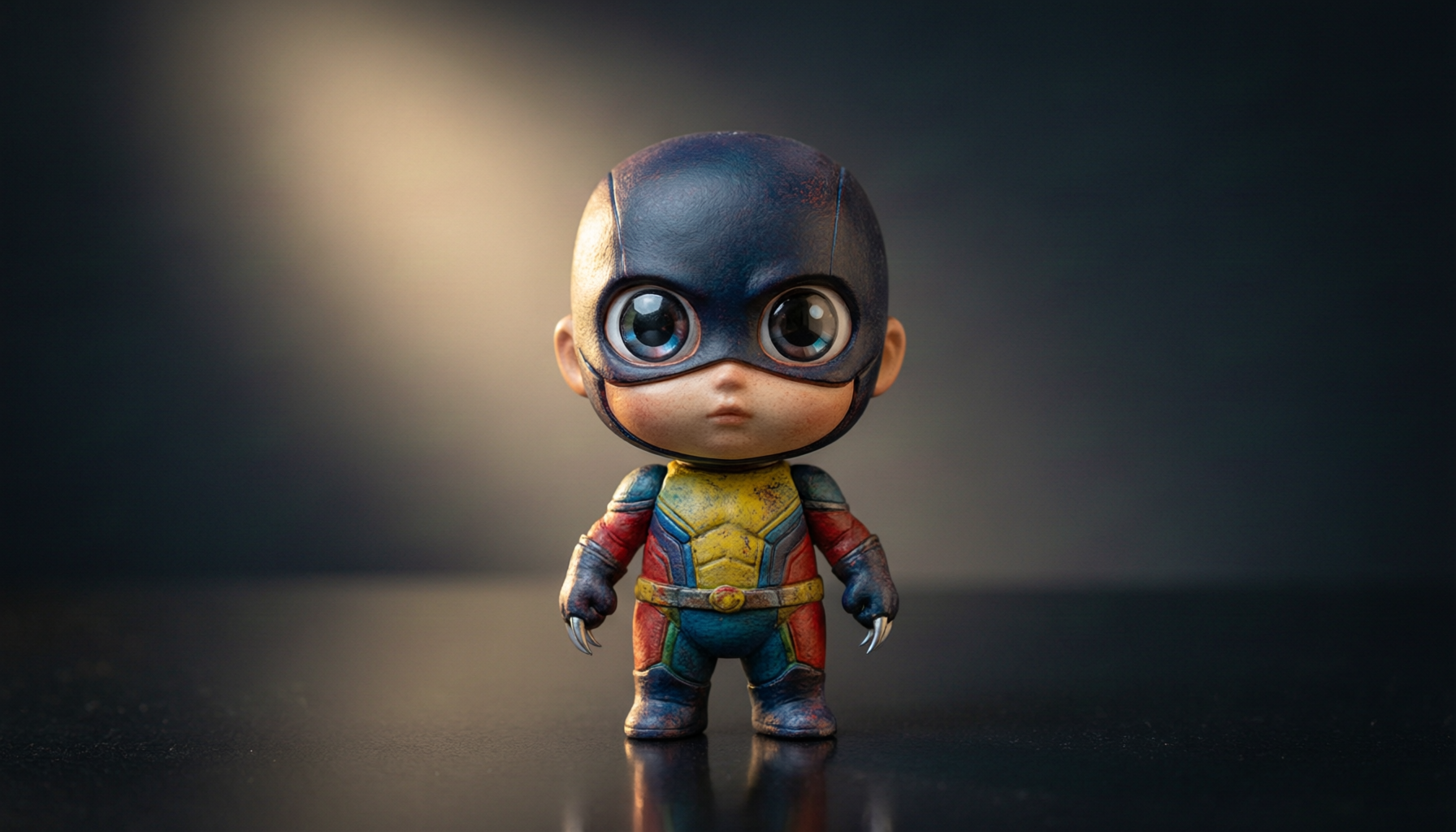
Picture this: Wolverine, the most ferocious mutant to ever unsheathe adamantium claws, rendered as a pudgy-cheeked toddler with oversized eyes and a tiny yellow cowl barely covering his head. He looks like he should be clutching a juice box instead of threatening to shred anyone who gets too close. That image — absurd, endearing, and unmistakably Wolverine — is the work of Skottie Young, and it has been quietly reshaping the economics of modern comic book collecting for over a decade.
If you have ever walked into a comic shop and noticed a wall of variant covers priced well above the standard edition, chances are a significant chunk of those featured Skottie Young's art. His baby variants — stylized reinterpretations of Marvel's heaviest hitters as impossibly cute infants — became one of the most commercially successful cover programs in the publisher's history. And Wolverine, with his contrast between feral rage and pint-sized charm, has been one of Young's most frequently revisited characters.
A Cartoonist Who Accidentally Broke the Variant Market
Skottie Young was born on March 3, 1978, and spent years working inside Marvel's bullpen as an illustrator and cover artist before something unusual happened. In February 2009, Marvel published a tie-in for the Wizard of Oz adaptation, and Young drew Dorothy and her companions as wide-eyed, round-faced little figures. The style was not quite chibi, not quite traditional superhero fare. It sat somewhere in between — exaggerated proportions with big heads, stubby limbs, and expressions that ranged from mischievous to bewildered.
Readers noticed. More importantly, Marvel's marketing department noticed.
The breakthrough moment came in October 2012 with Red She-Hulk #58, widely recognized as Young's first official Marvel "baby" variant cover. The character appeared as a snarling green infant with Betty Ross's signature attitude crammed into a body about the size of a fire hydrant. It was funny, it was distinctive, and it sold like wildfire. Within months, Marvel had Young churning out baby variants for nearly every number-one issue under the Marvel NOW! banner.
"It's been such a fun twelve years of getting to make people smile. I never thought drawing little versions of these characters would turn into what it became." — Skottie Young, Marvel.com interview (2024)
By 2015, the baby variant program had expanded to over 139 individual covers. Comic shops were ordering them in bulk. Collectors were hunting complete sets. Secondary market prices on key issues climbed steadily. And at the center of it all was a cartoonist who had found a visual language that connected with people who might never crack open a traditional superhero comic.
The Marvel Baby Variant Phenomenon, Explained
Understanding Skottie Young's Wolverine covers requires understanding the broader baby variant ecosystem that Marvel built around him. Here is how the program operated:
- Marvel NOW! Launch (2012–2013): The initiative relaunched dozens of Marvel titles with new number-one issues. Young provided baby variant covers for many of these #1s, including All-New X-Men #1, which featured the original five X-Men — young Cyclops, Jean Grey, Beast, Iceman, and a baby Angel — rendered in his signature style. The cover sold out at the distributor level within days.
- Expansion Phase (2013–2015): Marvel extended the program beyond just number-one issues. Young began drawing baby variants for ongoing series, annuals, event tie-ins, and one-shots. Wolverine appeared repeatedly during this period across multiple titles.
- Peak Saturation (2015–2017): At the height of the program, Marvel was releasing Young variants weekly. The sheer volume meant some covers barely registered on the secondary market, while key character appearances (Spider-Man, Wolverine, Deadpool) held their value consistently.
- Big Marvel Pivot (2024): After twelve years of baby variants, Marvel launched "Big Marvel," a 27-cover summer program that inverted Young's formula — instead of shrinking characters down, he drew them oversized and imposing. Wolverine: Blood Hunt #1 received one of these Big Marvel covers, marking a significant stylistic departure for the character.
The economics were straightforward. A standard cover comic retailed for $3.99 or $4.99. A Skottie Young variant of the same issue might command $15 to $40 on the secondary market within weeks of release, depending on the character and print run. For Wolverine-specific covers, demand stayed strong because the character's fanbase cuts across multiple collector demographics: X-Men loyalists, Weapon X enthusiasts, and variant cover speculators all competed for the same slabs.
Every Wolverine Cover Young Touched (And Why They Matter)
Wolverine occupies a special position in the Skottie Young catalog. The character's design translates surprisingly well to the baby variant format: the yellow cowl, the claw marks, the snarling expression — all of it reads clearly even when compressed into a figure that is four heads tall. Young has tackled Wolverine and Wolverine-adjacent characters across at least seven distinct covers, and each one tells a slightly different story about how the variant market evolved.
All-New X-Men #1 (2012) — The Origin Point
This is where the Wolverine connection started. Brian Michael Bendis's All-New X-Men brought the original five X-Men forward through time, and Young's variant depicted them as toddlers in classic costumes. Baby Wolverine, with his undersized mask and fists already balled up for a fight, was the clear fan favorite. The cover became one of the most sought-after Marvel NOW! variants, with CGC 9.8 copies selling in the $80–$150 range by 2016. Original art from this cover has appeared at auction, with Young's cover art pieces routinely fetching $2,000 or more.
X-Babies #3 — The Nostalgia Play
The X-Babies concept predated Young by decades (the original X-Babies one-shot was published in 1992), but his variant cover for the series gave the concept a fresh coat of paint. Wolverine appeared front and center, claws extended, with an expression somewhere between adorable and homicidal. This cover bridged two generations of X-Men fandom — the readers who remembered the original X-Babies gag and the newer crowd who had discovered the characters through Young's variants.
A-Babies vs. X-Babies #1 (2012) — The Crossover
Marvel pitted the Avengers Babies against the X-Babies in this one-shot, with Young providing the main cover. Wolverine appeared as part of the X-Babies lineup. The concept was pure spectacle — two teams of infant superheroes duking it out — and it sold well enough that Marvel reprinted it with additional Young variants. For collectors, the first printing with the Young cover remains the one to own.
All-New Wolverine Annual #1 (2016) — Laura Kinney Gets the Treatment
This cover was significant because it was not Logan getting the baby treatment — it was Laura Kinney, who had taken up the Wolverine mantle after Logan's (temporary) death. Young's variant depicted baby Laura with her distinctive claw configuration, and it signaled that the baby variant program had enough cultural weight to validate new legacy characters. The CGC 9.8 population for this variant remains relatively low, with copies trading in the $60–$100 range depending on market conditions.
Wolverine: Blood Hunt #1 (2024) — The Big Marvel Shift
Twelve years into drawing baby variants, Young flipped the script. The Big Marvel program asked him to draw characters larger than life, and Wolverine was one of the first characters to receive this treatment. The Wolverine: Blood Hunt #1 cover showed Logan at an exaggerated, hulking scale — a deliberate contrast to over a decade of diminutive portrayals. CGC 9.8 copies of this variant hit the market at $40–$75, with signed editions commanding significantly more. The cover represented something meaningful: Marvel and Young were both aware that the baby variant formula had a shelf life, and the Big Marvel pivot kept things from going stale.
| Issue | Year | Variant Type | Character Featured | Est. NM Value (2024–2025) |
|---|---|---|---|---|
| All-New X-Men #1 | 2012 | Baby Variant | Young Scott Summers / Original Five | $80 – $150 (CGC 9.8) |
| A-Babies vs. X-Babies #1 | 2012 | Baby Variant | X-Babies (incl. Wolverine) | $35 – $60 |
| X-Babies #3 | 2013 | Baby Variant | Wolverine (X-Baby) | $25 – $50 |
| All-New Wolverine Annual #1 | 2016 | Baby Variant | Laura Kinney (Wolverine) | $60 – $100 (CGC 9.8) |
| Amazing X-Men #1 | 2013 | Baby Variant | Wolverine / Team | $30 – $55 |
| Wolverine: Blood Hunt #1 | 2024 | Big Marvel Variant | Logan (Wolverine) | $40 – $75 (CGC 9.8) |
| X-Men Red #1 | 2022 | Baby Variant | Wolverine / Jean Grey | $25 – $45 |
Note: Values reflect approximate market pricing for Near Mint or CGC 9.8 copies as observed across eBay sold listings and GoCollect data from late 2024 through mid-2025. Actual sale prices vary based on condition, slab grade, and market timing.
Decoding the Art Style: What Makes a Skottie Young Cover Instantly Recognizable
You can spot a Skottie Young cover from across a comic shop. The visual formula is deceptively simple, but there is more technical craft underneath than most people realize.
Head-to-body ratio. Young's baby characters typically run between three and four heads tall. Standard comic figures run seven to eight heads. That compressed proportion is the foundation of everything else — it forces every detail of the character's costume and expression into a smaller canvas, which amplifies the visual impact.
Eyes as emotional anchors. The eyes on Young's characters are enormous — often consuming a third of the face. He uses them to carry the character's personality: Wolverine gets narrow, predatory eyes even in baby form; Deadpool gets wide, manic ones; Spider-Man gets the classic oversized white lenses translated into something that looks perpetually startled. The eye work is what separates Young's variants from generic chibi art. There is genuine character acting happening inside those proportions.
Costume fidelity. One reason the variants work as collector items is that Young preserves the essential design elements of each character's costume. Baby Wolverine still has the yellow cowl, the blue bodysuit, the brown gloves, and the three claw marks on each hand. The costume reads as Wolverine first and baby second. This matters because it keeps the cover tied to the character's brand identity rather than reducing it to a novelty.
Line weight and color palette. Young works with relatively clean, bold linework that holds up well at print scale. His colorists typically use bright, saturated palettes — Wolverine covers lean heavily into the character's signature yellow, with metallic silver for the claws and deep reds for accent claw slashes. The result is covers that photograph well for online listings and stand out in a stack of standard issues.
The Non-Baby Work Nobody Talks About
It is worth noting that Young is a capable mainstream comic artist outside the baby variant niche. His interior work on series like New X-Men and various Marvel one-shots shows solid draftsmanship in a more conventional superhero style. The baby variants became so dominant that they overshadowed his broader skill set — a situation Young has acknowledged with good humor in interviews. The Big Marvel program in 2024 was, in part, a deliberate attempt to show range beyond the infant formula.
The Collector Market: Where Skottie Young Wolverine Covers Actually Stand
The variant cover market operates on attention economics. Covers that generate buzz sell. Covers that fade from conversation depreciate. Skottie Young's Wolverine variants have held their ground for a specific set of reasons:
Cross-franchise demand. Wolverine is one of the handful of Marvel characters whose collecting audience extends well beyond traditional comic readers. Action figure collectors, Funko POP hunters, and general pop culture fans all recognize the character. A baby Wolverine variant cover sits at the intersection of multiple collecting communities, which keeps baseline demand steady even when the broader speculator market cools.
Completionist pressure. The baby variant program ran long enough (139+ covers) that completing a full set became a genuine challenge. Collectors who started with Spider-Man or Captain America baby variants eventually needed the Wolverine issues to fill gaps, creating secondary demand from people who might not have been X-Men fans in the first place.
Signed edition premiums. Young is active on the convention circuit and sells signed copies through his Substack and personal website. A CGC 9.8 signed Skottie Young variant typically carries a 30% to 60% premium over an unsigned copy of the same grade. For the Wolverine covers, this can push individual issues well past $100.
Original art scarcity. Young's original cover art pages for Marvel baby variants have appeared at Heritage Auctions and other major houses. Wolverine covers, given the character's profile, tend to land in the $3,000 to $8,000 range at auction, with exceptional pieces reaching higher. These are one-of-one items, and the pool of buyers includes both comic art collectors and general illustration enthusiasts.
Where Prices Have Actually Gone
The baby variant market experienced its sharpest appreciation between 2014 and 2018, when Marvel was actively promoting the program and collector interest was surging. After 2018, as Marvel scaled back the frequency of new Young variants, prices stabilized rather than crashed — a pattern that differs from most modern variant cover programs, which tend to collapse once the publisher stops producing them.
The 2024 Big Marvel program injected fresh interest into the ecosystem. Wolverine: Blood Hunt #1 with the Young Big Marvel variant saw immediate secondary market action, with raw copies moving at $15–$25 and CGC 9.8s holding in the $40–$75 band. Signed copies from convention appearances pushed past $120 in some cases. The key takeaway: Young's Wolverine covers are not speculative bubbles. They are sustained-demand items driven by character loyalty and artistic recognition.
Merchandise Beyond the Page: Prints, Toys, and the Skottie Wolverine Ecosystem
Skottie Young's baby Wolverine has escaped the confines of comic book pages and multiplied across multiple product categories. This is not unusual for popular Marvel characters, but the Young baby variant aesthetic occupies a distinct lane from standard Marvel merchandise.
Art prints and posters. Young regularly sells prints through his personal website and at conventions. Wolverine is consistently one of the top-selling characters in print form. The 2024 Big Marvel poster, featuring 27 variant covers including Wolverine: Blood Hunt, was marketed directly by Marvel and sold through comic shops and online retailers. Individual prints typically run $20–$40; signed and numbered editions go higher.
Collectible figures. While Marvel has not produced a full Skottie Young baby variant action figure line (the licensing would be complex), independent sculptors and 3D printing communities have created fan-made baby Wolverine figures based directly on Young's cover art. These fan pieces circulate on Etsy and at conventions, filling a gap that official merchandise has not fully addressed.
Funko POP! crossovers. The Funko POP! chibi aesthetic shares obvious DNA with Young's baby variants, and collectors frequently pair Skottie Young variant comics with corresponding Funko POP! figures for display. Young has signed Funko POPs at conventions, and signed Wolverine POPs paired with a Young variant cover make for high-impact display pieces in the collector community.
Apparel and accessories. Marvel has licensed Young's variant art for t-shirts, pins, and enamel sets. Baby Wolverine enamel pins, in particular, have become popular convention purchases. These items typically retail for $10–$18 and serve as accessible entry points for fans who want a piece of the Skottie Young aesthetic without spending slab-grade money on a comic.
Why Wolverine Specifically Resonates in Baby Form
Not every Marvel character translates equally well to the baby variant treatment. Iron Man looks like a toy robot. Thor looks like a Renaissance painting cherub. Captain America looks like a toddler in a Halloween costume. But Wolverine — Wolverine works.
The reason is rooted in character contrast. Wolverine is, at his core, a character defined by rage, pain, and an inability to escape his own violent nature. Putting that character into the body of an infant creates cognitive dissonance that is genuinely funny. A baby Wolverine snarling with tiny claws is humorous because we know what lurks underneath the cute exterior. The same logic explains why baby Deadpool works (the gap between chimichanga comedy and actual body horror is enormous) and why baby Thanos became a cultural moment when Young drew him.
There is also a practical design advantage. Wolverine's costume is one of the most recognizable silhouettes in comics. The pointed cowl, the claw marks, the color blocking — all of it reads instantly, even at thumbnail size on an online comic listing. That visual clarity gives Young's Wolverine variants a marketing advantage: they are immediately identifiable in a sea of variant covers, which drives impulse purchases and collector interest.
Young himself has noted in convention panels that Wolverine is one of the most-requested characters for baby variants, and the frequency of Wolverine appearances across his variant catalog reflects that demand. From the original All-New X-Men #1 in 2012 through Wolverine: Blood Hunt #1 in 2024, the character has been a through-line of the entire program.
Questions Collectors Actually Ask
Are Skottie Young baby variants considered key issues?
In the traditional sense, no — baby variants are cover variations, not story-significant issues. But within the variant collecting community, certain Young covers have achieved "modern key" status based on demand, price stability, and character significance. The All-New X-Men #1 baby variant and Wolverine: Blood Hunt #1 Big Marvel variant both hold prices that rival genuine key issues from the same era.
How many total Skottie Young variant covers exist?
The widely cited number is 139 baby variant covers produced between 2012 and approximately 2020, when Marvel began scaling back the program. The 2024 Big Marvel program added 27 more covers in the new oversized style. The total count continues to grow as Marvel commissions new Young variants for major releases.
What is the most valuable Skottie Young Wolverine cover?
The All-New X-Men #1 baby variant (2012) consistently commands the highest prices among Wolverine-specific Young covers. CGC 9.8 copies have sold in the $80–$150 range, and signed copies push higher. Original cover art from this issue would likely exceed $5,000 at auction if it became available.
Is the baby variant program still active?
Marvel significantly reduced the frequency of new Skottie Young baby variants after 2018. The 2024 Big Marvel program represented a stylistic evolution rather than a continuation of the baby format. However, Marvel has not officially retired the baby variant concept, and Young continues to produce occasional variants for major releases. The program is best described as dormant rather than dead.
Where is the best place to buy Skottie Young Wolverine variants?
For raw (ungraded) copies, eBay remains the most active marketplace with the widest selection. For graded copies, eBay, MyComicShop, and specialized variant dealers like The Comic Mint carry inventory. Young also sells signed copies directly through his Substack newsletter and at convention appearances. For original art, Heritage Auctions is the primary venue, though pieces surface occasionally on eBay and through private dealers.
Does Skottie Young still draw Wolverine for new covers?
Yes. As recently as 2024, Young produced the Wolverine: Blood Hunt #1 Big Marvel variant. He remains active as a cover artist and continues to feature Wolverine when Marvel commissions variant work. His 2024 cover work demonstrated that he is willing to experiment beyond the baby format while maintaining the visual identity that made the variants popular.
Twelve years after a green-skinned baby She-Hulk appeared on a comic cover and confused an entire industry, Skottie Young's variant art remains one of the most recognizable visual brands in modern comics. Wolverine, the grizzled, unkillable, perpetually angry mutant, became one of the program's most enduring mascots — a character whose menace somehow survived being compressed into a toddler's body. That is not just good marketing. That is good art.
The next time you see a yellow-cowled figure with oversized eyes and three tiny claws on each hand staring out from a variant cover wall, you will know exactly who drew it. And you will know that somewhere, a collector is already checking eBay sold listings to see what it is worth.