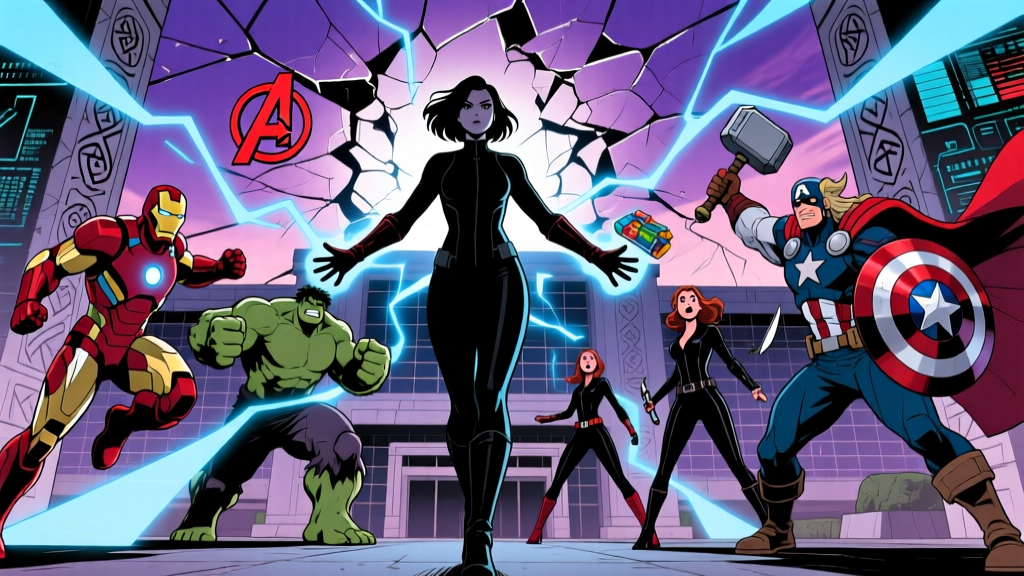
The cover shows a young woman in a green-and-yellow bodysuit, her hair streaked with a white bolt like a scar left by lightning. She is smiling. That smile is the most dangerous thing on the page. Behind her stand the Avengers—Captain America, Thor, Iron Man, the heavy hitters of Marvel's premier superhero team—and none of them look like they understand what is about to happen. Avengers Annual #10 hit newsstands in the summer of 1981 with a cover date stamp of August and a cover price of seventy-five cents. Four decades later, that seventy-five-cent book is one of the most important Bronze Age keys in the entire Marvel catalog, and the reason has a name, a Southern accent, and a power set that redefined what a villain could do to a hero.
Her name is Rogue. And she did not come to fight. She came to take.
This is the story of avengers annual 10—Chris Claremont and Michael Golden's 1981 showcase that introduced Rogue to the Marvel Universe, permanently altered Carol Danvers' life, and planted the seeds for one of the most complex character arcs in superhero comics.
A Stranger in San Francisco
The story does not open with Rogue. It opens with Jessica Drew—Spider-Woman—patrolling San Francisco on a rainy night and finding an unconscious woman collapsed on a rooftop. The woman has no memory. No identification. No idea who she is or how she got there. Jessica takes her in, and for a few pages, you might think you are reading a mystery thriller rather than a superhero annual.
That unconscious woman is Carol Danvers. Before she was Captain Marvel, before she was Binary, before the MCU made her a household name, Carol was Ms. Marvel—a hero with superhuman strength, flight, and a "seventh sense" precognitive ability that she had carried since her original series launched in 1977. By 1981, Carol had been through one of the roughest stretches any Marvel hero had endured. Her original series was cancelled. Her identity had been stolen by a Kree warrior named Marcus in a deeply uncomfortable Avengers storyline (issues #200–201, 1980) that involved mind control and forced pregnancy. She had been written out of the Avengers, stripped of agency, and left drifting.
Claremont picked her up off the floor—sort of. He gave her a voice, a personality, and a genuine anger at the people who had failed her. And then he sent Rogue after her.
The slow reveal works because Claremont withholds information the way a mystery writer would. You know something terrible happened to Carol. You know someone did this to her. The annual spends its first act letting Spider-Woman piece together clues, question the Avengers, and trace the attack back to a mutant with the ability to absorb other people's powers, memories, and identities through physical contact.
The Brotherhood Strikes: Rogue vs. Earth's Mightiest Heroes
The annual's central action sequence is a full-scale assault on the Avengers by Mystique's reformed Brotherhood of Evil Mutants. The team roster reads like a who's-who of X-Men antagonists: Mystique (shapeshifter and tactical leader), Destiny (precognitive blind seer and Mystique's partner), Avalanche (earthquake-generating gauntlets), Pyro (flame-throwing backpack), and Blob (immovable mass). Their objective: free the incarcerated Brotherhood members from Ryker's Island by drawing the Avengers away from the prison with coordinated attacks on multiple fronts.
And then there is Rogue.
Michael Golden drew her first real action debut with an energy that practically leaps off the page. Where the Brotherhood fights as a unit—Avalanche crumbling roadways, Pyro controlling fire corridors, Blob acting as a siege wall—Rogue operates as a solo instrument of destruction. She is not coordinating. She is hunting.
Golden's art on this annual deserves its own paragraph. His style in 1981 sat at a crossroads between the clean, heroic linework of the Silver Age and the gritty, textured realism that would dominate later 1980s comics. He drew faces that looked like real people rather than mannequins. His action choreography had weight—you could feel the impact of a punch, the strain of a blocked blow. And his character design for Rogue became one of the most enduring visual concepts in Marvel history: the green-and-yellow bodysuit, the brown bomber jacket, the white streak running through auburn hair, the gloves that covered every inch of skin because Rogue cannot touch another living being without absorbing them.
The Power Absorption Sequence: When Rogue makes contact with a hero in this issue, Golden draws the transfer as a visible energy cascade—purple-white lightning arcing between bodies, the victim's features going slack while Rogue's eyes glow with stolen power. Captain America throws a shield strike at her; she catches it, absorbs his tactical mind and peak-human conditioning through a glove-to-glove touch, and hurls the shield back with his own precision. Thor swings Mjolnir; she sidesteps, grabs his wrist, and for several seconds holds the power of a god—lightning crackling around her body, eyes white-hot with Asgardian energy. The sequence is terrifying because Rogue does not just overpower these heroes. She becomes them, temporarily wielding their abilities with an instinctive fluency that suggests she understands their powers better than they do.
The Avengers are not equipped to fight someone who turns their own abilities against them. Captain America's tactical genius, Thor's godlike strength, Iron Man's repulsor technology—every asset becomes a weapon in Rogue's hands the moment she makes skin contact. The battle reads less like a superhero fight and more like a horror sequence: an unstoppable force wearing your friend's face, using your friend's powers, smiling the whole time.
Scarlet Witch Turns the Tide
The battle at Ryker's Island is where the Avengers finally regroup and where Scarlet Witch earns her keep. Wanda Maximoff's hex power—probability manipulation—is one of the more abstract abilities in the Marvel Universe, and it turns out to be exactly what you need against someone who absorbs concrete powers. You cannot absorb bad luck. You cannot steal probability.
Scarlet Witch's hex bolts hit the Brotherhood at critical moments. Avalanche's gauntlets misfire. Pyro's flamethrower jams. Blob slips on debris that should not have been there. The Brotherhood's coordinated assault falls apart not because the Avengers hit harder, but because Wanda bent the odds just enough to create chaos in the enemy ranks. Mystique recognizes the situation and orders a retreat. She, Rogue, and Destiny escape. The rest of the Brotherhood—Avalanche, Pyro, and Blob—are captured and returned to Ryker's Island.
It is a partial victory. The Avengers stopped the prison break, but they lost the larger engagement. And they have not yet discovered what Rogue did to Carol Danvers.
What Rogue Took from Carol Danvers
The flashback structure that Claremont uses to reveal the attack on Carol Danvers is one of the most effective storytelling choices in the annual. Rather than showing the assault in real time, he lets Carol recount it—fragmented, confused, angry—while recovering at Professor Xavier's School for Gifted Youngsters. The pieces come together slowly, and each piece is worse than the last.
Rogue found Carol in San Francisco. The attack was fast. Rogue grabbed her, held on, and drained everything: superhuman strength, the ability to fly, invulnerability, the seventh-sense precognition. But she did not stop at powers. She absorbed Carol's identity—memories, personality fragments, learned skills, emotional connections. Everything that made Carol Danvers who she was flowed into Rogue like water pouring from one glass to another.
The key word here is permanent.
Rogue's mutant power had been established in earlier appearances (a cameo in Rom: Spaceknight Annual #3, 1981, and references in X-Men scripts that had not yet been published). She could absorb any person's abilities and memories through skin-to-skin contact. Normally, the absorption was temporary—touch someone, use their powers for a few minutes or a few hours, then the powers faded and the victim recovered. The duration scaled with contact time. A quick touch gave you seconds. A sustained grip gave you hours.
But the contact with Carol Danvers lasted too long. Rogue held on for what the narrative implies was several minutes—far beyond the threshold where the transfer becomes irreversible. When she finally released Carol, the damage was done. Carol's powers were gone. Her memories were scrambled. She could not remember her own name, her own history, the people she loved. And Rogue walked away carrying Carol Danvers inside her head—her strength, her flight, her combat training, her personality, all of it layered on top of Rogue's own identity like a second skin she could never remove.
"She took my powers, my memories, my life. I woke up in a hospital bed and I didn't know my own name. I didn't know what I'd lost until people started telling me who I used to be."
This is the moment that separates Avengers Annual #10 from typical superhero fare. In 1981, villains stole powers all the time. Doctor Doom siphoned the Silver Surfer's cosmic abilities. The Super-Skrull copied the Fantastic Four's powers. But those thefts were temporary, mechanical, reversible. Claremont made Rogue's absorption psychological and permanent. Carol did not just lose her super-strength. She lost her self. And Rogue did not just gain flight and strength—she gained a second consciousness living inside her skull, a ghost of Carol Danvers that would haunt her for decades.
The final pages of the annual show Carol at Xavier's mansion, physically recovered but psychologically shattered. She screams at the Avengers. She blames them for not protecting her, for not being there when she needed them. And the Avengers have no answer, because she is right. They failed her. Again.
Chris Claremont and the X-Men's Growing Shadow Over the Avengers
To understand why Avengers Annual #10 matters as much as it does, you have to understand where Chris Claremont stood in 1981. He had been writing Uncanny X-Men for six years. The Dark Phoenix Saga had concluded just twelve months earlier with Jean Grey's death in Uncanny X-Men #137 (August 1980). "Days of Future Past" had run in issues #141–142 (January–February 1981). Claremont was not just writing the X-Men—he was building the most ambitious, emotionally complex universe in mainstream comics, and the X-Men's gravitational pull was starting to affect every other Marvel title.
Avengers Annual #10 is, in many ways, an X-Men story wearing an Avengers costume. The Brotherhood of Evil Mutants is an X-Men concept. Mystique had been operating in X-Men-adjacent territory since her introduction in Ms. Marvel #16 (1978). Destiny was Claremont's creation. And Rogue—the character who would become the annual's lasting legacy—was always intended for the X-Men, even though she debuted in an Avengers book.
Claremont used the annual format to do something that regular monthly issues could not accommodate: he created a crossover event in miniature. The annual allowed him to introduce a character who belonged to the X-Men mythos into the Avengers' world, generate immediate conflict, and then carry the consequences back to his own title. When Rogue officially joined the X-Men in Uncanny X-Men #171 (July 1983), readers who had picked up Avengers Annual #10 two years earlier already knew her. They had seen what she could do. They had watched her dismantle Earth's Mightiest Heroes single-handedly. That prior knowledge made her defection from the Brotherhood and her struggle to earn the X-Men's trust dramatically richer.
Michael Golden's contribution to this annual cannot be overstated. Golden was one of the most technically accomplished artists working at Marvel in the early 1980s. His work on The 'Nam later in the decade would showcase his gift for gritty, grounded illustration, but on Avengers Annual #10 he delivered something different: a superhero comic that felt dangerous. His Rogue was not a glamorous villain. She was a young woman in over her head, following Mystique's orders with a bravado that barely masked her uncertainty. Golden drew her face with a tension between confidence and vulnerability that most comic artists could not achieve with a full page of dialogue.
Al Milgrom's inks over Golden's pencils gave the art a slightly heavier, more saturated quality than Golden's self-inked work. The shadows were deeper, the figure work more solid. It was a strong visual package for an annual that needed to feel like an event rather than a fill-in.
Rogue: From Villain to the Most Complicated Hero in the X-Men
Rogue's journey from Avengers Annual #10 to X-Men mainstay is one of the longest and most psychologically detailed character arcs in Marvel history. Here is the condensed version of what happened after she walked off the pages of this annual and into the X-Men:
- 1981–1983 (Brotherhood Era): Rogue continued operating with Mystique's Brotherhood. She appeared in Uncanny X-Men #158 (June 1982), where she fought the X-Men for the first time—and where Claremont began planting seeds for her eventual defection. Her internal monologue revealed a woman tormented by the voices and memories of everyone she had ever absorbed, Carol Danvers loudest among them.
- 1983 (Defection): Rogue showed up at Xavier's mansion in Uncanny X-Men #171 (July 1983), desperate and hunted. Mystique had manipulated her for years, and the accumulated personalities inside her mind were driving her toward a psychological break. Professor Xavier, against the objections of nearly every X-Man on the roster, offered her sanctuary.
- 1983–1990 (Redemption Arc): Rogue spent seven years earning the X-Men's trust. She could not touch anyone without absorbing them. She carried Carol Danvers' consciousness as a permanent passenger—at times, Carol's personality would surface, speaking through Rogue's mouth, acting through Rogue's body. This was not a power. It was a haunting. Claremont wrote Rogue as someone perpetually isolated, unable to form physical intimacy, carrying the guilt of what she had done to Carol and the terror of never knowing which thoughts were hers and which belonged to someone else.
- 1990s–Present: Rogue became one of the X-Men's most popular characters, appearing in the 1990s animated series (voiced by Lenore Zann), multiple film adaptations (played by Anna Paquin in the original X-Men trilogy), and virtually every X-Men comic team since her debut. Her power set—Carol's strength, flight, and invulnerability layered on top of her own absorption ability—made her one of the physically most powerful X-Men on the roster.
What makes Rogue's arc work, across forty-five years of publication, is that the core tragedy established in Avengers Annual #10 never goes away. She is still the woman who cannot touch another person. She still carries Carol Danvers' memories. She still remembers what it felt like to be a villain, to hurt people on Mystique's orders, to take things that were never hers. Every act of heroism she commits is shadowed by the knowledge of where she started.
Rogue's Full Power Set at Debut
| Ability | Source | Duration | Limitations |
|---|---|---|---|
| Power/Memory Absorption | Innate mutant ability | Permanent (base power) | Requires skin contact; prolonged contact causes permanent absorption; cannot control which abilities transfer |
| Superhuman Strength (Class 50+) | Absorbed from Carol Danvers (Ms. Marvel) | Permanent | None significant; strength level comparable to Carol's original Ms. Marvel form |
| Flight | Absorbed from Carol Danvers | Permanent | Speed cap varies by writer; generally sub-orbital atmospheric flight |
| Invulnerability | Absorbed from Carol Danvers | Permanent | Resists most physical trauma; not absolute invulnerability (can be hurt by sufficient force) |
| Carol Danvers' Memories/Personality | Absorbed during attack | Permanent (submerged) | Carol's personality occasionally surfaces; causes psychological distress and identity conflict for Rogue |
| Temporary Power Theft (various) | Absorbed from Captain America, Thor, others (in this issue) | Temporary (minutes to hours) | Short-contact absorptions fade; does not retain these abilities long-term |
Power classifications are based on Marvel's official handbook entries and Claremont's published scripts from the 1980s–1990s. "Class 50+" strength indicates the ability to lift in excess of 50 tons under optimal conditions.
Collector Values: What Avengers Annual #10 Is Worth Today
Avengers Annual #10 sits in a specific corner of the collector market: it is a Bronze Age key issue with a single defining character debut, which gives it a clear value anchor. Unlike event comics from the 1990s that were printed in massive quantities, the 1981 annual had a limited print run typical of Marvel annuals in that era—estimated at roughly 300,000 to 400,000 copies for the initial newsstand distribution. Survival rates in high grade are low. Annuals were thicker than standard comics, which meant they were more prone to spine stress, binding defects, and cover curling. Finding a copy in NM/MT 9.8 condition is genuinely rare.
Rogue's continued cultural relevance—the 2000 X-Men film, X2 (2003), X-Men: The Last Stand (2006), the 2024 Disney+ series X-Men '97 where Rogue received significant screen time—keeps demand steady. She is one of the most recognizable X-Men characters globally, and Avengers Annual #10 is where she started.
Here is where values sit in the 2025–2026 market, based on Heritage Auctions sales data, GoCollect price tracking, and eBay completed listings:
| Grade / Condition | Description | Estimated Value (USD) |
|---|---|---|
| CGC 9.8 (NM/MT) | Near-mint to mint. Virtually flawless. White pages, razor-sharp corners, no spine stress. | $4,000 – $7,000 |
| CGC 9.6 (NM+) | Near-mint plus. Exceptional copy with only microscopic imperfections. | $1,500 – $3,000 |
| CGC 9.4 (NM) | Near-mint. Outstanding copy. Minor spine stress acceptable. | $700 – $1,200 |
| CGC 9.0 (VF/NM) | Very fine to near-mint. Sharp cover, tight spine, strong color saturation. Collector's sweet spot. | $350 – $600 |
| CGC 8.0 (VF) | Very fine. Solid mid-grade. Complete, readable, with minor wear. | $150 – $300 |
| CGC 6.0 (FN) | Fine. Moderate wear. Spine stress visible, possible small creases. | $75 – $150 |
| CGC 4.0 (VG) | Very good. Significant wear but complete and readable. | $40 – $80 |
| Raw (Ungraded) | Varies enormously. Beware restoration, trimmed edges, and spine splits. | $25 – $250 |
The CGC 9.0 to 9.4 range offers the best value-to-cost ratio for most collectors. At these grades, covers display well—colors are bright, corners are close to sharp, spines are intact—without the steep premiums that 9.6+ copies demand. The jump from 9.4 to 9.6 alone can double or triple the price, and the visual difference between those grades is essentially invisible to anyone who is not a professional grader.
One critical note for buyers: the newsstand edition (75-cent cover price) is the true first print. Marvel has since reprinted Avengers Annual #10 in various collected editions and omnibus volumes. Those reprints are fine for reading, but they carry no collector value. Always check the indicia—the small print block on the inside—for the original 1981 publication date and first-printing identification before purchasing.
Why This Issue Holds Value
Some key comics spike and crash with pop culture trends. Avengers Annual #10 has held its ground for a different reason: Rogue is a permanent fixture of the X-Men franchise. She is not a flavor-of-the-month villain who disappears after one storyline. She is a core X-Men character with a forty-five-year publication history, multiple animated series appearances, three live-action films, and a leading role in the Disney+ X-Men '97 revival (2024). Every time Rogue appears on screen, a new wave of fans goes looking for her first appearance, and that search always leads back to the same book.
The X-Men franchise's position within the Marvel Cinematic Universe also provides a long-term tailwind. With Marvel Studios actively developing mutant-centric projects as of 2025–2026, Rogue's eventual MCU debut seems inevitable. When that happens, expect demand for Avengers Annual #10 to spike—the same pattern that played out with Incredible Hulk #181 (first Wolverine) when Hugh Jackman's casting was announced, and Tales of Suspense #39 (first Iron Man) when Robert Downey Jr. signed on.
The Carol Danvers Problem: A Hero Failed by Everyone
No discussion of Avengers Annual #10 is complete without addressing what this issue does to and for Carol Danvers. The woman who would eventually become Captain Marvel was, in 1981, one of the most mistreated characters in Marvel's history—not by villains, but by her own writers and editors.
Carol's original Ms. Marvel series (1977–1979) was ahead of its time: a feminist superhero narrative written by Gerry Conway and later Claremont himself, featuring a woman who was a former Air Force officer, a magazine editor, and a capable fighter in her own right before she ever gained superpowers. The series was cancelled at #23. Then came Avengers #200 (1980), where Carol was impregnated by a dimension-hopping entity named Marcus through mind control, gave birth to a child who aged to adulthood in hours, and then followed that child through a portal to another dimension—all while the Avengers stood around watching. It remains one of the most criticized storylines in Marvel's history, and rightly so.
Claremont, to his credit, spent years trying to fix what Avengers #200 had broken. His work on Carol in Avengers Annual #10 and the subsequent Uncanny X-Men #164 (October 1982)—where Carol gains Binary powers and leaves Earth entirely—was an attempt to give her agency, anger, and a path forward. The scene in Avengers Annual #10 where Carol confronts the Avengers is raw and uncomfortable. She does not forgive them. She does not soften. She tells them they failed her, and she leaves.
That moment mattered. In 1981, it was rare for a Marvel comic to let a female character be genuinely furious at male heroes and have the narrative validate that fury without qualification. Carol was right. The Avengers had failed her. And Claremont let her say it.
Every Question a Reader Brings to This Issue
Is Avengers Annual #10 really Rogue's first appearance?
It is her first full appearance, which is the designation that matters most to collectors. Rogue had a brief cameo in Rom: Spaceknight Annual #3 (1981), also written by Claremont, but she appears for only a few panels and has no dialogue of consequence. Avengers Annual #10 is where she functions as a fully realized character with dialogue, action sequences, and a defined role in the plot. In collector terminology, Avengers Annual #10 is universally recognized as the "first full appearance" key. The Rom cameo is a curiosity that most collectors do not chase aggressively.
Why did Rogue debut in an Avengers comic instead of an X-Men comic?
Annuals in the Bronze Age were often used by Marvel as testing grounds for new characters and concepts. They had larger page counts (typically 48–64 pages versus 22 for a standard issue), higher cover prices, and looser editorial constraints. Claremont was already writing Uncanny X-Men, but he used the Avengers Annual to introduce Rogue to a broader audience before bringing her into the X-Men fold. This cross-pollination strategy was common in the era—Wolverine debuted in Incredible Hulk #181 (1974), not an X-Men comic, for similar reasons.
Which Avengers appear in this annual?
The active Avengers roster in this issue includes Captain America (Steve Rogers), Thor, Iron Man (Tony Stark), Scarlet Witch (Wanda Maximoff), Wonder Man (Simon Williams), and Hawkeye (Clint Barton). Spider-Woman (Jessica Drew) plays a major role as the character who discovers Carol Danvers and investigates the attack, though she was not technically an Avenger at the time. Professor Xavier and several X-Men appear in the issue's closing pages.
Did Rogue keep Carol Danvers' powers permanently?
Yes. The absorption in Avengers Annual #10 was permanent and has remained a core part of Rogue's power set for over four decades of Marvel continuity. She retains Carol's superhuman strength, flight, and invulnerability as permanent abilities, layered on top of her own mutant absorption power. The psychological side effects—Carol's memories and personality fragments existing inside Rogue's mind—have been explored extensively in subsequent X-Men stories, most notably in Claremont's Uncanny X-Men run throughout the 1980s and in later series like X-Men Legacy (2008–2012).
What happened to Carol Danvers after this issue?
Carol appeared in Uncanny X-Men #164 (December 1982), where she gained Binary-level cosmic powers during an encounter with the alien Brood species. She left Earth and operated as Binary for several years. She eventually returned, her powers fluctuating between Binary-level and her original Ms. Marvel abilities. She adopted the Warbird codename in the 1990s Avengers run and finally took the Captain Marvel mantle in 2012 (written by Kelly Sue DeConnick). Her journey from Avengers Annual #10 to becoming one of Marvel's flagship heroes took over thirty years of publication.
Is Avengers Annual #10 a good entry point for new collectors?
At the CGC 8.0 to 9.0 level, this issue is relatively accessible for a Bronze Age key—prices in the $150 to $600 range are achievable for collectors who might be priced out of heavy hitters like Incredible Hulk #181 or Amazing Fantasy #15. The story holds up as a standalone read; you do not need extensive X-Men or Avengers knowledge to follow the plot. And Rogue's cultural visibility ensures that this is not a book likely to lose relevance. For someone building a Bronze Age key collection, Avengers Annual #10 offers strong character significance, a solid story, and reasonable pricing at mid-grade levels.
Reading Order: Rogue's Debut Arc
If you want to trace Rogue from Avengers Annual #10 through her first year as an X-Man, here is the essential reading sequence—focused on her appearances and key character beats rather than every tie-in:
- Avengers Annual #10 (August 1981) — Rogue's first full appearance; attack on the Avengers; permanent absorption of Carol Danvers' powers
- Rom: Spaceknight Annual #3 (1981) — Rogue's brief cameo; published around the same period but generally considered secondary to the Avengers Annual debut
- Uncanny X-Men #158 (June 1982) — Rogue's first clash with the X-Men while still operating with the Brotherhood
- Uncanny X-Men #164 (December 1982) — Carol Danvers gains Binary powers and leaves Earth; closes her immediate arc
- Uncanny X-Men #171 (July 1983) — Rogue defects from the Brotherhood and seeks sanctuary with the X-Men
- Uncanny X-Men #173–175 (September–November 1983) — Rogue's earliest missions as an X-Man; Madelyne Pryor subplot; the team slowly begins accepting her
Forty-five years after it hit newsstands, Avengers Annual #10 still reads like a statement of intent. Chris Claremont took a Marvel annual—a format most readers treated as disposable summer entertainment—and used it to introduce a character who would become one of the most psychologically layered figures in superhero comics. Rogue walked in as a villain, stole a hero's entire life, and walked out carrying the seeds of a redemption arc that would take decades to unfold. Michael Golden gave her a look that has not aged a day. And Carol Danvers, the woman Rogue destroyed and inadvertently preserved inside her own mind, spent the next thirty years clawing her way back to relevance. The seventy-five-cent cover price feels almost insulting given what this book contains. A mutant debut, a hero's devastation, a villain's origin, and the start of a story that has not finished being told.