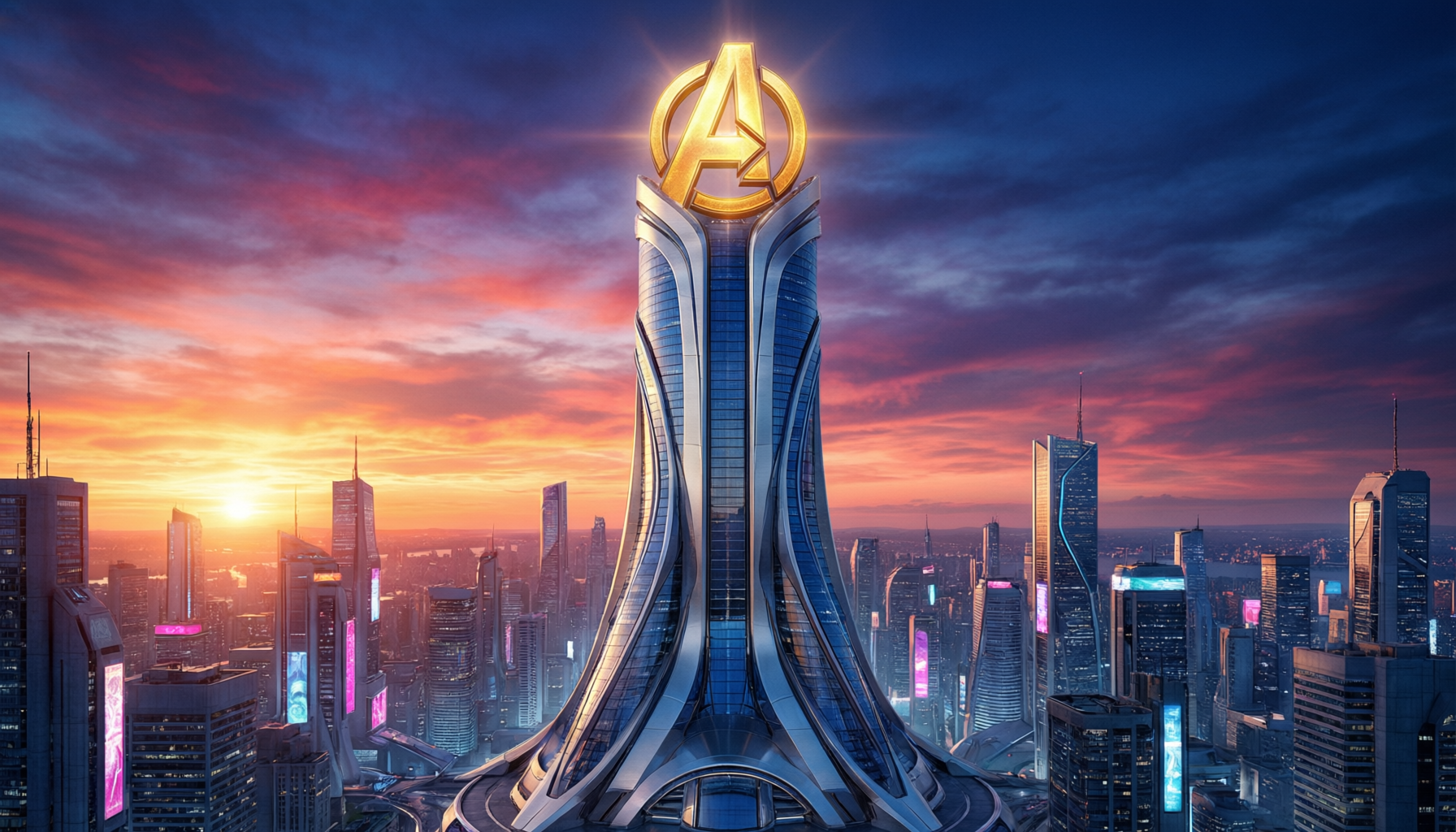
Avengers Tower: The Skyscraper That Became Earth's Last Line of Defense
From Stark's corporate HQ to the beating heart of Earth's Mightiest Heroes — the full story behind the most iconic headquarters in Marvel history.
There are fictional buildings that simply exist in the background of a story, and then there are structures that become characters themselves. The Avengers Tower sits firmly in the second category. Whether you first encountered it in the pages of Marvel Comics, watched the Avengers assemble around it in the MCU, or recognize it as that unmistakable silhouette on the Manhattan skyline — this building carries weight. It's more than glass, steel, and arc reactor technology. It's a statement: heroes are here.
The thing about Avengers Tower that most casual fans never fully appreciate is how many versions of it exist across Marvel's sprawling multiverse. The comics iteration has gone through multiple rebuilds, relocations, and outright demolitions. The MCU version — modeled after the MetLife Building on Park Avenue — became the visual anchor for the entire Infinity Saga. And then there's the version that lives in the collective imagination of fans: that "A" emblazoned on the side, glowing gold against a night sky, a beacon that means someone, somewhere, is about to save the world.
This article pulls apart every layer of Avengers Tower. Where it came from, how it evolved, what happened inside and around it, and why a fictional skyscraper still matters to millions of people who've never set foot in a comic shop.
The History of Avengers Tower: From Stark Industries to Earth's Headquarters
Before it ever bore the Avengers name, the tower was Stark Tower — the personal monument to Tony Stark's ego, engineering genius, and corporate empire. In the comics, the building debuted as part of the Avengers' long-running mythology, though the exact timeline differs depending on which continuity you follow.
Comics Origins
In the original Marvel comic continuity, the Avengers actually started with a different base entirely: the original Avengers Mansion on Fifth Avenue, donated by Tony Stark. That brownstone served as the team's headquarters for decades of publication, from the 1960s well into the 1980s. The move to a high-rise tower concept came later, reflecting a shift in how writers and artists wanted to portray the team. A mansion felt intimate and old-world. A tower felt modern, powerful, visible — a declaration that the Avengers weren't hiding in some residential neighborhood. They were right there, in the heart of Manhattan, impossible to ignore.
The tower concept became more prominent after various comic events necessitated a new base. Following the "Avengers Disassembled" storyline and the subsequent formation of the New Avengers, Stark Tower (already established as Tony's personal base) effectively became the team's new operational home. Brian Michael Bendis's run on New Avengers cemented the location as the Avengers' primary address, and the name "Avengers Tower" started appearing more frequently in dialogue and narration alike.
The MCU Transformation
If the comics introduced Avengers Tower gradually, the Marvel Cinematic Universe dropped it on audiences like a thunderclap. The post-credits scene of The Avengers (2012) showed the team eating shawarma in a wrecked diner, but the film's third act established Stark Tower as ground zero for the Battle of New York. Tony Stark's penthouse — all sleek surfaces, holographic interfaces, and that signature arc reactor powering the whole building — became the stage for one of the most iconic confrontations in blockbuster cinema when Loki confronted Tony there.
By the time Age of Ultron (2015) rolled around, the "STARK" signage had been replaced with the iconic "A" logo. The building had been repurposed, retrofitted, and rebranded. It was no longer a vanity project; it was a military, scientific, and humanitarian command center. The film shows it fully equipped with labs, armories, living quarters, and the kind of surveillance infrastructure that would make the NSA jealous.
After the Sokovia Accords and the team's fracturing in Captain America: Civil War (2016), Avengers Tower took on a different tone. It became, in a sense, a symbol of division — half-empty, some rooms sealed off, a reminder that the world's greatest heroes had broken apart. By Infinity War (2018), the tower had already shifted function again, and Endgame (2019) essentially closed the book on the location as fans knew it, with the team operating out of the upstate New York compound for the final battle.
Post-Endgame and the Spider-Verse
In Spider-Man: Far From Home (2019), attentive viewers caught a glimpse of the tower under renovation — with construction scaffolding and new ownership implied. Marvel left the building's fate deliberately ambiguous, which sparked years of fan speculation. The tower's ownership changed hands (in-universe), and its future in the MCU remains an open question heading into future phases.
Architecture and Design: What Makes Avengers Tower Tick
The genius of Avengers Tower's design — both in comics and on screen — is how it manages to feel simultaneously like a corporate office building and a superhero fortress. The exterior reads as Manhattan luxury: clean lines, reflective glass, the kind of structure that would look at home on a real estate brochure. But the interior tells a different story entirely.
Exterior Design
In the MCU, the building is clearly modeled after the MetLife Building (formerly the Pan Am Building) on Park Avenue. The visual effects team at ILM and Weta took the real-world structure and added Tony Stark's signature aesthetic language: angular additions at the upper floors, a cantilevered platform for Iron Man's flight operations, and the enormous illuminated "A" that faces the Manhattan skyline. The gold-and-blue color scheme of the logo ties directly to the Avengers' visual branding, making the building instantly recognizable even in wide aerial shots.
The comics version tends to depict the tower as more original architecture — a purpose-built structure rather than a retrofitted existing building. Artists have drawn it with varying numbers of floors, different proportions, and occasionally wildly different aesthetics depending on the era and the penciller's style. What stays consistent is the "A" at the top and the general sense that this is a building designed to be seen.
Interior Layout
Here's where things get interesting, because Avengers Tower's interior is essentially a greatest-hits collection of superhero infrastructure:
- Main Operations Floor: Holographic displays, global threat monitoring, communications arrays. Think NASA mission control crossed with a war room.
- Tony's Lab (Lower Levels): Fabrication equipment, Iron Man suit storage, the kind of workshop where a billionaire genius builds world-changing technology at 3 AM while AC/DC plays on the speakers.
- Training Facilities: Combat simulation rooms, sparring areas, and in some comic versions, full Danger Room-equivalent holographic environments.
- Living Quarters: Private rooms for each Avenger, designed to reflect their personalities. Tony's penthouse is minimalist luxury. Steve Rogers's room, when shown, tends to be sparse and functional. Thor's quarters have appeared with Asgardian design elements.
- The Armory: Weapons storage, suit maintenance, and enough firepower to equip a small army — which, given who lives here, makes sense.
- Helipad and Landing Platforms: Multiple levels of exterior access for Quinjets, Iron Man suits, and the occasional Asgardian arrival via Bifrost residue.
Power and Defense Systems
The tower runs on arc reactor technology, which in the Marvel Universe means virtually unlimited clean energy. Defense systems have varied across appearances but typically include energy shields, automated turret systems, and JARVIS/FRIDAY-managed security protocols. In the comics, the tower has been protected by everything from Stark-tech force fields to magic wards provided by Doctor Strange. It's the kind of building where a Tuesday afternoon might involve repelling a Doombot attack while simultaneously hosting a press conference three floors down.
Key Battles Fought at Avengers Tower
A headquarters this prominent is inevitably going to attract trouble. Here are the most significant conflicts that have erupted in, around, or directly because of Avengers Tower:
| Battle / Event | Key Combatants | Outcome | Source |
|---|---|---|---|
| Battle of New York | Avengers vs. Loki & Chitauri | Portal closed, Loki captured. Tower heavily damaged but structure survived. | MCU — The Avengers (2012) |
| Ultron's First Attack | Avengers vs. Ultron drones | Ultron escaped with Vibranium; tower sustained moderate damage. | MCU — Age of Ultron (2015) |
| Siege of Avengers Tower | New Avengers vs. The Hood's army | Hood repelled; tower defenses held after intense urban combat. | Comics — New Avengers (Bendis run) |
| Dark Avengers Takeover | Norman Osborn's forces vs. legitimate Avengers | Osborn seized the tower, rebranded it as Avengers Tower under H.A.M.M.E.R. control. Later reclaimed. | Comics — Dark Reign era |
| Infinity (2013) | Avengers & allies vs. Thanos's forces | Tower served as command center during global invasion; structural damage minor. | Comics — Infinity (Hickman) |
| Secret Wars Prelude | Various — multiversal incursion events | Tower destroyed during incursion; later rebuilt post-Secret Wars. | Comics — New Avengers (Hickman) |
What's remarkable about this list is the pattern it reveals: Avengers Tower doesn't just survive — it comes back. Destroyed? Rebuilt. Seized by villains? Recaptured. The building mirrors the team itself: resilient, stubborn, and impossible to keep down for long.
Cultural Significance: Why a Building Matters
It might sound strange to write thousands of words about a fictional building. But Avengers Tower occupies a unique space in pop culture that goes well beyond its function in any single story.
A Symbol Anyone Can Recognize
The Avengers "A" logo is one of the most recognizable symbols in modern entertainment. Placing that logo on top of a Manhattan skyscraper transformed it from a team emblem into something almost civic. In the MCU, when New Yorkers look up and see that "A" glowing against the sky, it means the Avengers are present, watching, ready. It's the superhero equivalent of a lighthouse.
This visual shorthand became so effective that Marvel has used it as merchandise, branding, and marketing material for over a decade. The image of Avengers Tower at night — gold "A" illuminated, city lights below — is practically wallpaper for MCU fans. It appears on phone cases, posters, lunchboxes, and about ten thousand desktop backgrounds.
The Fantasy of Living There
One of the quieter cultural impacts of Avengers Tower is how it sparked a specific fantasy: what would it be like to live there? Fan art has depicted Avengers movie nights in the common room, Thanksgiving dinners with the whole roster, and even mundane scenes like Steve Rogers doing laundry in the tower's basement. The building became a stage for imagining these characters as people, not just fighters.
This fantasy extends to the real world. When fans visit New York City, the MetLife Building has become an unofficial pilgrimage site. People stand on Park Avenue, angle their phones upward, and take photos — half-joking, half-hoping that maybe, in some multiverse, the "A" is really up there.
Narrative Function: The "Home Base" Archetype
From a storytelling perspective, Avengers Tower fills a role as old as fiction itself: the home base. Think of the Batcave, the X-Men's mansion, the Millennium Falcon (for a more mobile example). Audiences need a place to return to between adventures. It grounds the characters, provides continuity, and gives writers a controlled environment for character development scenes. Some of the best moments in Avengers stories — in comics and film — happen not during battles but in the quiet hours inside the tower: Tony and Bruce working on tech, Natasha watching from the rooftop, Hawkeye practicing archery in a training room nobody else uses.
A Marker of Change
The tower's evolution also mirrors the Avengers' own arc. When it was Stark Tower, the Avengers were Tony's project. When it became Avengers Tower, the team had an identity beyond any single member. When it was seized during Dark Reign, the team was at its most fractured. And when it went quiet post-Endgame, the audience understood — without a single line of exposition — that something fundamental had changed.
Avengers Tower Collectibles and Merchandise
The tower's iconic status has made it a favorite subject for merchandise across every price point. Here's a breakdown of the most notable collectibles featuring Avengers Tower:
LEGO Sets
LEGO has released multiple Avengers Tower sets over the years. The most ambitious was the LEGO Marvel Super Heroes Avengers Tower (76038), a 515-piece set featuring the tower with the iconic "A" logo, a Quinjet, and minifigures of Iron Man, Captain America, Thor, Black Widow, Hawkeye, and Ultron. It remains one of the more sought-after retired Marvel LEGO sets, with aftermarket prices sitting well above its original retail value. A later, larger set — the 76178 Daily Bugle — included the Avengers Tower in its skyline backdrop, though as a background element rather than the main build.
Model Kits and Statues
Several companies have produced detailed model kits and display statues of Avengers Tower. Iron Studios and Diamond Select have both released pieces that include the tower as a backdrop or diorama element. The high-end collectible market has seen limited-run resin statues depicting the tower in various battle-damaged states, which tend to sell out quickly among Marvel collectors.
Hot Toys and Funko
While not tower-specific products, several Hot Toys diorama bases and Funko Pop! vinyls use Avengers Tower as a backdrop element. The Hot Toys Iron Man Mark XLIII bust, for instance, includes a tower landing pad base. Funko's MCU-themed lines have periodically featured tower imagery in their packaging and exclusive convention releases.
Prints, Posters, and Art
The most accessible Avengers Tower collectibles remain art prints and posters. Official Marvel store prints, licensed art from companies like Mondo and Bottleneck Gallery, and fan art prints from Etsy and convention artists all feature the tower prominently. Mondo's screen-printed poster for The Avengers remains one of their highest-valued Marvel prints, with secondary market prices regularly reaching the hundreds.
Video Game Representations
Avengers Tower appears as a playable location in multiple games: Marvel's Avengers (Square Enix), Spider-Man (Insomniac, as a skyline element), LEGO Marvel Super Heroes, and Marvel vs. Capcom: Infinite. Each game interprets the tower differently, from photorealistic to stylized, but the core design language — that "A" on top — never changes.
The Most Memorable Scenes Set in Avengers Tower
Beyond the battles, some of the tower's most lasting moments are the quiet ones:
Tony and Loki's Penthouse Confrontation (The Avengers, 2012): The verbal sparring between Robert Downey Jr. and Tom Hiddleston in Tony's penthouse remains one of the MCU's sharpest dialogue scenes. "We have a Hulk." Enough said.
The Party Scene (Age of Ultron, 2015): The Avengers letting loose in the tower's common area, lifting Thor's hammer, and generally being human — right before Ultron crashes the party. The contrast between celebration and catastrophe is what makes the scene work.
The New Avengers Assemble (Comics, New Avengers #1, 2005): The moment that established the tower as the new team base. Bendis and Leinil Yu's debut issue showed the tower as both a fortress and a home, setting the tone for years of stories.
Tony's Final Walkthrough (Fan Interpretation): While never explicitly shown in the films, fans have widely discussed and illustrated the idea of Tony Stark walking through an empty Avengers Tower after the snap, the rooms silent, the lights dim. It's a scene that exists in fan art, fan fiction, and collective imagination — and it hits harder than most official scenes ever could.
Frequently Asked Questions
Is Avengers Tower a real building?
No, Avengers Tower is fictional. However, its MCU design is heavily based on the MetLife Building (formerly the Pan Am Building) located at 200 Park Avenue in Manhattan. Fans frequently visit the real building to take photos, though no Marvel branding or "A" logo exists on the actual structure.
How tall is Avengers Tower?
The MCU version is generally depicted as roughly the same height as the MetLife Building, which stands at 808 feet (246 meters) with 59 floors. Comic versions vary widely depending on the artist, but most depict it as significantly taller — sometimes over 100 stories, with the upper floors dedicated to Avengers operations and the lower floors serving as regular commercial office space.
What happened to Avengers Tower after Endgame?
In Spider-Man: Far From Home, the tower is briefly visible in the background with construction equipment around it, suggesting it's being renovated or repurposed. Marvel has not officially confirmed its current status in the MCU timeline, though fan theories suggest it may have been sold to a new owner. Its future role in upcoming MCU projects remains unannounced.
Who currently owns Avengers Tower in the comics?
Comics continuity shifts frequently, but Avengers Tower has historically been owned by Stark Industries (and later Stark Resilient) and leased or donated to the Avengers for use as their headquarters. After various reboots and story arcs, including periods where it was destroyed and rebuilt, ownership has remained tied to Tony Stark's corporate entities in most continuities.
What's the difference between Avengers Tower and Avengers Mansion?
Avengers Mansion was the team's original headquarters — a brownstone on Fifth Avenue in Manhattan, first appearing in Avengers #1 (1963). It served as the primary base for decades before the team relocated to Avengers Tower in later comic eras. The mansion is smaller, more residential, and associated with the classic Avengers lineup. The tower is modern, highly visible, and designed for a team operating at a global scale.
Can you visit Avengers Tower in real life?
You can visit the MetLife Building in New York City, which served as the visual reference for the MCU version. There is no official Marvel-themed experience at the location. However, various Marvel-themed attractions — including Avengers-related exhibits at Disney parks and Marvel-themed pop-up events — occasionally incorporate Avengers Tower imagery and experiences.
Final Thoughts
Fictional buildings don't usually earn the kind of emotional attachment that Avengers Tower commands. But then, Avengers Tower was never just a building. It was the place where Earth's mightiest heroes chose to stand together. It was where Tony Stark stopped being just a genius billionaire and started being a teammate. Where Steve Rogers found something resembling a home after waking up in a century he didn't recognize. Where Thor, an alien god, sat on a couch and drank a beer with people he'd come to love.
The tower represents an idea — that no matter how powerful you are, you need a place to come back to. A place where the lights are on, the coffee's brewing, and someone's got your back. That idea resonates whether you're reading a comic in 1965 or watching an IMAX screening in 2019.
And maybe that's the real power of Avengers Tower. Not the arc reactor in its basement or the weapons in its armory. Just the simple, stubborn insistence that heroes deserve a home — and that home deserves to be visible to everyone who needs to believe that help is out there, looking down from the top of a skyscraper with a golden "A" on its crown.
Avengers Tower — Earth's Mightiest Headquarters. Assemble.