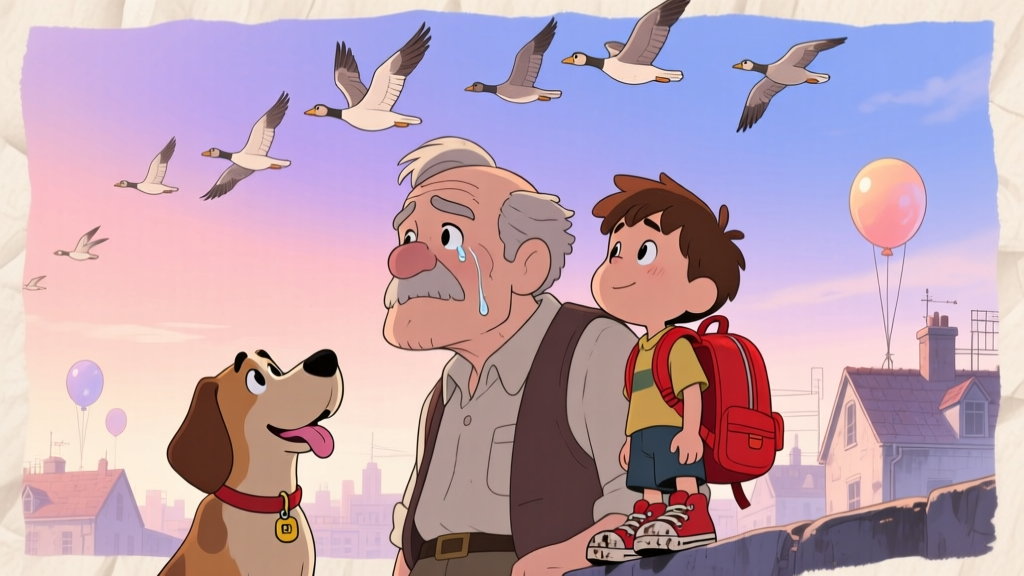
Most animated films introduce characters. Up dissects them — layer by layer, scene by scene — until you realize the flying house was never the point. The people inside it were.
When Pixar released Up in 2009, audiences expected a comedy about a house held aloft by balloons. What they got was a 96-minute thesis on grief, obsession, found family, and the quiet violence of unfulfilled promises. The film earned over $735 million worldwide and two Academy Awards, but its real achievement was quieter than box office numbers: it built a cast of characters so psychologically layered that you can watch the film a dozen times and still catch something new in a background detail or a line of throwaway dialogue.
This piece is not a general overview. It is a close reading — an excavation of the specific choices, design decisions, and narrative architecture that make each character in Up function at a level most live-action dramas never reach. We are going deeper: into Carl's entire biography, into Russell's badge sash, into the grammar of Dug's most famous sentence, into the symbolism of a thirteen-foot bird, and into the ten-minute opening sequence that may be the finest piece of visual storytelling Pixar has ever produced.
CFCarl Fredricksen: A Complete Biography
From Shy Boy to Sky Voyager
The Boy Behind the Goggles
We know Carl as the square-jawed, square-bodied widower who ties 10,907 helium balloons to his Victorian home and flies to South America. But the film quietly constructs his entire life in fragments, and piecing them together reveals a man shaped less by adventure than by the absence of it.
Young Carl is a quiet child — not shy exactly, but the kind of introverted kid who lives inside his own imagination. He worships Charles Muntz the way some kids worship athletes: completely, uncritically, with goggles on his head and a leather aviator cap pulled tight. Carl does not want to be Muntz. He wants to live inside the version of the world that Muntz represents — one where exploration matters, where the unknown is worth chasing, where life is not confined to the four walls of a suburban bedroom.
Then Ellie crashes through his window. Literally. She is missing a tooth, overflowing with certainty, and she has already decided that this boy is going to be part of her life. The power dynamic of their relationship is established in this single scene and never changes: Ellie proposes, Carl accepts. She dreams, he builds. She points at the horizon, and he follows. This is not codependency. It is partnership, but a specific kind — one where Carl is the anchor and Ellie is the sail.
The Marriage Years: What the Montage Does Not Show
The famous opening montage covers Carl and Ellie's life in roughly ten minutes. But what it skips is as revealing as what it includes. We see them painting the mailbox, selling balloons at the zoo, saving coins in a Paradise Falls jar. We see the miscarriage scene — one of the most emotionally devastating sequences in any Pixar film — and the quiet recovery that follows. We do not see Carl at work for any extended period. We do not see him with friends. We do not see him apart from Ellie at all, really, until she is gone.
This is a deliberate narrative choice. Carl's identity is so thoroughly fused with Ellie's that the film cannot show us one without the other. When she dies, we are not watching a man lose his wife. We are watching a man lose the entire architecture of his self. Every habit, every routine, every unspoken assumption about how tomorrow would look — gone. The house that Carl refuses to sell is not just a building. It is the physical manifestation of a shared life: every scuff mark on the floorboards, every hand-painted detail, every inch of garden Ellie designed. Selling it would mean admitting that the life they built was disposable. Carl will burn the house down before he admits that.
The Widower: Rituals of a Man Standing Still
Adult Carl — the Carl we spend most of the film with — has developed a set of daily rituals that function as emotional scaffolding. He talks to Ellie's photograph. He sits in his chair and does not sit in hers. He drives his balloon cart to the park, the same route, the same pace, because routine is the only structure keeping him upright. The construction site surrounding his house is not just a plot device; it is a visual metaphor for a world that has kept building while Carl stopped.
When Carl strikes the construction worker with his cane — the incident that forces him into the Shady Oaks retirement community — it is not an accident. It is the eruption of decades of suppressed frustration. Carl has been watching his world shrink for years: first Ellie's health, then her death, then the neighborhood, then the city encroaching on every side. The cane swing is the moment his grief finally turns physical, and the legal consequences are the world's cold reply: you cannot hit people, no matter how much you are hurting.
The Transformation: What Changes and What Does Not
Carl's arc is not a transformation in the way most protagonists transform. He does not become a different person. He becomes a larger version of the person he already was. The tenderness he showed Ellie — the quiet attentiveness, the willingness to build something for someone he loves — does not disappear when she dies. It goes dormant. Russell, Dug, and Kevin reactivate it.
The key scene is not the balloon flight or the final confrontation with Muntz. It is the moment Carl sits in Ellie's chair, opens her adventure book, and discovers that she filled the blank pages with photographs of their ordinary life together. The note she left — "Thanks for the adventure — now go have a new one" — does not tell Carl to forget her. It tells him that she was not waiting for Paradise Falls. She was waiting for him, every day, and he was already enough. That realization is what allows Carl to empty the house of furniture — to literally lighten the load — and fly back into the fight. He is not leaving Ellie behind. He is carrying her forward, in the only way that matters: by living.
Design Detail: Carl's silhouette is almost perfectly square — head, body, hands. Pixar's character designers used this geometry deliberately: squares suggest stability, stubbornness, and containment. As Carl softens emotionally, his body language opens up, but his silhouette never changes. He is still Carl. He is just a Carl with more room inside.
RRussell: The Badge Sash Tells the Real Story
Achievement as a Cry for Attention
Russell wears a sash covered in Wilderness Explorer merit badges. Most viewers see the sash as a cute character detail — a visual shorthand for "eager kid." But look closer. The badges are not random. They map Russell's emotional history more precisely than any line of dialogue.
Reading the Sash
Russell has accumulated dozens of badges by the time he appears on Carl's porch. The film gives us names for some: Assisting the Elderly (the one he still needs), First Aid, Protecting the Environment, Wilderness First Aid. The sheer volume suggests a kid who has thrown himself into the program with unusual intensity. Most Wilderness Explorers his age probably have five or six badges. Russell has enough to cover his entire torso.
Why? Because badges are measurable proof of accomplishment, and Russell lives in a world where his father's attention is conditional on achievement. The phone call we overhear — Russell's dad cancelling his attendance at the badge ceremony — is not the first cancellation. It is the latest in a long pattern. Russell has learned, at eight years old, that collecting achievements is the most reliable way to get an adult to look at him and say "good job." The sash is not a costume. It is armor.
The Missing Badge and What It Means
The Assisting the Elderly badge is the only one Russell has not earned, and it is the reason he knocks on Carl's door. The requirement is simple: help an elderly person with something. Russell approaches it with the same earnest intensity he brings to everything. He offers to help Carl cross the street. He offers to carry things. He will not take no for an answer because — and this is the part that aches — he has never had a task he could not complete through sheer effort.
The badge's significance deepens at the end. When Carl pins it on Russell at the Wilderness Explorer ceremony — standing in for the father who never showed — the gesture is layered. Carl is not just fulfilling a requirement. He is telling Russell that someone noticed his effort, that someone came, that the work he did was seen and valued. And then Carl adds Ellie's grape-soda pin: the highest honor he knows how to give. A man who lost everything handing a boy the thing he treasures most. The audience dissolves.
Russell's Father: The Character We Never See
Russell's dad is the most important character in Up who never appears on screen. We assemble him from fragments: the phone call, Russell's practiced nonchalance when he says "Phyllis says I have to call her 'Mom' now," the way Russell never seems surprised when someone lets him down. Phyllis is Russell's mother. The "now" implies a divorce, a remarriage, a reshuffled family in which Russell's father has become a weekend visitor — and an unreliable one at that.
Pixar trusts the audience to fill in the gaps. They do not show us the father because they do not need to. Russell's behavior tells us everything: the over-scheduling, the badge obsession, the way he attaches himself to Carl with a grip that is both endearing and desperate. This is a child who has learned to build a scaffold of activities between himself and the silence where a parent should be.
Casting Note: Jordan Nagai, who voiced Russell, had never acted before Up. He auditioned for a different Pixar project and was cast because the directors liked his natural persistence — he kept asking questions, kept trying, would not give up. They were casting the personality, not the performance.
DDug: Deconstructing "I Have Just Met You, and I Love You"
Nine Words That Contain the Entire Film
"I have just met you, and I love you." It might be the most quoted line from any Pixar film of the 2000s. On the surface, it is a joke — a Golden Retriever's inner monologue translated through a talking collar, delivering the kind of instant, unfiltered affection that only dogs seem capable of. Audiences laugh. But the sentence does more narrative work than its nine words suggest.
The Grammar of Devotion
Consider the construction. "I have just met you" — present perfect tense, establishing immediacy. This happened moments ago. There is no history between these two characters, no shared experience, no earned trust. Then: "and I love you." No condition. No qualification. No "because." The sentence refuses to explain itself. It simply declares love as a fact, the same way you might declare the sky is blue.
This is the opposite of how every human relationship in the film operates. Carl loves Ellie because of decades of shared life. Russell's love for his father is tangled up in obligation and longing. Muntz's love for his dogs is transactional — they serve him, he feeds them. Dug's declaration short-circuits all of that. He loves Carl not because Carl earned it or deserves it, but because Dug's capacity for love does not require a reason. It just exists, freely given, without invoice.
What Dug's Collar Actually Does
The talking collar is Muntz's invention, designed to turn dogs into tools — scouts who can report what they see, guards who can communicate threats. In Muntz's hands, the collar is a piece of military hardware. In Dug's mouth, it becomes something else entirely: a window into a consciousness that is simple, yes, but profoundly sincere.
Dug's translated thoughts are not clever. They are not strategic. They are a running feed of affection, curiosity, and distraction. "Squirrel!" is the famous punchline, but it is also evidence of something real: Dug's mind is exactly as complex as you would expect a dog's mind to be. The collar does not make him smarter. It just makes him audible. And what we hear is a creature whose dominant emotion is love — not trained obedience, not fear of punishment, but genuine, bubbling, uncontainable love.
The Speech as Thematic Key
If you had to summarize Up's argument in a single sentence, "I have just met you, and I love you" would be a strong candidate. The film is about the forms love takes when the structures that usually contain it — marriage, family, routine — fall away. Carl has to learn to love a boy who is not his grandson. Russell has to learn to trust a man who is not his father. Dug never had to learn this lesson. He already knew it. He loved strangers from the first frame. The rest of the cast spends the entire movie catching up to where Dug started.
Voice Detail: Bob Peterson, who co-directed the film, voices Dug. The performance works because Peterson plays every line with the same breathless earnestness — never winking at the audience, never signaling that the dog is in on the joke. Dug is never ironic. That is what makes him devastating.
KKevin: The Bird Who Mirrors Everyone
Thirteen Feet of Narrative Architecture
Kevin is the character most likely to be dismissed as "the funny bird." She is enormous, iridescent, eats chocolate with alarming speed, and has a habit of swallowing Russell's walking stick. But Kevin is also the most mechanically important character in the film — the hinge on which every major plot turn swings, and a mirror that reflects each character's true priorities.
What Kevin Reveals About Everyone Else
Watch how each character reacts to Kevin and you will understand them completely. Muntz sees a specimen — proof that he was right, vindication for decades of exile, a trophy to drag back to a civilization that mocked him. His entire relationship to Kevin is extractive. He does not care about the bird. He cares about what the bird represents for his reputation.
Carl, initially, sees an obstacle. Kevin is loud, disruptive, and attracts Muntz's attention — all of which complicates Carl's plan to park his house at Paradise Falls and die in peace. He does not want a giant bird in his life. He barely wants a boy and a dog. Kevin is surplus complication.
Russell sees a friend. He names her, feeds her chocolate, and defends her without needing a reason. Russell's relationship to Kevin is the simplest and the most morally advanced: this creature is here, she seems nice, she deserves protection. No ulterior motive. No symbolic weight. Just a kid and a bird.
And then there is the reveal: Kevin is a mother. Three chicks are waiting in a nest somewhere in the jungle. This information reframes everything. Kevin is not a specimen, an obstacle, or even just a friend. She is a parent trying to get home to her children — which is, of course, the exact same thing Carl is trying to do, metaphorically, for the entire film. The bird he almost ignored is living the same story he is.
The Species Question: Why Kevin's Design Matters
Kevin's species is fictional, but her design draws from real birds — particularly the Himalayan monal, whose iridescent plumage shifts between green, purple, and copper depending on the light. She is also reminiscent of the cassowary, one of the few bird species large enough and aggressive enough to be genuinely dangerous. This is important because Kevin needs to be both beautiful and formidable. A cute bird would make Muntz's obsession seem eccentric. A dangerous, magnificent bird makes his obsession seem understandable — and his willingness to cage her seem cruel.
Fun Fact: Russell names the bird "Kevin" before anyone determines her sex. When the film later reveals Kevin is female, the name sticks. This is a small, realistic detail — kids name things impulsively and do not care about accuracy.
CMCharles Muntz: The Man Carl Almost Became
Obsession as a One-Way Flight
Charles Muntz is the most important character in Up who appears in only a handful of scenes. He is not a villain in the traditional Pixar sense — not a Syndrome who wants to steal a hero's glory, not a Lotso who rules through intimidation. Muntz is something far more unsettling: a man who was once right, once celebrated, once loved by the world, and who let the withdrawal of that love hollow him out completely.
The Parallel Lives of Carl and Muntz
The parallels are precise enough to be a blueprint. Both men fell in love with an idea of adventure in childhood. Both men devoted their lives to a specific geographical destination — Paradise Falls for Carl, Kevin's species for Muntz. Both men withdrew from society when the world failed to match their expectations. Both men ended up alone in the vicinity of Paradise Falls, surrounded by the apparatus of their obsession: Carl with his house, Muntz with his dirigible.
The divergence point is connection. Carl, despite his best efforts to isolate himself, ends up with Russell, Dug, and Kevin. Muntz ends up with an army of dogs he designed to obey him. The difference is critical. Carl's companions challenge him, annoy him, force him to adapt. Muntz's companions are engineered to agree with him. He has surrounded himself with creatures who will never say no, never question his judgment, never ask him to consider that maybe — just maybe — caging a sentient bird for sixty years is not sanity but madness wearing an explorer's hat.
Christopher Plummer's Voice: Charm as a Weapon
The casting of Christopher Plummer is one of the film's shrewdest decisions. Plummer's voice carries a patrician elegance — cultured, confident, the kind of voice that makes even threats sound like dinner invitations. When Carl first meets Muntz aboard the Spirit of Adventure, Plummer's performance makes the old explorer seem genuinely charming. He offers Carl dinner, compliments his airship knowledge, reminisces about the old days. The charm is so effective that Carl — and the audience — takes several minutes to notice that something is wrong.
The turn comes when Muntz mentions the bird. The charm does not disappear; it curdles. The same voice that was warm a moment ago now carries an edge that is not anger but something more disturbing: certainty. Muntz is not ranting. He is explaining, calmly and reasonably, that he will do whatever is necessary to capture Kevin, and anyone who interferes will be dealt with. Plummer plays the line as if Muntz is describing the weather. That is what makes him terrifying.
The Fall: What Muntz's End Tells Us About the Film's Philosophy
Muntz falls from the dirigible at the film's climax. The fall is not dwelled upon — no dramatic slow motion, no final monologue. He simply falls, swallowed by the clouds, gone. Pixar makes this choice because Muntz's death is not a tragedy. It is a consequence. He had multiple off-ramps: he could have befriended Carl, studied Kevin without capturing her, returned to civilization with photographs instead of a caged animal. He chose the cage. He chose the obsession. The fall is just gravity catching up with a man who stopped being tethered to anything human decades ago.
ABGAlpha, Beta, and Gamma: Soldiers Who Were Always Just Dogs
The Pack Beneath the Collars
Alpha (Doberman), Beta (Rottweiler), and Gamma (bulldog) form the command tier of Muntz's canine army. They are the ones who lead patrols, coordinate captures, and report directly to Muntz. They carry themselves with the grim seriousness of career military officers — which is the joke, because they are dogs wearing translation collars, and their inner lives are about as complex as a squeaky toy.
Each Dog, Individually
Alpha, the Doberman, is the pack leader and takes his role with grave sincerity. His collar gives him a deep, authoritative voice, and he issues commands with the weariness of a middle manager who knows his team is incompetent but keeps trying anyway. "Do not move. You are under arrest" — delivered by a dog to a giant bird — is funny because of the gap between the seriousness of the delivery and the absurdity of the situation.
Beta, the Rottweiler, is Alpha's second-in-command. He is less vocal, more physical, the enforcer who stands behind the speaker and looks intimidating. Gamma, the bulldog, provides most of the pack's unintentional comedy — his stocky build and wheezing breathing undermine whatever tactical authority he is trying to project. A bulldog leading a pursuit is inherently ridiculous, and the film knows it.
The Mass Defection: What It Says About Muntz
The pack's defection at the film's end is swift and nearly total. Once Dug demonstrates that another way is possible — that someone can lead with kindness rather than command — the dogs abandon Muntz almost immediately. This is not disloyalty. It is the behavior of animals who were trained, not loved. Muntz built collars to make dogs talk. Carl gave Dug a sandwich and a place to sleep. When the dogs compare these two offerings, the choice is not close.
The defection is also the film's final argument about leadership. Muntz commanded through technology and fear. Carl earns loyalty through basic decency — sitting down, sharing food, speaking gently. The dogs, who spent decades following orders from a man who saw them as tools, transfer their allegiance to a man who sees them as what they are: dogs. Good dogs. Dogs who want to sit next to someone on a porch and be told they are good.
The Dogs of Up: Side-by-Side
| Dog | Breed | Role in Pack | Defining Trait | Loyalty Shift |
|---|---|---|---|---|
| Dug | Golden Retriever | Outcast / defector | Unconditional love, earnestness | First to leave Muntz |
| Alpha | Doberman Pinscher | Pack leader | Gravitas, weary authority | Follows Dug's lead |
| Beta | Rottweiler | Enforcer | Physical intimidation, few words | Goes with the pack |
| Gamma | Bulldog | Scout / comic relief | Wheezing enthusiasm, clumsy | Eagerly defects |
The Opening Montage: Ten Minutes That Changed Animation
No Dialogue. No Explanation. Just Life.
The opening sequence of Up runs approximately ten minutes and contains almost no dialogue. It tells the complete story of Carl and Ellie's relationship — from childhood meeting to old-age death — using only images, Michael Giacchino's score, and the audience's willingness to sit still and pay attention. It is widely regarded as one of the finest sequences in animated film history, and possibly the most emotionally concentrated ten minutes Pixar has ever produced.
The Structure: How the Montage Is Built
The sequence follows a deliberate emotional architecture. It opens with energy and charm: young Carl and young Ellie, the broken-window meeting, the midnight adventure to the abandoned house, the pinky-swear promise to go to Paradise Falls. Giacchino's waltz theme is playful, almost mischievous. The animation style during these childhood scenes is slightly looser, more fluid, reflecting the elasticity of youth.
Then the montage shifts to adulthood, and the rhythm changes. We see Carl and Ellie painting their house, working at the zoo (Carl selling balloons, Ellie tending animals), coming home tired but content. The waltz continues, but slower now, more reflective. Small rituals accumulate: the tie-straightening before work, the lunch together on the park bench, the coin dropped into the Paradise Falls jar. These details are not plot. They are texture — the fabric of a life being woven in real time.
Then the break. The scene where Carl and Ellie, preparing a nursery, learn they cannot have children. The music drops to a single piano note. Ellie sits on the floor, staring at nothing. Carl sits beside her. They do not speak. They do not need to. The film trusts the audience to understand what is happening from body language alone — and it works, because by this point, the audience has been trained by the montage's own grammar to read silence as meaning.
The Tie Knot: One Detail, Decades of Meaning
Among the montage's most remarked-upon details is Ellie tying Carl's necktie. She does it every morning before he goes to work. We see it repeated across years — different ties, same hands, same small domestic ceremony. It is a gesture of intimacy so routine that neither character seems to notice it. That is the point. Love, the montage argues, is not the grand adventure to Paradise Falls. Love is the thing that happens in between — the tie knotted by familiar fingers, the lunch packed without asking, the hand reached for in the dark.
When Ellie is gone, Carl ties his own tie. The gesture is the same. The hands are alone. The film does not comment on this. It simply shows it, and lets the audience carry the weight.
Why It Works on Children and Devastates Adults
One of the montage's most remarkable qualities is that it plays differently depending on the viewer's age. Children see a sweet story about two friends who grow up together. The visual language is clear and accessible: they meet, they play, they get married, they grow old. The miscarriage scene registers as sadness without specifics — something difficult happened, but the film does not require children to understand what.
Adults see everything. The miscarriage. The quiet grief. The years of saving coins for a trip they never take. The moment when Ellie, older now, slows down on the hill she used to race up. The hospital scene. The empty chair. Adults understand that the montage is not just showing a love story — it is showing a love story ending, and the particular cruelty of time, which gives you everything and then takes it back, one ordinary day at a time.
This dual readability is what separates the Up montage from most animated film openings. It does not talk down to children or pander to adults. It tells the same story at two different volumes, and both are true.
Technical Note: The montage was storyboarded by Ronnie del Carmen and animated by a small team who worked on the sequence for over a year. Director Pete Docter insisted on removing any scene that felt like it was "explaining" the characters' emotions rather than showing them. The result is a sequence that communicates almost entirely through visual rhythm and music — closer to silent film than to contemporary animation.
Why Every Character in Up Is the Same Story
Strip away the balloons, the talking collars, and the giant bird, and every character in Up is asking the same question: How do I love someone or something when the thing I love is not available to me? Carl loves Ellie, who is dead. Russell loves his father, who is absent. Dug loves Muntz, who sees him as a tool. Kevin loves her chicks, who are far away. Muntz loves a version of himself that the world rejected decades ago.
The film's argument is that the answer is not to cling harder. The answer is to let the love move — to redirect it toward whatever is in front of you, alive, and in need. Carl redirects his love from Ellie's memory to Russell. Dug redirects his loyalty from Muntz to Carl. Kevin lets go of her solitary wandering and trusts these strange small creatures to help her home. The characters who cannot redirect — Muntz, who cannot release his need for vindication — are destroyed by the rigidity.
This is what makes Up more than a charming adventure film. It is a quiet instruction manual for grief, written in balloon colors and dog voices and the iridescent feathers of a bird who just wants to get back to her babies.
Frequently Asked Questions
How many Wilderness Explorer badges does Russell have in Up?
The film does not give an exact count, but Russell's sash displays well over twenty distinct badges by the time he arrives on Carl's porch. They include badges for First Aid, Protecting the Environment, Wilderness First Aid, and various outdoor skills. The only badge he has not earned is Assisting the Elderly, which becomes the narrative catalyst for his encounter with Carl. The sheer volume of badges is itself a character detail — it signals a child who has poured unusual effort into structured achievement.
Is Kevin from Up based on a real bird species?
Kevin is a fictional species, but her design draws from several real birds. The iridescent plumage references the Himalayan monal, while her size and general build recall the cassowary. The setting around Paradise Falls is based on the Tepui plateaus of Venezuela, which are home to numerous endemic species — making the existence of an undiscovered giant bird at least theoretically plausible within the film's world.
What breed of dog is Alpha in Up?
Alpha is a Doberman Pinscher. The breed choice reflects his role as the disciplined, commanding leader of Muntz's dog pack. Dobermans are historically associated with guard and police work, which aligns with Alpha's self-serious personality. His talking collar gives him a deep, authoritative voice — making it all the funnier when his inner monologue turns out to be just as dog-brained as Dug's.
Why is the opening montage of Up considered so important?
The opening montage of Up is considered a landmark in animated storytelling because it communicates an entire love story — spanning decades — in roughly ten minutes with almost no dialogue. It relies entirely on visual storytelling, body language, and Michael Giacchino's score. The sequence covers marriage, infertility, aging, and death with a restraint and emotional precision that is rare in any medium, let alone a family film. It sets the emotional foundation for everything that follows and is frequently cited as one of the greatest sequences in animation history.
Why did Charles Muntz turn evil in Up?
Muntz was not born evil. He was a celebrated explorer who was publicly discredited when the scientific establishment accused him of fabricating his discovery of a giant bird species. Rather than accept the setback and move on, Muntz retreated into obsessive isolation, spending decades in South America trying to capture Kevin's species as proof that he was right all along. The isolation, the fixation, and the passage of time eroded his humanity. He is not a villain by nature — he is a cautionary example of what happens when devotion to a goal replaces connection with people.
What does Dug's "I have just met you and I love you" mean in the context of the film?
Dug's line represents the purest form of love in the film — love without prerequisite, without history, without condition. Every other character in Up loves someone because of a shared past or a biological bond. Dug loves Carl simply because Carl is there and showed him kindness. The line serves as a thematic counterpoint to the entire story: while Carl struggles to hold onto love rooted in the past, Dug demonstrates that love can also be freely given in the present, to anyone, for no reason at all.
Does Carl represent a different outcome than Muntz?
Yes. Carl and Muntz are deliberately constructed as parallel characters — both are aging men defined by a singular devotion to a goal connected to Paradise Falls. The difference is that Carl allows new relationships (Russell, Dug, Kevin) to redirect his love outward, while Muntz remains locked in his obsession. Carl empties his house — the physical symbol of his past — to save a living creature. Muntz would rather fall than release his grip. Carl is what Muntz could have been if he had let someone in.
What is the significance of Ellie's grape-soda pin?
The grape-soda pin is a bottle cap that Ellie pinned on young Carl as a makeshift "Explorer Badge" when they first met. It represents the beginning of their relationship and Ellie's belief that Carl was already an adventurer, even as a shy child. When Carl pins it on Russell at the Wilderness Explorer ceremony — calling it "the highest honor I can bestow" — he is passing Ellie's love forward. The pin connects three people across time: Ellie, who made it; Carl, who carried it; and Russell, who receives it as the father figure he needed finally shows up and says, in effect, "you are enough."
Rewatching Up after all these years, what strikes you is not the spectacle but the restraint. Pixar had every reason to make a louder film — more action, more villains, more set pieces around a flying house. Instead, they made a film where the most important scene is a man reading a scrapbook in a chair. Where the most quoted line is a dog saying nine words. Where the villain is not a monster but a warning. Where the bird matters more than the balloons.
The characters in Up endure because they are built from the inside out. Every design choice, every line of dialogue, every silent gesture serves a purpose that may not register on first viewing but accumulates weight with each rewatch. Carl's square jaw. Russell's overloaded sash. Dug's earnest eyes. Kevin's iridescent feathers. Muntz's too-charming voice. Ellie's hand on a necktie. Each one is a small piece of a larger argument about what it means to love, to lose, and to decide — against all evidence — that the adventure is not over yet.
The house flew. But it was the people who lifted it.