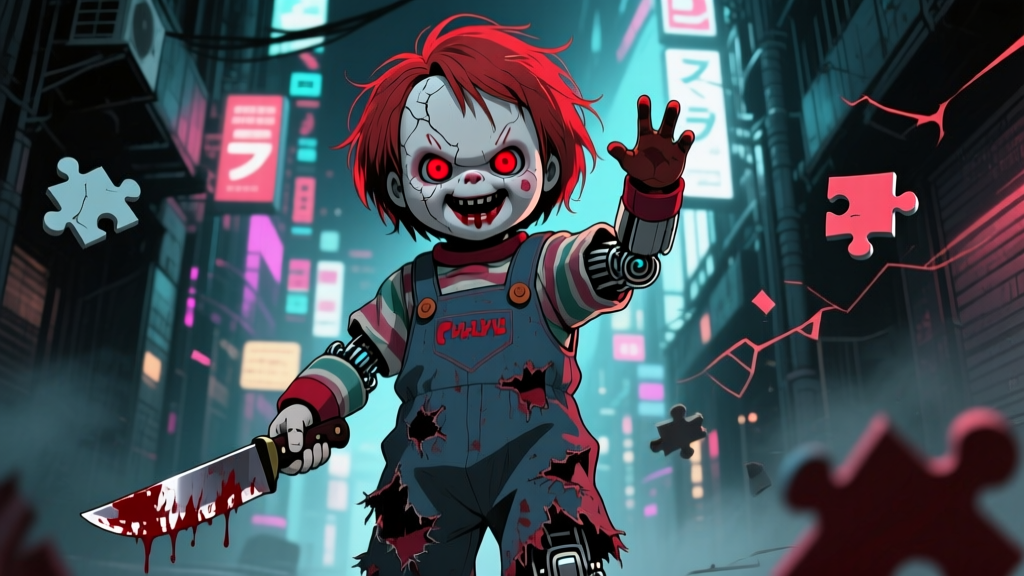
Denim overalls. A striped red-and-white shirt. Freckles dusted across a plastic nose. Twenty-nine inches of injection-molded nightmare fuel that has spent thirty-eight years proving the thing designed to comfort your child was never going to stay friendly.
When people talk about Chucky, they tend to focus on the voice — that gravelly, profanity-soaked rasp that Brad Dourif has delivered across eight films and three television seasons. Or they focus on the kills, the one-liners, the voodoo mythology. But before any of that registers on screen, before Chucky opens his mouth or picks up a knife, what hits you first is the body. The proportions. The physical design. The way a child-sized doll stands in a hallway and every instinct in your brain screams that something is wrong with the geometry of what you're looking at.
The chucky full body design is not an accident. It is the result of deliberate, painstaking work by special effects artists, puppeteers, and a screenwriter who understood that the most effective horror lives in the gap between what looks safe and what is safe. This article breaks down every layer of that design — from the original Good Guy doll proportions to the scarred, burned, stitched-together evolution across seven canonical films, the TV series reinterpretation, and the collectibles market that lets you bring the nightmare home.
The Blueprint: Kevin Yagher and the Original Good Guy Puppet Design
Don Mancini wrote the character. But Kevin Yagher built the body.
Yagher was twenty-six years old when he signed on as the lead special effects artist for Child's Play (1988). He had already apprenticed under Stan Winston — the man responsible for the Terminator endoskeleton and the xenomorph queen in Aliens — and had developed a reputation for animatronic work that blurred the line between prop and performance. When producer David Kirschner handed him Mancini's script and a concept sketch of a "1980s boys' doll," Yagher saw the assignment immediately: build something that looks like a toy until the exact frame where it needs to look alive.
The original Good Guy doll stood approximately 29 inches tall in the fictional toy line. Yagher's team constructed multiple physical versions for the first film, each serving a different production need:
- The full animatronic ("Cable Chucky") — A fully articulated puppet with nine points of facial articulation: independent eyebrows, eyelids, cheek muscles, upper lip, lower jaw, and eye rotation. Operated by a team of six puppeteers using cable controls fed through the doll's body. This version handled all close-up dialogue scenes and emotional expressions.
- The radio-controlled version ("RC Chucky") — A simpler, battery-powered build for walking and running sequences. Lighter than the cable version, with a radio receiver hidden inside the torso. Could move across a set at a convincing toddler pace.
- Static rubber copies — Cast hard-rubber replicas for scenes where Chucky was "just a doll" sitting on a shelf or being carried. These had no internal mechanics but featured hand-painted facial details that matched the animatronic exactly.
- Stunt doubles — Lightweight foam-and-latex builds for scenes involving falls, impacts, or fire. Sacrificial puppets, essentially — designed to be destroyed on camera.
The full body proportions were critical to Yagher's design philosophy. Chucky's head is slightly oversized relative to his torso — roughly a 1:3 head-to-body ratio, compared to the 1:7.5 ratio of an adult human or the 1:4 ratio of a real toddler. This is a standard doll proportion, but on a 29-inch puppet filmed at close range, it creates a subtle visual wrongness. The head is too heavy for the shoulders. The neck barely exists. When Chucky turns to look at you, the whole upper body seems to pivot rather than just the head, which produces the unsettling impression that the doll's gaze carries physical weight.
The costume — red-and-white striped shirt, denim overalls, small red sneakers — was designed to read as "generic 1980s American boy" at a glance. Costume designer April Ferry sourced the overalls from a children's clothing catalog and modified them to fit the puppet's proportions. The stripes on the shirt were hand-painted on some versions and fabric-sewn on others, depending on which puppet was in use. The result was an outfit so aggressively ordinary that it amplified the horror of everything that happened afterward. You don't need to make the monster look scary if you can make it look safe first.
Anatomy of a Doll: Physical Specifications Breakdown
For collectors, cosplayers, and effects artists who study the chucky full body design, the specific physical details matter enormously. Here is a consolidated reference based on screen-used props, production documentation, and licensed replica specifications:
| Feature | Specification | Notes |
|---|---|---|
| Height | 29 inches (73.7 cm) | Fictional toy-line spec; matched by Trick or Treat Studios replica |
| Head-to-body ratio | Approx. 1:3 | Deliberately oversized head for uncanny-valley effect |
| Hair | Red-auburn, rooted synthetic fiber | Hand-punched into scalp on animatronic versions; molded on static copies |
| Eyes | Blue, oversized, glass-like | Hand-painted irises on original props; tracking-pupil mechanism on cable puppet |
| Skin | Flesh-toned latex/rubber with freckles | Freckles hand-painted; scarred versions use layered silicone for wound texture |
| Shirt | Red-and-white horizontal stripes | Hand-painted on some puppets, fabric-sewn on others |
| Overalls | Denim, modified children's pattern | Sourced from catalog, adjusted for puppet proportions; Good Guy logo patch on chest |
| Shoes | Red sneakers, rubber-soled | Small enough to fit in an adult palm; weighted on RC version for stability |
| Facial articulation | 9 points (cable puppet) | Brows, lids, cheeks, upper lip, jaw, eye rotation |
| Weight (animatronic) | Approx. 12–15 lbs | Cable puppet with internal armature; static versions significantly lighter |
Scar Tissue and Stitch Marks: The Body's Evolution Across Seven Films
One of the sharpest design decisions in the Child's Play franchise is that Chucky's body degrades. Unlike Freddy Krueger, whose burned appearance stays consistent across every Nightmare on Elm Street film, or Michael Myers, whose mask resets with each sequel, Chucky accumulates damage. His body tells the story of every time he's been shot, stabbed, burned, dismembered, and resurrected. By the later films, the Good Guy doll barely resembles a Good Guy doll at all.
Child's Play (1988) — The Clean Slate
The original film presents two distinct versions of the chucky full body: the pristine Good Guy doll (unblemished skin, bright overalls, perfectly combed auburn hair) and the damaged version that emerges in the third act. After being shot, burned, and thrown around the Barclay apartment, Chucky's face develops cracks in the latex skin, exposing the mechanical endoskeleton beneath. One eye hangs loose. The shirt is singed. The overalls are torn. Yagher designed this progression to mirror the film's narrative: the further Charles Lee Ray's consciousness penetrates the doll body, the more the human violence leaks through the toy exterior.
Child's Play 2 (1990) — The Factory Rebuild
The sequel opens with the Good Guys toy company retrieving Chucky's remains and rebuilding him in a factory sequence designed to cover up the original incident. This "resurrected" Chucky has visible seam lines running along his face and body — thin, raised scars where new plastic was fused to old. His skin is slightly paler than the first film's version, giving him a wax-corpse quality. The overalls are cleaner, the hair freshly rooted, but something in the proportions feels reconstructed rather than restored. Effects artist Kevin Yagher returned for the sequel and insisted on these imperfections: the doll should look like a toy that was broken and badly repaired, not a toy that was replaced.
Child's Play 3 (1991) — The Military School Version
By the third film, the Good Guys toy line has been relaunched with a new marketing campaign, and Chucky's body reflects the franchise's in-universe reboot. His overalls are slightly darker denim, his shirt stripes more uniform. But the wear shows faster this time — within the first act, he's already accumulated dirt, scuffs, and a hairline crack across his left cheek from a fall onto concrete. The military school setting meant more action sequences, and the effects team (now led by David Allen after Yagher moved on to other projects) built heavier-duty stunt puppets with reinforced armatures. The tradeoff was a slight loss of facial expressiveness — the cable puppet's nine-point articulation was reduced to six points for durability.
Bride of Chucky (1998) — The Burned Icon
This is where the chucky full body design takes its most dramatic turn. Bride of Chucky opens with Chucky's remains stored in an evidence locker — and what remains is barely recognizable. The film's opening sequence shows his body reassembled from fragments: the face is a patchwork of scar tissue and fresh stitching, one arm is held together with surgical tape, and the overalls have been replaced by a makeshift wrapping of cloth and wire. When Tiffany (Jennifer Tilly) reconstructs him using a needle and thread, the stitching becomes part of his permanent design — thick black thread running across his face like a crude smile, his body held together by visible seams.
This "Frankenstein's Chucky" look became the character's defining visual for the next two decades. The scar tissue is rendered in a raised, pinkish silicone that contrasts with the original flesh-toned latex — a deliberate choice by effects supervisor David LeRoy Anderson to make the damage read as healed-but-wrong rather than fresh-and-gory. The pink scar tissue against the white-and-red striped shirt creates a color palette that is simultaneously doll-like and diseased.
Seed of Chucky (2004) — Domestic Decay
Seed of Chucky leans into the domestic-comedy angle, and the body design reflects a Chucky who has settled into something approaching a routine. The scars from Bride are still present but weathered, faded to a dull rose color. His hair is longer and messier — a deliberate choice that makes him look less like a factory-fresh doll and more like a person who has stopped caring about appearance. The overalls are stained and frayed at the cuffs. When his child Glen/Glenda is introduced (a genderless doll with no genitals, no navel, and a smooth, featureless lower body — a design choice that was both narratively significant and the subject of considerable fan discussion), the contrast between parent and child highlights how far Chucky has drifted from his Good Guy origins.
Curse of Chucky (2013) and Cult of Chucky (2017) — The Return to Horror
Don Mancini directed both of these direct-to-video entries and made a conscious decision to strip the character back to his horror roots. The chucky full body in Curse is closer to the 1988 original than any sequel version: cleaner skin, more intact overalls, brighter hair. But the damage accumulates faster within the film's single-location narrative — by the climax, Chucky's face is half-melted from a fire, exposing the skull-like armature beneath in a design that directly references the Terminator endoskeleton (an intentional homage, given Yagher's Stan Winston lineage).
Cult of Chucky introduced the soul-splitting mechanic, meaning multiple Chucky dolls appear simultaneously — each with identical Good Guy bodies but different damage patterns. One has a crushed skull. Another has been partially dissolved. A third is pristine, which somehow makes it more unsettling than the damaged ones. The effects team, led by Masters FX, built over a dozen individual puppets for this film, each representing a different "instance" of Charles Lee Ray's consciousness. Seeing an entire room full of Chucky bodies, each with unique wear patterns, is one of the franchise's most visually striking moments.
The Voice Inside the Body: Brad Dourif's Performance Architecture
A puppet without a voice is a prop. Brad Dourif made Chucky a character.
Dourif had already established himself as one of Hollywood's most reliable character actors — an Oscar nomination for One Flew Over the Cuckoo's Nest (1975), memorable turns in Blue Velvet (1986) and Mississippi Burning (1988) — when Don Mancini cast him as the voice of Charles Lee Ray. The decision was partly practical: Dourif could record dialogue in a booth while the puppeteers operated the doll on set, lip-syncing to playback. But it was also a creative masterstroke, because Dourif understood something about the role that most voice actors would have missed.
The Good Guy doll's pre-programmed voice lines — "Hi, I'm Chucky, and I'm your friend 'til the end!" and "I wanna play!" — are delivered in a high-pitched, cheerful register that sounds exactly like a 1980s talking toy. Dourif recorded these with a slightly compressed, tinny quality, mimicking the frequency range of a cheap speaker inside a plastic chest cavity. When Charles Lee Ray's consciousness takes over, the voice drops an octave, loses the tinny filter, and becomes raw, guttural, profane. The transition between these two registers — often happening mid-sentence — is the sonic equivalent of watching a toy's face rearrange itself into a killer's expression.
Dourif has voiced Chucky in every canonical film and every episode of the TV series, making his tenure one of the longest continuous performer-character pairings in horror history. Robert Englund played Freddy Krueger across eight films over 25 years. Dourif has played Chucky across eight films and three TV seasons over 38 years and counting. The voice has aged — it's raspier now, with more gravel in the lower register — and rather than hiding that, Mancini has written the aging into the character. The Chucky of the 2021 TV series sounds tired. He sounds like a killer who has been doing this for four decades and is starting to feel the weight of it. That exhaustion, filtered through Dourif's performance, gives the character an emotional texture that no other horror villain possesses.
"I never thought of Chucky as a voice role. I thought of him as a role. If you were doing Shakespeare and the director said 'you're playing the king, but you're inside a doll,' you'd still play the king. The body is the costume. The voice is the character."
— Brad Dourif, interview with Dread Central, October 2021
The TV Series Body: Chucky on the Small Screen (2021–2024)
When the Chucky television series premiered on SYFY and USA Network in October 2021 (drawing 4.4 million viewers across both networks on premiere night, per Nielsen data), the production team faced a practical problem that film crews had never encountered: they needed to build a Chucky puppet that could sustain a full-body performance across ten episodes of television, with the turnaround speed and durability that a TV production schedule demands.
The solution was a hybrid approach. For wide shots and full-body walking sequences, the series used a combination of practical puppetry and digital augmentation — a technique where a physical puppet was operated on set, and then CGI was used to clean up cable lines, smooth out joint movements, and add micro-expressions that the physical puppet couldn't achieve. For close-up dialogue scenes, a new generation of cable-controlled puppets was built with twelve points of facial articulation — three more than the original 1988 version — including independent nostril flaring and tongue movement.
The TV series also introduced multiple Chucky variants. The "Classic Chucky" retained the scarred Bride-era design, while newly manufactured Good Guy dolls (created within the show's narrative by a surviving executive at the fictional Play Pals toy company) featured a cleaner, more modernized look — slightly updated proportions, brighter paint, more contemporary overalls stitching. The visual contrast between the battered original and the fresh copies reinforced the show's central theme: you can remake the body, but you can't remake the soul inside it.
Season 2 (2022) expanded the body design further by introducing a "burned Chucky" variant — a doll whose body had been severely fire-damaged, with charred and bubbled latex skin, melted overalls fused to the torso, and exposed wiring that sparked intermittently. The effects team used a combination of silicone prosthetics and practical pyrotechnic residue (actual burned material applied to the puppet surface) to achieve the texture. Season 3 (2024), the series' final run, featured the most extreme body degradation yet: a Chucky whose consciousness was fragmenting across multiple bodies simultaneously, with each body reflecting a different stage of the character's physical history — pristine 1988 Good Guy, scarred Bride-era, burned Seed-era, and a new "decayed" variant with cracking skin and visible mold growth in the hair fibers.
The Knife and the Accessories: Completing the Full Body Picture
No discussion of the chucky full body design is complete without the knife.
Chucky's primary weapon — an eight-inch kitchen knife with a silver blade and a black composite handle — has appeared in every film and every season of the TV series. The prop department built multiple versions: full-size blades for close-up insertion scenes (blunted tips, retractable blades), miniature versions scaled to the puppet's hand for wide shots, and breakaway blades designed to snap on impact for stunt sequences. The knife's design has remained nearly identical across thirty-eight years, which is itself a statement: when the audience sees that specific blade gripped in a small plastic hand, they know exactly what happens next.
Beyond the knife, Chucky's body has been accessorized with an increasingly creative arsenal across the franchise:
- Electrical wire — Used to strangle victims in Child's Play (1988) and the TV series pilot. Thin, silver-colored copper wire, coiled in the doll's grip.
- Surgical tools — Curse of Chucky (2013) features Chucky wielding a scalpel and bone saw in a confined house setting, with the tools appearing oversized in his small hands.
- Firearms — Bride of Chucky and Seed of Chucky feature scenes where Chucky handles pistols and rifles, requiring specially built puppet hands with functional trigger fingers.
- Improvised weapons — Nail guns, ceiling fans, yard tools. The TV series made a point of showing Chucky adapting everyday objects into kill instruments, which required custom grip attachments on the puppet hands.
Franchise Body Comparison: How Each Era Stacks Up
| Era | Skin Condition | Costume State | Key Design Feature | Articulation Points |
|---|---|---|---|---|
| Child's Play (1988) | Clean, progressing to cracked | Pristine, then singed/torn | Endoskeleton reveal in third act | 9 (cable puppet) |
| Child's Play 2 (1990) | Pale, visible seam lines | Fresh overalls, factory-new | Reconstructed "wax corpse" quality | 9 |
| Child's Play 3 (1991) | Dirt and scuffs, hairline crack | Darker denim, uniform stripes | Heavier stunt builds for action | 6 (reduced for durability) |
| Bride of Chucky (1998) | Patchwork scar tissue, stitched | Cloth-and-wire wrapping, then overalls | Pink silicone scars, black thread | 9 |
| Seed of Chucky (2004) | Faded scars, weathered | Stained, frayed overalls | "Domestic decay" — unkempt, aged | 9 |
| Curse / Cult (2013–2017) | Reset cleaner, then rapid damage | Classic overalls restored | Multiple doll instances with unique wear | 9–12 (Masters FX builds) |
| TV Series (2021–2024) | Multiple variants simultaneously | Classic + modernized copies | 12-point articulation, CGI hybrid | 12 (physical) + digital |
Bring the Body Home: Collectibles and Replicas
The chucky full body design has spawned one of the deepest collectibles markets in horror merchandise. Whether you want a shelf-ready display piece or a screen-accurate museum-quality build, there is a price point and a product for you.
Mass-Market Options
- NECA "Ultimate Chucky" (15-inch) — $45–$60. Multiple interchangeable face plates (innocent, scarred, grinning, burned). Articulated joints. Accessory pack includes knife, cleaver, and miniature Good Guys box. The most popular collector's option by volume.
- Trick or Treat Studios life-size replica (29-inch) — $200–$300. Full-scale Good Guy doll matching the in-universe specifications. Hand-painted details, rooted hair, fabric overalls. This is the version that sits in a chair in your living room and makes delivery drivers uncomfortable.
- Super7 ReAction Figures (3.75-inch) — $18–$22. Retro action-figure format with cardback packaging designed to mimic the fictional Good Guys toy box. Multiple variants including "Bride of Chucky" scarred version and "Cult of Chucky" clean version.
- Funko Pop! Chucky — $12–$15. The stylized big-head format, available in multiple exclusives (Hot Topic, FYE, convention variants). Not screen-accurate but widely accessible.
- Medicom RAH (Real Action Heroes) Chucky — $220–$280. 12-inch articulated figure with cloth costume, screen-accurate face sculpt, and multiple hand positions. The premium collector's choice for display.
Screen-Used Props and Auction Pieces
The serious collector's market. Heritage Auctions sold a screen-used Good Guy doll from the 1988 Child's Play — a cast hard-rubber static puppet with hand-painted features — for $40,000 in 2022. A cable-controlled animatronic head unit from Child's Play 2 fetched over $65,000 at a Prop Store auction in Los Angeles the same year. These values place Chucky props in the same tier as screen-used Freddy Krueger gloves and original Michael Myers masks, with authenticated pieces appreciating roughly 8–12% annually, per tracking by Horror Memorabilia Quarterly (2024 annual report).
The most sought-after item remains the original Good Guys packaging box — the cheerful retail display with the tagline "I'm Chucky, your friend 'til the end!" Reproduction boxes sell for $25–$40 empty, but an original 1988 production box (never used as an actual retail product, since the Good Guy doll was fictional) has appeared at auction only twice, selling for $3,500 and $4,200 respectively.
Why the Body Design Matters More Than You Think
Here is the argument this article has been building toward: the chucky full body design is the single most important element of the franchise's longevity.
Consider the alternatives. Annabelle is a porcelain doll that sits in a case — visually striking but passive. M3GAN is a sleek, modern android — effective in her one film but too specific to a technological moment to sustain decades of sequels. Slappy the Dummy is a vaudeville prop — fun, but tonally limited to PG-rated mischief. What separates Chucky from all of them is that his body is expressive. The 29-inch frame, the oversized head, the slightly wrong proportions — these elements combine to create a vessel that can hold personality, not just menace.
When Chucky slumps in a chair after a failed kill attempt, his body language communicates frustration. When he tilts his head while studying a potential victim, the gesture reads as curiosity. When he runs — that stiff, slightly top-heavy sprint that the RC puppet achieved in 1988 and every subsequent effects team has worked to replicate — the movement is simultaneously terrifying and absurd, which is exactly the tonal note that Don Mancini and Kevin Yagher were aiming for from the beginning. Horror and comedy share a border, and Chucky's body lives directly on the line.
The design also benefits from what it doesn't do. Chucky has no supernatural physical abilities. He doesn't teleport, shapeshift, or grow to monstrous proportions. He is twenty-nine inches of plastic and latex and he stays that way. His kills are accomplished through cunning, improvisation, and the element of surprise — not superhuman strength. This constraint keeps the body design grounded in a physical reality that audiences can believe in, even as the voodoo mythology around him becomes increasingly elaborate. The body is the anchor. The body is the constant. Everything else changes, but the Good Guy doll's proportions, his overalls, his freckled face — those remain.
Thirty-eight years. Eight films. Three TV seasons. Dozens of individual puppet builds. One body design that refused to become irrelevant.
Chucky Full Body FAQ — What Collectors and Fans Ask
How tall is Chucky in real life?
The official in-universe height of the Good Guy doll is 29 inches (73.7 cm). Licensed life-size replicas from Trick or Treat Studios match this specification exactly. Brad Dourif, the voice actor, is 5'9" (175 cm) — meaning the character's human identity, Charles Lee Ray, was an average-height man whose consciousness was compressed into a body less than a quarter of his original size.
How many different Chucky puppets have been built across the franchise?
Across all eight films and three TV seasons, the production teams have built an estimated 80–100 individual Chucky puppets, including animatronic, radio-controlled, static, and stunt variants. The TV series alone required over a dozen puppet builds per season. Many of these were damaged or destroyed during production, particularly stunt doubles used in fire and impact scenes. A small number survive in studio archives and private collections.
Why does Chucky's face look different in Bride of Chucky?
The scarred, stitched appearance in Bride of Chucky (1998) was a deliberate redesign by effects supervisor David LeRoy Anderson. Within the narrative, the character had been dismembered at the end of Child's Play 3 and was reassembled by Tiffany using crude surgical techniques. The pink silicone scar tissue and black thread stitching became the character's defining look from that film forward, replacing the relatively clean Good Guy appearance of the first three films.
Is the 2019 reboot Chucky the same design?
No. The 2019 Child's Play reboot, produced by Bron Creative and Orion Pictures without Don Mancini's involvement, features a different doll called "Buddi" — a taller, more modern-looking smart-toy with a different face sculpt, different proportions, and a different costume (a solid-color shirt instead of the iconic stripes-and-overalls). The reboot's doll was designed to look like a contemporary tech product rather than a 1980s toy. Rights issues prevent the reboot from using the "Good Guy" name or the original Chucky character design.
What is the most expensive Chucky collectible ever sold?
A screen-used cable-controlled animatronic head from Child's Play 2 (1990) sold for over $65,000 at a Prop Store auction in Los Angeles in 2022. This remains the highest publicly recorded sale price for a Chucky-related item. A static Good Guy doll prop from the original 1988 film sold at Heritage Auctions for $40,000 in the same year.
Can Chucky's body be permanently destroyed in the films?
The doll body can be destroyed — and has been, repeatedly, through gunfire, fire, dismemberment, melting, and industrial shredding. However, the voodoo mythology allows Charles Lee Ray's soul to transfer to new vessels or to split across multiple bodies simultaneously (as introduced in Cult of Chucky). As of the TV series finale in 2024, Chucky's consciousness persists despite the destruction of numerous physical bodies. The body is replaceable. The soul is the problem.
Where can I buy a life-size Chucky doll?
The most accessible life-size option is the Trick or Treat Studios 29-inch Good Guy replica, available through trickortreatstudios.com and major Halloween retailers seasonally ($200–$300). NECA's 15-inch "Ultimate Chucky" provides a mid-range option at $45–$60 through entertainmentearth.com and specialty shops. For screen-accurate builds, custom effects artists and prop replicas occasionally surface on eBay and horror collector forums, typically in the $500–$2,000 range depending on detail level.
Sources: Fangoria Issue #372 (2018 Don Mancini interview); Dread Central Brad Dourif interview (October 2021); Heritage Auctions lot #7356-89857 (2022 sale); Prop Store Los Angeles auction results (2022); Horror Memorabilia Quarterly annual report (2024); SYFY/USA Network Nielsen premiere data (October 2021); Box Office Mojo (Child's Play franchise); Kevin Yagher production notes, Child's Play DVD special features (MGM, 2003); Child's Play 2 behind-the-scenes featurette (Universal, 2004); Masters FX studio interviews, Cult of Chucky Blu-ray extras (Universal, 2018).