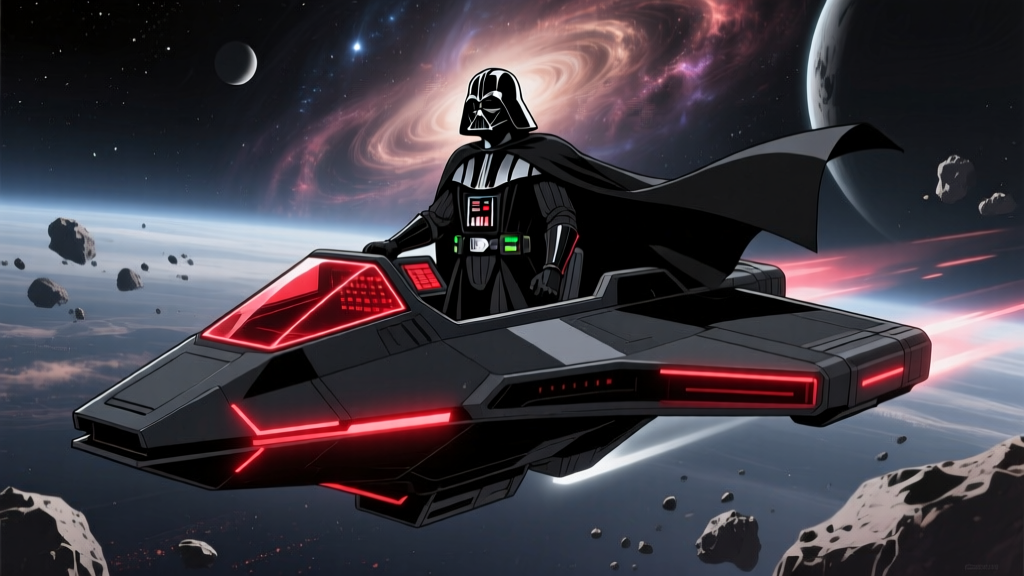
Twin solar panels folded like wings. A hull the colour of a Star Destroyer's belly. And one passenger who made the entire vessel feel like a flying coffin.
SenpaiSite Editorial • Updated June 2026When the hangar doors of the Super Star Destroyer Executor slid open in the early minutes of The Empire Strikes Back, a small, angular craft descended toward the icy surface of Hoth. It was not a fighter. It was not a bomber. It was a shuttle — a Lambda-class T-4a transport, painted in the muted grey of the Imperial fleet, carrying the most feared man in the galaxy to inspect a remote outpost. The scene lasts maybe forty seconds. Most viewers do not consciously register the ship. But that shuttle, and the ones that followed it across Return of the Jedi and the broader Star Wars canon, did more quiet storytelling work than most named characters in the original trilogy.
The Lambda-class shuttle became Darth Vader's personal transport not because it was the fastest or the most heavily armed vessel in the Imperial Navy, but because it communicated something that a fighter or a capital ship could not: authority without spectacle. Vader did not need a warship to announce his arrival. He needed a vehicle that said, I am here on business, and you should be afraid.
This article covers every dimension of the Darth Vader shuttle — its in-universe design specifications, its on-screen appearances, the TIE Advanced x1 starfighter that sometimes replaced it, its symbolic weight within the Star Wars narrative, and the collectibles market that has grown around one of the most recognizable silhouettes in the Imperial fleet.
Design and Specifications: The Lambda-Class T-4a Shuttle
The Lambda-class T-4a shuttle was designed by Sienar Fleet Systems, the same manufacturer responsible for the TIE fighter line. It entered Imperial service during the early years of the Galactic Empire and quickly became the standard personnel transport for high-ranking officers, government officials, and — most relevantly — Sith Lords operating under the Emperor's authority.
The ship's most recognizable feature is its triple-wing configuration. Two lateral solar panel wings fold upward when the shuttle is on the ground or in a hangar, giving it a hunched, bird-of-prey silhouette. A central dorsal wing extends vertically and houses sensor arrays and communication equipment. In flight, all three wings deploy outward, creating a wide, stable profile that prioritizes smooth atmospheric handling over speed or agility.
The hull is approximately 20 metres long, with a crew complement of up to six and a standard passenger capacity of eight, though the VIP-configured shuttles used by Vader and other senior Imperials typically carried fewer passengers in exchange for secure communications suites, deflector shield generators, and reinforced hull plating.
Engines and Performance
The Lambda-class uses a pair of Sienar Fleet Systems LS-72 twin ion engines, mounted on either side of the aft fuselage. These provide adequate sublight speed for a transport of its class — roughly 800 kilometres per hour in atmosphere, with a Class 1 hyperdrive for interstellar travel. The hyperdrive is the critical detail: it means the shuttle can make independent jumps between star systems without relying on a carrier ship. For a man like Vader, who frequently travelled alone or with a minimal retinue to impose his will on distant garrisons and fleet commanders, that autonomy was non-negotiable.
Armament and Defences
The standard Lambda-class carries two forward-mounted laser cannons and a deflector shield generator. This is modest armament by military standards, but the shuttle was never designed to win dogfights. Its defensive profile assumes that the vessel is either operating in secure Imperial space or travelling under escort. When Vader used a Lambda-class shuttle, it was almost always accompanied by TIE fighters or launched from a capital ship that could provide cover. The shuttle's job was to get a VIP from point A to point B in relative comfort and safety, not to engage enemy forces.
That said, some Legends-era sourcebooks — notably Star Wars: The Essential Guide to Vehicles and Vessels by Bill Smith — describe modified Lambda-class shuttles assigned to Vader that carried enhanced shielding, improved weapons, and encrypted Imperial Priority channels that gave them clearance to land anywhere in Imperial-controlled space without advance notice. Whether those modifications were standard for all VIP-configured Lambda shuttles or specific to Vader's personal craft depends on which continuity you follow, but the practical implication is the same: when that shuttle appeared on a garrison's sensor sweep, the commanding officer had roughly fifteen minutes to make sure everything was in order before the Dark Lord walked down the boarding ramp.
Interior Configuration
The cockpit accommodates a pilot and co-pilot side by side, with a narrow corridor leading back to the passenger compartment. In Vader's case, the passenger area was typically configured as a private cabin — a single meditation chamber or command seat surrounded by secure communications equipment. The Star Wars: Complete Locations reference book (DK Publishing, updated edition 2016) describes the interior as spartan by civilian standards: grey bulkheads, minimal padding, functional lighting. This was not a luxury yacht. It was a mobile command post designed for a man who had no interest in comfort and every interest in efficiency.
On-Screen Appearances: From Hoth to Endor
The Empire Strikes Back (1980)
The Lambda-class shuttle makes its first significant on-screen appearance in The Empire Strikes Back, though it is easy to miss if you are not looking for it. During the Hoth sequence, as the Imperial forces prepare their ground assault on Echo Base, a Lambda-class shuttle descends through the cloud layer and lands on the ice. The scene establishes that Vader has arrived to take direct command of the operation, rather than relying on Admiral Ozzel or General Veers alone.
The shot is brief but loaded with narrative information. The shuttle's descent is smooth, controlled, almost leisurely — it communicates that whoever is aboard has absolute confidence in their security and no concern for the Rebel defences below. When the ramp lowers and Vader steps out onto the ice, the shuttle behind him frames his silhouette in a way that makes the vessel feel like an extension of his armour: angular, grey, and utterly without warmth.
Later in the film, Vader uses a shuttle to travel from the Executor to Cloud City on Bespin, where he intends to confront Luke Skywalker. The Cloud City landing sequence gives the Lambda-class its most extended atmospheric flight footage in the original trilogy. The twin solar-panel wings extend fully as the shuttle descends through the orange-tinted clouds, and the vessel touches down on one of the city's landing pads with a grace that belies its boxy fuselage.
Return of the Jedi (1983)
Return of the Jedi gives the Lambda-class shuttle its most iconic moment and the scene most directly associated with the "Darth Vader shuttle" in popular memory. The film's opening act shows a Lambda-class shuttle descending to the forest moon of Endor, carrying Vader to the second Death Star under construction in orbit above. The approach sequence is one of the most visually striking in the original trilogy: the shuttle descends through dense cloud cover, its blue cockpit windows glowing faintly against the grey hull, while the skeletal framework of the Death Star looms in the sky behind it.
This scene is significant because it establishes the Death Star II's shuttle landing platform as a key location. Vader steps off the ramp and is met by the garrison commander, who immediately reports the status of the shield generator protecting the battle station. The entire sequence is shot to emphasize the shuttle's role as a harbinger — wherever it lands, trouble follows.
Later in the film, a second Lambda-class shuttle appears when the Emperor himself arrives at the Death Star. Palpatine's shuttle is visually identical to Vader's — the same grey hull, the same wing configuration, the same oppressive lack of ornamentation. This was a deliberate choice by the production designers: the shuttle is not personalized to its occupant because the Empire does not celebrate individuality. Even the two most powerful Force users in the galaxy travel in standard-issue military transports. The Empire's aesthetic is one of conformity, and the Lambda-class embodies that principle in every rivet.
Beyond the Original Trilogy
The Lambda-class shuttle appears across the broader Star Wars franchise in animated series, comics, novels, and video games. In Star Wars: The Clone Wars, a younger version of the shuttle is visible in Republic-era scenes, establishing that the design predates the Empire (though the Lambda-class became more closely associated with the Imperial military after the transition). In Star Wars Rebels, Lambda-class shuttles appear at Imperial installations and serve as mission targets for the Ghost crew's raids. The Rogue One novelization by Alexander Freed references a Lambda-class shuttle assigned to Vader's fortress on Mustafar, further cementing the vessel's association with the Dark Lord across multiple media.
The TIE Advanced x1: Vader's Other Ride
No discussion of Darth Vader's personal craft is complete without addressing the TIE Advanced x1 starfighter — the sleek, prototype fighter Vader piloted during the Battle of Yavin in A New Hope. While the Lambda-class shuttle served as Vader's transport between systems and installations, the TIE Advanced was his weapon of choice when the situation demanded he take a hands-on role in combat.
The TIE Advanced x1 was a prototype developed by Sienar Fleet Systems as a potential successor to the standard TIE/ln fighter. Unlike the mass-produced TIE fighters flown by Imperial pilots, the Advanced x1 featured a hyperdrive, deflector shields, and a pair of laser cannons mounted on the cockpit module rather than the wing panels. The distinctive bent-wing design — with angled solar panels that fold slightly forward — gave it a predatory, aggressive silhouette that set it apart from the flat hexagonal wings of the standard TIE.
Vader's personal TIE Advanced was further modified with enhanced targeting systems, improved engine output, and a life-support interface compatible with his chest-mounted control panel. When he flew into the trench run during the Battle of Yavin, he was flying a one-of-a-kind prototype that the Empire never put into full production. The reasons for the cancellation vary depending on the source: cost overruns, the Empire's preference for quantity over quality in its fighter doctrine, and the strategic reality that a hyperdrive-equipped fighter posed a security risk if captured.
The relationship between the TIE Advanced and the Lambda-class shuttle in Vader's operational life was complementary rather than competitive. When Vader needed to intimidate a garrison commander, negotiate with a crime lord, or travel to a secure facility, he took the shuttle. When he needed to dogfight, pursue fleeing Rebels, or personally engage in combat operations, he flew the TIE Advanced. The shuttle was his office. The fighter was his weapon.
The Lambda-class shuttle carried Vader's authority. The TIE Advanced x1 carried his rage. One arrived with the weight of the Empire behind it. The other arrived with the weight of a lightsaber.
Lambda-Class Shuttle vs. TIE Advanced x1: Side by Side
The two most significant vessels in Vader's personal fleet served entirely different functions. Here is how their specifications compare.
| Specification | Lambda-Class T-4a Shuttle | TIE Advanced x1 |
|---|---|---|
| Manufacturer | Sienar Fleet Systems | Sienar Fleet Systems |
| Length | 20 metres | 5.8 metres |
| Crew | 1–6 (pilot + support) | 1 (pilot only) |
| Passengers | Up to 8 (VIP configs fewer) | None |
| Hyperdrive | Class 1 | Class 4 (prototype) |
| Atmospheric Speed | ~800 km/h | ~1,200 km/h |
| Armament | 2 forward laser cannons | 2 twin laser cannons (cockpit-mounted) |
| Deflector Shields | Standard | Prototype (enhanced) |
| Primary Role | VIP transport / command shuttle | Prototype space superiority fighter |
| Production Status | Mass-produced | Prototype only (never full production) |
The table illustrates a fundamental divide: the shuttle was built for logistics and presence, the fighter for combat and pursuit. Vader used both depending on the mission, but it was the shuttle that became synonymous with his day-to-day operations as the Emperor's chief enforcer.
Symbolic Weight: Why the Shuttle Matters More Than It Looks
On the surface, the Lambda-class shuttle is unremarkable. It is not the fastest ship in the Imperial fleet. It is not the most heavily armed. It lacks the visual drama of a Star Destroyer or the mythological weight of the Death Star. Yet the Lambda-class shuttle that carries Darth Vader through the original trilogy performs a specific narrative function that no other vehicle in the Star Wars saga replicates quite as effectively: it is the vessel that brings bad news.
Consider the pattern. In The Empire Strikes Back, the shuttle descends to Hoth and Vader personally takes command of the ground assault, overriding his generals. In Return of the Jedi, the shuttle arrives at Endor and the Death Star's construction timeline is accelerated under the Dark Lord's direct supervision. In both cases, the shuttle's arrival signals a shift from standard Imperial operations to something more intense, more dangerous, and more personal. The garrison commanders who watch that grey hull descend through their atmosphere are not receiving a visiting dignitary. They are receiving an auditor with a lightsaber.
This is why the shuttle, rather than a fighter or a capital ship, is the correct vessel for Vader's character. A Star Destroyer would be too impersonal — it orbits at altitude and sends troops down in landing craft. A TIE fighter would be too aggressive — it implies a combat situation. The shuttle occupies a middle ground: it is a transport that implies a visit, a meeting, an inspection. The threat is not in the vessel's weapons. The threat is in who steps off the ramp when it lands.
The production designers at Industrial Light & Magic understood this implicitly. Joe Johnston, who contributed concept art for The Empire Strikes Back and later directed films including The Rocketeer and Captain America: The First Avenger, has spoken in interviews about the deliberate restraint in the Lambda-class design. The shuttle was meant to look functional, even mundane — a workhorse transport that would not draw attention to itself. The terror it inspired came entirely from context, not from design. That is a harder trick to pull off than building something that looks overtly threatening, and it is one of the reasons the Lambda-class has aged so well in the Star Wars visual vocabulary.
There is also a practical filmmaking dimension. In the early 1980s, model-making at ILM was an art form defined by physical constraints. The Lambda-class shuttle miniature, built for The Empire Strikes Back and reused with modifications for Return of the Jedi, was a relatively small and simple model compared to the massive Star Destroyer or Millennium Falcon miniatures. Its clean lines and flat surfaces were easier to photograph against bluescreen composites, and its wing-folding mechanism gave the model-makers a mechanical gimmick that added visual interest to landing and takeoff sequences without requiring complex pyrotechnics. The shuttle's on-screen presence was, in part, a product of what the effects team could build, photograph, and composite efficiently within the production schedule.
Collectibles: Owning the Dark Lord's Transport
The Lambda-class shuttle occupies a curious position in the Star Wars collectibles market. It does not generate the same immediate recognition as the Millennium Falcon or the X-wing, and it lacks the character appeal of a named starfighter like Boba Fett's Slave I. But among serious Star Wars vehicle collectors, the Lambda-class shuttle — particularly in its association with Darth Vader — is a cornerstone piece. Here is a survey of the most notable collectible versions.
LEGO Imperial Shuttle (75055 and earlier sets)
LEGO has released the Lambda-class shuttle in multiple sets over the years. The most widely known is set 75055, released in 2014 as part of the Return of the Jedi wave. This set includes 1,366 pieces, four minifigures (Darth Vader, a stormtrooper officer, and two stormtroopers), and a faithfully reproduced Lambda-class hull with folding wings, a detailed cockpit, and an opening boarding ramp. The grey-and-white colour scheme matches the film-accurate Imperial palette. Original retail was approximately $170, and the set has been retired. Secondary market prices for sealed copies typically range from $350 to $550, with opened-but-complete sets selling for $150 to $250.
An earlier LEGO Lambda-class shuttle appeared in the 2007 set 10174, part of the Ultimate Collector Series. This version used a slightly different piece inventory and included Darth Vader and Palpatine minifigures. The UCS designation gave it a larger scale and more detailed interior than the later 75055. Sealed copies of 10174 command significant premiums on the secondary market, often exceeding $800.
Model Kits: Bandai and Beyond
Bandai's Star Wars vehicle model kit line includes a 1/144 scale Lambda-class shuttle that is widely regarded as one of the best value-for-money Star Wars model kits on the market. The kit features snap-fit construction (no glue required), pre-coloured parts that match the film-accurate Imperial grey, and decals for both the standard Imperial shuttle markings and the specific shuttle seen in Return of the Jedi. Retail price sits around $25 to $35, and the kit is praised for its accuracy, panel line detail, and the functional wing-folding mechanism.
For advanced modellers, Bandai also released a Perfect Grade (PG) Lambda-class shuttle in a larger scale with significantly more internal detail, including a cockpit interior, a passenger cabin, and an engine bay with removable panels. The PG kit retails for approximately $120 and requires more assembly skill but rewards it with a display piece that rivals premium die-cast models in terms of detail and presence.
AMT/ERTL released vintage Lambda-class shuttle model kits in the 1980s alongside the original trilogy merchandise. These are now collector's items in their own right. A sealed, original 1983 ERTL Lambda-class shuttle kit in good box condition can sell for $150 to $300, driven by nostalgia and the increasingly active market for vintage Star Wars model kits.
Hot Toys and Premium Collectibles
Hot Toys has not released a standalone Lambda-class shuttle as of this writing, though the company's Darth Vader diorama sets occasionally include shuttle components as backdrop or display-base elements. The most significant premium Lambda-class shuttle collectible comes from Sideshow Collectibles, which released a limited-edition display piece featuring a detailed shuttle model mounted on a display stand with Imperial insignia. Original retail was approximately $300, and secondary market prices have climbed steadily as production numbers remain limited.
Fantasy Flight Games included a Lambda-class shuttle miniature in their Star Wars: X-Wing Miniatures Game line. The miniature, sculpted at a scale compatible with the other ships in the game, features impressive detail for its size, including the folded and deployed wing configurations (swappable parts). The expansion pack retailed for around $30 and remains available on the secondary market for $20 to $50 depending on condition and completeness.
Hasbro and Action Figure Vehicles
Hasbro released a Lambda-class shuttle vehicle in the Star Wars: The Vintage Collection line, scaled to accommodate 3.75-inch action figures. This release, which came packaged with a Darth Vader figure, recreated the shuttle in a compact form factor with folding wings and an opening ramp. Retail was approximately $50, and the set has been well-received by collectors who appreciate the pairing of the figure and the vehicle. Secondary market prices range from $60 to $120 for sealed examples.
The Kenner line from the original trilogy era never produced a Lambda-class shuttle toy, which has been a long-standing complaint among vintage collectors. The shuttle was simply not part of the vehicle lineup during the 1980–1985 Kenner production runs, despite its prominence in The Empire Strikes Back and Return of the Jedi. This omission is frequently cited as one of the most significant gaps in the vintage Kenner Star Wars toy line.
Frequently Asked Questions
What is the official name of Darth Vader's shuttle?
The shuttle is the Lambda-class T-4a shuttle, manufactured by Sienar Fleet Systems. It is a standard Imperial personnel transport used by high-ranking officers and officials throughout the Imperial fleet. Vader's specific shuttle was a VIP-configured variant with enhanced communications and shielding, but the base design was shared across the entire Imperial military.
Does the Lambda-class shuttle have a hyperdrive?
Yes. The Lambda-class T-4a is equipped with a Class 1 hyperdrive, which allows it to make independent hyperspace jumps between star systems. This capability was essential for VIP transports, as it eliminated the need for a carrier ship or escort to provide hyperspace navigation.
Which Star Wars films does the Lambda-class shuttle appear in?
The Lambda-class shuttle appears in The Empire Strikes Back (1980), Return of the Jedi (1983), and across various expanded universe media including The Clone Wars, Rebels, and the Rogue One novelization. Its most iconic appearance is the descent to the forest moon of Endor in the opening act of Return of the Jedi.
What is the difference between the Lambda-class shuttle and the TIE Advanced x1?
The Lambda-class shuttle is a transport — designed to carry VIPs between systems and installations. The TIE Advanced x1 is a prototype starfighter — designed for space combat and pursuit. Vader used the shuttle for travel and command visits, and the TIE Advanced when he needed to engage in direct combat. The shuttle appeared in Empire and Jedi; the TIE Advanced appeared in A New Hope during the Battle of Yavin.
How many passengers can a Lambda-class shuttle carry?
The standard configuration accommodates up to eight passengers. VIP-configured variants, like those used by Vader, carried fewer passengers in exchange for private cabins, secure communications suites, and enhanced defensive systems.
What is the most valuable Lambda-class shuttle collectible?
The LEGO UCS set 10174, released in 2007, commands the highest secondary market prices, with sealed copies regularly selling for $800 or more. Among non-LEGO collectibles, the Sideshow Collectibles limited-edition display piece and sealed vintage AMT/ERTL model kits from the 1980s hold significant value for serious collectors.
Did Kenner ever make a Lambda-class shuttle toy in the 1980s?
No. Despite the shuttle's prominent appearances in The Empire Strikes Back and Return of the Jedi, Kenner never produced a Lambda-class shuttle vehicle during the original trilogy toy line. This is widely considered one of the most significant omissions in the vintage Kenner Star Wars range and has been a point of frustration for collectors for decades.
Was the Lambda-class shuttle used by anyone other than Vader?
Yes. The Lambda-class was a standard Imperial transport used by officers, officials, and dignitaries across the Empire. In Return of the Jedi, the Emperor himself arrives at the Death Star in a Lambda-class shuttle identical to Vader's. Throughout The Clone Wars, Rebels, and the broader expanded universe, Lambda-class shuttles appear in service to a wide range of Imperial personnel.
The Shuttle That Carried the Weight of the Empire
It never fired a shot in anger on screen. It never made the Kessel Run. But every time that grey hull descended through a planet's atmosphere and that boarding ramp lowered, the galaxy held its breath. That was the Lambda-class shuttle's real weapon: the passenger it delivered.