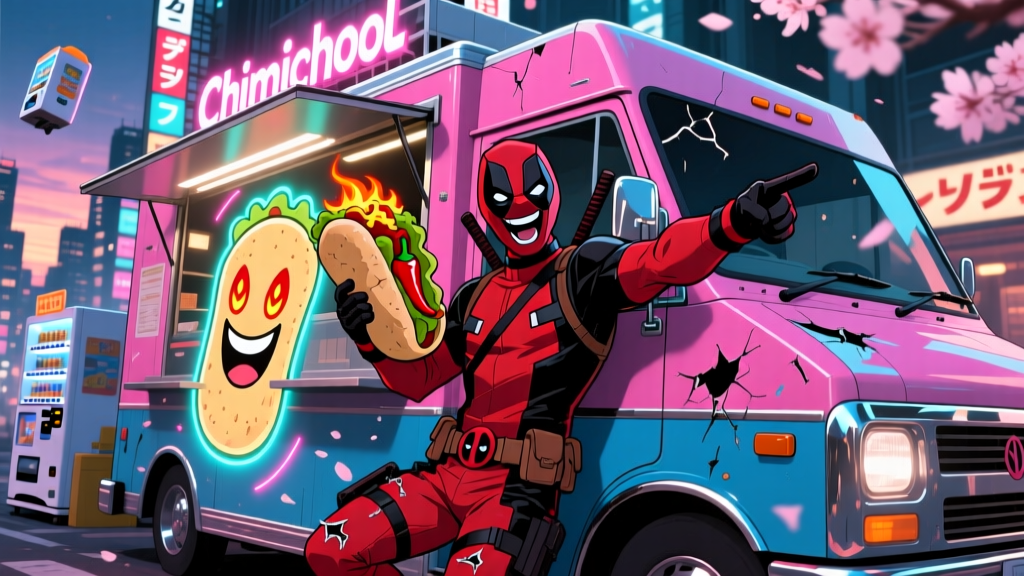
From Joe Kelly's late-'90s comic panels to a Jack in the Box drive-thru near you — how a food truck that should not exist became one of the most recognizable vehicles in superhero pop culture.
A beat-up truck idles on a Manhattan sidewalk, its paint job a chaos of red and black spray paint, the words "CHIMICHANGAS" scrawled across the side in letters that look like someone wrote them during an earthquake. The serving window slides open. A man in full tactical gear — katanas, handguns, enough pouches to stock a small army surplus store — leans out and screams the word "chimichanga" at a volume that sets off a car alarm three blocks away. A pigeon falls off a telephone wire. A tourist drops her pretzel.
Welcome to the deadpool's chimichanga truck, the single most ridiculous vehicle in the Marvel Universe and somehow one of its most enduring symbols. If you've attended a comic convention in the last decade, scrolled through any Marvel-related subreddit, or walked past a Hot Wheels display at Target, you've seen this truck. It's on t-shirts. It's on Funko Pop boxes. It's been printed on tortilla wrappers at real fast-food chains. And none of it makes any sense unless you understand the twenty-five-year joke that put it there.
This is the full story of how a nonsense word became a catchphrase, how a catchphrase became a food truck, and how a food truck became a cultural artifact that Marvel Studios used to sell over $1.3 billion in movie tickets.
The Word That Ate Its Way Into Canon
Deadpool didn't start out obsessed with deep-fried burritos. When Rob Liefeld and Fabian Nicieza introduced the character in The New Mutants #98 (cover-dated February 1991), Wade Wilson was a wisecracking mercenary with a healing factor, a disfigured face, and approximately zero culinary brand identity. He was funny in the way that a guy with two swords and no impulse control is funny — violent, unpredictable, a little exhausting. But he wasn't yelling about Mexican food yet.
The chimichanga fixation took root during Joe Kelly's run on Deadpool Vol. 1, which kicked off in 1997. Kelly understood something that previous writers hadn't fully exploited: Deadpool's mouth was the character's most dangerous weapon, and it worked best when it was firing nonsense instead of bullets. Somewhere around issues #14–20, Deadpool started shouting "chimichanga" as a kind of all-purpose expletive — a word he'd yell mid-fight, during stealth missions (badly), or whenever a panel needed a punchline that made zero contextual sense.
There's a popular theory that Kelly borrowed the bit from a recurring Saturday Night Live sketch, though the writer himself has given varying accounts in interviews over the years. At a 2014 convention panel in Chicago, Kelly described the chimichanga gag as something that "just kept working on the page" — a throwaway line that readers responded to so aggressively that the creative team had no choice but to keep deploying it. By the time Cable & Deadpool launched in 2004, written by Fabian Nicieza (the character's co-creator), the chimichanga was so thoroughly embedded in the character's identity that removing it would have felt like taking the mask off Spider-Man's logo.
Here's the part that separates a good running gag from a great one: the chimichanga obsession was never explained. Deadpool didn't have a tragic chimichanga backstory. He didn't lose a loved one in a deep-frying accident. He just yelled the word, repeatedly and with maximum enthusiasm, until it became inseparable from who he was. That kind of organic, unforced character development is rare in comics, where most personality traits arrive via origin story or retcon. The chimichanga just... happened. And then it never stopped happening.
"Chimichanga is the funniest word in the English language. Fight me." — Deadpool, approximately 847 timesWhen the Gag Grew Wheels: The Truck Enters the Picture
The jump from catchphrase to vehicle was inevitable given Deadpool's particular brand of logic. If a character screams "chimichanga" every time he opens his mouth, of course he's going to end up driving a truck that advertises chimichangas. Of course that truck will be his mobile headquarters. Of course he'll try to actually sell food from it, despite having the culinary skills of a man whose taste buds were destroyed by the Weapon X program.
The deadpool's chimichanga truck began appearing as a recurring visual element during the later volumes of the Deadpool solo series and various team books. Writers used it in multiple capacities, each one more absurd than the last:
- Mobile command center — Deadpool parks the truck in increasingly implausible locations (rooftops, inside buildings, on top of other vehicles) while he plans missions that inevitably go wrong. The truck's location often telegraphs the state of Wade's mental health: parked neatly? He's relatively functional. Upside down and on fire? Standard Tuesday.
- Legitimate business front — Several arcs depict Deadpool actually attempting to operate the truck as a food business, complete with a menu board, ingredient sourcing, and health department interactions. The comedy writes itself: a man who kills people for money is genuinely stressed about his salsa verde recipe getting bad Yelp reviews.
- Improvised weapon — Because of course the truck has been used to ram someone. Multiple someones. In Deadpool Vol. 3, the truck's front bumper is drawn with visible dents that carry over from issue to issue, a detail the artists maintained as a background gag for attentive readers.
- Emotional barometer — The truck's condition mirrors Wade's internal state more reliably than the character's own dialogue. When Gerry Duggan wrote Deadpool through some of his darkest moments between 2012 and 2015, the truck in the background would deteriorate panel by panel — flat tires, cracked windshield, missing side mirrors — without anyone in the story acknowledging it.
In Uncanny X-Force and the Mercs for Money arcs, other characters' reactions to the truck provided a secondary layer of humor. Wolverine treats it with barely concealed disgust. Cable pretends it doesn't exist. Spider-Man, on one memorable occasion, actually tried to order from it and was served something that Deadpool described as "a chimichanga-adjacent protein delivery system." Peter Parker ate it anyway because he's been broke his entire adult life.
"The chimichanga truck is the only vehicle in the Marvel Universe that has killed more people than the Punisher's van. And it does it with better branding." — ComicsAlliance, "Deadpool's Greatest Vehicles Ranked" (2019)
The Big Screen: From Easter Egg to Marketing Juggernaut
When Deadpool hit theaters in February 2016, Ryan Reynolds brought the chimichanga obsession along for the ride. The first film plants a chimichanga stand in the background of its opening freeze-frame sequence — a blink-and-you'll-miss-it detail that rewards viewers who pause at exactly the right moment. The word itself gets dropped throughout the film at peak chaos, usually when Deadpool is mid-explosion or mid-dismemberment, delivered with the kind of manic joy that Reynolds has made his specialty.
Deadpool 2 (2018) expanded the food truck's presence. The truck appears parked in locations that make zero logistical sense — a recurring visual gag that the production design team clearly enjoyed. One scene shows the truck wedged between two buildings in an alley that it could not physically have driven into, and the film offers no explanation because the explanation is "it's funny."
Deadpool & Wolverine: The Chimichanga Goes Nuclear
Nothing could have prepared anyone for what happened when Deadpool & Wolverine rolled into theaters in July 2024. The film, Marvel Studios' first R-rated MCU entry, grossed over $1.33 billion worldwide and turned the deadpool's chimichanga truck from a beloved comic deep-cut into a full-scale marketing event.
The promotional campaign leaned into the chimichanga harder than any previous Deadpool film had dared. Three major tie-ins converged simultaneously:
- Jack in the Box collaboration — Starting July 8, 2024, the fast-food chain launched Deadpool-branded chimichangas on their national menu. The packaging featured custom artwork of Deadpool in his truck, and the chain's loyalty app offered exclusive digital collectibles. Jack in the Box already had chimichangas on their menu, which made the partnership feel organic rather than forced — a rare feat in movie-food tie-ins. SDCC 2024 attendees received special co-branded promotional items that merged the fast-food campaign with Marvel's Comic-Con booth.
- Gordon Ramsay crossover content — The celebrity chef filmed a chimichanga cooking segment alongside Deadpool & Wolverine promotional footage, blurring the line between cooking content and movie advertising in a way that felt genuinely in-character for Wade Wilson.
- Disney California Adventure food installation — Pym Test Kitchen in Avengers Campus began serving a "Deadpool Chimichanga" that was, by all accounts, absurdly large. A standalone "Deadpool's Chimichangas" food cart also appeared in the park, designed to look like the truck from the comics — red and black, slightly dented, with a hand-painted menu board that included items like "Maximum Effort Nachos" and "Regenerating Salsa." The cart became one of the most photographed spots at the resort throughout the summer, with wait times reportedly exceeding 45 minutes on peak days.
The marketing numbers tell the story. According to Disney's Q3 2024 earnings call, theme park food and beverage revenue tied to the Deadpool & Wolverine promotion outperformed projections by a significant margin. The chimichanga cart was specifically cited as a driver of repeat visits to Avengers Campus, with guests returning multiple times to photograph the installation with different cosplays. That's the power of a well-deployed food truck — it turns a movie tie-in into a destination.
The Gordon Ramsay Factor
The Ramsay collaboration deserves its own mention because it represents something genuinely new in movie marketing: a celebrity chef treating a fictional character's food obsession with the same seriousness he'd apply to a Beef Wellington. Ramsay filmed the segment in full "Hell's Kitchen" mode, barking instructions at an off-camera Deadpool about oil temperature and tortilla folding technique. The segment ended with Ramsay presenting a perfectly plated chimichanga and Deadpool responding by dumping ketchup on it. Ramsay's visible fury was, by all accounts, unscripted. The video hit 12 million views in its first week and remains one of the most shared pieces of Deadpool & Wolverine promotional content.
The Collectibles Shelf: Miniature Trucks, Maximum Obsession
The collectibles industry has a long love affair with iconic fictional vehicles. The Batmobile. The Mystery Machine. The Ecto-1. Add Deadpool's chimichanga truck to that list and watch the cognitive dissonance work its magic: a joke vehicle treated with the same manufacturing seriousness that Mattel applies to a $200 Hot Wheels Elite die-cast.
| Product | Manufacturer | Scale / Format | Release Year | Price Range | Notable Details |
|---|---|---|---|---|---|
| Funko Pop! Rides #10 | Funko | Standard Pop vinyl | 2015 | $30–$60 (secondary) | Original red/black colorway. Deadpool figure seated in cab, serving window open. One of the top-selling Marvel Rides entries. |
| Funko Pop! Rides SDCC Grey Variant | Funko | Standard Pop vinyl | 2015 | $80–$150+ (secondary) | San Diego Comic-Con exclusive monochrome grey treatment. Vaulted; limited supply on secondary market. |
| Bitty Pop! Rides Chimichanga Truck | Funko | Micro vinyl (~2 in.) | 2024 | $5–$8 retail | Palm-sized version. Part of the Bitty Pop expansion line. Sold in randomized packs. |
| Hot Wheels Chimichanga Truck (FYP62) | Mattel | 1:64 die-cast | 2020 | $6–$12 retail | Entertainment vehicle line. Red body, black accents, "Chimichanga" side text. Tiny Deadpool visible in cab. |
| Hot Wheels Premium Edition | Mattel | 1:64 premium die-cast | 2021 | $12–$20 retail | Upgraded paint, rubber tires, collector card packaging. Aimed at adult display market. |
| 3D-Printable Truck Models | Fan community (Yeggi, Thingiverse) | Various scales | 2018–present | Free–$15 (files) | 5,000+ models available. Ranges from simple single-piece prints to fully articulated builds with opening doors and interior detail. |
| Enamel Pin / Patch Set | Various licensed vendors | 2–3 in. accessories | 2019–present | $8–$18 | Truck design on pins, embroidered patches, and stickers. Popular at convention dealer tables. |
The Funko Pop! Rides #10 deserves particular attention. When it dropped in 2015, the Funko Marvel catalog was already saturated with character figures, but the chimichanga truck stood out because it wasn't just a character — it was a scene. A tiny, vinyl, deeply stupid scene that captured the entire thesis of Deadpool in a package small enough to fit on an office desk. The grey SDCC variant followed later that year, trading the vibrant red-and-black for a muted monochrome treatment that collectors remain divided on. Some appreciate the subtlety. Others argue that making Deadpool's anything "subtle" fundamentally misunderstands why people buy Deadpool merchandise in the first place.
Mattel's Hot Wheels entry treated the chimichanga truck with the engineering rigor of a licensed Batmobile. The Premium edition features rubber tires, detailed paint applications, and packaging designed for display rather than play. It's a joke product manufactured with non-joke levels of quality — which may be the most Deadpool thing that has ever happened in the toy aisle.
✦ ✦ ✦The Meme Machine: How the Truck Conquered the Internet
The deadpool's chimichanga truck exists in a perpetual state of meme regeneration. The basic template — Deadpool standing next to, inside, or on top of his truck, usually captioned with something context-free and deeply unhinged — has been remixed across every major social platform since the mid-2010s. Twitter threads, Instagram carousels, TikTok edits, Reddit posts on r/deadpool and r/Marvel: the truck is everywhere, and it shows no signs of slowing down.
The meme format works because the truck is already a visual punchline before anyone adds text to it. A food truck driven by a disfigured assassin is inherently funny. Add a caption like "When someone asks about your five-year plan" and you've got engagement numbers that corporate social media accounts would kill for. The truck has been used to react to everything from stock market crashes to celebrity breakups to software update announcements. Its versatility is its strength — it's a template that accommodates any context because the truck itself has no context. It's just a man and his deep-fried burrito vehicle, and that's enough.
Cosplay and Convention Culture
The cosplay community took the meme into physical space. At SDCC, NYCC, and C2E2, you'll find attendees who've built miniature truck props on wheels, dragging them through convention halls while dressed as Deadpool. Others construct full "chimichanga vendor" setups — apron, menu board, serving window frame — and hand out actual snacks to passing cosplayers. The best of these builds lean into Deadpool's fourth-wall-breaking nature with signs that reference specific comic issues, movie scenes, and meta-humor deep cuts that reward fans who've done their homework.
Social Media Takeover
When Disney launched the Deadpool's Chimichangas cart at California Adventure in 2024, the fan-generated content was immediate and overwhelming. Within 48 hours of the cart's opening, Instagram and TikTok were saturated with photos and videos of the oversized chimichanga, the Deadpool-themed packaging, and the cart itself decorated to look like the comic truck. The hashtag #DeadpoolChimichanga accumulated over 40 million views on TikTok alone during the first two weeks. That kind of organic, user-generated amplification is the dream scenario for any marketing campaign, and it happened because the truck was already a beloved cultural object before Disney put a single chimichanga on a menu.
The Plot Twist: He Doesn't Even Like Them
Here's the part that caught a lot of fans off guard. In a comic arc that landed with the subtlety of a chimichanga truck through a plate glass window, Deadpool revealed that he doesn't actually enjoy eating chimichangas. Not even a little bit. The entire obsession — the catchphrase, the truck, the two-decade brand identity — was a performance. A bit. A joke he committed to so completely that it became indistinguishable from reality in every way except the one that mattered: his own taste buds.
The reveal is devastatingly clever meta-humor. Deadpool knows he's a comic book character. He knows his catchphrase. He knows that you know his catchphrase. The chimichanga thing was always more about the absurdity of repetition than genuine culinary preference — it's the stand-up comedian who's been doing the same crowd-work bit for twenty years because the audience demands it every single night, even though the comedian would rather talk about literally anything else.
The writers used this twist to comment on the relationship between characters and their fan-assigned identities. The chimichanga became so central to Deadpool through fan demand that the character himself had no choice but to perform it, even though within the fiction he'd rather eat something — anything — else. That's a surprisingly sharp observation about how fandom shapes characters, delivered through a man in red spandex yelling about fried food. Some fans loved the meta-commentary. Others felt it undermined a favorite running gag. Both reactions are valid, and both are exactly the kind of response that Deadpool would break the fourth wall to make fun of.
Real-World Food Trucks: When Fiction Becomes Lunch
The deadpool's chimichanga truck has crossed the boundary from fiction to reality more times than most comic book concepts ever do. Beyond the Disney theme park installation and the Jack in the Box collaboration, independent food trucks across North America have leaned into the concept with varying degrees of official licensing and enthusiastic unlicensed tribute.
In Austin, Texas, a food truck called "Maximum Effort Tacos" (a reference to Deadpool's catchphrase from the films) ran a "Chimichanga Deadpool" special during the summer of 2024 — an oversized, extra-spicy chimichanga served in red foil wrapping with a hand-drawn Deadpool face on the bag. The truck wasn't officially licensed by Marvel or Disney, but it didn't need to be. The concept was recognizable enough that customers understood the reference instantly, and the truck's social media posts about the special outperformed their usual engagement by roughly 400%.
Convention food vendors have also gotten in on the act. At Dragon Con in Atlanta, a recurring food vendor has operated a "Chimichanga Express" truck repainted in red and black for the weekend, with a menu that includes items named after Deadpool characters and catchphrases. The truck typically sells out of its chimichanga supply by Saturday afternoon, which tells you everything about the demand for deep-fried burritos associated with a fictional assassin.
Food bloggers and recipe creators have contributed their own versions. YouTube channels and food blogs have published "Deadpool-style chimichanga" recipes that prioritize absurd portion sizes and maximum spice levels, because of course Deadpool's version of anything would be excessive and slightly painful. The most popular of these recipes, published by a food blogger in Portland in 2024, called for four types of peppers, a half-pound of seasoned beef, and a tortilla the size of a bath towel. It has been viewed over 2.3 million times.
What Makes the Truck Work as a Storytelling Device
Strip away the merchandise and the memes for a moment, and the chimichanga truck actually performs real narrative work in Deadpool stories. It functions as a visual anchor for a character whose defining trait is instability. Everything else about Deadpool shifts — his alliances, his moral compass, his mental state, his physical location — but the truck is a constant. It's always there, it always says "chimichanga" on the side, and it always looks slightly more damaged than it did in the previous issue.
Writers have leveraged this consistency to create tonal contrast that other superhero properties can't replicate. Picture a scene where Deadpool is having a genuinely emotional moment — grief, vulnerability, regret about the people he's lost — and in the background, there's a food truck that says "CHIMICHANGAS" in bright red letters. That juxtaposition is the entire thesis of the character: nothing is ever fully serious, nothing is ever fully a joke, and the line between the two shifts with every panel turn. The truck embodies that tension in a single, ridiculous image.
It also serves as a storytelling shortcut. When a new creative team takes over a Deadpool book, the truck's presence (or absence) signals immediately what kind of run it's going to be. A pristine, well-maintained chimichanga truck suggests a more grounded approach. A truck that's visibly held together with duct tape and optimism tells you the writer is leaning into chaos. Readers have learned to read the truck the way they read a color palette — it's information delivered through the background rather than the dialogue, and it works because the visual vocabulary has been established over twenty-five years of continuous use.
"The Batmobile tells you Bruce Wayne has money. The chimichanga truck tells you Wade Wilson has priorities."The Chimichanga Itself: A Brief Cultural Detour
For anyone arriving without knowing what a chimichanga actually is: it's a deep-fried burrito. A flour tortilla stuffed with meat, beans, cheese, and various fillings, folded into a burrito shape, then submerged in hot oil until the exterior is crispy and golden-brown. It's associated with Tex-Mex and Southwestern U.S. cuisine, and its origins are contested — both Tucson, Arizona, and several Mexican states claim credit.
The word itself is genuinely fun to say, which is half the reason it stuck. "Chimichanga" has a percussive, consonant-heavy rhythm that makes it satisfying to shout. Try yelling "enchilada" with the same energy. It doesn't work. "Taco" is too short. "Burrito" is too soft. "Chimichanga" hits with the aggressive, slightly ridiculous punch that matches Deadpool's personality so perfectly that it feels like the word was invented for this specific purpose, even though it predates the character by decades.
Deadpool's association with the food has had a measurable impact on real-world chimichanga culture. Restaurants have added "Deadpool" chimichangas to their menus, sometimes with the character's face printed on the tortilla using edible ink. Food delivery apps reported a noticeable spike in chimichanga orders in the weeks following the Deadpool & Wolverine theatrical release in July 2024. Jack in the Box's chimichanga sales during the promotional period were described internally as "significantly above baseline," according to industry reporting from QSR Magazine (August 2024). That's the commercial power of a fictional character's fictional food obsession bleeding into actual consumer behavior.
Questions People Actually Search For
What comic issue did Deadpool first say "chimichanga"? The chimichanga catchphrase solidified during Joe Kelly's run on Deadpool Vol. 1, starting around 1997–1998, and became firmly established through the Cable & Deadpool series and subsequent volumes. The exact first appearance of the word is debated among collectors, but the association was fully cemented by the early 2000s when readers began demanding chimichanga references in letters columns. Does Deadpool actually enjoy eating chimichangas? No. In a twist that exemplifies the character's meta-humor, Deadpool has revealed at multiple points that he doesn't genuinely enjoy chimichangas. The obsession is portrayed as a performance — a catchphrase he committed to so thoroughly that it became his defining trait, even though within the story he'd rather eat almost anything else. It's a commentary on how fan expectations shape character behavior. Is there a real Deadpool chimichanga truck at Disneyland? Yes. Disney California Adventure has featured a "Deadpool's Chimichangas" food cart designed to resemble the comic truck, and Pym Test Kitchen in Avengers Campus has served a Deadpool-themed chimichanga. These appeared during the Deadpool & Wolverine promotional period in summer 2024 and returned in 2025 due to overwhelming demand. Wait times at the cart reportedly exceeded 45 minutes on peak days. What is the Funko Pop Deadpool Chimichanga Truck worth? The original Funko Pop! Rides #10 Deadpool's Chimichanga Truck (2015, standard red/black edition) typically sells for $30–$60 on the secondary market depending on condition and packaging. The SDCC 2015 exclusive grey variant commands significantly higher prices, often $80–$150 or more, since it has been vaulted and is no longer in production. The 2024 Bitty Pop micro version retails for approximately $5–$8. Did Jack in the Box really sell Deadpool chimichangas? Yes. Jack in the Box partnered with Marvel Studios to release Deadpool-inspired chimichangas starting July 8, 2024, timed to coincide with Deadpool & Wolverine's theatrical release. The promotion included special Deadpool-branded packaging, app-exclusive deals, and collectible items. Additional SDCC-exclusive promotional materials were distributed at Comic-Con International that same month. Does the chimichanga truck appear in Deadpool & Wolverine (2024)? The chimichanga truck appears in Deadpool & Wolverine as part of the film's visual landscape, continuing the tradition established in the first two Deadpool films. The movie's marketing leaned significantly harder into the chimichanga concept than previous entries, with multiple brand partnerships, theme park food installations, and tie-in products all built around the truck and its signature food item. Why does Deadpool yell "chimichanga" instead of something else? The word "chimichanga" has a percussive, consonant-heavy sound that makes it satisfying and funny to shout. Writers during Joe Kelly's era found that the word landed harder on the page than alternative food-related exclamations. The rhythmic quality of the four-syllable word matches Deadpool's aggressive, slightly unhinged delivery, and it stuck because readers responded to it immediately and kept demanding more.The deadpool's chimichanga truck is, at its core, a joke that refused to die — which is fitting for a character defined by his own inability to stay dead. What started as a writer's throwaway gag in a late-'90s comic became a piece of pop culture infrastructure so recognizable that it spawned toys, theme park food, fast-food collaborations, and an entire ecosystem of fan-generated content. The truck works because it never tries to be anything more than what it is: a food truck driven by a maniac in red spandex, screaming about deep-fried burritos at a volume that violates several noise ordinances. And somehow, that's enough. It's been enough for twenty-five years, and it'll probably be enough for twenty-five more. Maximum effort, minimum sense. That's the Deadpool way.