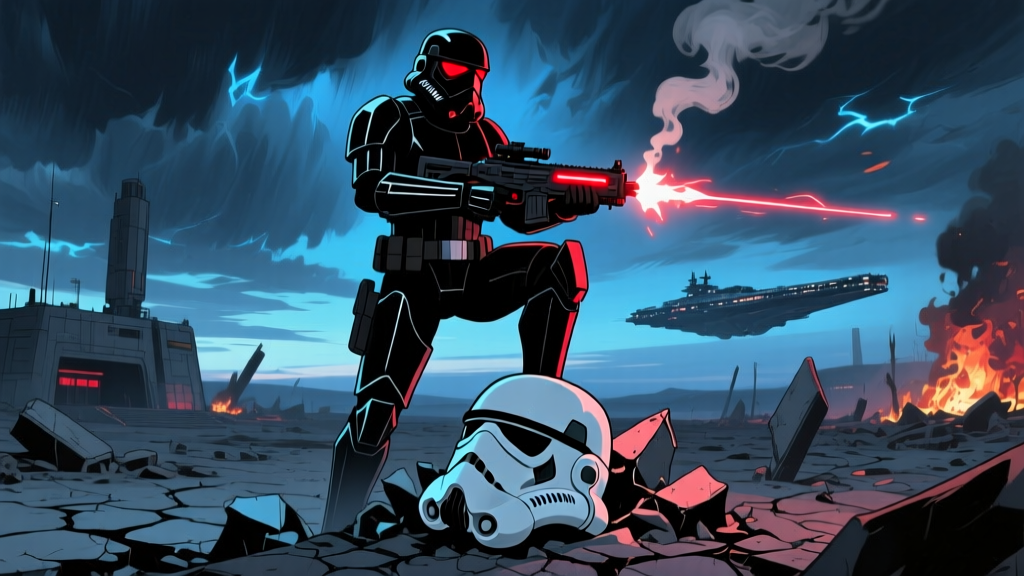
The rain falls sideways across the black volcanic sand of Mustafar. Director Krennic strides toward his shuttle flanked by six figures clad head-to-toe in obsidian armor, green lenses cutting through the gloom like bioluminescent predators. Each one cradles a blaster carbine that most Imperial personnel will never hold. These are Death Troopers — and every detail about them, from their scrambled comms to their scorched-muzzle sidearms, was engineered to make you uneasy before a single shot is fired.
What Separates Death Troopers From Every Other Stormtrooper
When Rogue One: A Star Wars Story premiered in December 2016, audiences had already spent nearly four decades watching white-armored stormtroopers miss shots in corridors. Gareth Edwards and his design team needed a unit that felt different on sight — something that communicated threat before a line of dialogue was spoken. The answer was Imperial Intelligence's most secretive field operatives: the Death Troopers.
Unlike the rank-and-file stormtrooper corps that answer to the Imperial Army, Death Troopers operate under Imperial Intelligence's direct authority. Their assignment is narrow and high-stakes: protect high-value assets, escort senior officers, and handle situations where the Empire would rather not leave witnesses. In Rogue One, their sole VIP is Director Orson Krennic (played by Ben Mendelsohn), the ambitious architect of the Death Star project. Where Krennic goes, Death Troopers follow — a detail of six operators who never remove their helmets on screen and never speak in a voice anyone can decipher without a decoder.
Within the Star Wars canon, their formal designation surfaced first through Star Wars: Galaxy of Heroes (2015, EA/Capital Games), the mobile title that introduced the unit name before Rogue One hit theaters. Pablo Hidalgo's Star Wars: Rogue One — The Ultimate Visual Guide (DK, 2016) later confirmed their classification as Imperial Intelligence special forces stormtroopers, distinguishing them from Death Squad stormtroopers, Purge Troopers, and other specialized units that fans sometimes conflate with them.
The Black Armor: Design Choices That Go Beyond Aesthetics
The most immediate thing you notice is the color. Imperial stormtrooper armor is white — that's been the visual language since 1977. Black armor in Star Wars signals a departure from the standard hierarchy. For Death Troopers, the all-black plating serves both a practical and psychological function. It reads as tactical gear rather than parade uniform. In-universe, the color is classified-grade stealth coating designed to reduce visual signature in low-light and urban environments.
The armor itself is a modified stormtrooper chassis with significant additions. The helmet retains the familiar twin-lens visor layout but swaps the standard white for a darkened shell with green-tinted polarized lenses. That green glow isn't arbitrary — it references night-vision and enhanced-spectrum optics built into the helmet's HUD. According to The Ultimate Visual Guide, the helmet integrates:
- Encrypted comms package — a dedicated vocoder and signal scrambler built into the helmet's lower faceplate
- Multi-spectrum visor display — thermal, infrared, and standard night-vision modes selectable by the operator
- Atmospheric filtration — rated for chemical and biological contaminants, enabling deployment in hazardous zones
- Reinforced chest plating — additional composite layer over the standard torso carapace, adding roughly 1.5 kg of mass
- Tactical utility belt — carries spare tibanna gas cells, thermal detonators, and a field-med kit
The pauldron configuration also differs from standard stormtrooper armor. Death Troopers wear an asymmetric shoulder plate on the left side, a design cue borrowed from real-world tactical load-bearing vests where one shoulder carries additional equipment weight. The overall silhouette is bulkier than a standard trooper's — intentionally so. Costume designers David Crossman and Glyn Dillon added roughly 12mm of padding beneath the armor plates to give the performers a denser, more imposing physical presence on camera.
The Blasters: SE-14r and E-11D
If the armor tells you these aren't regular troopers, the weapons confirm it. Death Troopers carry a two-weapon loadout that puts them a tier above the standard-issue E-11 blaster rifle most stormtroopers shoulder.
E-11D Blaster Carbine — Primary Weapon
The E-11D is a compact variant of the ubiquitous BlasTech E-11 series. Where the standard E-11 runs 47cm in overall length, the D-model trims that down to approximately 38cm by shortening the barrel shroud and collapsing the stock assembly. The trade-off is reduced effective range — roughly 120 meters in atmosphere versus the standard model's 200 meters — but Death Troopers rarely engage at distance. Their role is close-protection: tight corridors, shuttle ramps, command bunkers. At 15 to 40 meters, the E-11D's tighter beam dispersion actually outperforms the longer rifle.
The weapon mounts a folding foregrip and an under-barrel tactical rail, both of which appear on screen in the Mustafar sequence and the Scarif battle. In the Scarif ground combat scenes, you can see Death Troopers using the E-11D in semi-automatic mode for precision shots, then switching to rapid-fire bursts when Rebel forces push through the Citadel's blast doors — a flexibility the standard E-11 doesn't offer without modification.
SE-14r Light Repeating Blaster — Sidearm
Holstered at the hip, the SE-14r is a weapon with deep roots in Star Wars lore. Originally featured in The Empire Strikes Back (1980) as a sidearm for Imperial officers on Hoth, the SE-14r bridges the gap between a standard blaster pistol and a light carbine. It carries a larger tibanna gas cell than a typical DL-18 or DH-17, giving it a sustained-fire capability that a pistol simply can't match.
The "r" designation stands for "rapid" — the weapon can cycle six shots in roughly 1.2 seconds in its repeater mode. For Death Troopers protecting Krennic in the field, the SE-14r functions as the pull-and-shoot backup when the primary carbine is slung, damaged, or empty. In the scene where Krennic confronts Galen Erso on Lah'mu, one of the flanking Death Troopers can be seen with his SE-14r partially drawn — a small but telling detail that the unit treats every conversation as a potential firefight.
"The Death Troopers' loadout communicates rank. When you see black armor and that short carbine, you know the Empire sent its people who don't take prisoners — they take the asset and leave nothing else."
— Pablo Hidalgo, Star Wars: Rogue One — The Ultimate Visual Guide, DK 2016
Weapon Loadout Comparison: Death Trooper vs. Standard Stormtrooper
| Specification | Standard Stormtrooper | Death Trooper |
|---|---|---|
| Primary Weapon | E-11 Blaster Rifle (47cm) | E-11D Blaster Carbine (38cm, tactical rail) |
| Sidearm | SE-14r or DH-17 (varies by posting) | SE-14r Light Repeating Blaster (standard issue) |
| Effective Range (primary) | ~200 meters | ~120 meters (optimized for close protection) |
| Fire Modes | Semi-auto, full-auto | Semi-auto, burst, rapid-fire |
| Armor Color | White plastoid composite | Black stealth-coated plastoid |
| Helmet Systems | Basic HUD, standard comms | Multi-spectrum HUD, encrypted vocoder, signal scrambler |
| Chain of Command | Imperial Army | Imperial Intelligence (direct assignment) |
Scrambled Voices: The Comms System That Keeps Them Anonymous
One of the most unsettling details in Rogue One is that Death Troopers never speak intelligibly on screen. When they communicate, what the audience hears is a distorted, robotic warble — as if someone fed a human voice through a malfunctioning vocoder and then dragged it across a radio frequency. That effect was deliberate and painstaking.
Sound designers at Skywalker Sound built the Death Trooper voice using a multi-stage process. Actors recorded lines in clean English. Those recordings were then run through a digital vocoder, pitch-shifted downward by approximately 4 semitones, and layered with a secondary track of radio static and burst-transmission noise. The final composite sounds less like a person speaking and more like encrypted data packets being transmitted in real time — which, in the fiction, is exactly what's happening.
The in-universe explanation is that Death Trooper helmets contain a dedicated encryption module. Every word spoken by a Death Trooper is encoded using a rolling cipher that changes frequency patterns every 30 seconds. Only other Death Troopers and officers with clearance-level decryption keys (like Krennic himself) can decode the signal in real time. To anyone else — Rebels, civilians, rival Imperial officers without clearance — the comms are gibberish. This means that even if an enemy captures a Death Trooper's frequency, they're hearing noise without the cipher key.
The effect serves a dual purpose on screen. Practically, it means the filmmakers never had to worry about lip-sync or casting recognizable voice actors for troopers who keep their helmets on. Narratively, it reinforces the idea that Death Troopers exist outside the normal chain of command. They don't bark orders like regular troopers. They don't banter. They coordinate in a language that excludes everyone around them — including the audience.
Protecting Krennic: The Bodyguard Role on Screen
Director Krennic is a political animal, not a soldier. He maneuvers through Imperial bureaucracy with ambition and manipulation rather than battlefield competence. The Death Troopers exist to compensate for that vulnerability. Their on-screen deployment pattern in Rogue One follows a consistent logic:
- Lah'mu sequence — A reduced detail of four troopers accompanies Krennic to confront Galen Erso on his farm. The deployment is surgical: two flank the homestead while two remain at Krennic's side. The troopers' weapons are visible but not raised until Krennic gives the implicit go-ahead.
- Scarif Citadel — During the Rebel assault on the data vault, a full detail of six Death Troopers defends the Citadel's upper levels. Here, the E-11D carbines see sustained combat — rapid-fire exchanges with Cassian Andor and Chirrut Imwe in the corridor outside the vault.
- Mustafar — The volcanic Imperial facility where Vader resides. Death Troopers escort Krennic from his shuttle to the entrance, weapons at low-ready. The formation is textbook close-protection: diamond pattern, two forward, two flanking, two rear.
What stands out across all three sequences is the restraint. Death Troopers don't initiate violence — they respond to it. They don't pursue fleeing targets unless Krennic orders it. Their job is to keep the Director alive and operational, not to win battles. That restraint is visible in how they hold formation and how they position themselves between Krennic and any approaching figure, blasters angled downward but never holstered.
Behind the Scenes: Building the Death Trooper Look
The Death Trooper costume went through at least four design iterations before the final version appeared on screen. Costume designer David Crossman, who has worked on Star Wars productions since The Force Awakens, partnered with concept artist Glyn Dillon to develop a trooper that felt rooted in the Original Trilogy aesthetic while reading as distinctly more threatening.
Early concept art explored a matte-black armor with red visor lenses — a look that tested too close to Darth Vader's helmet and was quickly abandoned. The team also tried a dark grey with yellow-green lenses, which Dillon described in The Art of Rogue One (Abrams, 2016) as looking "more like a hazmat team than a kill squad." The final all-black with green visor combination landed because it hit a specific tonal note: military special-operations darkness with an unnatural, almost alien eye-color that reads wrong against the black shell.
The practical costumes were constructed from a combination of vacuum-formed ABS plastic plates and flexible urethane joints. Total costume weight ran approximately 18 to 22 kilograms per performer, depending on the weapon configuration carried. Performers were drawn from the UK-based 501st Legion costuming community as well as professional stunt personnel. The suit's limited visibility through the tinted lenses required careful choreography — every step, weapon transition, and formation shift was rehearsed on set with floor markers because the performers simply couldn't see their feet through the helmet.
The blaster props were built by Simon Lee and his team at Spectrum Engineering. The E-11D prop was constructed from a modified Sterling L2A3 submachine gun body — the same base weapon that provided the E-11 silhouette in the Original Trilogy — with a shortened barrel shroud, a custom foregrip, and a scratch-built tactical rail. The SE-14r holster prop was an evolution of the original mold used in The Empire Strikes Back, updated with additional surface detail and a quick-release magnetic holster mount.
Collectibles: From $15 Figures to Four-Figure Grails
The Death Trooper has become one of the most collectible character designs to emerge from the Disney-era Star Wars films. The black armor translates well to display — it photographs dramatically, holds paint applications cleanly, and stands out on a shelf next to rows of white-armored troopers.
Hasbro's Black Series 6-inch Death Trooper (2017, product code C2023) was the first widely available action figure with accurate film-accuracy sculpting. It ships with the E-11D carbine and SE-14r sidearm in its holster. Original retail was $22.99; secondary market prices for the carded first-release hover between $45 and $70 depending on condition. A re-release in 2020 with updated packaging brought the figure back to mainstream availability at the same price point.
On the premium end, Hot Toys' 1/6 scale Death Trooper (MMS451, released 2018) is the benchmark collectible. Priced at $265 at retail, the figure features a die-cast internal frame, fabric tactical webbing, LED-lit green visor lenses (powered by two AG13 button cells), and both the E-11D and SE-14r as removable accessories. The LED feature is what sells it — when the visors glow in a dim room, the figure captures the exact screen-presence of the Mustafar sequence. Secondary market pricing for a mint-in-sealed-box Hot Toys Death Trooper has climbed to $380–$520 as of early 2026, driven partly by the figure going out of production in late 2019.
Funko Pop! released a Death Trooper (#158 in the Star Wars line) in 2017, and it remains one of the more affordable entry points at $12–$18 retail. LEGO's Death Trooper polybag (set 40562, 2022) includes a minifigure with printed black armor detailing and the E-11D — a compact display piece that retailed for $3.99 as a promotional giveaway.
For prop replicas, eFX Collectibles produced a 1:1 scale E-11D blaster replica limited to 500 units worldwide. Original retail was $599, and these now trade between $800 and $1,100 on the collector market. The replica uses machined aluminum for the barrel assembly and hand-finished ABS for the body, with functional scope optics (non-laser, display only).
| Product | Scale | Original Retail | Current Secondary Market |
|---|---|---|---|
| Hasbro Black Series Death Trooper | 6-inch (1:12) | $22.99 | $45–$70 (carded) |
| Hot Toys Death Trooper (MMS451) | 12-inch (1:6) | $265.00 | $380–$520 (MISB) |
| Funko Pop! #158 | 3.75-inch (vinyl) | $12.99 | $15–$22 |
| LEGO Polybag 40562 | Minifigure | $3.99 | $8–$15 (sealed) |
| eFX E-11D 1:1 Replica | 1:1 (full scale) | $599.00 | $800–$1,100 |
Death Troopers Beyond Rogue One: Expanded Appearances
While Rogue One remains their definitive screen appearance, Death Troopers have shown up across multiple Star Wars properties since 2016. In Star Wars Rebels (Season 3, "Hera's Heroes," 2016), a Death Trooper squad led by Governor Pryce occupies the Lothal capital — marking their animated debut just weeks before Rogue One's theatrical release. In The Mandalorian (Season 3, 2023), a pair of Death Troopers appears briefly as part of a remnant Imperial force, confirming the unit survived past the events of the original trilogy.
In the gaming space, Star Wars Battlefront II (2017, DICE/EA) made Death Troopers a playable hero-class unit with boosted health and accuracy over standard stormtroopers, and Star Wars Jedi: Survivor (2023, Respawn) features them as mid-tier enemies guarding Imperial installations on the planet Koboh. Each appearance reinforces the same design language: black armor, green lenses, compact weapons, scrambled comms.
Blaster Specs, Armor Details, and Other Questions Fans Keep Asking
What blasters do Death Troopers carry?
Death Troopers carry two weapons as standard loadout: the E-11D blaster carbine as their primary rifle — a shortened, tactical variant of the standard E-11 with a folding foregrip and rail mount — and the SE-14r light repeating blaster as their holstered sidearm. The SE-14r is the same model originally seen on Imperial officers in The Empire Strikes Back (1980).
Why can't you understand what Death Troopers are saying?
Their helmets contain a built-in vocoder and signal scrambler that encrypts all outgoing communications. The scrambled speech you hear on screen is the encrypted signal — only other Death Troopers and officers with decryption clearance (like Krennic) can decode it in real time. The sound design was created at Skywalker Sound using pitch-shifted vocals layered with radio interference.
Why do Death Troopers wear black armor instead of white?
The black armor distinguishes them as Imperial Intelligence operatives rather than standard stormtroopers, who fall under the Imperial Army. The dark color functions as a stealth coating for low-light tactical operations. Psychologically, it also signals to in-universe characters and the audience that these troopers operate outside the normal rules of engagement.
What is the difference between a Death Trooper and a regular stormtrooper?
Death Troopers report to Imperial Intelligence, not the Imperial Army. They carry superior weapons (E-11D carbine and SE-14r instead of the standard E-11 and DH-17), wear enhanced armor with encrypted communications, and are assigned exclusively to protect high-value personnel. Regular stormtroopers are frontline infantry; Death Troopers are close-protection specialists operating in small, autonomous units of four to six troopers.
Are Death Troopers human underneath the armor?
Yes. Unlike the Clone Troopers of the prequel era, Death Troopers are recruited human soldiers. Pablo Hidalgo's Ultimate Visual Guide confirms they are volunteers from existing stormtrooper ranks who undergo additional training in close-protection tactics, encrypted communications, and independent field operations. No Death Trooper removes their helmet on screen in Rogue One.
How many Death Troopers appear in Rogue One?
Six Death Troopers are consistently visible across the film's key sequences — Lah'mu, Mustafar, and Scarif. The production used a core group of four suited performers for most scenes, with two additional performers brought in for wide shots and the Scarif battle sequence where the full six-trooper formation is shown.
The Enduring Pull of the Black Armor
Death Troopers occupy a strange space in Star Wars. They appeared in a single film, have fewer than fifteen minutes of collective screen time, never remove their helmets, and speak exclusively in encrypted static. And yet they've become one of the most recognizable and collected troop designs in the franchise's five-decade history.
The reason isn't complicated. The design does exactly what it was built to do: it communicates danger through pure visual information. You don't need to know the SE-14r's cyclic rate or the encryption frequency of their helmet comms to understand what a Death Trooper represents. You see six figures in black armor with green-lensed helmets standing in formation beside a man who built a weapon capable of destroying planets — and you understand immediately that these are not the troopers who miss shots in hallways. These are the ones the Empire sends when it needs something done quietly, efficiently, and without survivors asking questions afterward.
Whether you're a collector hunting down the Hot Toys MISB grail, a costumer studying David Crossman's vacuum-form techniques, or just someone who felt a chill the first time those green lenses appeared in the rain on Mustafar — the Death Trooper earned its place. Black armor, compact blasters, scrambled comms. Simple elements, perfectly deployed.