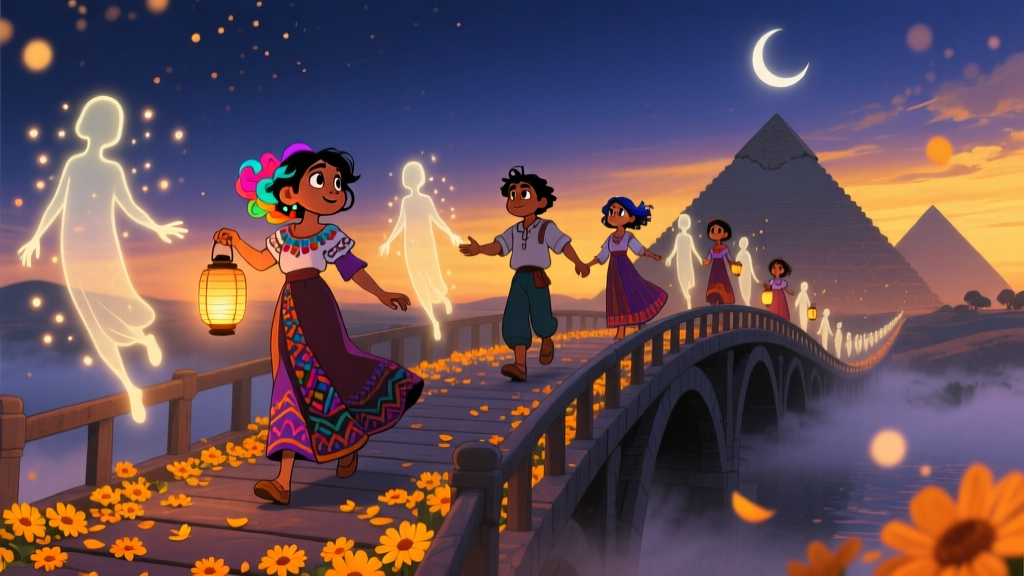
A twelve-year-old boy strums a guitar on a bridge made entirely of orange petals, and somewhere between the living world and the next, a skeleton in a tattered suit remembers a song he wrote for his daughter nearly a century ago. That scene—the emotional center of Pixar's 2017 film Coco—didn't just make audiences cry. It made them remember. The characters who populate this story aren't just cartoon inventions; they're rooted in centuries of Mexican tradition, family archetypes that exist in real households from Oaxaca to Monterrey, and a holiday that treats death not as an ending but as a door that swings both ways.
Coco grossed $814.6 million worldwide on a $175 million production budget and earned two Academy Awards—Best Animated Feature and Best Original Song for "Remember Me." But box office numbers only tell part of the story. What made the film stick was its cast of characters, each one engineered to carry a specific piece of the Día de los Muertos tradition into a format that global audiences could feel, not just observe.
Miguel Rivera: The Boy Who Refused to Stop Singing
Miguel is twelve years old, stubborn enough to argue with a great-great-grandmother he's never met, and talented enough to teach himself guitar from old recordings. He lives in the fictional town of Santa Cecilia—modeled loosely on real communities in Michoacán and Jalisco—surrounded by a family that has banned music for generations. His dream isn't abstract. He wants to play like Ernesto de la Cruz, the most famous musician in Mexican history, the man whose voice once filled every plaza and radio from here to the coast.
Anthony Gonzalez, who was twelve himself when he recorded the role, gives Miguel a voice that cracks between childhood earnestness and adolescent frustration. The animators designed him with oversized eyes—the kind Pixar has used since WALL-E to signal vulnerability—and dressed him in a red hoodie that reads as unmistakably modern, a deliberate contrast against the sepia-toned world of his ancestors. When Miguel crosses into the Land of the Dead, his hoodie and jeans make him instantly visible among the skeletal figures in traditional dress. He doesn't belong there, and the costume design makes sure you feel that displacement every frame he's on screen.
Culturally, Miguel represents the tension at the heart of many Mexican families: the pull between honoring tradition and forging your own identity. The film never resolves this by choosing one over the other. Instead, Miguel's arc shows that the two aren't actually in opposition—that remembering where you come from and becoming who you want to be can be the same act, if you're willing to listen to the people who came before you.
Design Notes and Animation Challenges
Pixar's technical team spent six years on Coco, and a significant chunk of that went into Miguel alone. His guitar—a replica of Ernesto de la Cruz's iconic instrument—required hand-animated finger placement for every strum. The studio brought in a professional guitarist as a reference performer, filming close-ups of chord transitions and replicating them frame by frame. Miguel's skin tones shift subtly depending on whether he's in the warm amber light of the Rivera workshop or the cool violet glow of the Land of the Dead, a technique the lighting department referred to internally as "two worlds, one boy."
Héctor: The Forgotten Musician in the Borrowed Suit
If Miguel is the heart of Coco, Héctor is its open wound. Voiced by Gael García Bernal with a warmth that never quite hides the desperation underneath, Héctor introduces himself as a minor bureaucrat in the Land of the Dead—a trickster trying to scam his way across the marigold bridge. The truth, revealed in one of the film's most devastating turns, is that he's Miguel's great-great-grandfather, a songwriter who was murdered by his best friend before he could come home to his daughter.
Héctor's skeleton design tells his story without a single line of dialogue. His bones have a faint yellowish tint—skeletons in the Land of the Dead fade as the living forget them, and Héctor is close to disappearing entirely. His outfit is a shabby version of the formal wear Ernesto de la Cruz wears: a rumpled jacket, a loosened tie, a hat that's seen better decades. The costume designer, Danielle Feinberg's team, built his look around the idea of "what a mariachi suit looks like after ninety years of hoping someone remembers you."
Bernal's performance anchors the film's emotional register. When he sings "Remember Me" to young Coco in the flashback sequence, his voice is thin and slightly off-key—deliberately so. The recording sessions used a stripped-down arrangement, just guitar and voice, and Bernal reportedly asked to record it alone in the booth without the directors watching. The result is one of the most intimate moments in Pixar's entire catalog: a father singing a lullaby to a child he knows he'll never see again.
"The whole idea of the final death—that you disappear when no one remembers you—that's not something Pixar invented. That's a genuine part of Día de los Muertos belief. In Mexican tradition, the dead exist in three stages: the physical death, the burial, and the moment the last person who knew you dies or forgets your name. Héctor is living in that third stage, and it's running out." — Smithsonian Magazine, cultural analysis of Coco (2017)
Mama Coco: The Memory Keeper
Mamá Coco—born Socorro Rivera, though the film uses her childhood nickname throughout—is the oldest living member of the Rivera family. She sits in a wheelchair by the door of the family compound, her skin mapped with wrinkles, her eyes half-closed as though she's looking at something nobody else can see. Ana Ofelia Murguía, a veteran Mexican actress with over six decades of stage and screen work, voices the elderly Coco, and the restraint in her performance is remarkable. Coco speaks rarely and softly. She doesn't need to say much. Her entire character is built around a single, fragile thread: the fading memory of her father.
The character design for Mama Coco was based on real references from Pixar's research trips to Mexico. The team visited communities in Oaxaca and Michoacán during Día de los Muertos celebrations between 2013 and 2016, and several of the elderly women they met—their posture, their shawls, the particular way they held their hands—found their way into Coco's animation. Her rebozo (traditional shawl) is a soft lavender, and her wheelchair has been customized with hand-painted floral motifs, the kind you'd find on furniture in villages around Lake Pátzcuaro.
The film's climax hinges on Coco. When Miguel returns from the Land of the Dead and sings "Remember Me" to her, the song isn't a performance—it's a key turning in a lock that's been jammed for decades. She remembers. She opens a drawer. She pulls out a torn photograph. And the entire Rivera family's history, suppressed for generations by a matriarch's grief, comes flooding back. It's a scene that has been used in film studies courses at USC and NYU as an example of how animation can handle memory and loss with more precision than live action sometimes manages.
Ernesto de la Cruz: The Saint Who Wasn't
Benjamin Bratt voices Ernesto de la Cruz, a character modeled on the golden-age icons of Mexican cinema and music—figures like Jorge Negrete and Pedro Infante, stars of the 1940s and '50s who were simultaneously singers, actors, and national celebrities. Ernesto is charming, handsome (as far as a skeleton with a permanent grin can be), and magnetic on screen. He's also a murderer and a plagiarist, a man who poisoned his best friend and stole his songs.
The design team gave Ernesto the most ornate skeleton in the film. His bones are polished to a high sheen—he's remembered by millions, so his physical form in the Land of the Dead is pristine. He wears an elaborate white charro suit with silver embroidery, a wide-brimmed sombrero, and a guitar encrusted with skull-shaped inlays. His mansion in the Land of the Dead is a grotesque monument to self-aggrandizement: every wall is covered with his own image, every shelf holds awards he didn't earn.
Ernesto's villainy works because it mirrors something real. The history of Mexican popular music includes plenty of disputes over songwriting credit, and the exploitation of anonymous or forgotten composers by well-connected performers is not a fictional invention. The film handles this with enough subtlety that children see a straightforward bad guy, while adults recognize a systemic pattern.
Dante: The Xoloitzcuintli Who Knew the Way
Dante is a hairless Mexican dog—a Xoloitzcuintli, one of the oldest dog breeds in the Americas, with a lineage stretching back over 3,500 years to pre-Columbian Mesoamerica. He's goofy, clumsy, and missing several teeth. His tongue hangs out of his mouth at an angle that suggests he's not entirely in control of it. He's also, without question, the smartest character in the film.
In Aztec mythology, Xoloitzcuintli dogs were believed to guide the souls of the dead through Mictlán, the nine-layered underworld. The dead would encounter a river at the entrance to the afterlife, and only a Xolo dog could carry them across. Dante fulfills this exact role in Coco, though the film presents it with characteristic lightness: he's a spirit guide (alebrije in the making) who looks like he'd lose a fight with a mailbox. When he transforms into his alebrije form late in the film—sprouting vibrant, painted wings and bioluminescent markings—the contrast between his ridiculous everyday body and his spiritual purpose is exactly the point.
Pixar's decision to include a Xoloitzcuintli was not casual. In 2016, the Mexican Kennel Federation reported that Xolo registrations had jumped 30 percent following early promotional material for Coco. The breed, once rare outside specialist circles, became a visible symbol of Mexican heritage in international pop culture almost overnight. Dog breeders in Mexico City and Guadalajara noted a surge in inquiries from families who wanted "a dog like the one in the movie."
The Rivera Family: Generations of Shoemakers and Silence
The Rivera family is an ensemble, not a single character, but its collective presence is one of the film's defining features. At its head is Mamá Imelda (voiced by Alanna Ubach), Miguel's great-great-grandmother and the woman who banned music from the family after Héctor abandoned her and young Coco. Imelda is formidable, dignified, and furious—even in death, she carries herself with the authority of someone who raised a daughter alone and built a shoe business from nothing.
The living Riveras include Mamá Elena (Alanna Ubach), Miguel's grandmother, who wields a chancleta (slipper) with terrifying precision and stuffs her grandchildren with tamales as though malnutrition were a personal enemy. She's modeled on a recognizable archetype: the abuela who expresses love through food and discipline in equal measure, whose kitchen is a sovereign territory where dissent is not permitted.
The shoemaking tradition is central to the family's identity and to the film's visual language. The Rivera workshop is animated with obsessive detail—leather hides hang from hooks, lasts (the foot-shaped forms used to shape shoes) line the shelves, and the sound design layers the rhythmic tapping of hammers and the creak of stretched leather into nearly every scene set in the compound. Pixar's research team visited actual zapaterías (shoe workshops) in León, Guanajuato, a city famous for its leather industry, to capture the texture and rhythm of the work.
Other notable Riveras include Papá Julio (Alfonso Arau), the family's oldest living member, who appears briefly but carries the weight of generational memory; and Miguel's parents, Luisa (Carla Medina) and Papá (Jaime Camil), who are loving but bound by the family rules they inherited without question.
Residents of the Land of the Dead: A City Built on Bones and Marigolds
The Land of the Dead is not one character but thousands, and the city itself is arguably the film's most visually ambitious creation. Modeled on the hillside architecture of Guanajuato—a UNESCO World Heritage city in central Mexico with stacked colonial buildings in candy-colored paint—the Land of the Dead reimagines the city as a vertical metropolis built by and for skeletons. Buildings from different eras of Mexican history are stacked on top of each other, connected by staircases, bridges, and trolley lines. The entire city glows with marigold light, and the cempasúchil petals that carpet every surface serve the same function they do in real Día de los Muertos observance: they guide the dead home.
Among the named residents are several worth singling out:
- Chicharrón (voiced by Edward James Olmos) — Héctor's friend, a skeleton who has nearly been forgotten by everyone in the living world. His "final death" scene—where he dissolves into golden light because no one alive remembers him anymore—is one of the quietest and most devastating moments in the film. Olmos delivers the scene with a resigned gentleness that makes it worse.
- Pepita — An alebrije (spirit guide) in the form of a jaguar-eagle hybrid with vivid green and orange stripes. She serves Mamá Imelda and is instrumental in tracking Miguel down. Alebrijes are a genuine Mexican folk art tradition, originating from the work of artisan Pedro Linares in the 1930s, and the film's interpretation stays true to their fantastical, hybrid-animal aesthetic.
- Frida Kahlo (voiced by Natalia Cordova-Buckley) — A cameo appearance as herself, complete with her signature unibrow and flower crown. She appears in the Land of the Dead as a stage director, a fitting nod to Kahlo's real-life theatricality and her status as one of Mexico's most recognizable cultural figures.
- El Santo and other luchadores — Background characters in the Land of the Dead include the legendary masked wrestler El Santo, a pop culture icon in Mexico whose career spanned four decades and dozens of films.
Voice Cast and Cultural Casting Choices
One of the most discussed aspects of Coco's production was its commitment to an almost entirely Latino voice cast—a rarity for a major American animated feature, even in 2017. The decision was not without controversy; Pixar had faced criticism in previous years for casting non-Latino actors in Latino-coded roles, and the studio made a visible effort to correct course here. The result is a cast that sounds like the culture it represents, with native Spanish speakers delivering lines that carry the cadence and warmth of actual Mexican speech patterns.
| Character | Voice Actor | Role | World |
|---|---|---|---|
| Miguel Rivera | Anthony Gonzalez | Protagonist, aspiring musician | Living / Land of the Dead |
| Héctor | Gael García Bernal | Miguel's great-great-grandfather | Land of the Dead |
| Mamá Coco | Ana Ofelia Murguía | Family matriarch, memory keeper | Land of the Living |
| Ernesto de la Cruz | Benjamin Bratt | Villain, stolen-credit musician | Land of the Dead |
| Mamá Imelda | Alanna Ubach | Great-great-grandmother, music ban enforcer | Land of the Dead |
| Mamá Elena | Alanna Ubach | Grandmother, discipline and tamales | Land of the Living |
| Chicharrón | Edward James Olmos | Héctor's fading friend | Land of the Dead |
| Papá Julio | Alfonso Arau | Oldest living Rivera | Land of the Living |
| Frida Kahlo | Natalia Cordova-Buckley | Cameo, stage director | Land of the Dead |
| Dante (Xolo dog) | — (non-speaking) | Spirit guide, loyal companion | Both Worlds |
| Source: IMDb credits and Pixar official press materials (2017) | |||
Día de los Muertos: How the Characters Carry the Tradition
The real power of Coco's character roster is that each one embodies a specific element of Día de los Muertos without feeling like a textbook entry. The filmmakers worked with cultural consultants throughout production—Mexican-American cartoonist Lalo Alcaraz, who had initially criticized Disney's attempt to trademark the phrase "Día de los Muertos" in 2013, eventually joined the production as a cultural advisor after the studio publicly course-corrected.
The ofrenda (the altar that families build to honor their dead) is the film's central visual motif, and every character relates to it differently. Miguel wants his photo placed on it; Mamá Elena guards it with fierce devotion; Héctor's entire existence in the afterlife depends on whether his photograph appears on one. The film uses the ofrenda not as a prop but as a narrative device: what's on the altar, what's missing from it, and who controls it becomes the engine of the entire plot.
The cempasúchil (marigold) petals that form the bridge between worlds are drawn directly from tradition. In real Día de los Muertos observance, families scatter marigold petals from the cemetery to their front door so the dead can find their way home. Pixar scaled this up to cosmic proportions, turning a domestic ritual into an interdimensional transit system. The animation team simulated over 7 million individual petals for the bridge sequence, each one interacting with light and wind independently.
The concept of the final death—that a person ceases to exist in the Land of the Dead when no living person remembers them—is the film's most philosophically ambitious idea and the one most rooted in actual Mexican belief. In communities across Mexico, particularly in Michoacán and Oaxaca, families speak of the dead in the present tense. They set out food, pour drinks, and tell stories about the deceased as though they were sitting in the next room. Coco literalizes this: in the Land of the Dead, your existence is sustained by memory, and when memory fails, you dissolve into golden dust and are gone for good.
Alebrijes: From Folk Art to Spirit Guides
The alebrijes in Coco—Pepita, Dante's transformed state, and various background creatures—draw from a folk art tradition that originated with Pedro Linares López, a Mexico City artisan who, according to his own account, dreamed of fantastical hybrid creatures during a fever in 1936. He began sculpting them from papier-mâché, and the tradition spread to Oaxaca, where woodcarvers adopted the form using copal wood. The film's alebrijes are visually faithful to the painted, multi-colored aesthetic of real Oaxacan alebrijes, with patterns and color combinations that reference specific artisan workshops in San Martín Tilcajete and Arrazola.
Collectibles and Merchandise: The Characters Off-Screen
Coco's characters have generated a substantial merchandise footprint since the film's November 2017 release. Funko Pop! released a line of vinyl figures covering the core cast: Miguel (with guitar, standard and glow-in-the-dark variants), Héctor (in his tattered suit), Ernesto de la Cruz (charro outfit), Dante (standard and alebrije editions), and Mama Coco. The Miguel glow-in-the-dark variant (#1237) and the Diamond Collection exclusive have become sought-after items on secondary markets, with sealed copies listing between $45 and $90 on eBay as of early 2026.
LEGO released a single Coco-themed set—the 225-piece "Día de los Muertos" celebration set (40434)—that featured minifigures of Miguel, Héctor, and a skeleton musician, along with an ofrenda build. The set retired in 2022 and now trades at roughly double its original $40 retail price on BrickLink and secondary markets. Mattel produced a line of articulated dolls, with the Miguel and Ernesto figures featuring removable guitars and, in Ernesto's case, a display stand modeled after his Land of the Dead concert stage.
Beyond mass-market merchandise, the characters have inspired a wave of artisan-produced collectibles, particularly in Mexico itself. Woodcarvers in Oaxaca—the same communities whose alebrije tradition informed the film—began producing Coco-themed alebrijes within months of the film's Mexican premiere. In San Martín Tilcajete, workshops like those of the Ángeles family and the Jiménez family reported that Coco-inspired commissions accounted for 15-20 percent of their output through 2019. These hand-carved, hand-painted pieces sell for $80 to $600 depending on size and complexity, representing a genuine economic impact for artisan communities that typically operate on thin margins.
Where to Find Authentic Coco Collectibles
- Funko Pop! official store and authorized retailers — Best for standard vinyl figures; glow-in-the-dark and Diamond variants require secondary market hunting.
- eBay and Mercari — Primary secondary market for retired LEGO sets, rare Funko variants, and Mattel dolls.
- Oaxacan artisan cooperatives (direct purchase) — Workshops in San Martín Tilcajete and Arrazola ship internationally; expect 4-8 week lead times for custom alebrije pieces.
- Disney Store and Disney Parks — Seasonal Día de los Muertos merchandise drops, typically in September-October, featuring Coco character designs on apparel, ornaments, and home decor.
Why These Characters Still Resonate, Seven Years Later
Most animated films produce characters that fade from cultural memory within a year or two of release. Coco's cast has had the opposite trajectory. In Mexico, the film is regularly cited in discussions about cultural preservation and representation. In the United States, it's used in classrooms as a teaching tool for Día de los Muertos, with teachers in California, Texas, and Arizona reporting that students engage more readily with the holiday after seeing the film. In 2019, the Smithsonian's National Museum of the American Latino referenced Coco in its programming around Día de los Muertos exhibitions, noting that the film had done more to introduce the tradition to a global audience than decades of academic publications.
The characters work because they're specific before they're universal. Mamá Coco isn't "a generic grandmother figure"—she's a woman from a particular place, with particular memories, sitting in a particular wheelchair with particular hand-painted flowers on its wheels. Héctor isn't "a sad ghost"—he's a songwriter from the 1920s who wrote a lullaby for his daughter and was murdered before he could deliver it. The specificity is what makes them feel real, and the feeling of reality is what makes them matter to people who've never been to Mexico, never seen an ofrenda, and never heard a Xoloitzcuintli bark.
Pixar's next challenge, should a sequel or spinoff materialize (a Coco 2 has been in discussion since 2024), will be matching the emotional density of this first film. The characters set a high bar. They earned every one of those $814 million at the box office and every tear shed in the theater when Mama Coco opened her eyes and remembered her father's name.
Questions People Actually Ask About Coco's Characters
Is Héctor based on a real person?
No. Héctor is an original character created by the film's writers. However, his story—a forgotten songwriter whose work was stolen by a more famous performer—draws on real disputes in Mexican music history where anonymous composers received no credit for songs that made others wealthy. The film's writers have cited the general pattern of exploitation in the Mexican music industry of the 1920s-1940s as thematic inspiration, though no single individual served as Héctor's direct model.
What kind of dog is Dante, and are they really that ugly?
Dante is a Xoloitzcuintli (pronounced "show-low-eats-QUEEN-tlee"), one of the oldest dog breeds in the world. They're hairless, with tough, smooth skin that can range from black to slate gray to reddish tones. They are not, objectively speaking, conventionally cute—which is precisely why Pixar chose the breed. Dante's unconventional appearance mirrors his role as an unlikely hero. Xoloitzcuintli dogs are intelligent, loyal, and historically significant in Mesoamerican culture. They tend to be medium-sized, weighing 10-50 pounds depending on the variety (toy, miniature, or standard).
Why does Mamá Coco look so different from the other characters?
Mamá Coco's design was based on extensive research trips to Mexican communities. Pixar animators visited elderly women in villages around Oaxaca and Michoacán, studying their posture, skin texture, clothing, and mannerisms. Coco's wrinkled face was one of the most technically complex elements in the film—her skin required a custom deformation system to handle the way wrinkles compressed and shifted as she moved her face. The lavender rebozo she wears was modeled after textiles the team observed in the town of Santa Fe de la Laguna, Michoacán.
Are alebrijes really part of Día de los Muertos?
Not traditionally. Alebrijes are a 20th-century folk art form created by Pedro Linares López in Mexico City around 1936. They're fantastical painted creatures—part-dragon, part-bird, part-deer—that have no inherent connection to Día de los Muertos. The film took creative license by placing them in the Land of the Dead as spirit guides, combining the alebrije aesthetic with the pre-Hispanic concept of the nagual (animal spirit companion). The result works cinematically even if it's not ethnographically precise. Artisans in Oaxaca have since begun producing Día de los Muertos-themed alebrijes, blending the two traditions in ways the film arguably catalyzed.
Who is the woman directing the stage show in the Land of the Dead?
That's Frida Kahlo, the real-life Mexican painter (1907-1954) known for her self-portraits, her unibrow, and her status as a feminist and cultural icon. She's voiced by Natalia Cordova-Buckley. Kahlo's inclusion in the Land of the Dead is a nod to her towering presence in Mexican culture—she's one of the few Mexican artists whose name is instantly recognizable worldwide, and her work frequently explored themes of death, identity, and the body that align with the film's concerns.
Will there be a Coco 2 with new characters?
As of mid-2026, Disney has announced a Coco 2 in development, though specific plot details and new character information have not been publicly confirmed. The original film's director, Lee Unkrich, departed Pixar in 2019, so the sequel would likely have different creative leadership. Any new characters would presumably expand the Rivera family tree or explore new regions of the Land of the Dead.