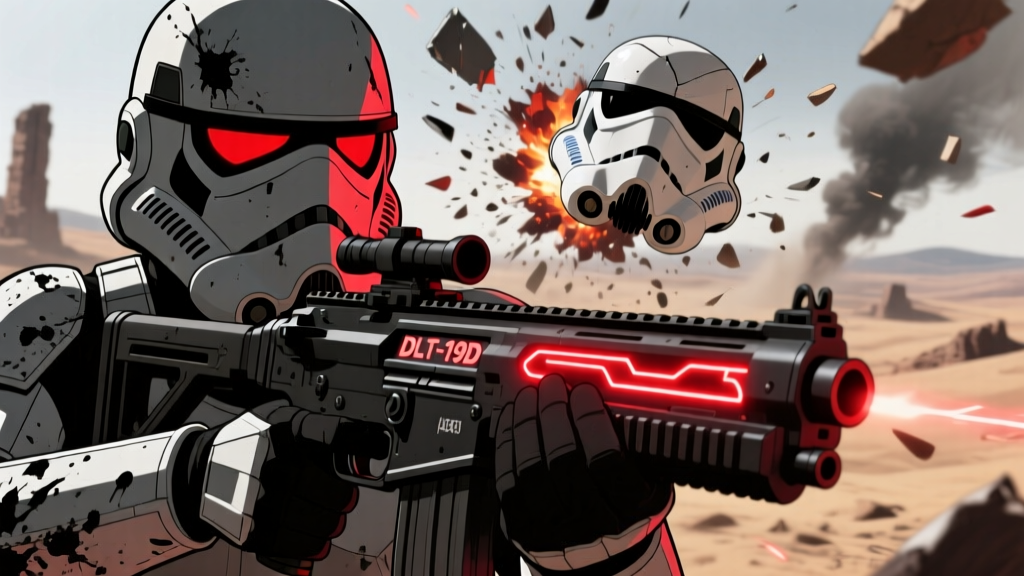
Rogue One's Scarif sequence plays like a war film shot from ground level. Rebel soldiers scramble across a beach, explosions throwing sand thirty feet in the air, and somewhere in that chaos a squad of black-armored soldiers advances in perfect formation. Each one cradles a long, dark rifle that looks nothing like the standard E-11 blasters carried by regular stormtroopers. That rifle is the DLT-19D heavy blaster — and for a lot of fans sitting in theaters in December 2016, it was the first time they noticed Imperial weapons had tiers.
The DLT-19D didn't arrive out of nowhere. It sits at the end of a long lineage of BlasTech heavy blasters that stretches back to the very first Star Wars film in 1977. But the D variant carries a specific pedigree: built for the Empire's most secretive soldiers, designed for engagements at distances where a regular blaster's bolts would scatter into useless light. Understanding what makes the DLT-19D different from its parent platform, where it shows up across the franchise, and why it has become one of the most sought-after prop replicas in the Star Wars collector community requires digging through nearly fifty years of blaster lore, practical prop design, and fandom obsession.
The DLT-19 Family Tree: From A New Hope to Rogue One
BlasTech Industries' DLT-19 heavy blaster rifle first appeared on screen in Star Wars: Episode IV — A New Hope (1977). In that film, stormtroopers aboard the Death Star carry them slung over white armor during the detention block shootout and the hangar bay scenes. The prop department, led by Roger Christian and supervised by production designer John Barry, built the original DLT-19s by modifying German MG34 machine gun barrels and attaching custom housings fabricated from aluminum tubing, plastic sheet, and surplus camera parts. The result was a weapon that read as genuinely military on camera — heavy, purposeful, mechanically complex in ways that a simple ray gun never could.
The base DLT-19 reappeared in The Empire Strikes Back (1980), carried by stormtroopers on Hoth and Cloud City. It also showed up prominently in Star Wars Rebels (2014-2018), where the animated series gave it a cleaner, more stylized design while preserving the overall silhouette. Bounty hunters like Boba Fett and Bossk used variants in various Legends-era comics and reference books, broadening the weapon's reputation beyond purely Imperial use.
Then came the D variant. The DLT-19D was created specifically for Rogue One: A Star Wars Story (2016) as the signature longarm of death troopers — the elite, black-armored soldiers assigned to Imperial Intelligence and the Tarkin Initiative. Director Gareth Edwards wanted the death troopers to feel distinct from every stormtrooper variant audiences had already seen, and the weapons department delivered. The DLT-19D took the parent DLT-19's profile and reworked it with a dark, matte-grey-and-black finish, an integrated optical scope, and subtle geometric changes to the barrel shroud and cooling fins.
What the "D" Actually Changes
The differences between a standard DLT-19 and the DLT-19D are specific enough to matter to anyone building a costume or studying Imperial small arms. The most obvious modification is the scope. The base DLT-19 mounts no optic — it's a point-and-shoot weapon with iron sights at best. The D variant adds a fixed magnification scope (depicted in reference materials as a 3x or variable-power optic) on a raised rail above the receiver, giving the rifle a designated-marksman capability that extends effective range to roughly 800 meters in Star Wars lore, compared to the base model's cited 450-meter envelope.
The barrel assembly on the DLT-19D also differs. The original DLT-19 uses a finned barrel shroud for heat dissipation during sustained fire, but the D variant reshapes those fins into a tighter, more angular pattern that matches the death trooper aesthetic — all hard edges and flat planes rather than the rounder profile of the original. The stock gets a similar treatment: the DLT-19's folding stock is retained but finished in the same dark composite material rather than bare metal.
Internally — at least according to Star Wars reference books and the Star Wars: The Rebel Files (2017) by Daniel Wallace — the DLT-19D uses a tuned gas system and a heavier Tibanna-gas power cell, trading rate of fire (approximately 2 shots per second compared to the base model's 3) for increased bolt cohesion at distance. Each shot carries more energy and travels further before losing focus. That tradeoff — fewer rounds, greater precision — perfectly matches the death trooper doctrine of small-unit, high-value target elimination.
| Specification | DLT-19 (Base) | DLT-19D (Death Trooper) |
|---|---|---|
| Manufacturer | BlasTech Industries | BlasTech Industries (Imperial contract) |
| Classification | Heavy blaster rifle | Heavy blaster rifle (marksman variant) |
| Effective Range | ~450 meters | ~800 meters |
| Rate of Fire | ~3 shots/second | ~2 shots/second |
| Optic | None (iron sights) | Integrated 3x magnification scope |
| Barrel Shroud | Rounded cooling fins | Angular, reshaped fin assembly |
| Finish | Standard grey/silver | Matte black / dark composite |
| Stock | Folding (metal) | Folding (dark composite) |
| Primary Users | Stormtroopers, bounty hunters | Death troopers (Imperial Intelligence) |
| First Appearance | A New Hope (1977) | Rogue One (2016) |
On-Screen Appearances: Where the DLT-19D Shows Up
The DLT-19D's screen debut in Rogue One remains its most iconic showing. During the Scarif beach battle, death troopers armed with DLT-19Ds advance on Rebel positions in tight wedge formations, their scoped rifles picking off targets at ranges where the Rebels' standard A280 blasters can't effectively return fire. The film's cinematography, shot by Greig Fraser, frames the weapons with unusual clarity — several close-ups show the scope housing and barrel detail in sharp focus, a deliberate choice that tells you the production team knew exactly what kind of attention Star Wars fans would pay to every piece of gear.
Death troopers (and their DLT-19Ds) later appeared in The Mandalorian Season 1, Episode 7 ("Chapter 7: The Reckoning"), where they serve as protection for Moff Gideon's remnant forces. The DLT-19D is visible in the hands of death troopers during the Nevarro standoff. While the screen time is shorter than Rogue One's battle sequences, the appearance cemented the weapon as part of the post-Empire Imperial remnant arsenal — these weren't leftover props gathering dust, they were still being issued to whatever Imperial cells retained enough infrastructure to equip their soldiers properly.
Animated and Gaming Appearances
The DLT-19D crossed into animation through Star Wars Rebels, where death troopers first appeared in Season 3 as part of Grand Admiral Thrawn's forces. The show's stylized art direction simplified the rifle's details somewhat — the scope and angular barrel read clearly at a glance, but fine surface details get lost at television resolution. Still, it was enough to establish the weapon in a show that reached a younger audience than the films, expanding the DLT-19D's recognition beyond hardcore prop collectors.
In gaming, the DLT-19D became a playable weapon in Star Wars Battlefront II (2017, DICE/EA). Players who selected the Death Trooper specialist class or equipped the weapon through unlock progression got a rifle that played distinctly from the base DLT-19 — slower handling, higher per-shot damage, and that scope providing a zoom function the unscoped original lacked. In competitive multiplayer, the DLT-19D occupied a marksman niche between assault blasters and sniper rifles. Its damage falloff curve was less severe than the DLT-19's, rewarding players who held angles at medium-to-long range rather than spraying at close quarters. Community weapon tier lists on Reddit's r/StarWarsBattlefront consistently placed it in the upper-middle tier, praised for accuracy but criticized for a magazine capacity of roughly 20 bolts before requiring a cooldown cycle.
The weapon also appears as a collectible item in Star Wars: Galaxy of Heroes (mobile, EA Capital Games) and as a detailed prop in Star Wars Jedi: Survivor (2023, Respawn Entertainment), where it can be found in environmental storytelling contexts on Imperial-held worlds.
Prop Replicas and the Collector Market
If you want a DLT-19D on your shelf, you've got more options than you'd expect — and they range wildly in price, accuracy, and build quality. The replica market for this weapon has grown substantially since Rogue One's release, driven by the 501st Legion (the international Star Wars costuming organization) and display collectors who want screen-accurate pieces.
Mass-Produced Replicas
Hasbro's Star Wars: The Black Series line has released a 1:12 scale DLT-19D as part of its Death Trooper figure accessory sets, and separately as a standalone "Credit Collection" display piece. The standalone version, released around 2021-2022, retailed in the $30-$45 range and offered decent surface detail for injection-molded plastic — panel lines, scope markings, and barrel rifling are all present, though the finish reads more toy than prop. For display at a distance or casual shelf placement, it works. For costume accuracy, it falls short.
On the higher end, companies like Destiny Guns and Imperial Arms produce 1:1 scale DLT-19D replicas using a combination of 3D printing (typically resin or PLA) and metal hardware. Imperial Arms lists their DLT-19D at full scale, approximately 44 inches in overall length, designed to 501st Legion costume standards. Prices for these replicas typically range from $180 to $350 depending on finish level — bare kits that require sanding, priming, and painting sit at the lower end, while fully finished and weathered versions command the premium. Build quality varies between shops, but the better examples use metal bipods, functional scope housings with actual glass optics, and magnets or clips for attaching the weapon to a death trooper costume's magnetic weapon mount system.
DIY and 3D-Printed Options
The 3D printing community has been especially active with the DLT-19D. Etsy hosts dozens of listings for STL files and printed kits, with prices for digital files starting around $15-$25 and printed (but unfinished) kits running $60-$120. PLA and resin are the standard materials. A popular approach involves buying a printed kit, then modifying it with real-world hardware — aluminum tubing for the barrel, surplus scope rings, Denix replica trigger mechanisms — to push the finished product closer to screen accuracy.
Jan Hamernik, a prop builder whose DLT-19 conversion work has been documented on his personal site, describes the process as essentially building a firearm from scratch using a non-functional donor body. His DLT-19 build (a base model, not the D variant) used a Denix submachine gun replica as the core, with custom 3D-printed parts replacing the stock, scope, and barrel shroud. The D variant conversion adds complexity because the angular barrel fins and dark finish require additional modeling work.
"The DLT-19D is one of those props where the screen-used versions were themselves kit-bashed from multiple sources. So when you're building a replica, you're essentially kit-bashing a kit-bash. The irony isn't lost on anyone doing this work." — Jan Hamernik, prop builder and replica documentation, jan-hamernik.com (2024)
What Collectors Actually Pay Attention To
Screen accuracy in the DLT-19D replica world comes down to a handful of details that separate serious builds from shelf fillers. The scope housing is the most scrutinized component — the on-screen prop has specific proportions and a distinctive rail mount that mass-produced replicas frequently get wrong. Cooling fin count and spacing on the barrel shroud is another common point of debate; the Rogue One props used a specific fin configuration that differs from the original A New Hope DLT-19, and mixing those up signals an inaccurate build immediately to anyone in the costuming community.
Finish matters enormously. The death trooper DLT-19D should read as matte black with subtle dark grey undertones — not glossy, not chrome, not gunmetal. Getting the right paint involves layers of flat black, light dry-brushing with dark grey to bring out surface detail, and a final matte clear coat. Some builders add subtle chipping and wear marks to simulate field use, though the death troopers in Rogue One carry weapons that look freshly issued rather than battle-worn.
The collector market has also seen interest in VeVe's digital DLT-19D collectible — a 3D model released as part of a Star Wars digital statue series. While it's not a physical object, VeVe's platform treats it as a limited-edition display piece, and secondary market prices for the digital collectible have fluctuated between $15 and $80 depending on rarity tier and demand cycles in the NFT-adjacent collectibles space.
Building a Death Trooper Costume Around the DLT-19D
For 501st Legion members pursuing death trooper certification, the DLT-19D is a required component of the costume. The 501st's costume reference library (CRL) specifies requirements for the weapon prop: correct overall dimensions, proper scope configuration, accurate barrel shroud geometry, and the correct matte-black-to-dark-grey finish. Builders who submit their costumes for review must photograph the weapon alongside the armor to demonstrate proportional accuracy.
The death trooper costume itself is considered one of the more challenging Imperial builds in the 501st. The armor is black (not white), which means every scuff, gap, and imperfection is more visible. The helmet features a vocoder unit that distorts the wearer's voice into the death trooper's signature garbled speech, and integrating electronics — voice modulation, helmet fans for ventilation, LED elements in the armor — adds complexity beyond a standard stormtrooper build.
Weapon mounting is another practical concern. Death troopers in Rogue One carry their DLT-19Ds on magnetic slings or chest-mounted weapon clips when not actively firing. Replica builders replicate this using neodymium magnets embedded in both the armor's chest plate and the weapon's receiver housing. The magnets need to be strong enough to hold a 3-5 pound prop rifle securely while the trooper walks, runs, or poses for photographs at conventions. Getting that balance right — strong enough hold without making the weapon impossible to detach quickly — takes iteration and testing.
- 501st Legion CRL requirements: Correct DLT-19D profile, accurate scope, proper barrel shroud fins, matte black finish, proportional sizing to trooper height
- Weight range for 1:1 replicas: 3-5 pounds (varies by material — resin builds lighter, metal-hardware builds heavier)
- Typical build timeline: 4-8 weeks for a finished DLT-19D from bare kit, including sanding, priming, painting, and scope installation
- Magnetic mount strength: N52-grade neodymium magnets recommended, rated for 15+ lbs pull force per mount point
- Estimated total cost: $200-$400 for a screen-accurate DLT-19D prop (excluding armor)
Why the DLT-19D Resonates With Fans
There's a reason the DLT-19D generates more discussion than dozens of other Star Wars weapons that appeared in the same film. Part of it is simple visual design: the dark finish and angular modifications make it look like a weapon that belongs to soldiers who operate in a different tier than the grunts. In a franchise where equipment design communicates narrative information instantly — Rebels carry rough-hewn weapons, Imperials carry sleek ones — the DLT-19D communicates something specific. This isn't a standard-issue tool. This is a precision instrument issued to people who don't miss.
The death troopers themselves amplify that impression. They don't speak in recognizable human voices. They move with mechanical precision. And they carry weapons that look customized, not mass-produced. The combination creates an archetype — the faceless elite operative — that resonates across military science fiction far beyond Star Wars. Fans of the genre recognize the type from Warhammer 40K's Tempestus Scions, Halo's ODSTs, and Destiny's Guardians. The DLT-19D is Star Wars' contribution to that visual language.
But there's also a practical appreciation at work. Among prop collectors and replica builders, the DLT-19D is admired because it represents some of the best prop design work in the sequel-era Star Wars films. The Rogue One props department, under the supervision of the Lucasfilm design team, took an existing weapon design (the DLT-19) and modified it just enough to create something new without losing the lineage. That restraint — knowing what to change and what to leave alone — is what separates memorable prop design from busy, overdesigned clutter. The DLT-19D reads as a believable firearm that happens to fire coherent light instead of lead, and that grounded quality is exactly what Star Wars weapon design does at its best.
"Rogue One gave us the chance to design weapons for soldiers who were a step above regular stormtroopers but below the Sith and Inquisitors. The DLT-19D had to feel special without feeling fantastical — like something a real special forces unit would carry." — Doug Chiang, design supervisor, The Art of Rogue One (Abrams, 2016)
Where the DLT-19D Sits in the Broader Star Wars Blaster Hierarchy
Within the Star Wars weapons taxonomy, the DLT-19D occupies a specific rung. Below it sit the standard E-11 blaster rifles (the everyday stormtrooper weapon) and the base DLT-19 (the heavy blaster carried by regular heavy weapons troopers). Above it, you find dedicated sniper platforms like the DLT-19x targeting blaster (used by scout troopers in Return of the Jedi) and the Longblaster used by Bossk in The Empire Strikes Back. The DLT-19D doesn't quite reach dedicated sniper status — it's a marksman rifle, not a sniper rifle — but it fills the gap between general-purpose heavy blasters and true precision weapons.
That positioning is what makes it interesting from a collector's perspective. It's not the most common weapon in the Imperial arsenal, which gives it exclusivity. But it's also not so rare that it feels disconnected from the broader Star Wars visual language. Someone who owns a DLT-19D replica alongside an E-11 and a standard DLT-19 can display all three and tell a clear story about Imperial weapons procurement — the standard-issue rifle, the heavy support variant, and the specialized marksman version issued to elite units. That narrative quality is what drives serious collecting.
Questions Collectors and Fans Ask About the DLT-19D
What does the "D" in DLT-19D stand for?
In Star Wars canon, the "D" suffix designates the death trooper-specific variant of the DLT-19 platform. The naming convention follows BlasTech's in-universe product coding system, where letter suffixes indicate modified versions of a base weapon. The DLT-19x (used by scout troopers) follows the same pattern — different suffix, different specialization.
Is the DLT-19D the same weapon as the standard DLT-19?
No. They share the same receiver and operating platform, but the DLT-19D includes an integrated scope, reshaped barrel shroud, heavier power cell, and a dark composite finish. The base DLT-19 is a general-purpose heavy blaster. The D variant is a marksman-optimized variant built for Imperial Intelligence's death trooper units.
Can I build a screen-accurate DLT-19D for 501st Legion costuming?
Yes, and many builders have. The 501st Legion's costume reference library accepts DLT-19D props that meet specific criteria for accuracy. Most builders start with a 3D-printed kit from a reputable maker and finish it with proper painting, scope installation, and hardware. Build times typically run 4-8 weeks for a finished, convention-ready prop. Check your local 501st garrison's CRL before starting, as requirements can be updated.
Where can I buy a DLT-19D replica?
Options span the full price range. Hasbro's Black Series 1:12 scale accessories run $30-$45. Full-scale 3D-printed kits from Etsy and specialized prop shops (Imperial Arms, Destiny Guns) range from $60 for unfinished kits to $350 for fully finished replicas. For screen-accuracy builds, expect to invest additional time and materials in finishing, painting, and hardware upgrades.
Which Star Wars media features the DLT-19D?
The weapon appears in Rogue One: A Star Wars Story (2016), The Mandalorian (Season 1, 2019), Star Wars Rebels (Season 3 onward, 2016-2018), Star Wars Battlefront II (2017), and various supplementary reference books and mobile games. Its primary association remains with the death trooper units introduced in Rogue One.
How does the DLT-19D compare to the E-11 blaster rifle?
They serve entirely different roles. The E-11 is a compact, general-purpose blaster — the standard sidearm-equivalent for stormtroopers. The DLT-19D is a full-length heavy blaster rifle designed for precision fire at extended range. Comparing them is like comparing a standard-issue carbine to a designated marksman rifle in real-world military terms. Different weight, different range, different tactical application.
Star Wars DLT-19D Death Trooper Blaster Rifles Rogue One Prop Replicas 501st Legion Imperial Weapons