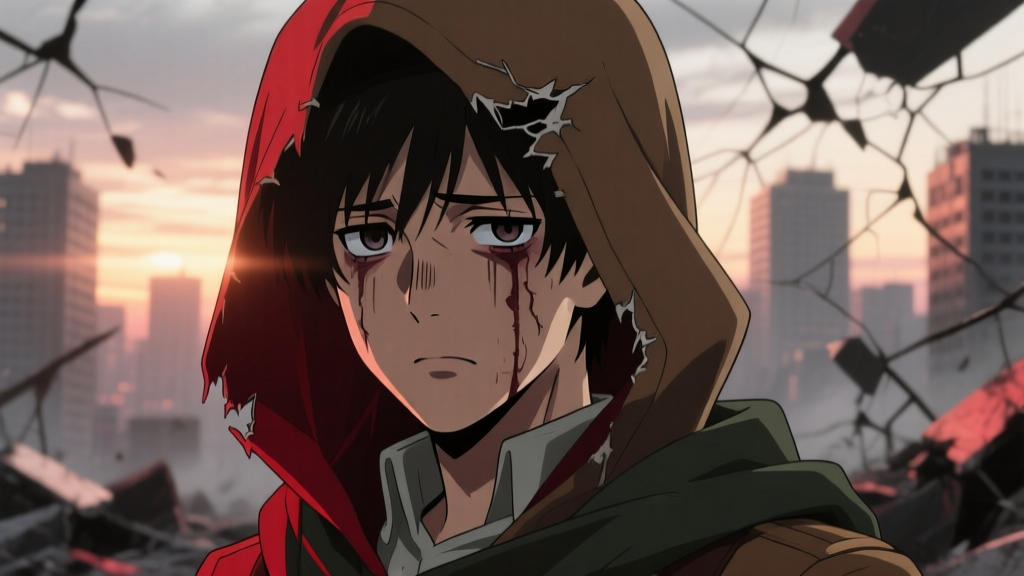
How Eren Yeager’s Final Arc Subverts Shonen Protagonist Archetypes
When the final episode of Attack on Titan aired, fans didn’t just feel sadness or closure—they felt betrayed. Not by the show, but by the genre itself. The backlash wasn’t about plot holes or rushed pacing (though those were debated). It was visceral: a collective recoil from watching a protagonist not only abandon his ideals, but weaponize them as justification for genocide. That discomfort—sharp, lingering, morally queasy—is the point. Hajime Isayama didn’t break shonen convention in S4. He dismantled it with surgical precision.
I remember watching Episode 85—the Liberio courtroom scene—on repeat. Not for spectacle, but for syntax. Eren doesn’t shout. He doesn’t weep. He leans forward, voice low and even, and says: “I’m not doing this for revenge. I’m doing it because it’s the only way to be free.” His eyes don’t flicker. His breathing stays steady. There’s no trembling hand, no tear-streaked face—no visual shorthand for “he’s suffering.” MAPPA frames him like a prosecutor delivering closing arguments: centered, unblinking, lit with cold, even light. Contrast that with Naruto’s confrontation with Pain in Episode 163. Naruto collapses to his knees, bloodied and sobbing—not from weakness, but from the unbearable weight of empathy. His redemption isn’t earned through victory; it’s forged in shared grief. He touches Pain’s forehead and says, “I understand your pain.” It’s a moment of radical vulnerability disguised as strength. Eren refuses that gesture entirely. In Episode 87, when Mikasa begs him to stop, he doesn’t hesitate. He doesn’t even look at her. He turns away—and the camera holds on her face, frozen mid-breath, as if time itself flinches.
This isn’t moral ambiguity. It’s moral erosion rendered with chilling consistency. Naruto’s arc hinges on the idea that willpower can *reconstruct* identity: the outcast becomes the Hokage *because* he chooses connection over isolation. Luffy, in Wano and beyond, never wavers in his belief that freedom means protecting others’ right to choose—even Kaido’s subordinates get offered a path out. Their power grows *alongside* their compassion. Eren’s power, by contrast, calcifies his convictions into dogma. His Founding Titan ability doesn’t just grant him control over other Titans—it mirrors his psychological trajectory: total assimilation, zero negotiation, no room for dissent. When he activates the Rumbling, MAPPA doesn’t cut to sweeping aerial shots of destruction first. They linger—six full seconds—on Armin’s face as he realizes what Eren has done. His mouth opens. No sound comes out. That silence is louder than any explosion.
Isayama confirmed this intentionality in his December 2021 interview with Shonen Jump: “People ask me if Eren was always going to become a villain. But he wasn’t a villain—he was a boy who believed in ‘heroic inevitability.’ And that belief is the most dangerous thing in the world.” Note the phrasing: not “fate,” not “destiny”—inevitability. It’s a critique of how shonen often treats moral clarity as an endpoint rather than a practice. Naruto stumbles backward into wisdom; Luffy barrels forward with instinctive decency. Eren marches straight ahead, convinced every step is righteous because it feels necessary. His final monologue in Episode 87 isn’t a rant—it’s a logic puzzle solved aloud: “If freedom requires sacrifice, then sacrifice must be justified. If the world won’t let us live, then the world must end. Therefore, I am free.” It’s terrifyingly coherent.
MAPPA’s direction amplifies the rupture. Where Naruto uses warm, saturated palettes during emotional breakthroughs—and One Piece lingers on expressive, almost cartoonish close-ups to underline sincerity—S4 employs desaturated blues and greys, tight framing, and jarringly long takes. In the War Hammer Titan fight (Episode 75), Eren doesn’t roar before transforming. He exhales—slow, deliberate—and the screen goes black for half a second before cutting to his Titan form mid-swing. There’s no buildup, no music swell. Just consequence. Even the soundtrack abandons leitmotif: his theme, once heroic and string-heavy, fractures into dissonant piano fragments by Episode 80, then vanishes entirely.
That’s the subversion: Eren doesn’t “fall” in a dramatic arc. He *ascends*—into certainty. His tragedy isn’t that he loses himself. It’s that he finds himself *too well*. The boy who screamed “I’ll kill every last one of them!” in Episode 1 doesn’t grow out of that rage. He systematizes it. He builds infrastructure for it. He recruits Armin—the voice of reason—as his strategist, not his conscience. When Armin pleads with him in the basement (“Eren… please stop”), Eren replies, “You’re still thinking like a soldier. I’m thinking like a king.” It’s not hubris. It’s ideology made flesh.
Naruto and Luffy survive because their worlds bend to accommodate their growth. Eren’s world bends to accommodate his collapse—and breaks under the strain. That’s why the finale lands like a gut punch instead of a catharsis. We aren’t meant to forgive him. We’re meant to recognize the architecture of his conviction—the same architecture that fuels real-world justifications for violence cloaked in liberation. Isayama doesn’t offer redemption because redemption would imply the system works. Instead, he gives us silence, ashes, and Mikasa’s hand on Eren’s nape—not in love, but in termination. A mercy kill dressed as closure.
This works because it refuses the genre’s safety net. Shonen teaches us that effort yields virtue, that pain refines purpose, that power is neutral until wielded. Eren proves otherwise. His will doesn’t purify—it petrifies. His freedom isn’t emancipation. It’s erasure. And in refusing to let him smile at the end, or whisper “thank you” to his friends, or even blink in regret—MAPPA and Isayama force us to sit with the uncomfortable truth: some protagonists don’t get saved. Some are too far gone to want saving. And that, perhaps, is the most shonen thing of all—not the triumph, but the terrible, unflinching honesty of the fall.