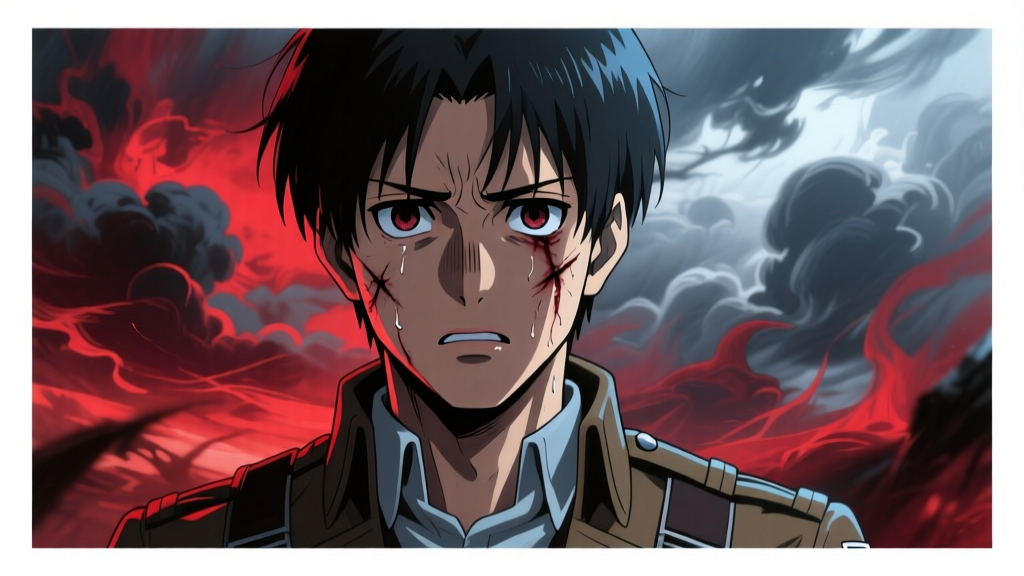
Eren Yeager's Complete Character Arc: From Shonen Protagonist to Tragic Antagonist
When Eren Yeager screamed “I’ll kill every last one of them!” in Episode 1, it sounded like the battle cry of a classic shōnen hero—raw, righteous, and tethered to revenge. By Episode 87, he stood atop a mountain of rubble and corpses, whispering, “I’m free,” as the Rumbling consumed continents. That line wasn’t triumph. It was exhaustion. A final, hollow punctuation mark on a character arc that redefined what an anime protagonist could become.
I remember watching Season 1 with my friends, shouting along when Eren first transformed in Trost District—his veins bulging, skin cracking, eyes wide with fury and purpose. We thought we knew him: the angry boy who lost his mother, the stubborn trainee who refused to bow, the inheritor of the Attack Titan’s rage. But Hajime Isayama didn’t build Eren to win a tournament or save a princess. He built him to break.
The First Fracture: The Fall of Shiganshina (Episode 1)
It’s easy to overlook how much is encoded in that opening sequence—not just trauma, but structure. The camera lingers on Eren’s hand gripping Mikasa’s scarf as the Colossal Titan breaches Wall Maria. That scarf isn’t just a symbol of care; it’s the first thread of entanglement. His vow—“I’ll kill every last one of them”—isn’t abstract. It’s directed at *them*: the Titans, the enemy, the faceless force that took everything. But Isayama frames the scene so the sky darkens *before* the Titan appears—like fate tightening its grip before the first blow lands.
This isn’t just origin trauma. It’s deterministic framing. The walls aren’t barriers—they’re incubators. And Eren isn’t just reacting; he’s being *prepared*. His childhood nightmares of hands bursting from his back? Not premonitions. They’re ancestral memories bleeding through, long before he knows what the Founding Titan is.
The Second Fracture: The Truth of the Walls (Season 3, Episode 17)
“The world outside is not our enemy.” Erwin’s dying words echo—but Eren doesn’t hear them. He hears Grisha’s memories instead: the blood on his father’s hands, the basement door, the choice to inject Eren with the serum *while he screamed no*. That moment reframes everything. His entire moral compass—the belief that “freedom” meant punching through walls—shatters. Now freedom means *erasing borders*, because borders are lies told by oppressors.
What makes this turning point devastating is how quietly it lands. No dramatic music. Just Eren sitting alone in a cell, staring at his hands—same hands that once gripped Mikasa’s scarf, now stained with the knowledge that his father murdered the Reiss family. His first act after escaping? Not vengeance against the Military Police. Not diplomacy with the Survey Corps. He goes to Historia and says, “You’re the true heir. You should be queen.” He’s already abdicating moral authority—even before he seizes absolute power.
The Third Fracture: The Attack on Liberio (Season 4, Episode 15)
This is where Eren stops being readable as a hero—or even an antihero—and becomes something colder: a strategist who weaponizes empathy. He lets Falco eat the Jaw Titan not out of compassion, but because he *needs* Falco alive to deliver Zeke’s plan to the Eldians. He hugs his friends goodbye knowing he’ll slaughter them in days. He tells Mikasa, “I don’t want you to understand me”—not as cruelty, but as surrender. He’s already stepped beyond justification.
Watch his face during the parade. When the crowd cheers, he doesn’t smile. His eyes scan for exits, for threats, for *control*. His Titan form emerges not with a roar, but with a sigh—a physical manifestation of inevitability. The Attack Titan’s rage has calcified into resolve. There’s no more fire left to burn. Just ash, and motion.
Freedom as Annihilation
Eren’s definition of freedom evolves in three brutal stages:
- Stage 1 (Shiganshina): “Freedom is removing the walls.” A spatial, physical ideal—simple, tangible, heroic.
- Stage 2 (Reiss Basement): “Freedom is choosing our own story.” A narrative ideal—breaking inherited guilt, rejecting Grisha’s script.
- Stage 3 (Rumbling): “Freedom is ending the choice itself.” A metaphysical collapse—no more debate, no more negotiation, no more history. Just silence.
Isayama doesn’t let Eren have a grand speech defending genocide. In Episode 85, when Armin confronts him inside the Paths, Eren doesn’t argue ethics. He says, “I’m scared. I’m tired. I don’t want to think anymore.” That’s the heart of it. His arc isn’t about ideology winning—it’s about trauma winning. Every “choice” he makes post-Liberio is less decision and more gravitational pull toward self-annihilation.
Determinism Woven Into the Bones
The manga’s biggest structural gamble—and the anime replicates it flawlessly—is making determinism *visible*. The Paths aren’t just a plot device. They’re the visual grammar of fate. When Eren walks among the naked, floating bodies of past Titan holders, he’s not in a dream. He’s in a genealogical archive. His memories aren’t flashbacks—they’re downloads. His rage isn’t volition; it’s firmware.
Even his final conversation with Historia confirms it: “I never wanted this power… but I used it anyway.” He knows he’s trapped—not by chains, but by the weight of 2,000 years of Eldian resentment, Marleyan propaganda, and his own inherited despair. The horror isn’t that he chooses evil. It’s that *choice dissolves* under that weight.
The Tragedy Isn’t in His Death—It’s in His Clarity
Eren dies smiling—not because he won, but because he finally stopped fighting himself. In the Paths, he sees Ymir Fritz’s 2,000-year loop of obedience, love, and exhaustion. He understands her. And in that understanding, he chooses *not* to repeat it. He breaks the cycle not by building something new, but by burning the engine.
That’s why Mikasa’s final act—decapitating him—isn’t betrayal. It’s mercy. She doesn’t kill the monster. She kills the boy who begged her, years ago, to never let him go mad. She honors the Eren who existed *before* the basement, before the Rumbling, before the Paths—when freedom still meant holding hands, not leveling cities.
“I am the only one who can stop Eren.” — Mikasa, Episode 87
She says it without hesitation. Not as a soldier. As a sister. As the last person who remembers the texture of his humanity—the way he chewed his nails before exams, how he blushed when Armin praised his tactics, the exact pitch of his laugh when Jean tripped over his own boots. All of that remains real, even as he becomes the apocalypse.
Eren Yeager’s arc isn’t a warning against power. It’s a diagnosis: What happens when trauma becomes theology? When grief hardens into doctrine? When “freedom” stops being a right and starts being a weapon calibrated to erase every alternative?
Attack on Titan didn’t give us a villain who fell from grace. It gave us a hero who climbed so high he mistook the edge of the world for the sky—and jumped, convinced the fall was flight.
I still watch the first episode sometimes. Not for nostalgia, but to remember the weight of that early scream—how full of life it was. How desperately, beautifully human. That Eren didn’t vanish. He was buried. And the tragedy isn’t that he became a monster. It’s that the monster was always just another version of the boy who wanted to be free.