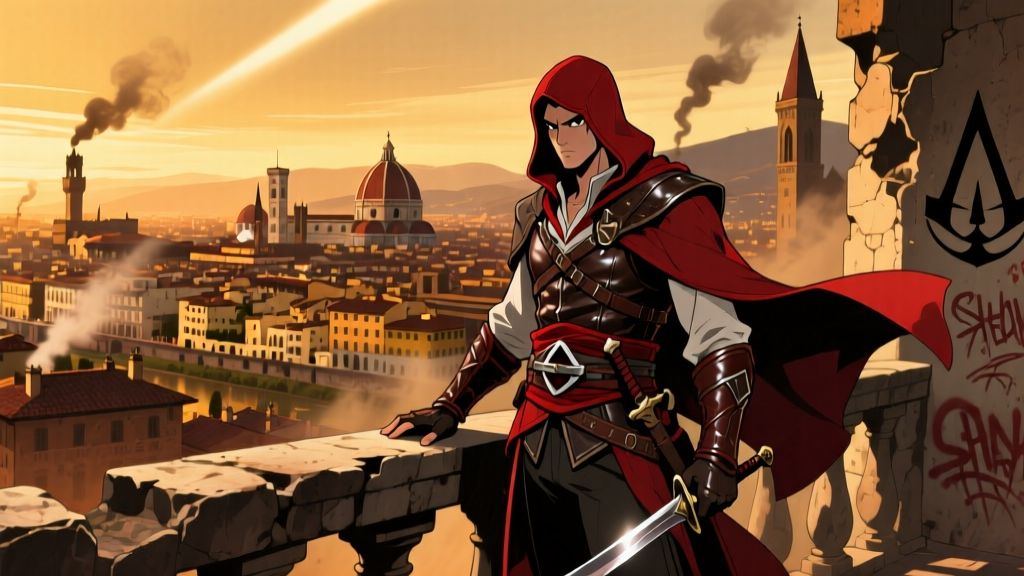
Ezio Auditore da Firenze: The Assassin Who Stole the Renaissance — And Never Gave It Back
Florence, 1476. A seventeen-year-old boy watches his father and two brothers hang from ropes in the Piazza della Signoria. The crowd jeers. The corpse of Francesco de' Pazzi swings nearby. The boy's name is Ezio Auditore da Firenze, and in roughly ninety seconds of gameplay, Ubisoft Montreal accomplished what most RPGs fail to do across forty hours: they made you feel the exact moment a person stops being young.
Across three mainline titles — Assassin's Creed II (2009), Assassin's Creed: Brotherhood (2010), and Assassin's Creed: Revelations (2011) — Ezio Auditore became the face of a franchise that had, until his arrival, rested entirely on Altair Ibn-La'Ahad's hooded shoulders. More than that, he became the gold standard for what a video game protagonist could accomplish when writers let a character age, grieve, love, fail, and ultimately let go. No respawn. No sequel bait. Just a man's entire life, compressed into roughly 120 hours of gameplay across the "Ezio Trilogy."
This is not a retrospective wrapped in nostalgia. This is a proper teardown of the most fully realized character Ubisoft has ever shipped — why he works, where the writing stumbled, and what the Ezio era tells us about storytelling in open-world games nearly two decades later.
The Hanging That Changed Everything
Before Ezio, the original Assassin's Creed (2007) was a technical marvel wrapped around a protagonist who felt more like a philosophical mouthpiece than a human being. Altair was compelling in concept — a disillusioned killer questioning his order's morality — but his personality rarely extended beyond stoic detachment. He spoke in riddles. He moved like a predator. Players respected him. They did not, however, know him.
Ubisoft Montreal understood this gap. Creative director Patrice Desilets and narrative director Corey May built Assassin's Creed II around a single mandate: make the player care about the person beneath the hood before they ever pick up a hidden blade. The result was a prologue sequence that remains one of the most effective origin stories in gaming. You play as Ezio during his teenage years — racing through Florence's rooftops, flirting with Lisa Gherardini, brawling with the Pazzi brothers in the streets. The game spends roughly two hours letting you inhabit a careless, privileged young nobleman before ripping that life away entirely.
The execution scene works because of what precedes it. You've met Giovanni Auditore. You've heard him laugh. You've watched him ruffle his son's hair and hand over a pouch of florins with a conspiratorial wink. Federico has teased Ezio about his love life. Petruccio, the youngest, has asked his big brother to climb the Campanile di Giotto because he's too sick to make the climb himself. These are not cutscene NPCs delivering exposition. They are family members rendered through gameplay — you physically interact with each of them, complete small tasks for them, hear their voices crack with warmth.
Then they die. All of them. In under five minutes.
"Requiescat in pace" — the phrase Ezio whispers to every target after an assassination — first appears as an act of mercy. By Revelations, it reads as exhaustion. That shift is not accidental. It is the entire character arc compressed into four words.
The scene's restraint is what separates it from typical video game tragedy. There is no slow-motion. No orchestral swell. Ezio reaches the gallows, his father tries to speak through a broken jaw, the lever pulls, and the bodies drop. The crowd noise cuts to near-silence. Ezio stands still for exactly two seconds — an eternity in a medium that rarely lets its characters be still — before the game hands control back to the player. Your first instinct isn't revenge. It's disbelief.
Three Games, Three Versions of the Same Man
Most video game sequels reset their protagonists. Master Chief is functionally identical across Halo 2, 3, and 4. Nathan Drake's personality barely shifts between Uncharted titles. Ezio is the rare exception: each game presents a fundamentally different version of the same person, shaped by the events of the previous entry.
Assassin's Creed II — The Vengeful Son (1476–1499)
In AC2, Ezio is reactive. Every assassination he commits is personal — Uberto Alberti betrayed his family directly. The Pazzi conspirators orchestrated the hanging. Rodrigo Borgia, the game's primary antagonist, represents the institutional corruption that allowed the murder to happen. Ezio's motivation is straightforward: kill everyone responsible. The game tracks this obsession across 23 years of in-game time, and the writing is sharp enough to show the cost of that obsession. Ezio's mother, Maria, stops speaking after the executions. She will not utter another word for the remainder of the game. Claudia, his sister, hardens into someone unrecognizable from the carefree girl in the prologue.
The genius of AC2's structure is that it lets you feel the seduction of revenge. Early kills are satisfying — Uberto's assassination in the Piazza della Signoria, the same square where Giovanni died, is cathartic in a way few game moments achieve. But by the time Ezio reaches the Vatican Vaults and confronts Rodrigo Borgia, something has shifted. He has the Pope at his mercy. He raises the blade. And then he doesn't kill him. Not out of mercy, but because murder will not bring his family back. It is the first moment Ezio chooses something other than vengeance, and the game trusts the player to understand this without a single line of dialogue spelling it out.
Brotherhood — The Reluctant Commander (1499–1507)
Brotherhood opens with Monteriggioni — the town Ezio spent AC2's middle act restoring — destroyed in roughly ten minutes of gameplay. Cesare Borgia's cannons level the walls. Mario Auditore, Ezio's uncle, is shot in the chest and tossed from the battlements. The Apple of Eden is lost. Ezio is wounded, humiliated, and forced to flee to Rome with nothing.
This is where the writing earns its sequel status. Brotherhood is not a rehash — it's a thematic counterargument to AC2. Where the second game asked "what will you sacrifice for revenge?", Brotherhood asks "what will you build after the revenge is done?" Ezio cannot fight Cesare Borgia alone. The game's core mechanic — recruiting and training assassins — is not merely a gameplay addition. It's a narrative statement: Ezio must learn to lead, to trust, to invest in people who might die because of his decisions.
The assassination of Cesare Borgia himself is telling. After years of pursuit, Ezio does not deliver a grand speech. He does not monologue. He drops Cesare from the walls of Viana Castle in Navarre, Spain — the same way Cesare dropped Mario from Monteriggioni. The symmetry is deliberate, but the execution is cold, almost bureaucratic. Ezio has become something harder than the boy who screamed at Uberto Alberti's corpse. He has become the weapon his father tried to prepare him for.
Revelations — The Pilgrim (1511–1512)
Revelations is the quietest game in the trilogy, and that quietness is the point. Ezio is now 52 years old. His knees creak when he free-runs — a subtle animation change that Ubisoft Quebec implemented specifically to convey age. He travels to Constantinople not to fight, but to understand. The game's central question is one that almost no action title dares to ask: what does a killer do when there is nothing left to kill for?
The answer Ezio finds is Sofia Sartor — a Venetian-Italian bookshop owner who has never held a blade, never scaled a building, and never lost family to the Templar order. Their relationship is the most mature romance Ubisoft has ever written. It unfolds through conversations, not cutscenes: Ezio brings Sofia rare books, they debate philosophy, she teases him about his scars. When Ezio finally tells her about the Brotherhood, he does so with the weary honesty of a man who has kept a secret for thirty years and is simply tired of carrying it.
The final scene of Revelations — and, effectively, of Ezio's playable life — takes place on a bench in Florence's Piazza della Signoria. The same square where his family was executed. Ezio sits beside Sofia, watches the sunset, and speaks his last words: "I've had my share of adventures. Now it's time to rest." He closes his eyes. He does not open them again. It is the most restrained death scene in a medium that usually treats mortality as a plot device, and it works precisely because the game has spent three titles earning every second of that silence.
The Trilogy at a Glance: How Ezio's Story Shifted Across Three Titles
| Title / Year | Ezio's Age | Core Theme | Key Mechanic | Metacritic |
|---|---|---|---|---|
| AC II (Nov 2009) | 17–40 | Vengeance & loss of innocence | Villa management, dual hidden blades | 91/100 |
| Brotherhood (Nov 2010) | 40–48 | Leadership & institutional power | Assassin recruitment, crossbow | 90/100 |
| Revelations (Nov 2011) | 52–53 | Legacy, purpose & letting go | Hookblade, bomb crafting, Den Defense | 80/100 |
| Metacritic scores reflect the PS3/Xbox 360 composite averages at time of release. AC II sold approximately 9 million copies across platforms by 2012 (per Ubisoft financial reports). | ||||
What Makes Ezio Work When So Many Game Protagonists Don't
The answer is unglamorous: consistency of voice. Across three games, two short films (Assassin's Creed: Lineage and Assassin's Creed: Embers), a novelization by Oliver Bowden, and dozens of promotional tie-ins, Ezio Auditore sounds like the same person. Not the same archetype — the same person. The jokes he makes at 40 reference things that happened to him at 20. His distrust of institutions in Brotherhood is a direct consequence of watching the Medici and Pazzi tear Florence apart in AC2. His willingness to mentor young assassins in Revelations mirrors the guidance Mario and Leonardo da Vinci gave him decades earlier.
Compare this to Desmond Miles, the "modern-day" framing character who appears alongside Ezio across all three titles. Desmond is functionally a different character in each game — confused in AC2, determined in Brotherhood, and philosophical in Revelations — but those shifts feel like rewrites rather than growth because the games never show us why he changed. Ezio's evolution is legible because every shift is earned through gameplay events the player experienced firsthand.
The Voice Behind the Hood
Roger Craig Smith's voice performance deserves specific attention. Smith was relatively unknown when cast as Ezio in 2009, and his performance across the trilogy is a masterclass in vocal aging. In AC2, Ezio's voice carries a reedy, almost musical quality — he sounds like a Florentine nobleman who has read too much Petrarch and believes love conquers everything. By Brotherhood, the voice drops half an octave. The musicality is gone. Sentences are shorter, harder, delivered with the clipped cadence of someone who has started giving orders and expects them to be followed. In Revelations, Smith adds a gravel texture that suggests decades of shouting over wind on horseback. The performance in the final bench scene — where Ezio's voice cracks on the word "rest" — was reportedly recorded in a single take. Smith has said in interviews (notably a 2017 panel at PAX West) that he considered those lines "the hardest thing I've ever had to say into a microphone."
The People Who Built Ezio (And the Ones He Couldn't Save)
Ezio's character does not exist in a vacuum. The Ezio Trilogy's supporting cast is among the strongest in any open-world franchise, and the relationships Ezio forms — and fails to maintain — are what give his arc its weight.
- Leonardo da Vinci — The trilogy's emotional anchor. Leonardo is the only character who appears across all three games in a non-combat role. He builds Ezio's weapons, patches his wounds, and — in Brotherhood's "Da Vinci's Disappearance" DLC — risks his own life to decode a Templar cipher. Their friendship works because it's asymmetrical: Leonardo needs Ezio for protection, Ezio needs Leonardo for purpose. When Leonardo dies offscreen between Brotherhood and Revelations, Ezio does not grieve on-camera. He simply stops mentioning him. The silence is devastating.
- Caterina Sforza — Ruler of Forli, warrior, and arguably the most competent person Ezio ever meets. Their brief romance in AC2 is one of the few relationships where Ezio is not the more capable partner. Caterina does not need saving — she needs an ally — and the game respects her enough to let her operate independently after their partnership ends.
- Claudia Auditore — Ezio's sister undergoes the most dramatic transformation in the trilogy. She begins as a spoiled Florentine teenager, becomes the madam of a Roman brothel (which functions as an intelligence network), and is formally inducted into the Assassin Brotherhood in Brotherhood's final act. Her arc mirrors Ezio's: both siblings were shaped by the same trauma, but Claudia chose institution-building where Ezio chose solitary combat.
- Rodrigo & Cesare Borgia — The father-son antagonist pair inverts Ezio's own family tragedy. Where Giovanni Auditore raised Ezio with warmth and moral complexity, Rodrigo Borgia raised Cesare as a weapon. Cesare's descent into megalomania is, in many ways, what Ezio might have become without the Brotherhood's influence — a person consumed entirely by ambition.
- Sofia Sartor — Introduced only in Revelations, Sofia represents the life Ezio almost never had. She is intellectual, grounded, and completely outside the Assassin-Templar conflict. Their courtship is built on conversation rather than rescue, and it gives the trilogy's final hours an emotional register no previous entry achieved.
The Imprint Ezio Left on Gaming
Measured purely by commercial performance, Assassin's Creed II was a phenomenon. The title shipped approximately 9 million units within its first three years, according to Ubisoft's FY2012 annual report, and established the franchise as Ubisoft's primary revenue driver through the early 2010s. The Ezio Trilogy collectively sold over 30 million copies across platforms by 2015, based on figures from Ubisoft's investor presentations. For context, that made Ezio Auditore the protagonist of one of the best-selling character-driven trilogies in gaming history — comparable to Master Chief's original Halo trilogy (roughly 30 million copies by 2010, per Microsoft disclosures) and Nathan Drake's Uncharted run (approximately 21 million by 2012, per Sony).
But the numbers tell only part of the story. Ezio's deeper impact was on game narrative structure itself. Before AC2, the dominant model for open-world protagonists was the blank-slate avatar — a character defined primarily by player projection. Grand Theft Auto IV's Niko Bellic (2008) had begun shifting this model, but it was Ezio who proved that an open-world lead could carry the emotional complexity of a linear RPG protagonist without sacrificing player agency. After Ezio, the industry watched a wave of open-world titles invest more heavily in character-driven storytelling: Red Dead Redemption (2010) gave us John Marston's doomed reckoning, The Witcher 3 (2015) built an entire open world around Geralt's paternal search for Ciri, and even Ubisoft's own Far Cry 3 (2012) structured its narrative around Jason Brody's moral degradation.
Ezio also pioneered what might be called "aging as narrative mechanic." The decision to show Ezio at 17, 40, 48, and 52 across three titles was unprecedented for a mainstream action franchise. It demonstrated that players would accept physical and psychological change in a protagonist if the change felt earned — and it opened the door for later experiments like Red Dead Redemption 2's Arthur Morgan (whose aging is compressed but palpable) and The Last of Us Part II's time-jump structure.
Looking back, the Ezio Trilogy's specific narrative innovations have been absorbed across the industry in ways players may not even notice:
- Protagonist aging across sequels — Physical and psychological change reflected in animation, voice direction, and dialogue cadence rather than merely stated in cutscenes.
- Base-building as character arc — Monteriggioni's restoration in AC2 and Rome's liberation in Brotherhood tied economic mechanics directly to Ezio's emotional investment in community.
- Silence as narrative device — The bench scene in Revelations proved that withholding dialogue and action could carry more emotional weight than a cinematic climax.
- Supporting cast as mirrors — Each major supporting character (Leonardo, Claudia, Caterina, Sofia) reflected a different facet of Ezio's identity, making the world feel like a conversation rather than a backdrop.
GameSpot's 2011 "Best Character of the Generation" list placed Ezio Auditore at number 3, behind only Gordon Freeman and Master Chief — both of whom had significantly longer franchise histories. The selection noted that Ezio "accomplished in three games what most characters cannot accomplish in ten."
The Embers Problem: Where the Writing Faltered
It would be dishonest to discuss Ezio without addressing Assassin's Creed: Embers — the 2011 animated short film that depicts Ezio's final years in rural Tuscany. The short, while visually beautiful, makes a controversial narrative choice: Ezio dies of a heart attack on a market bench in Florence while watching a young man who may or may not be a Templar agent. The ambiguity is the problem. After a trilogy built on moral clarity — Ezio always knew who his enemies were and why he fought them — Embers introduces doubt at the exact moment the character deserved certainty.
Fans were split. Some read the short as a final statement on the futility of the Assassin-Templar war: even in retirement, Ezio cannot stop scanning crowds for threats. Others saw it as an unnecessary complication — a studio hedging its bets on a potential sequel hook rather than trusting the character's arc to close cleanly. Ubisoft never officially addressed the controversy, but the fact that Ezio has not appeared as a playable character since Revelations suggests the studio understood the value of leaving well enough alone.
How Ezio Stacks Up Against Other Assassin's Creed Leads
The franchise has introduced twelve playable protagonists across mainline titles since 2007. None have matched Ezio's narrative completeness, and the gap is instructive.
Connor Kenway (AC III, 2012) is arguably the most ambitious protagonist Ubisoft has attempted — a half-Mohawk, half-British warrior caught between colonial powers and indigenous sovereignty. The concept is rich, but the execution is uneven. Connor's personality shifts between scenes without clear motivation, and the game's most emotionally powerful moments (the burning of his village, his confrontation with Samuel Adams) are undercut by a combat system that prioritizes spectacle over intimacy. Edward Kenway (Black Flag, 2013) solved the charisma problem — he's charming, reckless, and genuinely funny — but his redemption arc compresses too much growth into too little screen time. Bayek of Siwa (Origins, 2017) comes closest to matching Ezio's emotional depth, particularly in the game's opening hours, but the RPG structure of Origins — with its 60+ hour runtime and loot-driven progression — dilutes the narrative focus that made the Ezio Trilogy so tight.
The fundamental difference is structural. The Ezio Trilogy was written as a single, continuous story divided into three chapters. Every subsequent AC protagonist has been written as a standalone entry, with connections to the broader lore bolted on after the fact. The result is that Ezio's arc has a beginning, middle, and end — while characters like Eivor (Valhalla, 2020) and Kassandra (Odyssey, 2018) feel like opening chapters of stories that were never fully told.
Questions Players Still Ask About Ezio
Is Ezio Auditore based on a real historical person?
No. Ezio is a fictional character created by Ubisoft Montreal. However, the trilogy places him alongside real historical figures — Leonardo da Vinci, Niccolo Machiavelli, Caterina Sforza, and the Borgia family — all of whom were genuine Renaissance-era personalities. The Pazzi conspiracy of 1478, which the game references, was a real assassination attempt against Lorenzo and Giuliano de' Medici in Florence's cathedral. Ezio's father and brothers are not connected to the historical conspiracy; their execution is a fictional catalyst.
How old is Ezio when he dies?
Ezio was born on June 24, 1459. The animated short Assassin's Creed: Embers depicts his death in 1524, making him approximately 65 years old. The exact date of his death is not specified in the short, but the seasonal setting (late summer or early autumn, based on the market produce and lighting) suggests he died roughly three months after his 65th birthday.
Why did Ubisoft kill off Ezio?
Ubisoft has not issued a formal statement explaining the decision. The narrative reasoning, however, is clear: Ezio's arc was structurally complete after Revelations. The trilogy had traced his life from birth to death, and extending his story further would have required either introducing a new conflict (which would dilute the existing arc) or revisiting resolved themes. The short film Embers was released in November 2011, the same month as Revelations, suggesting the decision was made during production rather than as a reactive measure.
Will Ezio return in a future Assassin's Creed game?
As of mid-2026, Ezio has not appeared as a playable character in any mainline title since Revelations. He has made cameo appearances — a reference in AC Valhalla's "A Fated Encounter" DLC (2023) and brief mentions in tie-in novels — but Ubisoft has consistently avoided resurrecting him as a protagonist. Given the franchise's recent pivot toward mythological settings (Mirage, Shadows), a return seems unlikely in the near term, though the franchise has never ruled it out publicly.
What is the correct play order for the Ezio Trilogy?
The intended order is: Assassin's Creed II → Assassin's Creed: Brotherhood → Assassin's Creed: Revelations. Each game picks up directly where the previous one ends. For the fullest experience, watch the short film Assassin's Creed: Lineage (2009) before starting AC2 — it covers Giovanni Auditore's final days and provides crucial context for the hanging scene. Watch Assassin's Creed: Embers (2011) after completing Revelations.
A Bench in Florence
There is a reason players still talk about Ezio Auditore nearly fifteen years after his last appearance. It is not the parkour. It is not the hidden blades or the Leonardo-designed gadgets or the rooftop chases across Venice's canals. Those are good — often excellent — but they are mechanics, and mechanics age. Combat systems feel sluggish after a generation. Graphics become quaint. Open-world design evolves past what seemed innovative in 2009.
What endures is the bench.
A fifty-two-year-old man sits in a square where his family was murdered thirty-six years earlier. He is not scanning the crowd for Templars. He is not calculating escape routes or planning his next assassination. He is watching the sunset with someone he loves, and he is tired, and he is at peace. The game does not tell you how to feel about this moment. It does not need to. You have spent three titles — roughly 120 hours — earning the right to sit on that bench with him.
Video games have given us heroes who save galaxies, soldiers who single-handedly win wars, and detectives who solve impossible crimes. Ezio Auditore did none of those things. He avenged his family. He built a brotherhood. He found someone to grow old with. And then he sat down and closed his eyes.
Requiescat in pace, Ezio. You earned it more than most.