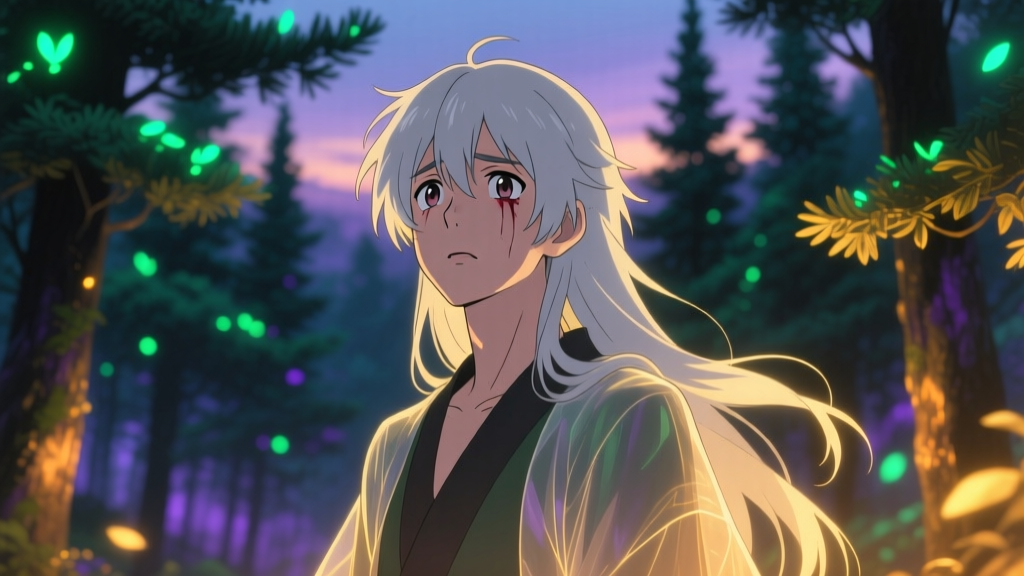
Why does Ginko have no origin story—when every other anime protagonist in 2006 was excavating theirs with a backhoe?
Not amnesia. Not retcon. Not even “we’ll reveal it later.” Ginko’s absence of origin is structural—not a gap to be filled, but a wall built with intention. In 2006, as Monster spent 74 episodes tracing Johan Liebert’s childhood through flashbacks filmed like war documentaries, and as Berserk’s 1997–2002 run weaponized Griffith’s betrayal as both plot engine and emotional scalpel, Mushishi opened its first episode—“The Light Sleeping on the Mountain”—with Ginko already in motion: walking down a mountain path, adjusting his glasses, kneeling beside a boy whose skin glows faintly under moonlight. No voiceover. No flashback sting. No establishing shot of a childhood home. Just presence, observation, and a diagnosis delivered in the tone of a pharmacist reading dosage instructions.
This isn’t restraint. It’s refusal.
I remember watching that episode in real time, waiting for the pivot—the moment the camera would tilt up to reveal a scarred wrist, or pan across a drawer full of old letters, or linger just a beat too long on his left eye (the one made of polished wood). But it never came. The episode ends with Ginko boarding a ferry, not looking back, while the cured boy watches him from shore—not with gratitude, but quiet incomprehension. That silence isn’t atmospheric. It’s architectural.
The case file format as ethical containment
Mushishi doesn’t use episodic structure for convenience. It uses it as a formal safeguard against narrative colonization—especially of suffering. Each episode functions like a field report: Situation → Observation → Hypothesis → Intervention → Outcome. Ginko enters, assesses, acts, departs. There is no “after” for him—not emotionally, not narratively. We never see him debrief, journal, or dream about the cases. He doesn’t carry them. He transfers them—to us, to the landscape, to the silence between frames.
Compare this to Monster’s Episode 25, “The Man Who Sold the World,” where Johan’s childhood asylum is rendered in oppressive chiaroscuro, every cracked tile and rusted bedframe annotated with psychological weight. That episode doesn’t just show trauma—it performs exegesis on it. It invites the viewer into an interpretive loop: *What caused this? How did it warp him? What does this say about systems of power?* Mushishi denies that loop entirely. In Episode 1, the glowing boy’s condition stems from a mushi that feeds on unspoken grief—but we never learn whose grief, or why it went unspoken. Ginko diagnoses the physiological effect (“light-sleeping fever”) and neutralizes the mushi. Full stop. The family’s sorrow remains uninterrogated, unexploited, untranscribed into character backstory.
This works because mushi are not metaphors—they’re ecological phenomena. They don’t symbolize trauma; they inhabit its margins. A mushi doesn’t appear because someone was abused. It appears where attention has pooled and stagnated: in a forgotten shrine, a sealed well, a child’s unsent letter. Ginko treats symptoms, not sins. His clinical detachment isn’t coldness—it’s anti-therapeutic performance: a deliberate rejection of the Western therapeutic gaze that insists suffering must be narrativized to be valid.
Ginko’s eye isn’t a wound—it’s a boundary marker
Yes, he lost his left eye and part of his arm to a mushi. Yes, he wears a prosthetic carved from wood and lacquered with resin. But here’s what the series never does: it never lingers on the injury as spectacle. No slow-motion flashback of the accident. No close-up of sutures. No trembling hand touching the socket. In Episode 1, when the boy asks about his eye, Ginko answers, “It’s artificial. Made by a craftsman in Iyo.” Period. The response is factual, geographically specific, socially embedded—and utterly devoid of interiority.
This matters. In contemporaneous series like Claymore (2007) or Durarara!! (2010), physical difference is almost always tethered to backstory-as-revelation: “This scar is where my sister died”; “This tattoo activated the day I betrayed my clan.” Ginko’s eye refuses that grammar. It’s not a signifier. It’s infrastructure—a tool that lets him see mushi, yes, but also a literal barrier: the wood doesn’t reflect light, doesn’t register emotion, doesn’t blink. It holds the line between observer and observed.
That line is ethical. When Ginko kneels beside a patient, his wooden eye doesn’t “witness” their pain—it registers spectral resonance. He doesn’t empathize; he calibrates. This isn’t dehumanization. It’s a radical form of respect: refusing to collapse the patient’s experience into his own history, or into a legible arc of recovery.
The 2023 Netflix dub: exposition as violation
Which makes the 2023 Netflix dub of Mushi-Shi: Next Passage Episode 3—“The Sound of Wind and Rain”—so jarring. In the original 2014 broadcast, Ginko encounters a woman whose voice has been stolen by a mushi that lives in echoes. He traces the phenomenon to a landslide that buried her village—and then stops. He notes the geological instability, identifies the mushi’s behavior, and devises a way to return her voice without destabilizing the slope. No mention of her surviving the slide. No speculation about guilt or survivorship. Just cause, effect, intervention.
The Netflix script adds two lines:
“You lost everyone that day,” Ginko says, voice low.
“I still hear them… in the rain,” she replies.
That second line didn’t exist in the Japanese script. It wasn’t implied. It wasn’t gestured toward. It was invented—and not as poetry, but as psychologized shorthand. Suddenly, her condition isn’t ecological; it’s elegiac. Her silence becomes symbolic. And Ginko—previously a diagnostician—becomes a confessor.
This falls flat because it mistakes stillness for emptiness. The original scene’s power lies in what it withholds: no names, no dates, no “before.” The landslide is terrain, not tragedy. The woman’s voice returns not as catharsis, but as equilibrium restored—a shift in atmospheric pressure, not emotional resolution. By adding that line, the dub reintroduces the very trauma loop Mushishi spent 18 years resisting: suffering must be voiced, interpreted, and thus consumed.
Contrast with Dororo (2019): when origin stories become moral engines
Consider Dororo’s 2019 reboot—a series that needs Hyakkimaru’s origin. His body was literally bartered at birth; each limb reclaimed is a chapter in a theological ledger. The show’s moral architecture depends on that transaction: you cannot judge the warlords without knowing the infant’s severed arms. Trauma isn’t background noise; it’s the score.
Mushishi operates in a different cosmology. Its ethics aren’t juridical (who owes what?) but ecological (what balance has shifted?). Ginko isn’t seeking restitution. He’s maintaining thresholds—between human and mushi, between memory and erosion, between speech and silence. His lack of origin isn’t a narrative shortcut. It’s the condition of possibility for that work. If we knew where he came from, we’d start asking where he’s going—and Mushishi has no interest in destinations. Only in the quality of attention paid along the way.
That’s why, in the final shot of “The Light Sleeping on the Mountain,” the camera doesn’t follow Ginko onto the ferry. It holds on the boy, now asleep, his skin matte again—no glow, no trace. The wind stirs the grass. A cicada clicks. And then, silence—not as absence, but as held breath. As permission.
Studio Artland didn’t forget to write Ginko’s past. They built a world where such writing would be violence.