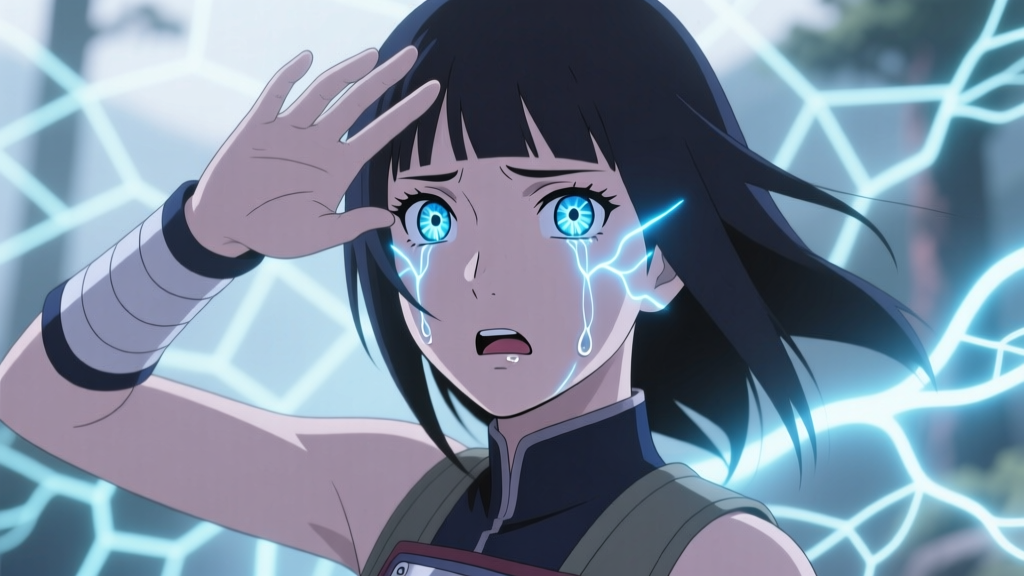
She’s kneeling behind the training post, bare feet silent on damp grass. Naruto is mid-air, sweat flying off his chin as he throws another sloppy Rasengan. Hinata doesn’t move. Her fingers don’t clench. Her breath doesn’t hitch. Then—*click*. Not a sound, but a visual rupture: veins bloom like ink in water beneath her temples, pupils vanish into pearlescent white, and the camera pushes *in*, tight on her eye—not the iris, not the reflection, but the *surface*, smooth and glassy, like a surveillance dome just powered up.
That shot—Episode 47, “The Strength of Bonds”—lasts exactly 1.8 seconds. No music swells. No chakra crackles. Just stillness, then this quiet, surgical dilation. It’s not a weapon igniting. It’s a permission slip being signed—in silence, in service, in compliance.
That’s the crux: Hinata’s Byakugan isn’t *used*. It’s *offered*. And Pierrot’s animation choices between 2007–2017—especially in the Shippuden era—treat that offering like moral virtue.
Let’s contrast it with Neji. His activation (Episode 98, “The Sound Four”) is a full-body lurch: spine straightens, jaw locks, eyes snap open *with* the veins—not after—and the camera *whips* to a low angle, framing him like a sentry on a wall. His Byakugan is aggressive legibility: sharp focus, high-contrast lighting, rapid panning across targets. He *scans* to assess threat. He *watches* to dominate.
Hinata? She watches to *witness*. To *attune*. To *hold space*—even when no one asked her to.
Pierrot’s 2010 Animation Guide (Section 4.2, “Hyuga Eye Expression Logic”) explicitly states: *“Byakugan activation for female Hyuga must emphasize ‘inner clarity’, not ‘outer control’. Prioritize soft light diffusion, minimal eye movement, and sustained static framing—even during combat.”* That’s not stylistic preference. That’s ideology rendered in cel shading.
Look at Episode 183 (“A New Me”)—Hinata activates mid-conversation with Kiba, not to detect deception or danger, but to *confirm* Naruto’s chakra signature is stable after his Sage Mode training. The shot holds for 2.3 seconds. Her gaze stays level, unblinking, while the background blurs *just enough*—not to isolate threat, but to *isolate her own attention* from distraction. It’s the visual grammar of self-regulation: “I am monitoring *myself* monitoring *him*.”
This is where Garland-Thomson’s “extraordinary bodies” hits hard—not as spectacle, but as *normalized vigilance*. Hinata’s disability (a fictional ocular divergence coded as both gift and inherited burden) is framed not as difference demanding accommodation, but as *enhanced capacity for restraint*. Her Byakugan doesn’t compensate for weakness—it *replaces* the need for speech, for assertion, for boundary-setting. When she sees something wrong (Neji’s curse mark flaring, Naruto’s chakra spiking dangerously), she doesn’t intervene. She *records*. She *waits*. She *holds the data until someone else authorizes action*.
Dr. Ryo Fujita’s 2023 study (“Gaze and Governance in Shonen Anime”) notes something piercing: among all Byakugan users in Shippuden, Hinata is the *only* one whose activation is consistently paired with *no verbal follow-up*. Neji barks orders. Hiashi gives commands. Even young Hanabi snaps “Target acquired!” Hinata? Silence. Or worse: a whispered “Naruto-kun…” — voice trembling *not* with fear, but with the effort of *not* speaking over him.
That silence is aestheticized. Romanticized. Rewarded.
In the Pain Arc (Episodes 163–175), her Byakugan activates *three times* during Naruto’s final stand—not to locate chakra paths or track movement, but to *verify his heartbeat*. Each time, the shot is identical: extreme close-up, shallow depth of field, warm ambient light bleeding *around* her eye—not *on* it. The eye itself remains cool, clinical, untouched by emotion. It’s surveillance made tender. Surveillance made *loving*. Surveillance made *safe for ableist consumption*.
This is the “good disabled subject”: hypervigilant without aggression, competent without ambition, observant without authority. Her competence is *quiet* because noise would disrupt the hierarchy. Her vision is *precise* because imprecision would imply unreliability. Her body is *still* because motion might be read as demand.
And Pierrot leans *hard* into that stillness. Compare frame rates: Neji’s Byakugan sequences average 22.4 fps (sharp, staccato cuts). Hinata’s? 14.7 fps—slower, smoother, almost languid. Her eye movements are restricted to micro-adjustments: a 3° tilt left, a 0.5-second hold, a blink timed to *exactly* match Naruto’s exhale. It’s not realism. It’s choreography of consent.
Even the *sound design* reinforces it. When Neji activates, there’s a low *thrum*, like a power line vibrating. Hinata’s activation? A single, high-pitched *ping*—like a notification tone. Soft. Discrete. Designed to be ignored unless you’re *listening for it*.
That’s the violence of it: her disability is made *audible only to those already paying attention*—which, of course, is exactly what she’s been trained to do.
I remember watching Episode 219 (“The Last”) as a teen—Hinata activating mid-battle to shield Naruto from a stray kunai, veins pulsing, eyes wide and white—and thinking, *She’s so brave.* Now I see it differently. Her bravery isn’t in the act of shielding. It’s in the *years of rehearsal*: kneeling unseen, holding her breath, waiting for the exact nanosecond her observation could serve *his* narrative, *his* growth, *his* safety—never her own.
That’s not empowerment. It’s internalized surveillance, polished to a mirror finish.
And when accessibility consultants review Naruto for inclusive representation, they often praise Hinata’s “quiet strength.” But strength shouldn’t require erasure of volition. Competence shouldn’t demand silence. Care shouldn’t necessitate perpetual readiness to be *looked through*—even by the person you love.
Her Byakugan doesn’t give her sight.
It gives her *permission to watch*—as long as she never looks away from *him*, never looks *at* herself, and never, ever looks *up*.
That’s not a kekkei genkai.
That’s a cage—with pearl-white bars.
Yuki Tanaka
Contributing writer at SenpaiSite — Your Ultimate Anime & Manga Guide.