Picture a kid in October 1974, flipping through a spinner rack at the corner drugstore. He pulls out a comic with something weird on the cover: a stocky figure in yellow and blue crouched between the Hulk and a snarling beast called the Wendigo. The price tag reads 25 cents. He tosses it back, grabs a Spider-Man instead, and walks out. That copy of Incredible Hulk #181 sits on the rack for another week before someone else buys it, reads it once, and shoves it into a box in the basement.
Fifty-one years later, that same flimsy piece of newsprint — if it somehow survived in near-mint condition — is appraised at more than most people earn in a year. A single CGC 9.9 copy sold for $320,000 in 2021, making Incredible Hulk #181 the most expensive Bronze Age comic book ever auctioned. Not Amazing Fantasy #15. Not Giant-Size X-Men #1. This one.
And it all started because a writer needed a Canadian government agent to punch the Hulk in the face.
Before the Claws: How Marvel Built the Stage
By late 1974, Marvel Comics was deep into what historians now call the Bronze Age. Stan Lee had stepped back from day-to-day writing to focus on publishing and Hollywood development. A new generation of creators — Len Wein, Roy Thomas, Gerry Conway — were steering the universe into darker, more experimental territory. The Hulk, written by Gerry Conway, had wandered into the Canadian wilderness for a storyline involving the Wendigo, a supernatural creature born from cannibalism in the frozen north.
Incredible Hulk #180 (the issue right before our subject) ended with a panel that barely registered at the time. A mysterious figure stood in shadow, described only as a Canadian government operative. No name. No costume. No claws. Just a silhouette and some cryptic dialogue about dealing with the Hulk problem up north.
That was the setup. The payoff came one month later.
The Creative Team Behind the Debut
Len Wein wrote the script. Herb Trimpe penciled the pages. Jack Abel inked. Glynis Wein handled colors. This was a solid mid-tier Marvel creative team — not the Lee/Kirby dream machine, but competent professionals turning in monthly work on a title that was never Marvel's top seller. Nobody at the Bullpen thought they were making history with this issue. They were meeting a deadline.
There's also the matter of John Romita Sr.'s contribution. Marvel's art director reportedly sketched early design concepts for Wolverine's costume — the yellow-and-blue bodysuit, the pointed mask, the clawed gloves. Trimpe translated those concepts into the final published look. The exact division of creative credit remains one of comicdom's longest-running arguments, and it probably never gets resolved to everyone's satisfaction. What's certain is that the character who appeared on those pages was a collaborative product, not a single creator's vision.
And Now, the Wolverine: Inside the Fight That Started Everything
The story is titled "And Now...The Wolverine!" and it wastes no time. The Hulk is rampaging through the Canadian wilderness, locked in combat with the Wendigo. The Canadian government's Department H — their superhuman affairs agency — decides they've had enough. An operative codenamed Wolverine gets dispatched to neutralize both threats. Not observe. Not negotiate. Neutralize.
Department H was run by James Hudson (who would later become the superhero Guardian, then Vindicator). Hudson sends Wolverine in with a straightforward directive: handle the situation. What happens next is a twenty-page brawl that reads like nothing else Marvel was publishing in 1974.
The Fight Itself
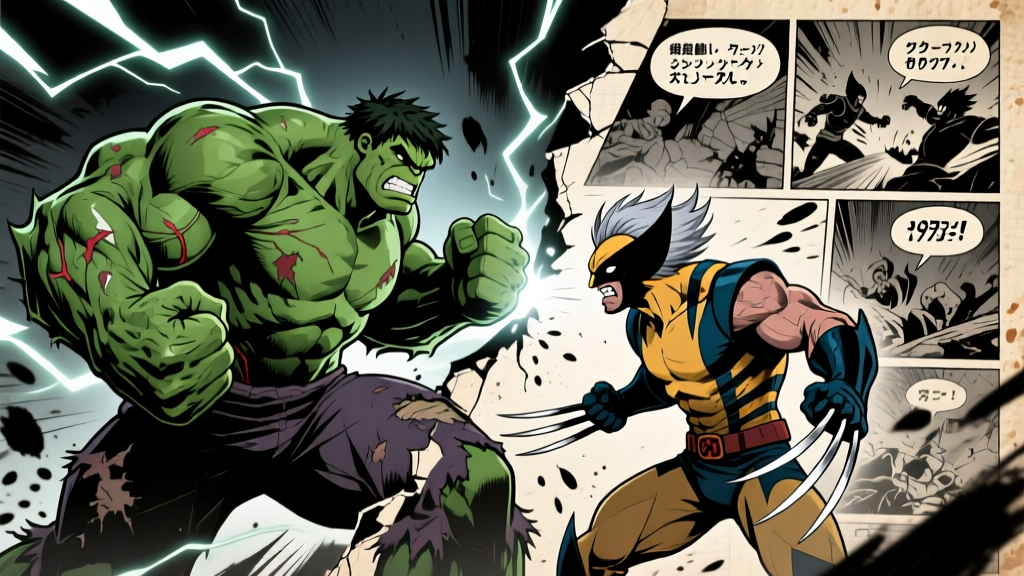
Wolverine crashes the Hulk-versus-Wendigo party by attacking both creatures. He's fast — faster than either of them expected — and his claws are already drawn. Here's the thing that separates this from a hundred other "new character fights the Hulk" stories: Wolverine actually hurts him. Not in a cosmic, reality-warping way. He just shreds through the Hulk's skin with adamantium-laced claws and a berserker's fury that matches the green giant blow for blow.
Trimpe's artwork nails the physical contrast. The Hulk is enormous, a slab of green muscle towering over everyone. Wolverine is compact — barely five-foot-three in later canon — but coiled like a spring. Every panel makes you feel the weight difference, and every panel makes you believe Wolverine doesn't care.
The fight isn't clean. There's a subplot involving Georges and Marie Baptiste, two characters caught in the crossfire whose shifting allegiances add a layer of moral grime to the superhero fisticuffs. Wolverine, as drawn by Wein and Trimpe, is aggressive, reckless, and barely controllable. He's not a hero in this issue. He's a weapon pointed at a problem.
The battle eventually tips in the Hulk's favor — the green goliath's strength is simply too much — but the damage is done. Readers had seen something they hadn't encountered before: a character who could go toe-to-toe with Marvel's strongest monster and look like he belonged in the ring.
What Made This Wolverine Different
Marvel had introduced plenty of one-off antagonists before. Characters who showed up, fought the hero, and vanished into back-issue bins forever. What made Wolverine stick?
Three things, all visible in this first appearance:
- The healing factor. Wein established immediately that Wolverine could recover from injuries at an inhuman rate. In a medium where characters take months to heal from plot-convenient wounds, this was a cheat code. It meant writers could put Wolverine through hell in every issue without breaking continuity.
- The berserker rage. This wasn't a disciplined soldier. This was a man barely holding back an animal inside him. Wein wrote him as volatile, dangerous to allies and enemies alike. That psychological edge gave him depth that most new characters took years to develop.
- The mystery. Who was he? Why did the Canadian government have a mutant weapon on payroll? What was the adamantium skeleton Wein hinted at? These questions weren't answered in #181 — they were planted, deliberately, to make readers come back.
The Canadian angle was also unusual. American comics in 1974 were aggressively U.S.-centric. A character explicitly tied to a foreign government's intelligence apparatus felt fresh and slightly unpredictable. It gave writers room to explore international espionage angles that the typical New York-based superhero couldn't touch.
"In those days, you introduced a character, and if the readers didn't respond, you moved on. We had no way of knowing Wolverine would become what he became. He was just another guy in a funny costume who could fight." — Herb Trimpe, recalling the issue in a 2009 interview
From One-Off to Icon: Wolverine's Road to the X-Men
Here's the part that makes Hulk #181 so valuable: it didn't just introduce a character. It introduced a character who would become the backbone of Marvel's most commercially successful franchise.
In May 1975, roughly seven months after Hulk #181 hit newsstands, Len Wein and artist Dave Cockrum published Giant-Size X-Men #1. This special issue relaunched the X-Men with an international roster — Storm from Kenya, Colossus from Russia, Nightcrawler from Germany, and Wolverine from Canada. Wein, who had created Wolverine for the Hulk, immediately saw the character's potential in a team book.
What happened next is Marvel publishing history at its most consequential. Writer Chris Claremont took over X-Men from issue #1 and spent the next seventeen years turning it into the industry's best-selling title. Wolverine was the breakout star from the beginning — the guy readers argued about on convention floors and in letter columns. By the early 1980s, he had his own solo series. By the early 1990s, X-Men #1 (1991) sold over 8 million copies, and Wolverine was on every cover.
The trajectory from there is almost absurd:
- 1982: Wolverine gets his first solo limited series, written by Claremont with art by Frank Miller.
- 1988: Ongoing solo series launches. It runs for 189 issues.
- 2000: Hugh Jackman plays Wolverine in Bryan Singer's X-Men. The film grosses $296 million worldwide and launches a franchise that would earn over $7 billion across twelve films.
- 2017: Logan releases to critical acclaim, earning an Oscar nomination for Best Adapted Screenplay — a first for a live-action superhero film.
- 2024: Deadpool & Wolverine grosses over $1.3 billion, making it the highest-grossing R-rated film in history.
Every single one of those milestones traces back to a 25-cent comic book from November 1974. That lineage is exactly what drives the collector market into a frenzy.
The Collector's Gold Rush: Hulk #181 by the Numbers
If you're reading this and wondering whether your attic copy is worth a fortune — probably not, but let's break down what the market actually looks like.
In the 1980s, you could pick up Incredible Hulk #181 in a comic shop's back-issue bin for two or three dollars. Maybe less if the condition was rough. The speculator boom of the early 1990s pushed prices up, and the character's rising profile through the X-Men animated series (1992–1997) kept demand steady through the decade.
The real explosion started in the 2010s. The combination of the MCU, the X-Men film franchise, and a maturing collector market with professional grading services (CGC, CBCS) created conditions where Bronze Age keys appreciated faster than most traditional investments. Hulk #181 was the biggest beneficiary.
| CGC Grade | Condition | Approx. Market Value | Availability |
|---|---|---|---|
| 9.9 (Near Mint/Mint) | Virtually flawless | $320,000+ (record sale, 2021) | 1 known copy |
| 9.8 (Near Mint/Mint) | Nearly perfect | $45,000 – $146,000 | Extremely rare |
| 9.6 (Near Mint+) | Outstanding | $12,000 – $18,000 | Very scarce |
| 9.4 (Near Mint) | Excellent | $7,000 – $10,000 | Scarce |
| 8.0 (Very Fine) | Above average | $3,500 – $4,500 | Moderate |
| 6.0 (Fine) | Average | $2,000 – $2,800 | Moderate |
| 4.0 (Very Good) | Below average | $1,400 – $1,900 | Available |
| 2.0 (Good) | Heavily worn | $900 – $1,300 | Available |
| Raw (ungraded) | Varies | $400 – $3,500 | Common (risky) |
Sources: QualityComix price guide (2025), GoCollect market data, Heritage Auctions past results, CGC Census reports.
Why the Prices Are So Extreme
The answer is scarcity meeting demand. Marvel's newsstand print runs for a mid-tier title like Incredible Hulk in 1974 were estimated at 250,000 to 350,000 copies. That sounds like a lot, but consider the survival rate. These were disposable entertainment products bought by children and teenagers. Most were read, re-read, traded, crumpled, water-damaged, or thrown away by parents cleaning out bedrooms. Industry consensus puts the number of surviving 9.4-or-better copies at well under 50 graded examples. The CGC Census, which tracks every professionally graded comic, confirms this scarcity.
On the demand side, Wolverine isn't just a comic book character. He's a global pop-culture brand. Hugh Jackman played the role across nine films spanning seventeen years. Every new X-Men movie announcement, every Wolverine video game release, every comic convention panel about the character sends ripples through the market. According to Heritage Auctions data, sales volume for Hulk #181 spikes 20-30% in the months surrounding major Wolverine media events.
The 2021–2022 Speculator Boom and Correction
The comic book market experienced a massive surge during the COVID-19 lockdowns. People stuck at home rediscovered their collections, celebrity collectors like Nicolas Cage and Kevin Smith made headlines, and online auction platforms drove prices to record levels. Hulk #181 was ground zero for this phenomenon — the CGC 9.9 sale at $320,000 happened during this peak.
By mid-2022, the market corrected. Lower-grade copies that had been bid up 40-60% above their historical values dropped back roughly 15-20%. But here's what separates Hulk #181 from the rest of the pack: high-grade copies barely retreated. When a book is genuinely rare in high grade and tied to a character with permanent cultural relevance, the floor stays high. As of 2026, prices for CGC 9.0 and above have stabilized and are slowly climbing again.
The Original Cover Art: Lost to Fire
One of the more painful chapters in this story. The original cover art for Incredible Hulk #181 — Herb Trimpe's hand-drawn, hand-inked illustration of the Hulk, the Wendigo, and Wolverine — was destroyed in a fire at Trimpe's studio. Gone. Not in a private collection, not in a museum vault, not locked in Marvel's archives. Ash.
Marvel's original art from this era occupies a strange legal and cultural gray area. The artwork was technically the property of the publisher, but for decades the industry's practice was to return pages to artists (or let them keep them). Many pages were lost, sold cheaply, or — as in this case — destroyed in accidents. The surviving interior pages from Hulk #181, when they surface at auction, command prices in the five-figure range for individual boards. A full splash page from this issue would likely break $30,000 at Heritage or Sotheby's.
The loss of the cover art adds an almost mythological dimension to the book's story. The most iconic image of Wolverine's debut exists only in printed reproductions. The original is gone, and it's never coming back.
Hulk #181 in the Wider Marvel Canon
Strip away the collector hype for a moment and consider the creative legacy. Incredible Hulk #181 introduced a character who would anchor two of Marvel's three most profitable franchises (X-Men and Wolverine solo). The story itself — a government agent deployed to neutralize a superhuman threat in a remote location — became the template for dozens of Wolverine stories over the next five decades. Weapon X, the conspiracy that bonded adamantium to his skeleton, traces its narrative DNA directly back to Department H and the mission Hudson sent Logan on in this issue.
The fight choreography set a standard too. Hulk vs. Wolverine in #181 was the first time Marvel showed the green giant facing an opponent who was simultaneously smaller, faster, more vicious, and completely unafraid. That dynamic — David versus Goliath, except David has metal claws and a healing factor — became Wolverine's signature move. You can see echoes of this fight in X-Men: The Animated Series ("Fatal Attractions," 1994), in the X-Men Origins: Wolverine film (2009), and in practically every video game where Wolverine and the Hulk share a roster.
For the Hulk franchise specifically, #181 represents an interesting pivot. The Wendigo arc was one of the better Bronze Age Hulk stories, and the introduction of a government antagonist who could actually challenge the Hulk added narrative tension that the title had been missing. It didn't save the series from its ongoing commercial struggles — the Hulk was always a niche character compared to Spider-Man or the X-Men — but it gave the book a moment of genuine creative distinction.
A Comparison With Other Bronze Age Keys
| Issue | Year | Significance | Peak Value |
|---|---|---|---|
| Incredible Hulk #181 | 1974 | First full Wolverine | $320,000 |
| Amazing Spider-Man #129 | 1974 | First Punisher | $95,000 |
| Giant-Size X-Men #1 | 1975 | New X-Men team | $65,000 |
| Star Wars #1 | 1977 | First Star Wars comic | $40,000 |
| Iron Man #55 | 1973 | First Thanos | $35,000 |
Hulk #181 doesn't just lead the Bronze Age — it dominates it. The gap between #181 and the second-place entry is enormous, and that gap has been widening, not shrinking, over the past five years.
If You're Thinking About Buying One
A few practical realities for anyone considering adding Hulk #181 to their collection:
CGC grading is non-negotiable at these price points. The market for forged and restored comics is sophisticated. Recoloring, trimming, and cover swapping are all documented practices that can fool an untrained eye. A CGC slab verifies authenticity, grade, and restoration status. If someone offers you a "raw" Hulk #181 for $5,000 and claims it's a 9.0, walk away. Professional authentication isn't optional — it's the entire foundation of the high-end comic market.
Raw copies exist, but they're a gamble. You can find ungraded copies on eBay for $400 to $2,000 depending on visible condition. The problem? Without professional grading, you're eyeballing it. A book that looks like a 7.0 to an amateur might be a 5.0 once a CGC grader examines the spine wear, page quality, and staple integrity. Budget buyers often end up overpaying for condition they overestimated.
There are cheaper Wolverine keys. If the goal is to own a piece of Wolverine history without liquidating a savings account, consider these alternatives:
- Incredible Hulk #180 — Wolverine's teaser cameo (last page). CGC 6.0 copies run $200–$400. Less prestigious, but still a tangible connection to the character's origin.
- Giant-Size X-Men #1 (1975) — Wolverine's first appearance with the team that made him famous. CGC 6.0 copies available for $250–$450.
- Wolverine Limited Series #1 (1982) — Chris Claremont and Frank Miller. The character's first solo outing. A CGC 9.4 sells for around $400–$700.
Each of these gives you a Wolverine first in some category, and none of them require a mortgage payment.
Questions Collectors Keep Asking
Is Hulk #180 or #181 the real "first appearance"?
This comes up constantly. Hulk #180 has Wolverine's shadowy last-page cameo — technically his first published panel. But #181 is where the character appears in full: costume, dialogue, fight scenes, personality. The collector market overwhelmingly treats #181 as the canonical first appearance, and that's where the premium sits. Think of it like a movie: #180 is the post-credits teaser, #181 is the actual film.
Has Hulk #181 ever been reprinted?
Yes. Marvel has reprinted the story multiple times — in Marvel Treasury Edition, in various trade paperback collections, in the Essential black-and-white line, and in digital formats. None of these reprints carry collector value. The market cares about the original 1974 newsstand edition with the 25-cent cover price.
Did Wolverine kill the Wendigo in this issue?
No. He fights both the Wendigo and the Hulk, but neither creature is killed. The Wendigo storyline continues in subsequent Hulk issues, and the Wendigo has appeared dozens of times across Marvel continuity since 1974. Wolverine's role in #181 is antagonist / wild card — he's there to fight the Hulk, not to resolve the Wendigo plot.
Why is this issue more valuable than Giant-Size X-Men #1?
Two factors. First, scarcity: Giant-Size X-Men #1 was a special issue with a larger print run (estimated 400,000+) and was more likely to be preserved by fans who knew it was significant. Hulk #181 was a regular monthly issue with a smaller run, and nobody in 1974 knew Wolverine mattered. Second, the "first appearance" premium: #181 is the character's true debut, while Giant-Size X-Men #1 is technically his second (or third, counting the #180 cameo). First appearances always command the highest prices in comics.
Is it a good investment right now?
Comic books aren't stocks, and nobody should be making financial decisions based on a blog article. That said: Hulk #181 in high grade has shown consistent long-term appreciation over twenty years. The 2021–2022 spike and correction shook out some speculative froth, and prices for CGC 9.0+ have stabilized at levels that reflect genuine collector demand rather than hype-driven speculation. The character's cultural footprint — through film, television, video games, and new comics — ensures that demand for this book won't evaporate. But the comic market is illiquid, grading turnaround times can stretch to months, and past performance doesn't guarantee future returns. Do your own homework.
The 25-Cent Legacy
Here's what I keep coming back to when I think about Incredible Hulk #181. Len Wein died in September 2017. Herb Trimpe died in April 2015. Neither of them lived to see the CGC 9.9 sell for $320,000. Neither of them saw Deadpool & Wolverine break a billion dollars at the box office. They were working comic book professionals doing a job — writing and drawing a monthly issue that, from their perspective, was one of dozens they'd produce that year.
And yet they created something that outlasted both of them. A character who started as a one-off government antagonist became one of the most recognizable fictional figures on the planet. The fight between the Hulk and the Wolverine in those Canadian wilderness panels set off a chain reaction that, five decades later, shows no sign of slowing down.
The kid at the spinner rack in 1974 who passed over that comic for a Spider-Man? He probably doesn't think about it anymore. But somewhere in a climate-controlled storage unit, a CGC-slabbed copy of Incredible Hulk #181 sits in a Mylar sleeve, graded 9.8, insured for more than a year's salary. And on its cover, a man in yellow and blue crouches between two monsters, claws extended, ready to fight anything that moves.
That's a hell of a legacy for 25 cents.
Sources: QualityComix Comic Price Guide (2025 edition); GoCollect market analytics and sales database; Heritage Auctions (comics.ha.com) past lot results; CGC Census and certification reports; CGC Comics News archive, "CGC-certified Hulk #181 Claws Its Way to $146,000"; PriceCharting.com historical sales data.