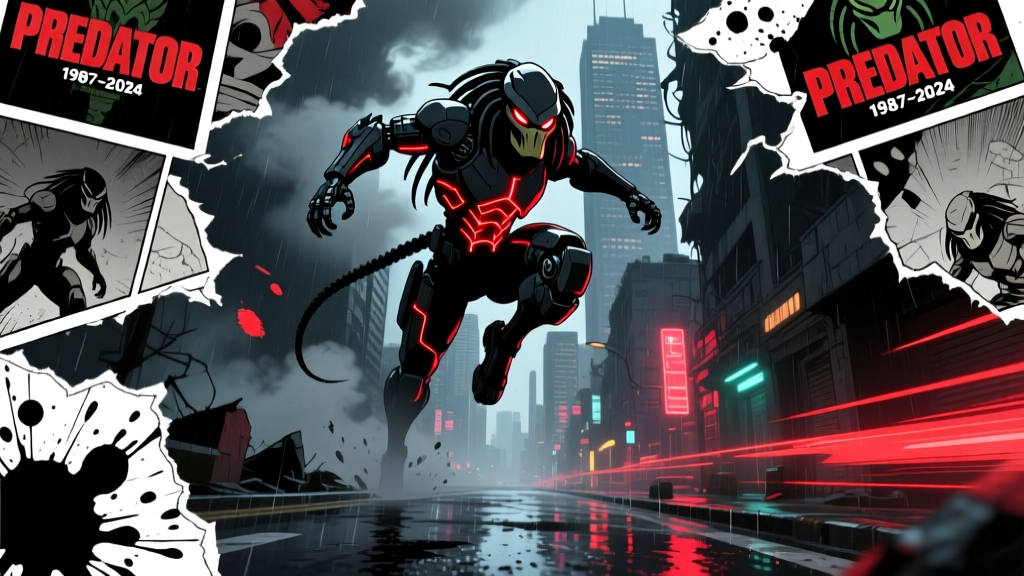
Walk into any serious sci-fi memorabilia shop from Los Angeles to Akihabara, and you will spot it within seconds: that silhouette. Broad shoulders, mandibles splayed, a figure half-consumed by jungle foliage, watching Arnold Schwarzenegger's commando squad from the canopy above. The 1987 Predator one-sheet is one of the most replicated images in action cinema history, and it spawned a poster lineage that now stretches across seven films, nearly four decades, and dozens of international print variants that most fans have never seen.
This is a catalog of every major Predator movie poster released theatrically — the artwork choices, the design philosophy shifts, the rare international variants that command four-figure prices on the secondary market, and the subtle details that separate a genuine first-printing from a mass-market reprint. Whether you are a collector hunting for a Japanese B2 linen-backed original or simply someone who appreciates how movie marketing evolved alongside the franchise itself, this guide covers what you need to know.
The 1987 Original: John McTiernan's Jungle Terror
When Fox commissioned the theatrical poster for Predator in early 1987, the marketing team faced a peculiar problem. The film's villain — designed by Stan Winston's effects studio over six grueling months of sculpting and mechanical rigging — was barely visible on screen for the first two acts. McTiernan deliberately withheld the creature, using thermal-vision POV shots and distorted jungle silhouettes to build dread. So the poster had to do what the screenplay did: suggest a threat without fully revealing it.
The resulting artwork, painted by illustrator John Alvin (who would go on to paint posters for E.T., Blade Runner, and The Lion King), shows Dutch's commando unit advancing through dense Central American jungle while an enormous, translucent Predator figure looms above them, half-dissolved into the canopy like a heat mirage. The color palette is overwhelmingly green — seventeen distinct shades of jungle green by one collector's count — with the Predator's thermal-vision glow rendered in amber and burnt orange along the figure's edges. The tagline, printed in a blocky sans-serif font that Fox's marketing department had been using since the Alien campaign in 1979: "Soon to be a major motion picture."
"The original Predator one-sheet works because it lies to you. It promises a standard Arnold action movie — big guy, big gun, big jungle — and then hides the actual hook of the film inside the negative space of the composition. Your eye is drawn to Schwarzenegger first, the Predator second. That's the entire narrative arc of the film compressed into a single image."
— Rob Gallagher, senior appraiser at Heritage Auctions Entertainment department, 2024 catalog notes
Domestic Variants
Fox produced three distinct domestic poster printings for the June 1987 release. The advance one-sheet (27" × 41") featured the Alvin artwork with the "Coming Soon" tagline and a slightly warmer color grade, leaning into the oranges of the thermal-vision effect. The regular one-sheet swapped the tagline for the film's release date and added the MPAA rating bar. A style B poster, used primarily for newspaper advertising inserts and lobby display, showed a tighter crop — just Dutch's face in the lower third with the Predator's mandible-framed visage filling the upper two-thirds, rendered in that now-iconic shimmer-cloak distortion effect.
The advance one-sheet is the version that collectors fight over. In PSA-graded mint condition, an original 1987 advance poster sold for $2,400 at Heritage Auctions in November 2023. Even ungraded, folded originals from theater distribution routinely pull $300–$500 on eBay, provided the fold lines are clean and the color saturation holds in the darker jungle passages.
International Variants
The international poster market for the 1987 Predator is where things get genuinely wild. Japan received a B2 poster (20" × 29") with entirely different artwork — a photo-composite of the Predator in full reveal, mandibles open, against a blood-red background. This piece was never distributed in the US and was printed in a run estimated at only 3,000–5,000 copies for Japanese theatrical distribution. A linen-backed example sold for $1,850 at a Tokyo memorabilia fair in 2022.
The Italian fotobusta set is another grail item. Italian theaters received a set of eight 13" × 19" lobby-card-style prints, each featuring a different scene from the film with lurid, hand-painted color grading that cranked the jungle greens to near-neon levels. Complete sets in VG+ condition trade between $600 and $1,100 depending on provenance. The German market got a DIN A1 poster with a darker, more muted color palette — the jungle rendered in near-black greens and the Predator's cloaking effect pushed to a ghostly silver — that sits in the $200–$400 range for originals.
Predator 2 (1990): Concrete Jungle, Different Rules
Three years later, Stephen Hopkins moved the hunt from Guatemala to Los Angeles, and the poster campaign followed suit. Gone were the jungle greens; in their place, a harsh urban palette of concrete gray, sodium-vapor orange, and the thermal-bloom reds of a city cooking in its own heat. The domestic one-sheet, this time painted by William Stout — a legend in underground comics and film illustration who had previously storyboarded for John Carpenter — placed Danny Glover's Detective Harrigan in a low-angle power pose, shotgun raised, with the Predator perched atop a skyscraper silhouette behind him.
The design shift was deliberate. Fox's marketing research in 1990 suggested that audiences associated the first film's jungle setting too strongly with Vietnam-era war movies, which limited the sequel's appeal to younger demographics. The urban backdrop on the poster was meant to signal a tonal shift: this was a cop thriller that happened to have an alien in it, not another jungle commando picture. The tagline — "This time, the hunter is the hunted... on our home turf" — drove the point home with all the subtlety of a police battering ram.
What makes the Predator 2 poster historically significant, though, is a detail most people miss: embedded in the Predator's wrist-gauntlet display on the theatrical one-sheet, barely visible at normal viewing distance, is a skull that belongs to the Xenomorph from Alien. This Easter egg, confirmed by Stan Winston's effects team in a 1991 Cinefex interview (issue #46), predated the Alien vs. Predator comic books by Dark Horse and planted the seed that would eventually grow into two crossover films.
Original domestic one-sheets for Predator 2 have not appreciated as steeply as the 1987 original — the film's mixed critical reception at release kept demand moderate — but PSA-graded examples still command $180–$350. The Japanese B2 variant, which features a chrome-and-neon aesthetic with the Predator's cloaking effect rendered as a mirror-chrome distortion rather than a shimmer, typically sells for $400–$700.
Alien vs. Predator (2004) and AVP: Requiem (2007)
Paul W.S. Anderson's Alien vs. Predator arrived in August 2004 with a poster campaign that tried to split the difference between two of cinema's most recognizable silhouettes. The domestic one-sheet, designed by Fox's in-house creative services team rather than an outside illustrator, used a split-composition approach: the Alien's elongated cranium on the left, the Predator's dreadlocked skull on the right, meeting in the center like two halves of a Rorschach test. The palette was dominated by cold steel blues and the sickly green of Alien blood, a deliberate departure from the warm jungle tones of the earlier films.
This was also the first Predator-franchise poster to lean heavily on CGI in its artwork. The creature renderings were pulled from the film's digital asset library rather than painted by hand, and the difference is immediately apparent when you place the 2004 poster next to the Alvin or Stout originals. There is a flatness to the digital composites, a lack of the atmospheric imperfection that gives hand-painted posters their texture. Collectors have not been kind to the AVP poster in terms of valuation: mint domestic one-sheets sell for only $60–$120, reflecting both the larger print run (digital-age posters were printed in significantly higher quantities) and the film's reputation among franchise purists.
AVP: Requiem (2007), directed by the Strause brothers, doubled down on the digital approach with a poster showing the Predator and Xenomorph locked in combat against a Pacific Northwest backdrop. The color scheme leaned into cool teals and deep blacks, and the composition borrowed heavily from the Alien 3 marketing playbook. International variants were minimal — most markets received the same digital composite with translated text overlays. Values remain low: $40–$80 for a domestic one-sheet in good condition.
Predators (2010): Back to the Jungle, Back to Paint
Nimrod Antal's Predators was produced by Robert Rodriguez, who had been trying to make a direct sequel to the 1987 original since 2003. The poster campaign reflected that back-to-basics philosophy. For the domestic one-sheet, Fox hired illustrator Tyler Stout (no relation to William Stout, though the coincidence delighted fans) to create a piece that consciously echoed John Alvin's 1987 composition: a squad of warriors advancing through alien jungle, with a Predator figure integrated into the canopy above.
The differences, though, are telling. Where Alvin's 1987 Predator was a ghostly, half-seen presence, Stout's 2010 version showed multiple Predators — three distinct figures in varying states of cloaking — reflecting the film's expanded mythology. The color palette was also noticeably cooler than the original, with the tropical greens replaced by the blue-greens of a more alien forest, and the thermal-vision oranges dialed back in favor of thePredator's new blue-tech energy effects. Adrien Brody's character, Royce, occupies the foreground in a pose that deliberately mirrors Schwarzenegger's stance from 1987, a visual echo that the marketing team leaned into during the press tour.
The Predators poster also had the distinction of receiving one of the most striking international variants in the franchise. The Russian theatrical poster replaced the illustrated artwork entirely with a photographic composite of Brody in the jungle, shot from below at an extreme angle, with the Predator's thermal-vision overlay framing the entire image in reds and yellows. It looks like nothing else in the franchise's marketing history, and examples are scarce — Russian posters from this era were printed in small runs for a market that was still developing its theatrical infrastructure. Expect to pay $250–$500 for a verified original.
The Predator (2018): Shane Black's Divisive Reimagining
Shane Black had been in the original 1987 film as Hawkins, the radio operator with the dirty jokes. Thirty-one years later, he returned as director of The Predator, and the poster campaign reflected his attempt to bridge the franchise's gritty origins with a more mainstream, effects-driven sensibility. The domestic one-sheet showed the upgraded "Fugitive Predator" in a full-body reveal against a suburban autumn backdrop — the first time a Predator poster had used a non-jungle, non-urban environment as its primary setting.
The color palette leaned into Halloween-season oranges and deep browns, a calculated move by Fox's marketing department to position the film as autumn counter-programming. The Predator itself was rendered with a level of anatomical detail that previous posters had avoided: every muscle fiber, every dreadlock tendon, every piece of biomechanical armor was visible. It was impressive as a technical achievement and polarizing as a design choice. Some collectors praised the return to a more creature-focused composition; others felt it lacked the mystery and negative space that made the 1987 and 1990 posters memorable.
International variants for The Predator were numerous but visually similar — the era of radically different regional artwork had largely passed, replaced by a global marketing strategy where the same digital assets were distributed to all territories with localized text. The most notable exception was the Mexican lobby card set, which used alternate angles of the Predator rendered in a higher-contrast, more saturated style that recalled the Italian fotobusta tradition. Values for the domestic one-sheet sit at $50–$100 in mint condition, reflecting both the large print run and the film's mixed reception.
Prey (2022): A Return to Hand-Painted Territory
Dan Trachtenberg's Prey was released directly on Hulu and Disney+ in August 2022, which meant its poster campaign faced a different challenge than the theatrical releases: it needed to work as a thumbnail on a streaming menu, not just as a 27" × 41" print on a theater wall. The primary key art, designed by the agency Gravillis, shows Amber Midthunder's Naru standing on a Great Plains ridge, her makeshift weapon raised, with the Predator's ship descending through the clouds above in a pillar of amber light.
The composition is the most painterly Predator poster since the Stout work on Predators. The color palette centers on the golden-amber tones of the Northern Plains at dusk — burnt sienna, wheat gold, dusty sage green — with the Predator's thermal-vision signature appearing only as a faint heat-bloom in the upper atmosphere. This is a poster that understands what the best Predator marketing has always understood: the creature is more frightening when partially withheld. Naru is the focal point, not the Predator, and the visual hierarchy communicates the film's core premise — that this is a story about the hunted becoming the hunter.
The streaming release created an unusual situation for collectors. Because Prey had no traditional theatrical run, there were no mass-produced one-sheets distributed to cinemas. Instead, 20th Century Studios (the rebranded Fox) produced a limited run of promotional posters for press kits, film festival screenings, and awards-campaign events. These are significantly scarcer than standard theatrical one-sheets. A verified Prey promotional poster sold for $425 at a Prop Store auction in early 2024, and prices are expected to climb as the film's reputation continues to grow.
A special note on the Comanche-language variant poster: Studios produced a version of the key art with all English text replaced by Comanche translations, reflecting the film's use of the Comanche language in its audio track. This variant was distributed exclusively to Native American cultural organizations and a small number of promotional events. Fewer than 200 copies are believed to exist, making it potentially the rarest official Predator poster ever produced.
Collector Values at a Glance
The table below reflects approximate market values as of mid-2026, compiled from Heritage Auctions, Prop Store, eBay completed listings, and private-sale data from the Movie Poster Forum community. Values assume original theatrical or studio-authorized prints, not commercial reprints.
| Film | Poster Variant | Good/VG | NM/Mint | Notes |
|---|---|---|---|---|
| Predator (1987) | US Advance One-Sheet | $300–$500 | $1,800–$2,500 | John Alvin art; most sought-after in franchise |
| Predator (1987) | Japanese B2 | $800–$1,200 | $1,500–$2,000 | Unique photo-composite art; red background |
| Predator (1987) | Italian Fotobusta (set of 8) | $600–$800 | $900–$1,100 | Hand-painted lobby cards; complete sets scarce |
| Predator 2 (1990) | US One-Sheet | $100–$180 | $250–$350 | William Stout art; Xenomorph skull Easter egg |
| Predator 2 (1990) | Japanese B2 | $250–$400 | $500–$700 | Chrome-mirror cloaking effect variant |
| AVP (2004) | US One-Sheet | $40–$70 | $80–$120 | Digital composite; large print run |
| AVP: Requiem (2007) | US One-Sheet | $25–$40 | $50–$80 | Lowest franchise values; abundant supply |
| Predators (2010) | US One-Sheet | $60–$100 | $120–$200 | Tyler Stout art; homage to 1987 composition |
| Predators (2010) | Russian Theatical | $150–$250 | $350–$500 | Photo-composite; thermal-vision framing |
| The Predator (2018) | US One-Sheet | $35–$60 | $70–$100 | Autumn palette; full-body creature reveal |
| Prey (2022) | US Promotional | $200–$300 | $400–$600 | Limited press-kit run; Gravillis agency |
| Prey (2022) | Comanche-Language Variant | $500–$800 | $1,000–$1,500 | <200 copies; rarest franchise poster |
Design Evolution: What the Posters Tell Us About the Franchise
Lay all seven Predator film posters side by side and you get something close to a thesis on how Hollywood's relationship with blockbuster marketing has changed over four decades. The 1987 original is a painting — brushstrokes visible, color gradients imperfect, the kind of artwork where you can sense the illustrator making decisions about where to place a shadow or how much of the creature to reveal. By 2004's AVP, that human touch has been replaced by digital compositing — clean, precise, and utterly soulless when compared to the Alvin originals.
The arc bends back toward artistry with Predators (2010) and Prey (2022), both of which commissioned illustrators or illustration-forward agencies to create their key art. This is not a coincidence. Both films were positioned as returns to form — Rodriguez and Trachtenberg were directors who grew up loving the 1987 original, and their marketing choices reflected that reverence. The Predators poster was essentially a love letter to John Alvin, and the Prey campaign understood that the most effective Predator marketing creates a visual tension between the human protagonist and the unseen threat.
The international variants tell a parallel story about globalization in film marketing. In the 1980s and early 1990s, regional markets had their own distributors, their own printing houses, and often their own artists. A Japanese Predator poster was a fundamentally different object from an American one — different paper stock, different printing process, different artistic sensibility. By 2018, that diversity had collapsed. The Predator's international posters were, with minor exceptions, the same digital file with translated text. Something was gained in consistency. Something was lost in soul.
The Thermal-Vision Thread
One visual element that connects nearly every Predator poster across the franchise is the use of thermal-vision color language — those signature reds, oranges, and yellows that the Predator's point-of-view shots established in the 1987 film. Even when a poster's primary palette is green (1987), gray (1990), blue (2004), or gold (2022), there is almost always a thermal-vision accent somewhere in the composition: a glow behind the creature's eyes, a heat-bloom in the atmosphere, a weapon-charge effect in amber. This is the franchise's visual DNA, as fundamental to Predator as the lightsaber's color-coded blade is to Star Wars.
The only notable exception is the AVP: Requiem poster, which abandoned thermal colors in favor of the Alien franchise's signature cool teals and acid greens. It is, arguably, the only Predator poster that does not visually belong to the Predator franchise — and it is also, by almost every metric, the least memorable and least valuable in the series. The market has spoken.
Spotting Fakes and Reprints
The Predator poster market, particularly for the 1987 original, has attracted its share of counterfeiters. Here is what separates a genuine theatrical print from a reproduction:
- Paper stock: Genuine 1987 one-sheets were printed on acidic, slightly off-white stock that has yellowed with age. Modern reprints use bright-white, acid-free paper that looks wrong under UV light. Hold a blacklight to the margins — originals will fluoresce a dull amber; reprints will glow bright blue-white.
- NSS number: The National Screen Service assigned a unique number to every theatrical poster distributed in the US before 1995. The 1987 Predator one-sheet carries NSS #870086. Reprints almost never include this number, and when they do, the font is wrong — originals used a specific dot-matrix stamp that has a slightly irregular character spacing.
- Fold pattern: Theatrical one-sheets were folded into eighths for distribution to cinemas in flat envelopes. Original fold lines are sharp, consistent, and have slight color cracking along the crease. Reprints are either shipped rolled (no folds) or have artificial fold lines that lack the color cracking.
- Print registration: Offset lithography, the standard process for 1980s theatrical posters, produces slightly overlapping color separations visible under magnification. Digital reprints use inkjet or laser processes that show a regular dot pattern instead.
Questions Collectors Actually Ask
What is the most valuable Predator movie poster?
The 1987 advance one-sheet in PSA-graded mint condition holds the record, with a sale of $2,400 at Heritage Auctions in November 2023. The Japanese B2 variant and the Italian fotobusta complete set are close runners-up in the $1,000–$2,000 range. Among modern-era posters, the Prey Comanche-language variant is the most valuable due to its extreme scarcity.
Who painted the original 1987 Predator poster?
John Alvin, one of the most prolific film poster illustrators of the 1980s and 1990s. His credits include E.T. the Extra-Terrestrial, Blade Runner, Gremlins, The Goonies, and The Lion King. Alvin passed away in 2008, which has contributed to the rising value of his original artwork across all titles.
Are there any Predator posters worth collecting from the AVP era?
The AVP films have the lowest poster values in the franchise, generally under $120 for mint domestic one-sheets. However, some collectors pursue the international variants — particularly the Japanese B2 for AVP, which used a unique photo-composite with higher contrast than the domestic version and trades in the $150–$250 range.
Why did Predator 2 have an Alien skull on its poster?
The Xenomorph skull embedded in the Predator's wrist display on the Predator 2 poster was confirmed by Stan Winston's effects team as an intentional Easter egg. It was a nod to the shared universe concept that Dark Horse Comics was exploring in their Alien vs. Predator comic series, which launched in 1989. This detail is often cited as the first on-screen (or on-poster) acknowledgment of the crossover concept that eventually led to the AVP films.
Is the Prey poster rare because of the streaming release?
Yes. Because Prey was released directly on Hulu and Disney+ without a traditional theatrical run, there were no mass-produced posters distributed to cinemas. The posters that exist are from limited promotional runs for press kits, film festivals, and awards campaigns. The Comanche-language variant is even rarer, with fewer than 200 copies believed to exist. This scarcity, combined with the film's strong critical reception, has driven values higher than some theatrical-release posters in the franchise.
How should I store and display Predator posters to preserve their value?
Archival storage in acid-free polyester (Mylar) sleeves with acid-free backing boards is the standard. Store flat in a climate-controlled environment — 65–70°F, 40–50% relative humidity. For display, use UV-filtering acrylic in a frame, and keep the piece out of direct sunlight. Never laminate a collectible poster; lamination destroys value for serious collectors. Linen-backing is acceptable and sometimes preferred for vintage international variants (Japanese B2s, Italian fotobustas), as it stabilizes the paper and allows for conservation framing. A basic preservation checklist:
- Slide the poster into a 3-mil Mylar sleeve with a buffered, acid-free backing board cut to size.
- Store horizontally in a flat archival box (Lineco or University Products both make suitable options) — never rolled in a tube for long-term storage.
- Keep the storage environment below 70°F and under 50% relative humidity. Silica gel packets inside the box help stabilize moisture.
- Inspect every six months for foxing, silverfish activity, or adhesive transfer from backing boards.
For international variants that arrived linen-backed or folded, professional conservation is worth the investment. A qualified paper conservator can flatten fold lines, repair edge tears with Japanese tissue, and stabilize fragile stock without diminishing the poster's collector value. Expect to pay $150–$400 per piece for this work, depending on condition and the conservator's reputation.
Sources: Heritage Auctions Entertainment catalog archives (2022–2025); Prop Store of London auction results; Cinefex #46 (1991) Stan Winston interview; Movie Poster Forum community price guides; PSA/DNA authentication standards documentation; 20th Century Studios press materials for Prey (2022).