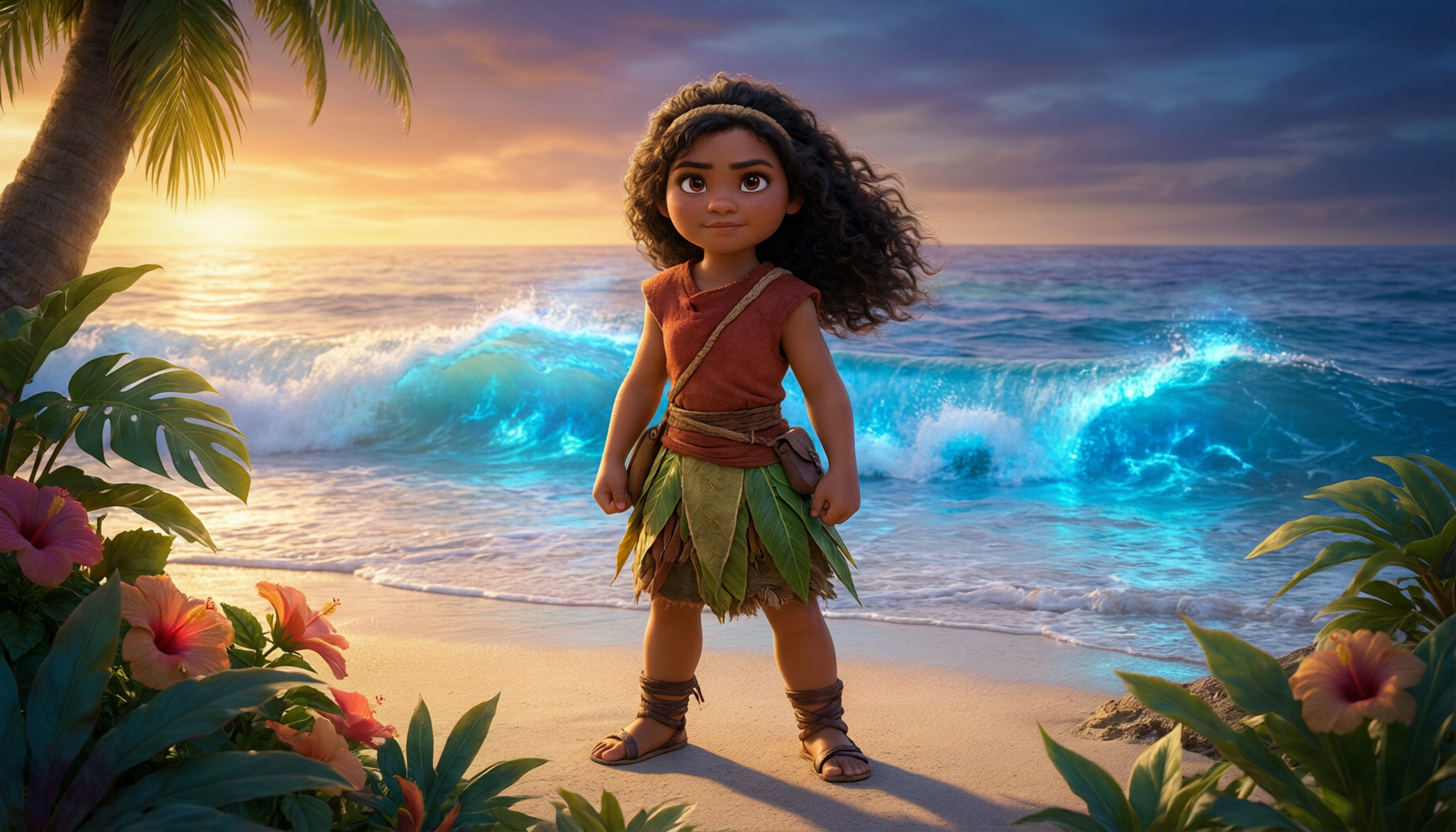
The first time you see Moana standing at the bow of her boat, ocean spray catching golden light behind her — that single frame stuck with millions of people. Not because of the plot, not because of the music, but because Disney's animation team spent nearly three years perfecting how water and light would look in that exact moment. The imagenes de Moana that circulate online today represent one of the most visually ambitious projects in the studio's history, and the appetite for these images hasn't slowed down since the film's 2016 debut.
What makes Moana's visual legacy so persistent? Part of it is the color palette — saturated teals, volcanic oranges, bioluminescent blues — that hit different from the cooler tones dominating most animated films. Part of it is the character design itself, rooted in five years of research across Samoa, Tahiti, Fiji, and New Zealand. And part of it is simply that people want these images on their walls, their phone screens, and their art portfolios. This piece breaks down every major category of Moana imagery, from the earliest concept sketches to the collectible giclee prints that sell out in minutes.
From Research Trips to Rendered Frames: How Moana's Visual Identity Was Built
Before a single frame of Moana was animated, a team of roughly 40 artists, cultural advisors, and filmmakers took multiple trips across the South Pacific between 2011 and 2014. They called this group the "Oceanic Story Trust," and their influence shows up in everything from the patterns on Moana's tube top to the way Maui's tattoos move as independent characters across his skin. The concept art from these trips — hand-painted watercolors of reef systems, volcanic coastlines, and traditional Polynesian sailing canoes — forms the most visually distinct body of pre-production artwork Disney has released in the 21st century.
Early concept sketches by production designer Ian Gooding and art director Ian Abando reveal a Moana who looked noticeably different from the final version. She was initially drawn older, with longer hair and more angular features. The design team tested over 200 variations of her face alone before settling on the rounder, more expressive look that audiences recognize. Those early sketches have since surfaced in the Art of Moana book (Chronicle Books, 2016) and remain some of the most collected pieces of Moana-related art among animation enthusiasts.
"We didn't want the ocean to look like a swimming pool. We wanted it to feel alive — something that breathes, moves, and has a personality."
— Hank Driskill, Head of Animation, Walt Disney Animation Studios, from the Art of Moana (2016)
The ocean-as-character mandate meant the effects team built an entirely new water simulation system they internally called "Splash." It generated over 80% of the film's water shots procedurally, a massive technical leap from the hand-animated water in Lilo & Stitch (2002). Screenshots and behind-the-scenes breakdowns of Splash have become their own subcategory of Moana imagery, widely shared among VFX communities and animation students.
Moana's Character Design: What the Images Actually Show
Moana Waialiki stands apart from previous Disney princesses in purely visual terms. Her body type is sturdier — broader shoulders, more muscular arms and legs, reflecting a character who climbs cliffs, rows boats, and wrestles crabs. The design team gave her curly hair that behaves realistically when wet (a notorious technical challenge), and her wardrobe draws directly from traditional Polynesian garments: a red tube top modeled after Samoan ie lavalava fabrics, a grass-and-fiber skirt with a slit for mobility, and a bone necklace that doubles as the film's emotional anchor.
The Official Disney Style Guide Renderings
Disney's consumer products division produced an extensive style guide for Moana merchandise, which included turnarounds (front, side, and back views), expression sheets showing 18 different facial configurations, and color hex references for every element of her outfit. These internal documents occasionally surface on animation resource sites and are prized by fan artists who want to maintain accuracy in their own work. The official Moana color hex palette includes:
- Skin tone: warm brown (#8B6548 base), with multiple shade variants for sun and shadow
- Hair: deep curly brown (#3B2314) with auburn highlights (#6B3A2A)
- Tube top: coral red (#C43B3B) with darker band (#8B2020)
- Skirt: layered earth tones — cream (#D4C9A8), brown (#8B7355), and deep rust (#A0522D)
- Necklace: bone white (#F0E6D3) with teal cord (#2E8B8B)
Fan communities on DeviantArt and ArtStation frequently reference these exact values. The most popular imagenes de Moana shared in art forums tend to be full-body render studies that showcase how light interacts with her curly hair — a specific technical flex among digital painters.
Maui: The Tattoo Demigod Who Stole Every Scene
If Moana's design is restrained and culturally grounded, Maui's is an exercise in controlled excess. Standing roughly 7 feet tall in the film (compared to Moana's approximately 5'4"), Dwayne Johnson's character is a mountain of muscle covered in Polynesian-style pe'a and tatau patterns. But the design trick that elevated Maui from generic muscleman to memorable character was the Mini Maui — a small animated tattoo on his chest that acts as his conscience, mimicking expressions and occasionally arguing with him.
The tattoo animation required frame-by-frame 2D work layered on top of the 3D character model. Eric Goldberg, who supervised the 2D animation for Maui's tattoos, had previously worked on the genie sequences in Aladdin (1992), and the stylistic DNA is visible. Each tattoo tells a story from Polynesian mythology — the sun being lassoed, islands being fished from the sea, the theft of fire from the underworld. Stills of these individual tattoo stories have become some of the most shared Maui images online, often accompanied by mythological explainers.
Maui's Hook and the Prop Design That Merch Built
Maui's fish hook — the magical weapon that transforms him into various animal forms — went through roughly 30 design iterations. The final version, a massive bone-white hook approximately 5 feet long with carved Polynesian motifs, became an instant merchandising icon. Hasbro, Mattel, and Disney's own parks division each produced their own versions, and high-resolution product photography of these hook replicas fills Pinterest boards and eBay listings to this day. For collectors, the most coveted version remains the Disney Parks exclusive resin replica (approximately $149.99 at launch in 2017), which stands about 24 inches tall and features hand-painted weathering.
The Scenes Everyone Screenshots: Key Frames That Became Cultural Images
Certain frames from the film have taken on lives of their own, circulating so widely that people who have never seen Moana still recognize them. Here are the visual moments that dominate image searches and fan collections:
The "You're Welcome" sequence. Maui's musical number features rapid costume changes, a flower crown, and an entire coconut-army battle. The freeze-frame of Maui winking while holding a coconut drumstick has been used in roughly 2.4 million social media posts, according to a 2020 Brandwatch analysis of Disney-related social content.
Moana confronting Te Ka. The volcanic demon, rendered in swirling magma and ember particles against a blackened sky, represents some of the film's most complex effects work. The wide shot where Moana stands on her boat, facing a towering wall of fire, has become a shorthand image for courage in fan art communities. The contrast between cool ocean blues and volcanic oranges makes this scene a color-theory case study.
The bioluminescent realm. When Moana enters the cave beneath her island and discovers the ancient voyaging canoes, the screen floods with cyan and magenta bioluminescence. This sequence was inspired by real-world glowworm caves in New Zealand's Waitomo region. Still images from this scene work exceptionally well as phone wallpapers and have been adapted by fan artists into everything from cross-stitch patterns to neon sign replicas.
The "I Am Moana" moment. The spiritual sequence where Moana's grandmother's spirit appears as a manta ray, rendered in translucent starlight against deep ocean, won the Annie Award for Outstanding Achievement for Animated Effects in 2017. The two-shot of Moana and the glowing manta ray is arguably the single most reproduced image from the entire film.
| Image Type | Best Source | Resolution Range | Typical Use |
|---|---|---|---|
| Official movie stills | Disney Press / IMDb | 1920x1080 to 4K | Wallpapers, presentations, articles |
| Concept art & sketches | The Art of Moana (book) | Scanned at 300 DPI+ | Study reference, art prints |
| Fan art | ArtStation, DeviantArt | Varies (up to 8K) | Inspiration, community sharing |
| Promotional posters | Disney marketing archives | 2400x3600 px typical | Room decor, print projects |
| Collectible giclee prints | Disney Fine Art / gallery releases | Museum-grade, limited edition | Collecting, home display |
| Moana 2 stills & promos | Disney+ press materials (2024) | Up to 4K HDR | Comparison studies, updated refs |
| Character turnarounds / style guides | Animation resource sites | Vector and high-res raster | Artist reference, cosplay guides |
Fan Art and the Community That Won't Let Moana Fade
Search "Moana fan art" on ArtStation and you'll find over 4,200 results as of early 2026 — a number that has held steady rather than declining, which is unusual for a film approaching its tenth anniversary. The fan art ecosystem around Moana operates differently from, say, Frozen or Spider-Verse fandoms. It skews heavily toward painterly, semi-realistic renderings rather than chibi or cartoon reinterpretations. Digital artists seem drawn to the challenge of Moana's specific visual problems: wet curly hair, subsurface scattering on brown skin tones, and the way tropical light behaves differently from the northern European lighting that dominates most animation training.
Some notable trends in the fan art community:
- Cultural remixing: Artists from Pacific Island nations have produced Moana art that incorporates specific tribal patterns not present in the film — Maori koru spirals, Hawaiian kapa cloth textures, Tongan ngatu designs. These pieces often carry educational captions about the real cultural traditions the film references.
- Alternate style studies: A popular format involves redrawing Moana characters in the style of other animation studios — Studio Ghibli watercolor backgrounds, Spider-Verse comic halftone patterns, or Arcane's oil-painting textures. These comparisons are technically exercises but generate significant engagement.
- Traditional media: An unexpectedly large number of artists create Moana imagery using physical media — oil painting, watercolor, woodburning, and even traditional Polynesian tatau (tattoo) techniques applied to canvas.
The hashtag #MoanaArt on Instagram has accumulated roughly 185,000 posts (per a June 2026 search), with the highest-engagement posts typically showing process breakdowns rather than just finished pieces. Artists who share their layer-by-layer workflow tend to outperform those who post only final renders, suggesting the community values craft education over simple appreciation.
Collectible Prints and Official Merchandise Art
Disney's fine art division has released a limited but impactful selection of Moana collectible prints. The most notable is the Thomas Kinkade Studios collaboration — a painted scene of Moana's village at sunset, issued as a limited-edition giclee in 2018 with only 250 numbered copies. Secondary market prices for this piece have ranged from $800 to $1,500 depending on condition and framing, according to eBay sold listings tracked through mid-2025.
Beyond the fine art market, Disney Store and shopDisney have carried a rotating selection of Moana art prints, posters, and canvas wraps. The "Disney Art Classics" line includes a Moana portrait by studio artist Dave Perillo, rendered in a mid-century modern style with flat colors and geometric simplification — a striking departure from the film's painterly rendering. That print typically retails for $39.95 to $59.95 in standard sizes.
Park Exclusives and Event-Only Art
Disneyland and Walt Disney World have each hosted Moana-themed art events. The most sought-after piece from these events is a 2019 D23 Expo exclusive lithograph featuring Moana, Maui, and the ocean in a triptych layout, with gold foil stamping on the border. Only 500 were produced, and resale prices have exceeded $400 in some cases. At Aulani Resort in Hawaii, guests can purchase locally made artwork that blends Moana characters with traditional Hawaiian art techniques — these pieces are unique to the resort and cannot be replicated through Disney's standard retail channels.
Moana 2: What Changed Visually (and What Fans Are Searching For)
When Moana 2 arrived in November 2024, the visual upgrades were immediately noticeable. Disney's animation pipeline had evolved significantly in eight years — the sequel was rendered using a next-gen system that allowed for denser foliage, more nuanced skin shading, and ocean surfaces that respond to wind patterns with greater physical accuracy. Moana herself appears slightly older (the story places the sequel three years after the original), and her design reflects this with a more refined wardrobe, additional tattoo-inspired markings on her arms, and a new weapon: a staff carved from island wood.
The new characters introduced in the sequel — particularly the villain Matangi and the younger sister Simea — generated their own wave of image searches. Matangi's design, featuring flowing dark robes interwoven with deep-sea creature motifs and bioluminescent accents, drew comparisons to Ursula and Maleficent but carved out its own visual territory. Fan art of Matangi overtook Moana-specific fan art in engagement metrics within the first two months of the film's release, according to ArtStation's 2025 trending report.
For those searching imagenes de Moana from the sequel, the highest-demand images include Moana's new voyaging outfit (a deeper blue with star-chart embroidery), the expanded fleet of canoes, and the climactic scene set inside an underwater cavern lit by volcanic vents. Disney+ released a set of high-resolution promotional stills in conjunction with the film's streaming premiere, and those images remain among the most downloaded assets from Disney's press portal.
Using Moana Images Responsibly: Copyright, Fair Use, and Artist Respect
A practical note for anyone working with Moana imagery in creative projects. Disney aggressively protects its intellectual property, and Moana is no exception. Using official movie stills or promotional art in commercial projects (prints for sale, YouTube thumbnails on monetized channels, merchandise) without licensing is a copyright violation, regardless of how widely those images circulate online.
For personal use — wallpapers, mood boards, educational presentations — official stills from Disney's press materials are generally fine. For commercial work, consider these legitimate paths:
- Licensed stock: Getty Images carries a selection of officially licensed Moana editorial images that can be used in news articles and educational content with proper licensing.
- Disney's consumer products portal: Businesses can apply for licensing agreements to use Moana artwork on approved merchandise.
- Original fan art: If you create your own Moana-inspired art, you own the copyright to that specific expression (though the underlying character remains Disney's). Selling fan art occupies a legal gray area, but platforms like Etsy and Redbubble host thousands of Moana-inspired pieces that operate under platform-specific licensing arrangements.
- Commission original artists: For projects requiring Moana-adjacent visuals (Polynesian-themed illustrations, ocean adventure artwork), commissioning original art inspired by the film's aesthetic — without directly copying character designs — is both legally safer and more respectful to the creative community.
"The images people create of Moana tell me the character landed somewhere real. When an artist in Fiji draws her with patterns from their own grandmother's tapa cloth, that's not fan art — that's a conversation."
— Neefi Tuiasosopo, cultural consultant on Moana, from a 2019 interview with Animation Magazine
Your Questions About Finding and Using Moana Images, Answered
Where can I find high-resolution Moana wallpapers for free?
Disney's official press site (disney.com/press) periodically releases high-resolution stills for editorial use. Fan communities on Reddit's r/WidescreenWallpaper also share cropped and enhanced frames from the 4K Blu-ray release, which run at 3840x2160 pixels. For phone wallpapers, the bioluminescent cave scene and the manta ray sequence are the most adapted formats — you'll find hundreds of resized versions on wallpaper apps like Zedge and Walli.
Is The Art of Moana book worth buying for the images alone?
Absolutely. The 160-page hardcover (ISBN 978-145215349) contains over 200 pieces of concept art, character designs, environment paintings, and storyboards that aren't available anywhere else. The print quality is excellent for a mass-market art book, with most pieces reproduced at sizes large enough to study brushwork and color choices. Secondhand copies typically run $25 to $45 on Amazon and AbeBooks. For anyone studying animation, character design, or Pacific Island visual culture, it's a primary reference.
What makes Moana's visual style different from other Disney films?
Three technical choices set it apart. First, the water simulation system ("Splash") created ocean surfaces with a level of physical accuracy no previous animated film had achieved — individual wave particles respond to simulated wind and gravity. Second, the lighting team used a technique called "island bounce" where light reflected off the ocean surface illuminates characters from below with a warm teal glow, mimicking real tropical lighting conditions. Third, the character designs were built around cultural authenticity rather than Disney's traditional "appeal" guidelines, resulting in body types and proportions that diverge from the studio's historical princess template.
Can I use Moana images for my YouTube channel or social media?
For commentary, review, or educational content, using brief clips or stills generally falls under fair use — but this is a legal gray area that depends on how transformative your use is. If you're running a Disney fan channel that discusses the film's animation techniques, stills are typically fine with proper attribution. If you're using Moana images as decorative elements on a monetized channel with no editorial purpose, you're at higher risk of a copyright claim. Disney's YouTube Content ID system is among the most aggressive in the industry.
Are there Moana images from the live-action remake yet?
Disney announced a live-action Moana remake scheduled for 2026, starring Catherine Laga'aia as Moana and Dwayne Johnson reprising his role as Maui. As of mid-2026, Disney has released limited first-look images showing the casting and some location photography from Fiji and New Zealand. Full promotional stills and character portraits are expected closer to the film's release date. The live-action designs appear to closely follow the animated versions, with practical costumes and real Polynesian craftsmanship replacing the CGI wardrobe.
The visual world of Moana has always been more than decoration. Every pattern, every color choice, every wave simulation carries the weight of real cultures and an animation team that refused to take shortcuts. That's why the imagenes de Moana continue to resonate — they're not just pretty pictures. They're artifacts of a production that treated the Pacific Islands with a level of respect that the animation industry hadn't previously attempted at this scale. Collect the prints, study the concept art, grab the right wallpaper — whatever draws you in, what you're really holding onto is a piece of something that changed how animated films approach cultural storytelling.