Kaina’s Vertical Literacy in The Orbital Children: How Zero-G Text Orientation Maps Cognitive Disorientation
At 12:44 in Episode 3, Kaina tilts her wrist display—not to adjust brightness or volume, but to rotate the entire interface 90 degrees clockwise. Her fingers flick upward, and the Japanese text snaps into vertical alignment, flowing top-to-bottom along the long edge of the screen like a traditional shōjo manga panel. She doesn’t blink. Neither does the camera. It holds on her face for two full seconds—calm, focused—as if this gesture were as natural as breathing. And in her world, it is.
The popular take is that The Orbital Children’s UI design is “cool futurism”—a sleek visual shorthand for orbital life. But that misses the point entirely. Kaina’s literacy isn’t adapted to zero-g; it’s constituted by it. Her reading habits aren’t interface preferences. They’re embodied cognition in real time—neurological recalibration made visible through typography.
NASA’s 2021 microgravity spatial disorientation study (NASA/TP–2021-220957) observed that subjects in sustained weightlessness didn’t just misjudge distances—they reorganized their internal coordinate frames. Up/down lost gravitational anchoring; front/back weakened without consistent locomotion cues; only left/right retained relative stability, tied to body axis. Crucially, the report noted: “Subjects spontaneously adopted axial reference shifts in symbolic processing—especially in tasks requiring rapid serial decoding, such as text scanning.” That’s not speculation. That’s what Kaina does.
Compare her to Anon. In Episode 1, when Anon pulls up mission logs on his tablet, he scrolls linearly—top-to-bottom, horizontal lines, Western-style. His eyes track left-right across each line like a metronome. He never rotates anything. Even during the station-wide gyro failure in Episode 4, his interface stays locked in landscape mode while alarms flash red. His cognition remains anchored to Earth-normal syntax—even as his inner ear screams otherwise. Kaina doesn’t have that luxury. Her vestibular system is already remapped. So her literacy follows.
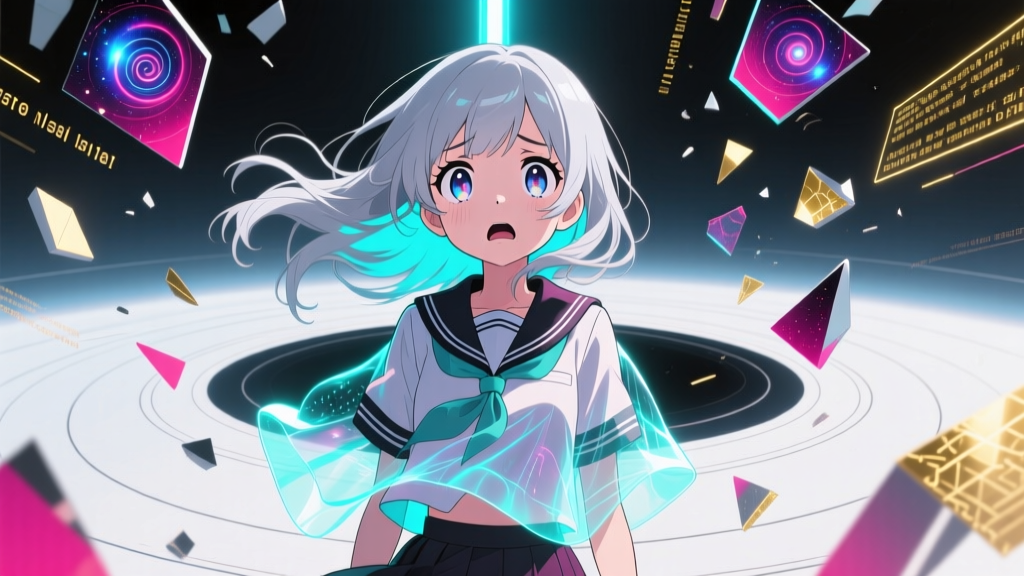
Episode 5’s “Data Storm” sequence isn’t just visual chaos—it’s typographic violence. At 18:33, the HUD fractures: kanji invert, hiragana spin counterclockwise, English subtitles appear upside-down *and* mirrored, then dissolve into rotating glyphs that pulse with gyroscope data. This isn’t style for style’s sake. It mirrors NASA’s documented “perceptual slippage”: when spatial anchors collapse, symbolic systems destabilize *in kind*. Kaina doesn’t panic. She blinks—and traces a character in the air with two fingers. The glyph stabilizes. Her motor memory overrides the sensory noise. That’s not plot convenience. That’s neuroplasticity rendered in animation.
Which makes Bones’ Planetes (2003–2004) all the more revealing in contrast. There, text always obeys gravity—even aboard the Toy Box. Subtitles stay bottom-aligned. Control panels use horizontal menus. When characters read schematics, they orient them “correctly,” even floating mid-cabin. Why? Not because Bones lacked imagination, but because their model of space adaptation was pre-2010: cognitive resilience as *resistance* to disorientation, not integration with it. Planetes’s realism was mechanical and procedural; The Orbital Children’s is phenomenological. Science SARU didn’t ignore vestibular science—they built narrative architecture around its consequences.
Then there’s Episode 7, at 28:11: the shared VR kanji puzzle. Kaina and Nasa float side-by-side in void-black space, hands extended toward a suspended, three-dimensional character—空 (“sky” or “void”). Kaina traces its stroke order vertically, her arm moving downward along the Y-axis. Nasa tries horizontally—and the glyph shudders, rejecting his input. Only when he rotates his wrist 90°, matching Kaina’s orientation, does the character solidify. It’s not about “who’s right.” It’s about whose sensorimotor history aligns with the system’s embodied logic. This works because it treats literacy as a physical act—not abstract symbol recognition, but kinesthetic negotiation with space.
I remember watching that scene twice in one sitting, then pausing to sketch the stroke order on paper. My hand kept wanting to go left-to-right. I had to consciously rotate the page. That friction—between my terrestrial muscle memory and Kaina’s orbital fluency—is where the show lands its deepest punch. It doesn’t ask you to imagine zero-g. It asks you to *unlearn* how you read.
That’s why Kaina’s vertical literacy matters beyond aesthetics or even worldbuilding. It’s the first time an anime has treated written language not as a transparent medium, but as a scaffold—one that bends, breaks, and rebuilds itself under altered physics. Her gestures aren’t flourishes. They’re evidence: of cognition distributed across body, tool, and environment. Of literacy as gravity-dependent.
And if you watch closely—really closely—you’ll notice something else. After Ep7, Kaina never rotates her display again. Not once. By the finale, she reads horizontally, seamlessly, without hesitation. Not because she’s “reverted.” But because the distinction has dissolved. The axis isn’t fixed anymore. It’s chosen. And that, perhaps, is the most human thing of all.