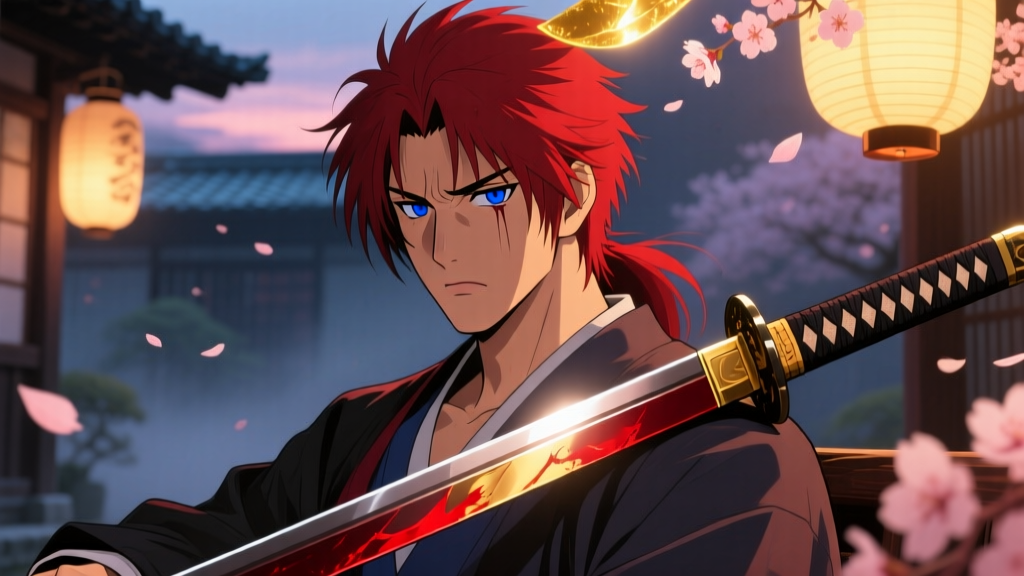
Himura Kenshin’s Reverse-Blade Sword as Embodied Shame Ritual
I remember watching episode 14 of the original Rurouni Kenshin for the first time—not on Netflix, but on a grainy VHS dub, rewound too many times. When Kenshin drew his sakabatō to stop Saitō’s blade mid-swing and the steel rang hollow—no clashing, no spark—I paused it. Not because it was cool. Because it felt like watching someone hold their breath for ten minutes.
That’s the point. The sakabatō isn’t a weapon. It’s a somatic shame practice—one that doesn’t speak in dialogue but in tremor, repetition, and avoidance. And if you’re coming to Kenshin through the 2023 Netflix remake, you’ve likely missed the scaffolding: the historical weight of Edo-period kata, the moral architecture of Tokugawa-era penance, and how director Kazuhiro Furuhashi choreographed restraint like a liturgy.
Let’s start with the grip. In volume 2 (episode 8), after Kenshin disarms a thug without drawing, we see his left hand tighten—knuckles white, thumb pressing into the scabbard’s mouth—not to draw, but to contain. His right hand rests flat over the hilt, fingers splayed, not curled. That’s deliberate. In real kenjutsu kata—especially the Shindō Munen-ryū forms Kenshin’s based on—this open-fingered “resting grip” signals non-intent. It’s not neutral. It’s rehearsed abstinence. Every time he adjusts it—on the train platform in vol. 14, at the shrine steps in vol. 25—it’s less habit than ritual recalibration: I am still holding myself.
Then there’s the polishing. Not the dramatic, moonlit sword-cleaning of samurai films. Kenshin polishes the scabbard. Repeatedly. In vol. 25, he does it three times in one scene—wiping the same spot with slow, downward strokes, cloth folded precisely, wrist bent at 90 degrees. Historian Tetsuo Najita, in Tokugawa Moral Economy, describes how Edo-period merchants performed daily ledger-keeping not just for accuracy, but as “moral accounting”—a physical act that re-anchored ethics in muscle memory. Kenshin’s scabbard-polishing is that ledger. He doesn’t sharpen the blade (it can’t cut). He maintains the vessel that holds his violence in check. The ritual isn’t about cleanliness. It’s about continuity of containment.
And then—the flinching. Not at blood or pain, but at sound. At the shink of a drawn katana in episode 4. At the tink of a practice sword striking wood in episode 17. These aren’t PTSD ticks. They’re conditioned aversions—like a monk recoiling from profanity. Furuhashi’s choreography makes this visible: in fight scenes, blades never lock. Kenshin deflects with the blunt edge, slides past steel, uses the scabbard as shield—not because it’s clever staging, but because contact would break the vow. Blade-on-blade is communion with killing. His footwork avoids it like crossing a threshold into defilement. Compare that to the 2023 Netflix version, where the sakabatō clangs, scrapes, and even sparks off other swords. It looks dynamic—but it evacuates the central tension. The original didn’t avoid impact for safety. It avoided it for sacrament.
This maps cleanly onto Tokugawa-era seppuku manuals—not the suicide guides, but the preparation texts used by retainers performing ritual atonement. These manuals don’t focus on the final cut. They obsess over posture, breath timing, the folding of the kimono, the exact placement of the tantō on the tatami. Why? Because the body had to become the site where shame was made legible, reversible, and socially witnessed. Kenshin’s entire physicality mirrors this: the bow before every confrontation (vol. 14), the way he kneels to clean a child’s scraped knee while keeping his sword upright and un-drawn (vol. 2), the silence he keeps when others demand justification. His body speaks the language of pre-Meiji atonement—where morality wasn’t declared, but performed until it calcified into bone.
Which brings us to the mantra: “I am not a killer.” It’s repeated so often it risks cliché—until you hear it as cognitive behavioral therapy written in blood-ink. Not affirmation, but interruption. In vol. 9, after subduing an assassin who calls him “Hitokiri,” Kenshin says it twice—first low, then louder, eyes locked on his own hands. That’s not self-persuasion. It’s a loop designed to short-circuit the old neural pathway: blade drawn → threat assessed → kill executed. Instead: blade drawn → “I am not a killer” → pause → reassess → sheath. Modern CBT calls this “thought-stopping + replacement.” The Tokugawa called it kokorozashi no kyoiku—education of intention. Same function. Different lexicon.
The Netflix remake, for all its visual polish, flattens this. It gives Kenshin trauma flashbacks set to swelling strings—but never shows him scrubbing the scabbard at 4 a.m., or hesitating before opening a sliding door because the shoosh of paper sounds like a blade leaving its saya. Those silences are where the shame lives. Not in memory, but in muscle. Not in confession, but in calibration.
So next time Kenshin draws the sakabatō, don’t watch for the strike. Watch for the micro-tremor in his wrist as he checks the edge alignment. Watch how long he holds the bow—longer than social custom requires. Watch how he walks away *before* the opponent hits the ground, as if proximity to collapse might contaminate the vow.
That’s not heroism. It’s penance made kinetic. And it’s why, twenty-eight years later, the sakabatō still doesn’t cut—not because it can’t, but because every millimeter of its dull edge is polished, gripped, and flinched-at with unbearable care.