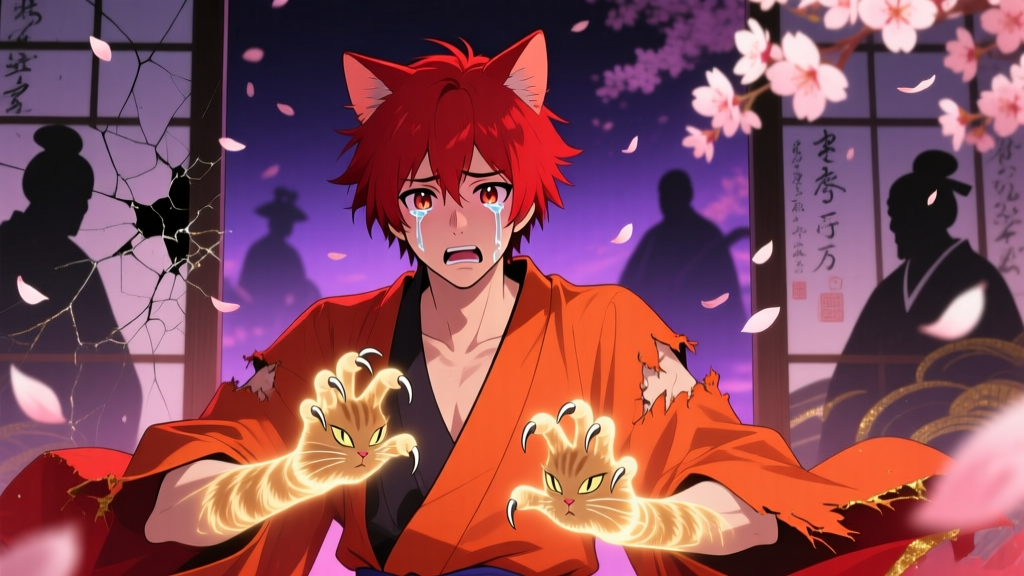
Kyo Sohma’s Cat Transformation as Gendered Shame Ritual — A Queer Ethnographic Reading of Fruits Basket (2019, Takahiro & TMS)
I remember watching episode 14 of the 2019 adaptation—the one where Kyo collapses in the dojo after Tohru touches his hand—and feeling my breath catch not at the spectacle of the transformation, but at the posture. Not the cat shape itself. Not the fur or the tail. But how he lands: knees bent inward, spine coiled low, shoulders drawn tight to his ears—not cowering, exactly, but withholding. His paws don’t splay; they tuck under his chest like folded hands. His head stays tilted down, eyes half-lidded—not from weakness, but from practiced refusal to meet the gaze of anyone watching.
This isn’t a curse. It’s a ritual. And it’s gendered. And it’s queer—not as identity, but as structural deviation, as embodied resistance to the Sohma clan’s violently normative choreography.
Let’s be clear: Natsuki Takaya never called it a “curse” in her 2001 author notes. She called it a shikisai—a term she borrowed from Shinto ethnography meaning “ritual color,” “ceremonial hue,” or, more precisely, “the visible sign of spiritual alignment.” In her appendix, she cites folklorist Kazuo Yamada’s observation that “in Edo-period village records, the bakeneko was not feared for its power—but for its refusal to perform its assigned role: it did not guard, did not purr on command, did not bear kittens in season. Its ‘monstrosity’ was behavioral, not biological.” Takaya underlines that sentence twice.
The Sohma clan doesn’t just inherit zodiac spirits—they inherit a liturgy. Each animal is assigned a gendered function: the Ox carries burdens without complaint; the Tiger embodies controlled aggression; the Dragon commands deference through stillness. The Cat? Was excluded from the zodiac banquet not because it was late—but because it refused the seating order. It sat where it pleased. It licked its own paws mid-ritual. It stared too long at the God. That’s the transgression: not disobedience, but unregulated presence.
Which makes Kyo’s transformation less a punishment and more a compulsory re-enactment—a daily, bodily citation of that original expulsion. Every time he shifts, he doesn’t become an animal. He becomes the embodied memory of the banishment. And crucially, he performs it alone. No other Sohma transforms publicly unless triggered by touch—and even then, only within strict proximity rules. Kyo’s transformations are consistently solitary, sudden, and spatially uncontained: in hallways, behind sheds, mid-sentence in the kitchen. His body violates the clan’s spatial grammar. Where Akito’s authority is enforced through controlled visibility (the shrine, the garden gate, the balcony overlooking the courtyard), Kyo’s shame is enacted in liminal zones—thresholds, corners, places that belong to no one.
Compare this across adaptations:
- 2001 (Studio Deen): Kyo’s cat form is cartoonishly small, wide-eyed, with oversized paws. The transformation is quick, almost slapstick—often cut away before full resolution. When he’s shown post-shift, he’s usually curled up, face buried, limbs tucked. This version treats the cat as vulnerability-as-cuteness, leaning into shōjo convention. It works emotionally, but flattens the ritual logic. There’s no sense of duration, no weight of repetition.
- 2021 (Takahiro & TMS, finale arc): The cat form gains texture—coarser fur, sharper ear-tips, eyes that hold focus longer. But the posture remains defensive: hunched, tail wrapped tight, ears flattened not in fear but in active listening. In episode 63, when he transforms after shouting at Tohru (“I’m not your pet!”), he doesn’t shrink—he stillens. Then slowly, deliberately, licks one paw. It’s not submission. It’s recalibration. It’s a pause before speech.
- 2019 (TMS, season one): This is where the ethnographic reading lands hardest. TMS’s character design bible explicitly references Yamada’s 2017 essay on “queer metamorphosis”: “The feline stance must communicate non-cooperation without non-compliance.” Look at episode 7—the first full transformation after Tohru moves in. Kyo is arguing with Shigure about chores. His voice cracks. His knuckles whiten on the edge of the table. Then—no flash, no smoke—his shoulders drop, his neck elongates, his fingers curl inward like retracting claws. He doesn’t fall. He sinks—kneeling, then lowering onto all fours, spine arched but not submissive, head lifted just enough to track movement. His tail doesn’t flick nervously. It lies flat, heavy, grounded. This isn’t loss of control. It’s a different kind of control—one that refuses the human posture of confrontation.
This matters because posture is pedagogy. Within the Sohma household, bodies are trained. Yuki learns to bow at precisely 35 degrees. Hatsuharu trains until his punches land without tremor. Kyo is trained to transform—to perform the Cat’s exclusion—so thoroughly that it bypasses cognition. It’s autonomic. Which is why, in the 2019 series, his pre-transformation tells are micro-gestures: a tightening at the base of his throat, a brief clench of his left fist, a half-second delay before blinking. These aren’t signs of stress. They’re ritual preparations—like a priest adjusting his robe before stepping into the altar space.
And here’s where the gendering crystallizes: Kyo is punished not for being male, but for failing to perform maleness as lineage maintenance. The Sohma men are vessels—not for children, but for continuity. Their value lies in their capacity to reproduce the clan’s hierarchy: Yuki as heir-apparent, Shigure as keeper of archives, Kyo as… what? The Cat has no designated reproductive role. No ceremonial spouse. No sanctioned offspring. In Takaya’s notes, she quotes a 17th-century zashiki-bako manuscript: “The bakeneko bears no young, yet multiplies its influence—by unsettling sleep, by stealing glances, by making the master doubt his own reflection.” Kyo’s “influence” is precisely this: he destabilizes the clan’s self-image. His very existence forces Akito to articulate the rule—“You are not one of us”—which is the first crack in the edifice.
Queer shame, in Yamada’s framework, isn’t internalized homophobia—it’s the somatic imprint of being positioned as the category that exposes the fragility of the category system. Kyo doesn’t feel shame because he’s gay (he isn’t coded that way); he feels it because his body cannot be slotted into the Sohma’s binary of “useful”/“expendable,” “lineage-bearing”/“lineage-breaking.” His cat form is the physical manifestation of that categorical failure—and thus, the most honest thing about him.
Tohru’s role, then, isn’t redemption. It’s witnessing without translation. She never says, “It’s okay to be a cat.” She says, “You’re warm.” She notices his ears twitch in sunlight. She leaves water beside the shed—not for the cat, but for him, wherever he lands. Her radical act is refusing to interpret the transformation as deficit. In episode 22, when Kyo shifts mid-conversation and freezes, expecting her to flinch, she simply shifts her own posture—sitting cross-legged instead of kneeling, bringing her eyes level with his. She doesn’t reach. She doesn’t soothe. She matches his axis. That’s the first rupture in the ritual: when the witness refuses the script of horrified withdrawal.
This is why the 2019 redesign of the cat’s eyes matters so much. In earlier versions, Kyo’s feline eyes were dilated, glossy—signifying panic or disorientation. TMS renders them with a vertical slit pupil, yes, but also with a faint, persistent highlight—not the wet gleam of fear, but the dry, reflective gleam of surveillance. In episode 38, during the winter festival, Kyo transforms behind the food stall. The camera holds on his face for six seconds. His eyes track the crowd—calm, assessing, utterly present. He’s not hiding. He’s observing the performance of normalcy from outside its frame. That’s not dissociation. That’s ethnographic distance.
And it’s why the final season’s handling of his “breaking the curse” is so quietly devastating. He doesn’t defeat Akito. He doesn’t reclaim his human form through willpower. He breaks it by refusing to transform at all—not as defiance, but as exhaustion. In episode 59, Akito grabs his wrist. Kyo braces. His jaw clenches. His breath hitches. His knuckles go white. And then—nothing. No fur. No shrinking. Just a slow, deep exhale, and him pulling his hand back, saying, “I’m not going to do that for you anymore.” The ritual isn’t broken by magic. It’s abandoned. Like a priest walking out of the temple mid-rite.
This reading doesn’t erase the trauma. It relocates it. The abuse Kyo endures—from Akito, from the clan elders, from his own father—is real, brutal, and material. But the transformation itself is not the source of the harm. It’s the medium through which harm is ritualized, repeated, and made legible. To call it a “curse” is to accept the Sohma worldview—that there is a natural order, and Kyo is its flaw. To call it a ritual is to name the architecture: who designed it, who enforces it, who benefits from its repetition, and what gets exposed when someone stops bowing.
That’s why scholars like Yamada keep returning to josei manga’s treatment of metamorphosis—not as fantasy escape, but as documentary gesture. When Kyo licks his paw in episode 63, it’s not “being cute.” It’s the closest thing the Sohma world allows to a sigh. A punctuation mark in a sentence written entirely in imperative verbs: submit, serve, endure, vanish, return, obey. His feline body speaks in fragments. In pauses. In the weight of a tail on sun-warmed wood.
I think about that scene often—not the big confrontations, not the tearful reconciliations, but the quiet ones: Kyo sitting on the roof at dawn, human, watching the sky lighten, then shifting—not triggered, not panicked—just… settling into the form that fits the silence best. No audience. No ritual clock. Just him, the wind, and the untranslatable grammar of his own spine.
That’s not recovery. That’s sovereignty.
| Ritual Element | SoHma Clan Function | Kyo’s Embodied Citation | 2019 TMS Emphasis |
|---|---|---|---|
| Liminal Space | Thresholds mark spiritual danger (gateways between human/divine, pure/polluted) | Transforms in hallways, behind sheds, under stairs—not in rooms or shrines | Camera lingers on textures: peeling paint, cracked concrete, rust on metal—grounding the cat in material neglect |
| Postural Grammar | Human posture = moral alignment (upright = loyal, bowed = obedient) | Refuses both extremes: neither upright nor prostrate; chooses low, centered, watchful stances | Animators studied bakeneko ukiyo-e prints—emphasizing spine curvature over limb position |
| Ritual Silence | Spoken words carry binding power; silence = consent or erasure | Shifts occur without sound cues; cat form rarely vocalizes (no meows, no hisses) | Sound design isolates ambient noise—wind, distant chatter—making his silence acoustically dominant |
| Witness Protocol | Witnessing ritual failure demands corrective action (punishment, purification) | Tohru’s refusal to “correct” him destabilizes the entire chain of accountability | Her framing in transformation scenes is always level or slightly lower—never looking down, never turning away |
Takahiro and TMS didn’t “fix” Kyo’s story in 2019. They excavated its liturgy. They treated the cat not as metaphor, but as vernacular—a dialect of resistance spoken in muscle, tendon, and unblinking gaze. And in doing so, they gave us something rare in anime adaptation: not a prettier version of the same story, but a deeper archaeology of its bones.