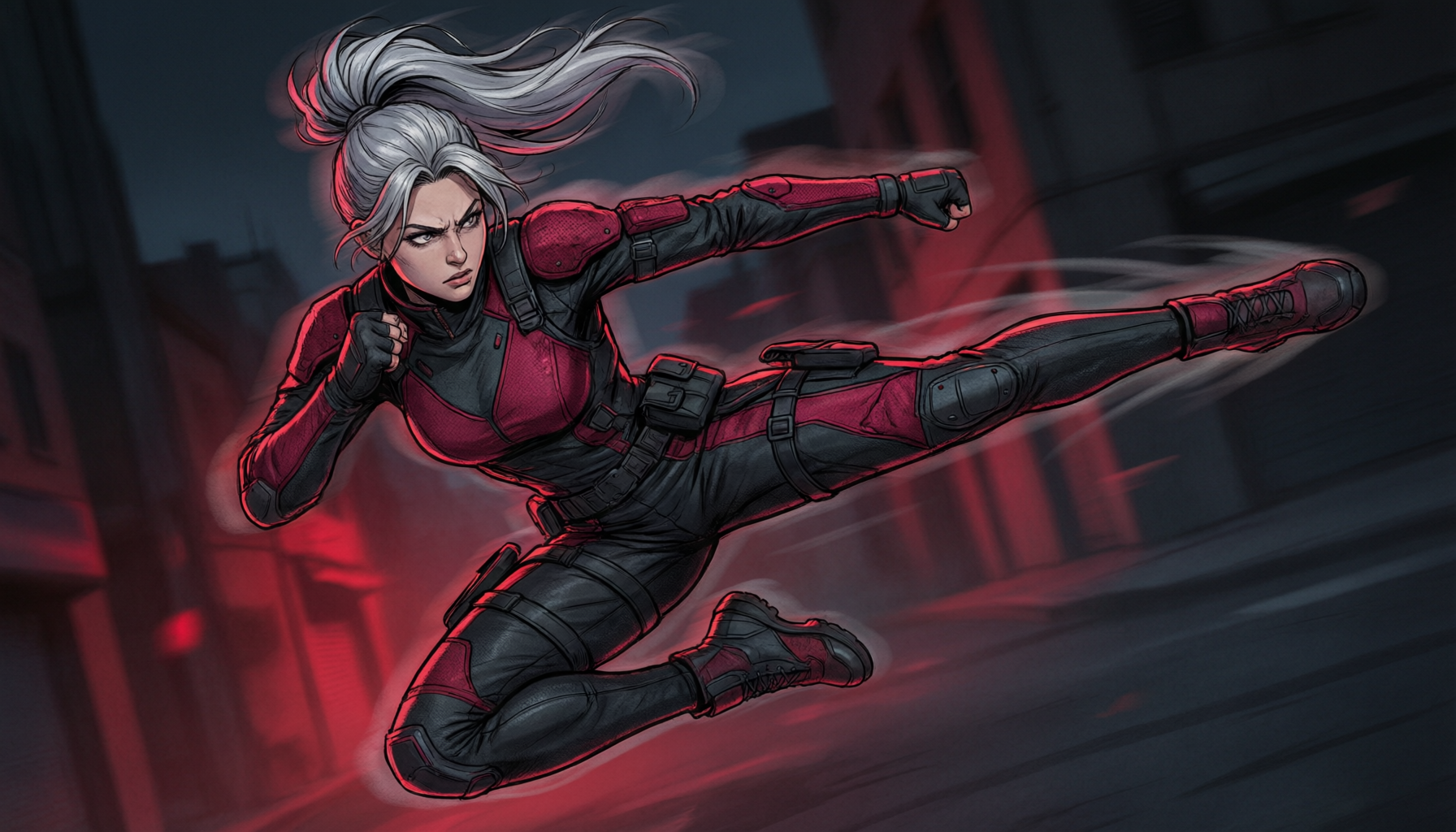
Picture this: it's 2009, you're reading Deadpool: Merc with a Mouth #9, and suddenly you're staring at a blonde woman in a pink-and-red tactical suit who talks just as fast as Wade Wilson and hits twice as hard. No buildup. No origin arc. She just kicks through a dimensional rift like she owns the place. That was the moment Lady Deadpool — real name Wanda Wilson — went from "what if?" curiosity to a character fans refused to forget.
The strange part? She was never supposed to become a recurring fixture. Writer Victor Gischler and artist Bong Dazo introduced her as a one-off alternate-universe riff, a way to riff on Deadpool's formula from a different angle. But comic readers latched onto her with the kind of intensity that catches editorial off guard. Forum threads on CBR and Reddit exploded within 48 hours of that issue hitting shelves. Cosplay appeared at conventions within months. And once Marvel noticed the groundswell, the question became: how do you put this character in front of more people?
Animation turned out to be the answer — or at least part of it. Lady Deadpool's transition from page to screen wasn't a single dramatic leap but a series of smaller ones, each building her profile until she became something no one expected: a character who could headline her own conversations without Deadpool in the room.
2009 First comic appearance Earth-3010 Home universe 6+ Animated appearances 12+ Licensed collectiblesThe Comic Book Origin Story Nobody Saw Coming
Wanda Wilson hails from Earth-3010, a parallel reality in Marvel's ever-expanding multiverse. Her backstory mirrors Wade's in the broad strokes — she was subjected to experimental Weapon X-style treatments that granted her a regenerative healing factor, peak physical conditioning, and a mouth that runs faster than a speedster on espresso. The crucial difference is tone. Where Wade's trauma manifests as manic, chaotic energy, Wanda processed hers into something colder. More focused. She's still funny, but the jokes land like shrapnel rather than confetti.
In her original universe, Wanda operated as a solo mercenary before being recruited into the Deadpool Corps — a multiversal team assembled from alternate-reality versions of Deadpool. The Corps included Headpool (a reanimated head in a jar), Kidpool (a child-aged Deadpool), Dogpool (exactly what it sounds like), and Deadpool himself. Lady Deadpool slotted into this roster as the team's most tactically competent member, which is a bit like saying you're the most organized person in a room full of fireworks.
"She's the one character in the Deadpool Corps who can plan a mission and complete it without getting distracted by a chimichanga truck. That alone makes her dangerous." — Victor Gischler, in a 2010 interview with Comic Book Resources
The Deadpool: Merc with a Mouth series (2009–2010) ran for 13 issues and served as Lady Deadpool's primary comic showcase. After that, she appeared sporadically in Deadpool Vol. 3 tie-ins, the 2015 Deadpool's Secret Secret Wars miniseries, and various Deadpool Corps revival arcs. Her total panel count across all appearances sits somewhere around 340 pages — not enormous by Marvel standards, but enough to establish a distinct personality and fighting style that animation studios would later mine for material.
What Made the Comics Work
The creative team understood something fundamental: Lady Deadpool couldn't survive as "Deadpool but female." She needed her own comedic rhythm. Bong Dazo drew her with a physicality that read as trained and deliberate — her combat poses are grounded, her strikes look like they come from someone who studied martial arts rather than someone improvising. Gischler wrote her dialogue with fewer pop-culture references than Wade's and more dry sarcasm. When she breaks the fourth wall, she does it with the weary exhaustion of someone who knows the script and wishes the writers had tried harder.
That tonal distinction became the foundation for every animated adaptation that followed.
Lady Deadpool's Animated Appearances: A Growing Resume
Animation gave Wanda Wilson something comics alone couldn't: a voice, movement, and a way to reach audiences who'd never pick up a Deadpool tie-in comic. Her screen journey spans several projects, each adding layers to the character.
Marvel Disk Wars: The Avengers (2014–2015)
The Japanese anime series Marvel Disk Wars: The Avengers, produced by Toei Animation, marked Lady Deadpool's first significant animated outing. The show's format — Marvel heroes and villains compressed into collectible "DISKs" that kids could activate — was unapgetically toy-driven, but it gave dozens of secondary characters screen time they'd never get in a mainstream American production. Lady Deadpool appeared across multiple episodes as a wildcard operative, interacting with both heroes and villains depending on who annoyed her less.
Toei's animation team rendered her in a style that split the difference between anime conventions and Marvel's house aesthetic. Her movements were fluid and martial-arts-heavy, with a noticeable emphasis on acrobatic close-quarters combat rather than the gunplay Wade favors. The Japanese-language voice work gave her a sardonic, almost bored delivery that fans praised on MyAnimeList and Twitter for nailing the comic's dry-wit approach.
Marvel Animated Shorts and Guest Spots
Beyond Disk Wars, Lady Deadpool has surfaced in Marvel's animated ecosystem through shorter appearances — promotional shorts tied to comic releases, character profile segments, and crossover event tie-ins. Marvel's digital content team has used her in web-exclusive animated clips designed for social media, where her fourth-wall-breaking tendencies translate naturally to direct audience address.
The challenge for animators has always been differentiation. When you're working with a character who shares 80% of Deadpool's design language, the 20% that's different has to do heavy lifting. The ponytail helps. The color palette helps. But it's the body language — more controlled, less erratic — that sells her as a separate person rather than a palette swap.
The MCU Multiverse Question
With Marvel Studios leaning into multiverse storytelling post-Spider-Man: No Way Home (2021) and Deadpool & Wolverine (2024) demolishing box office records with $1.338 billion worldwide, speculation about Lady Deadpool's live-action debut has reached fever pitch. While that's technically outside animation, the ripple effects matter: every new Deadpool variant introduced on screen drives viewers back to animated content to find versions they haven't seen yet. Streaming data on platforms carrying Marvel animated content shows measurable upticks in Lady Deadpool-adjacent searches following major MCU announcements.
Visual Design: Pink, Lethal, and Instantly Recognizable
Let's talk about that suit. Lady Deadpool's costume design is one of the more successful "variant" redesigns in Marvel's catalog, and it works because it respects the original while making decisive changes.
The Design DNA
- Base suit: Tactical bodysuit in hot pink (#FF1493) and deep red (#CC0000), mirroring Deadpool's red-and-black scheme but shifted to a warmer palette
- Signature feature: Blonde ponytail emerging from the back of the mask — this single element does more for character recognition than any amount of dialogue
- Eye patches: Slightly more angular than Wade's, giving her a sharper, more aggressive expression even in repose
- Utility belt and harness: More streamlined than Deadpool's bulkier loadout, reflecting her preference for speed over firepower
- Boots: Knee-high tactical boots with reinforced plating, drawn with a slight heel that suggests style-consciousness without sacrificing combat realism
For animation specifically, the ponytail became the key identifier. In motion, it reads beautifully — it whips during combat, bobs during her trademark head-tilts, and gives animators a secondary motion element that makes every action scene more dynamic. Toei's team on Disk Wars leaned into this hard, often using the ponytail as a motion trail during her acrobatic sequences.
The color shift from Deadpool's red-black to pink-red was a deliberate gamble. Hot pink can read as gimmicky if overused, but the designers balanced it with enough black and dark red to keep the tactical feel intact. In well-lit animation scenes, the pink pops against backgrounds; in shadowed or moody sequences, the darker tones dominate and she reads as a more traditional operative. It's a costume that adapts to its lighting environment, which is rarer than it sounds.
Wanda Wilson vs. Wade Wilson: More Than a Gender Swap
The lazy take on Lady Deadpool is "female Deadpool." That reduction misses what makes her work as a character and why she's survived longer than most alternate-universe variants. Here's where they actually diverge:
| Trait | Wade Wilson (Deadpool) | Wanda Wilson (Lady Deadpool) |
|---|---|---|
| Combat Style | Gunplay-heavy, improvisational, chaotic brawler | Martial arts foundation, acrobatic, calculated strikes |
| Humor | Pop-culture blitzkrieg, non-stop references | Dry sarcasm, deadpan observations, self-aware exhaustion |
| Fourth Wall Breaks | Constant, gleeful, often absurd | Selective, used to underscore frustration or irony |
| Mental State | Openly unstable, played for comedy and pathos | Controlled volatility — intense but functional |
| Team Dynamics | Terrible team player, beloved despite it | Reluctant team player, respected because of it |
| Weapon Preference | Dual pistols, katanas, heavy ordnance | Twin short blades, throwing knives, occasional sidearm |
| Healing Factor | Extreme regeneration, visible scarring | Comparable regeneration, less visible scarring |
| Color Palette | Red and black | Hot pink and deep red |
The combat distinction matters more than it might seem. In animation, fight choreography is character development. When Lady Deadpool moves through a scene with controlled, acrobatic precision, she's telling you something about her discipline and training that no exposition dump could convey. Wade crashes through walls; Wanda finds the gap in the wall and slides through it. Both approaches work. They just attract different kinds of attention from the audience.
Her humor also translates differently in animation. Wade's comedy relies heavily on timing and volume — he talks fast, loud, and often. Wanda's best animated moments come from understatement. A quiet line delivered while reloading, a flat stare at the camera during an explosion behind her, a muttered comment about the catering on set. It's comedy that rewards viewers who pay attention, rather than comedy that demands they do.
Behind the Mask: Voice Acting and Character Performance
Voicing a Deadpool variant is a peculiar challenge. The actor has to honor the character's established energy without doing an impression of whoever voices Wade. Lady Deadpool's voice performers have navigated this by leaning into Wanda's defining trait: controlled intensity.
In the Japanese-language version of Marvel Disk Wars: The Avengers, her voice actress adopted a lower register with a flat, sardonic delivery — think less "wacky mercenary" and more "special ops veteran who's seen too much and finds most things mildly disappointing." This approach distinguished her immediately from Deadpool's higher-energy Japanese voice work and set a template that subsequent appearances have largely followed.
The English-language dub and later animated appearances maintained this philosophy. The voice sits in a mid-to-low range, with a slight rasp that suggests both physical damage and emotional weariness. Punchlines are delivered with timing that implies the character considers humor beneath her but can't help herself. It's the vocal equivalent of a reluctant smirk.
Deadpool voice actors have talked about the difficulty of sustaining manic energy across long recording sessions. Lady Deadpool's voice work inverts that challenge: the actor has to sound engaged while performing a character who acts like she'd rather be anywhere else. It's a subtler skill, and it doesn't get the same highlight-reel attention, but it's harder to sustain over a full season.
What the Voice Direction Gets Right
The best voice direction for Lady Deadpool treats her as a dramatic character who happens to be funny, rather than a comedy character who happens to be in action scenes. That framing changes everything — the pacing of her lines, the weight behind her threats, the pauses before she breaks the fourth wall. When she addresses the audience directly, it feels like she's letting them in on a private joke, not performing for them.
Fan reception to this approach has been consistently positive across communities. Threads on the Marvel subreddit and dedicated Deadpool fan forums frequently cite her voice work as one of the better "variant" performances in Marvel animation — precisely because it doesn't try to compete with Deadpool's vocal pyrotechnics.
Collectible Figures and Merchandise: The Shelf Presence
Here's where Lady Deadpool's cultural footprint becomes measurable in dollars and centimeters of shelf space. Despite being a secondary character in a franchise dominated by one of Marvel's most bankable antiheroes, she's accumulated a surprisingly robust merchandise catalog.
Notable Collectibles
- Hasbro Marvel Legends Lady Deadpool — 6-inch articulated figure with dual katanas, alternate head sculpt, and Deadpool Corps accessory. Part of the Marvel Legends retro wave, retailing around $24.99 at launch. Resale prices on secondary markets (eBay, BigBadToyStore) have climbed to $60–$85 for carded examples as of 2025.
- Funko Pop! Lady Deadpool — Standard vinyl figure (#154 in the Marvel line) with the signature ponytail rendered in stylized Funko proportions. A San Diego Comic-Con exclusive variant with a metallic finish commanded $120+ on the collector market within a year of release.
- Diamond Select Toys Lady Deadpool Statue — 10-inch PVC statue based on her Merc with a Mouth appearance, featuring dynamic action pose with throwing knives. Limited production run of approximately 3,000 units.
- Marvel Rising / Infinite Series variants — Smaller-scale figures in the 3.75-inch range, typically bundled in Deadpool Corps multipacks that include Headpool and Kidpool variants.
- Cosplay and apparel — Licensed costume manufacturers (Rubie's, Disguise) have produced Lady Deadpool cosplay kits ranging from $35 budget sets to $90 premium versions with padded muscle suits. Etsy sellers report consistent demand for custom ponytail-mask combinations, with top sellers moving 200+ units annually.
The merchandise data tells a story about audience composition. Deadpool's core merchandise skews heavily toward the 18–35 male demographic, according to NPD Group toy industry reports. Lady Deadpool's collectibles show a notably wider spread — significant purchase volume from female collectors, cosplayers, and fans who specifically seek out variant characters rather than mainline ones. She occupies a niche that Marvel's licensing team has been increasingly attentive to: the character variant collector who wants the deep-cut figure, not just another Spider-Man.
The Cosplay Factor
Convention floors tell you things that sales data can't. At San Diego Comic-Con, New York Comic Con, and Dragon Con, Lady Deadpool has maintained steady cosplay representation since roughly 2013. The costume's appeal is practical as much as aesthetic — the suit is recognizable from a distance, the ponytail element is simple to fabricate, and the pink-red colorway photographs well under convention lighting. More importantly, it's a costume that doesn't require a specific body type to pull off, which broadens its appeal considerably.
Cosplay photographers like ProCosplay have documented the trend, noting that Lady Deadpool consistently ranks in the top 15 most-requested Marvel cosplay builds among their community surveys. That's remarkable for a character who has never headlined her own comic series or animated show.
Where Lady Deadpool Goes From Here
The multiverse isn't going away. If anything, it's becoming Marvel's primary storytelling architecture for the next phase of both cinematic and animated content. That means variant characters like Wanda Wilson have more potential pathways to screen time than ever before.
The success of Deadpool & Wolverine proved that audiences will show up for multiverse storytelling when it's anchored by characters they already love. Lady Deadpool sits in a sweet spot: known enough to generate excitement, obscure enough to feel like a genuine discovery for new viewers. Animated projects — whether streaming series, direct-to-video features, or web shorts — are the natural testing ground for her next evolution.
Marvel Animation's expanding slate under the Disney+ umbrella suggests there's room for her in projects that explore the Deadpool Corps concept more deeply. A Deadpool Corps animated series — something fans have petitioned for since at least 2016 — would give Lady Deadpool the sustained narrative space she's never had in any medium. And if the comics have shown us anything, it's that Wanda Wilson is at her best when she has room to operate alongside a team, playing the straight woman to a cast of lunatics while quietly stealing every scene she's in.
For now, she remains one of Marvel's most compelling "what if" success stories — a character who was never supposed to matter and who simply refused to be forgotten.
Frequently Asked Questions
Who is Lady Deadpool in the comics?
Lady Deadpool is Wanda Wilson, a mercenary from the alternate universe designated Earth-3010. She has the same regenerative healing factor and combat skills as Wade Wilson but with a more disciplined, tactical approach to her work. She was introduced in Deadpool: Merc with a Mouth #9 (2009) and later became a core member of the Deadpool Corps, a multiversal team of Deadpool variants.
What animated shows or movies has Lady Deadpool appeared in?
Her most prominent animated role was in Marvel Disk Wars: The Avengers (2014–2015), a Japanese anime produced by Toei Animation. She has also appeared in various Marvel animated shorts and digital promotional content. She has not yet headlined her own animated series, though fan demand for a Deadpool Corps show has been vocal for years.
How is Lady Deadpool different from Deadpool?
While they share similar powers (healing factor, enhanced physicality, fourth-wall awareness), Wanda is more methodical in combat, favors martial arts over gunplay, and has a drier, more sardonic sense of humor. Where Wade is chaotic and loud, Wanda is controlled and understated. Her fourth-wall breaks feel like reluctant confessions rather than performance art.
Is Lady Deadpool going to appear in live-action movies?
As of mid-2026, there has been no official confirmation of Lady Deadpool appearing in live-action MCU projects. However, with the multiverse becoming a central narrative device and Deadpool & Wolverine (2024) earning $1.338 billion at the global box office, industry analysts consider her inclusion in future projects to be a matter of "when" rather than "if." Until then, her animated appearances and comic runs remain the primary way to experience the character.
What are the best Lady Deadpool collectible figures to start with?
For new collectors, the Hasbro Marvel Legends Lady Deadpool is the best entry point — solid articulation, good paint application, and widely available on the secondary market for $60–$85. The Funko Pop! variant is a cheaper alternative at around $12–$15 for the standard edition. Serious collectors should track down the Diamond Select Toys statue, though its limited production run makes it increasingly difficult to find under $150.
Why is Lady Deadpool's suit pink instead of red?
The hot pink and deep red color scheme was a deliberate design choice to distinguish her visually from Wade Wilson while maintaining a clear visual connection. The pink palette reads as distinct under any lighting condition, which matters both in comics and animation. Combined with the blonde ponytail element, it ensures she's recognizable at a glance — a critical requirement for any character who needs to be identified quickly in action sequences.
Does Lady Deadpool break the fourth wall like Deadpool does?
Yes, but with a different energy. Wanda is aware she's a fictional character and will occasionally address the reader or viewer directly. The difference is frequency and tone — she does it sparingly, usually to comment on plot contrivances or express exhaustion with the narrative she's trapped in. If Wade's fourth-wall breaks are a stand-up routine, Wanda's are a muttered aside to the person sitting next to her.