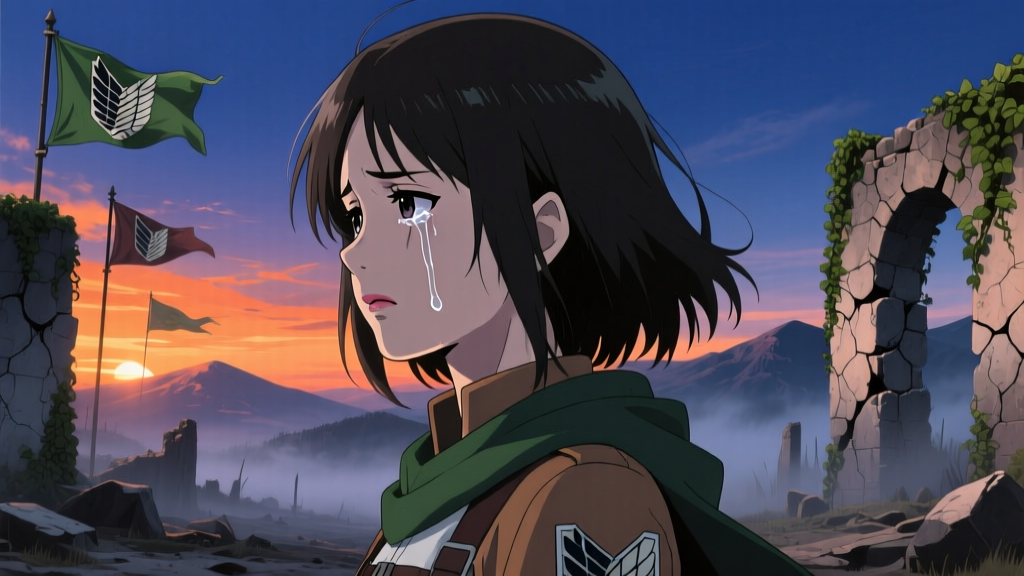
Mikasa doesn’t stop speaking because she can’t—she stops because language has already spoken *for* her.
From Chapter 130 to 139, Mikasa utters exactly seven lines of dialogue—five of them are variations of “Eren,” one is “I’m sorry,” and the final is “I love you.” That’s it. Not a single strategic command. No protest against the Rumbling’s mechanics. No rebuttal when Armin argues ethics in the basement of Liberio. She stands, watches, breathes—and stays silent. This isn’t the silence of shock or dissociation. It’s surgical. It’s deliberate. And it’s linguistic.
Her mouth closes—but her mind doesn’t go quiet
What makes this silence so radical is that Mikasa’s internal monologue remains vivid, precise, even lyrical: she notices the way light catches Eren’s eyelashes as he sleeps (Ch. 131); she recalls the weight of his hand on her shoulder during their first training exercise (Ch. 133); she dissects the grammar of Erwin’s final order—not its morality, but its syntax (“Do not hesitate”—imperative, no subject, no appeal to reason). Her cognition is intact, even heightened. What’s severed is the bridge between thought and utterance—not trauma-induced aphasia, but a refusal to feed the machinery of speech that has, for thirteen years, translated violence into policy, grief into propaganda, love into loyalty oaths.
I remember watching Episode 87—the anime adaptation of Ch. 134—and pausing mid-scene when Mikasa walks past the wall of names in Shiganshina’s ruins. The anime gives her a soft exhale, a blink, a slow turn of the head. But the manga shows her gaze lingering—not on the names, but on the carved grooves beneath them: the chisel marks left by soldiers who inscribed names *after* the fall of Wall Maria, under military directive. That detail isn’t emotional—it’s forensic. She’s reading the violence embedded in the act of inscription itself.
Pre-Rumbling Mikasa spoke like a soldier trained to translate feeling into function
- Before the Rumbling: her dialogue was instrumental. “I’ll protect you.” “Don’t move.” “Hold the line.” Even her confessions (“I only live to be with you”) were phrased as operational commitments—subject-verb-object, zero ambiguity, zero subjunctive.
- During the Rumbling: her voice vanishes—not when Eren transforms, but after Historia declares the royal family’s records “officially void” (Ch. 132). That’s the moment language is formally unmoored from truth. From then on, every public utterance—from Falco’s plea to Armin’s broadcast—is mediated, edited, archived. Mikasa steps out of the chain of transmission.
This works because Isayama treats silence as semantic labor—not absence, but substitution
Roland Barthes’ “Death of the Author” isn’t about erasing intent; it’s about refusing to let authorial authority override the reader’s right to interpret rupture as meaning. Mikasa’s silence operates similarly: by withdrawing from dialogue, she forces us to read her through gesture, proximity, duration. When she kneels beside Eren’s corpse and places her palm flat on his chest—not clutching, not shaking, just measuring the absence of pulse—that silence carries more ethical weight than any courtroom monologue could. It refuses the narrative economy that would demand she “process” or “forgive” or “testify.”
At Tokyo Comic Con 2023, Isayama confirmed this wasn’t an animation shortcut or editorial constraint. He said: “Mikasa’s last words had already been written—in Chapter 5. Everything after is her choosing which silences to keep, and which ones to break.”* He didn’t say “trauma.” He said “choice.” And he said “silence” twice—once in Japanese (shizukesa), once in English, holding both syllables like objects.
The final irony? Her seven lines are all addressed to Eren—never to the world that demands explanation
| Line | Context | Linguistic Function |
|---|---|---|
| “Eren…” (x3) | Upon seeing him in the Paths; at the edge of the Rumbling; over his body | Deictic anchoring—not naming, but locating self *in relation to him*, outside grammar |
| “I’m sorry.” | To Historia, after the Rumbling ends | Refusal of collective accountability—no “we,” no “our people,” just singular, untransferable regret |
| “I love you.” | Last panel of manga | Not declaration, but deposition—spoken aloud only after Eren is no longer a political subject, only a body |
This isn’t healing. It’s boundary-drawing. Mikasa doesn’t find peace in speech—she finds sovereignty in withholding it. And in a story built on walls, titans, and declarations that reshape reality, that might be the most revolutionary sentence of all.