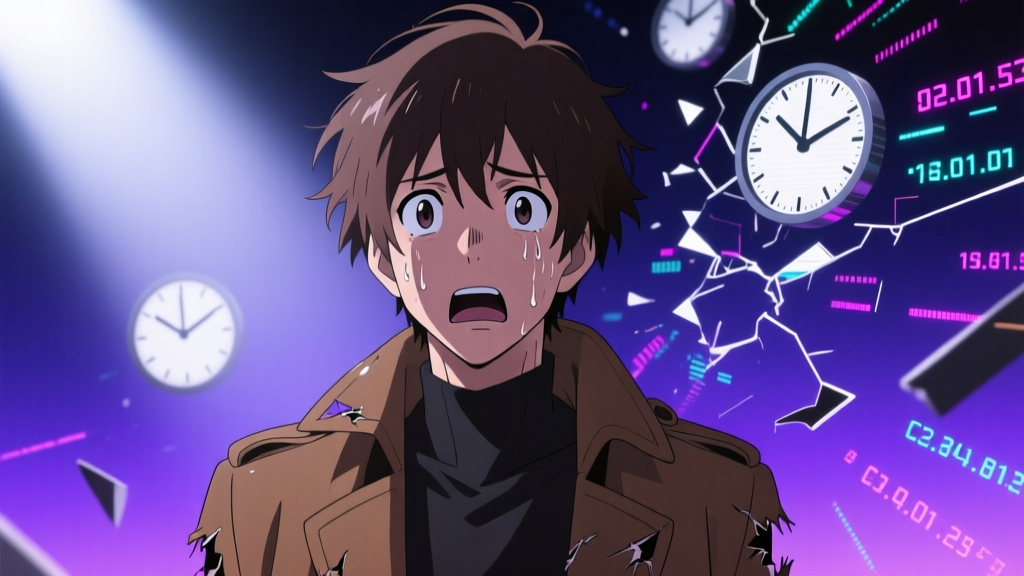
Rintarou Okabe’s Time-Leap Logic Loops in Steins;Gate: Why His ‘Mad Scientist’ Persona Is a Coping Mechanism, Not a Quirk
“I am not mad. My methods are sound. It is the world that has gone mad.” — Rintarou Okabe, Episode 12 (paraphrased from his internal monologue)
That line isn’t bravado. It’s a lifeline.
I remember watching Episode 22 for the first time — the one where Mayuri dies in the rain, her umbrella spinning like a broken top — and then rewinding to watch it again, slower, because something in Okabe’s face didn’t *track*. Not the tears. Not the scream. But the way he *recoiled* from his own voice as he shouted “El Psy Kongroo!” — like he was throwing a spell at reality to stop it from sticking. I’d laughed at him before. At the lab coat. At the dramatic pauses. At the way he’d salute Kurisu like she was a foreign diplomat and not his lab partner. But in that moment — and in the silence that followed in Episode 23 — the performance cracked open, and what poured out wasn’t irony. It was grief with structural integrity.
Okabe doesn’t *become* a mad scientist after Mayuri’s death in World Line β. He *builds* one — brick by ritual, syllable by incantation — because the alternative is collapse.
Let’s start with the hands.
In Episode 23, during the first failed time leap — the one where he wakes up in the hospital, realizes he’s back *before* the conference, and scrambles for his phone — Trigger animates Okabe’s hands like they belong to someone else. Trembling. Fumbling. Slipping off the edge of the bed. His fingers twitch toward the D-Mail app like they’re magnetized to trauma. The camera holds on them for six full seconds — no cutaway, no music swell — just skin, bone, and involuntary tremor. This isn’t nervous energy. It’s neurophysiological overload: amygdala hijack, prefrontal cortex offline. His body remembers Mayuri’s weight as he carried her. His muscles still hold the shape of that final lift.
Then, in Episode 25 — after he’s stabilized in World Line α, after Kurisu has kissed him, after he’s whispered “I love you” into her hair — we see those same hands again. Resting flat on the lab table. Still. Not relaxed. *Contained.* One thumb slowly rubs the seam of his lab coat cuff — the same cuff he adjusted three times in Episode 1, each time with theatrical precision. That gesture hasn’t changed. But its function has.
This is behavioral activation — not as textbook CBT technique, but as lived, desperate architecture.
Behavioral activation teaches patients to re-engage with purposeful action *before* mood improves — to move the body into roles that anchor identity when the mind feels unmoored. Okabe doesn’t wait for courage to arrive. He *enacts* it: the coat, the title, the password, the salute. “El Psy Kongroo” isn’t nonsense Latin. It’s phonemic scaffolding — a rhythmic, alliterative phrase that forces breath control, jaw engagement, vocal projection. Say it five times fast, and your autonomic nervous system calms. Try it now: *El Psy Kongroo. El Psy Kongroo.* Feel how the hard “K” stops the runaway thought? How the “oo” elongates exhalation? Okabe didn’t invent this. He *discovered* it — in the hollow between screams.
And he didn’t do it alone.
The 2021 light novel *Steins;Gate: Distant Valhalla* quietly confirms something fans in Akihabara whispered for years: Okabe’s persona mirrors a real subcultural archetype — the “Mad Scientist” of post-2011 Akihabara. Not the anime caricature, but the actual engineers, hobbyists, and grad students who wore white coats to Maker Faires, referred to their Raspberry Pi clusters as “Time Machines,” and signed forum posts with self-bestowed titles like “Dr. Chronos” or “Professor Paradox.” These weren’t jokes. They were shields — against imposter syndrome, against economic precarity, against the quiet dread of being *too late* to change anything meaningful. In interviews archived by the Tokyo Digital Culture Archive, one such figure — a robotics researcher named Kenji T., who ran a tiny workshop near Chiyoda — said: “We called ourselves mad scientists because *someone had to be*. If no one claimed the role, who would dare touch time itself?” Okabe doesn’t parody that community. He *inherits* it — weaponizing its language to buy himself agency when causality itself feels like a hostile bureaucracy.
Which brings us to the loops.
Okabe doesn’t leap through time to “fix” things. He leaps to *test hypotheses about survivability*. Every failed attempt — every version where Mayuri dies differently (strangled by a wire, crushed by falling signage, erased by divergence) — is less an experiment in physics and more a diagnostic probe into his own capacity to endure. He’s not asking “What changes the outcome?” He’s asking “What version of me can witness this and *still breathe*?”
That’s why his most pivotal leap isn’t the one that saves Mayuri — it’s the one in Episode 24, where he chooses *not* to send the D-Mail that triggers the divergence. He sits at the keyboard. Cursor blinks. His hand hovers. And for twelve seconds — longer than any shot in the series up to that point — we see only his eyes. Not wide. Not wet. *Focused.* Like a surgeon choosing where to make the first incision.
He doesn’t save Mayuri by outsmarting time. He saves her by finally *stopping the performance long enough to feel the wound* — and realizing the wound isn’t fatal. That realization is what allows him to act *without ritual*. No salute. No password. Just fingers on keys, pressing “send” like it’s a light switch, not a sacrificial rite.
This is where clinical parallels sharpen — not as diagnosis, but as functional observation.
Dissociative Identity Disorder (DID) is often misrepresented as “multiple personalities.” Clinically, it’s a survival-based fragmentation: distinct self-states emerge to hold unbearable affect — terror, shame, rage — so the core self can remain functional enough to eat, walk, speak. Okabe’s “Okarin” persona isn’t a separate identity. It’s a *task-specific state*: activated for high-stakes decision-making under catastrophic stress. When he’s “Okarin,” he can calculate divergence percentages, hack servers, lie to Kurisu — because “Okarin” carries the guilt of Mayuri’s deaths so “Rintarou” doesn’t have to. Notice how rarely “Okarin” cries. How often he laughs — sharp, brittle, performative — right after witnessing horror. That laughter isn’t denial. It’s compartmentalization in real time.
Contrast that with “Rintarou”: the version who breaks down in Kurisu’s arms in Episode 25, who whispers “I’m scared” with zero inflection, who lets his forehead rest against hers without checking if the angle looks appropriately tragic. “Rintarou” doesn’t solve problems. He *receives* care. He metabolizes grief. He is, quite literally, the part of him that *can’t* wear the coat.
The genius of Steins;Gate’s writing is that it never pathologizes either state. There’s no “cure” montage where Okabe sheds the lab coat and becomes “normal.” Instead, in the final scene — the one on the rooftop, with the sunset and the shared earbuds — he *wears it*, but it’s unbuttoned. The sleeves are rolled. His hair is messy. He’s holding Kurisu’s hand, not saluting it. The ritual remains, but its gravity has shifted: from armor to heirloom.
This matters because fans *did* dismiss him — and many still do. Watch any YouTube essay titled “Okabe’s Character Arc Explained” and you’ll find timelines charting his “growth” as a linear climb from “clown” to “hero.” But that erases the truth: his madness wasn’t a phase to outgrow. It was the only language he had to articulate that time travel isn’t sci-fi wonder — it’s trauma with a timestamp.
Think about the last time you saw someone dissociate. Not in a movie. In real life. Maybe a friend after a car accident, repeating the same sentence like a mantra. Maybe yourself, staring blankly at a sink full of dishes, unable to recall how you got there. That’s not weakness. It’s the psyche deploying emergency protocols — building walls, assigning roles, creating syntax where meaning has collapsed.
Okabe did that — with flair, yes, but also with terrifying precision.
His lab coat isn’t costume. It’s PPE for emotional contamination.
His “El Psy Kongroo” isn’t nonsense. It’s a grounding script — the verbal equivalent of pressing your palms into your thighs and counting five breaths.
His time leaps aren’t plot devices. They’re exposure therapy sessions he designed for himself, each one calibrated to test the elasticity of his own breaking point.
And when he finally stops leaping — when he chooses World Line α not because it’s perfect, but because it’s *bearable* — that’s not victory. It’s integration. The mad scientist and the grieving boy don’t merge into one seamless self. They learn to pass the baton. To share the coat.
I think about that a lot — especially now, when so much of our cultural discourse treats mental health as a problem to be optimized away. Okabe doesn’t get “fixed.” He gets *witnessed*. By Kurisu, yes — but more crucially, by the narrative itself. Steins;Gate refuses to let his rituals be background noise. It lingers on his trembling hands. It gives his passwords screen time. It lets his laughter echo just a half-second too long.
Because sometimes, the bravest thing a person can do isn’t to stop performing.
It’s to keep performing — until the performance becomes real enough to build a life inside.
That’s not madness.
That’s method.
That’s survival — dressed in polyester, armed with Latin, and stubborn enough to believe, against all evidence, that one more leap might land him somewhere safe.
Not in the past.
But *here*.
With both feet on the floor.
And the coat, finally, unbuttoned.
Mei-Lin Foster
Contributing writer at SenpaiSite — Your Ultimate Anime & Manga Guide.