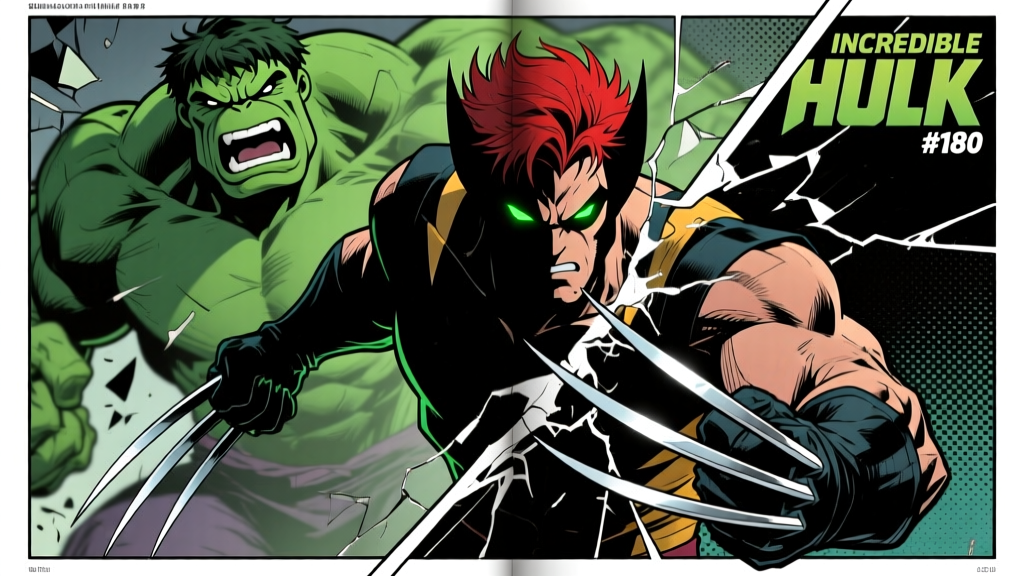
October 1974. A kid in a spinner rack pulls out The Incredible Hulk #180, flips to the back, and sees something on the final page that stops him cold: a short, snarling man in a yellow-and-blue suit with claws bursting from his knuckles. He's standing on a snow-covered ridge, staring down at the Hulk, and the caption reads like a dare. That single panel — nothing more than a cliffhanger teaser crammed into the bottom of page 22 — rewrote comic book history. Nobody knew it yet, but Marvel had just slipped the most commercially successful X-Man of all time into the back of a book about a green giant fighting a yeti.
Fifty years later, Incredible Hulk #180 sits in a rarefied tier of Bronze Age comics. Graded copies in top condition trade for tens of thousands of dollars. The issue appears on virtually every "must-own" list for Silver and Bronze Age collectors. And the character it introduced went on to anchor a multi-billion-dollar film franchise, spawn dozens of solo series, and become the character most associated with the X-Men brand worldwide. All from one page.
The Issue Nobody Was Talking About (Until the Last Page)
The Incredible Hulk #180, cover-dated October 1974, hit newsstands with a 25-cent cover price and a story titled "And the Wind Howls: Wendigo!" On paper, this was standard Bronze Age Marvel fare. The Hulk had been wandering the Canadian wilderness for a stretch of issues, and writer Len Wein needed a monster to throw at him. The Wendigo — a towering, fur-covered cannibal spirit drawn from Algonquian folklore — fit the bill. Herb Trimpe, the book's regular penciller, rendered the creature as a pale, hulking nightmare with matted white fur and hollow eyes.
The story itself is solid but unremarkable by the standards of the era. Bruce Banner is trudging through the frozen Quebec countryside when he stumbles upon a remote logging camp whose workers have been attacked by the Wendigo. The creature is actually Georges Baptiste, a French-Canadian logger cursed after resorting to cannibalism in the wilderness. His sister, Marie, has been desperately searching for a way to break the curse, and she enlists the Hulk's help — or rather, the Hulk gets involved whether anyone asks him to or not.
What follows is roughly fifteen pages of Hulk versus Wendigo, with Trimpe's muscular linework giving both creatures room to throw down. Panels show trees snapping like matchsticks. Boulders get hurled. The Hulk takes a few solid hits from a creature that, unlike most of his opponents, matches him in raw physical strength. Wein's dialogue leans into the tragedy of the Baptiste siblings while maintaining the action-first pacing that Marvel's editorial demanded at the time.
Most readers in 1974 probably enjoyed the fight, closed the book, and moved on. The Wendigo was a one-off villain. The setting was remote. There was no major subplot advancement. This was, by every conventional measure, a middle-tier Hulk issue.
Except for the last page.
The Cameo That Rewrote the Playbook
Here's exactly what happens on that final page: the Wendigo has been subdued. The Hulk is exhausted but standing. And then, from a ridge above, a figure watches. He's compact — barely five-foot-three in the costume — dressed in a canary-yellow cowl and blue tunic with black trunks. Three metal claws extend from each gloved fist. He doesn't speak a single line of dialogue in this issue. He doesn't fight anyone. He just stands there, silhouetted against the Canadian sky, observing.
The last-panel cameo: Wolverine appears on page 22 of Incredible Hulk #180 in a single panel. He is identified in the caption as an agent of Department H, a fictional Canadian government intelligence agency. The caption teases a confrontation with the Hulk in the next issue. His name is printed for the first time in any published comic: Wolverine.
The narrative purpose was straightforward: set up the next issue. Department H had apparently been monitoring the Hulk's rampage through Canadian territory, and they were sending their top operative to deal with the problem. Readers who picked up #181 would get the real showdown — Hulk versus Wolverine versus the Wendigo, a three-way brawl that gave the new character room to demonstrate his speed, his healing factor, and those retractable adamantium-laced claws.
But the visual design is what stuck. Even in a single panel, Trimpe's rendering of the character was instantly distinctive. The yellow-and-blue costume read as something genuinely new in the Marvel lineup — not a variation on any existing hero's look, but a completely fresh silhouette. The cowl with its pointed ear-flaps, the tiger-stripe gloves, the compact build that contrasted sharply with the tall, lean superheroes dominating the racks — all of it communicated "different" before a single word of backstory was printed.
"I designed the character to look like an actual wolverine — small, aggressive, and mean. The claws were the centerpiece. Len [Wein] wanted something that could go toe-to-toe with the Hulk, which meant the character had to read as dangerous even when he was half the size of his opponent." — Herb Trimpe, interviewed in Comic Book Artist #12 (2001)
Len Wein, Herb Trimpe, and the Accidental Icon
Len Wein was thirty-two years old when he wrote Incredible Hulk #180, and he was already one of Marvel's most reliable workhorse writers. He'd go on to co-create Swamp Thing for DC, write landmark issues of X-Men and Uncanny X-Men, and serve as editor on Watchmen. But in 1974, he was the guy who could crank out a competent Hulk script on deadline, which is more or less what Marvel needed.
The character name "Wolverine" came from Wein's knowledge of the animal — a small, ferocious mustelid native to the northern forests of Canada and Alaska. Wein was living in upstate New York at the time and had encountered the animal's reputation through nature writing. "The wolverine is pound for pound one of the toughest animals on the planet," he said in a 2009 panel at the Toronto Comic Con. "It'll fight bears over a carcass. That attitude was exactly what I wanted for a character who was supposed to challenge the Hulk."
The costume design came from John Romita Sr., Marvel's art director, who sketched the initial look based on Wein's description. Romita gave the character the yellow-and-black color scheme (the blue tunic was added later in the production process, possibly by Trimpe or colorist Glynis Wein), the pointed cowl, and the signature clawed gloves. Herb Trimpe then translated this design into the final pencilled version that appeared in print.
Trimpe had been drawing The Incredible Hulk since 1968 and was deeply familiar with the book's visual language. His style was grounded, almost workmanlike — heavy inks, blocky figures, environments that felt like real places rather than stylized comic-book backdrops. When he placed Wolverine on that final-page ridge, he made a deliberate choice to frame the character from a low angle, looking up. The effect is subtle but powerful: the small figure looms. He reads as a threat despite being dwarfed by the landscape around him.
There is an ongoing debate among comics historians about how much creative input Trimpe had versus Wein and Romita on Wolverine's design. Trimpe himself gave varying answers over the years, sometimes crediting Romita's sketch entirely and other times suggesting he modified the design significantly during pencilling. What's clear is that the version of Wolverine that appeared on that final page — the specific proportions, the cowl shape, the way the claws extended — was Trimpe's hand on the page.
From One Panel to Cultural Juggernaut
Wolverine's path from a last-page cameo to the most bankable character in the X-Men franchise was anything but inevitable. Here's the timeline of how it unfolded:
Incredible Hulk #181 (cover-dated December 1974) gave Wolverine his first real action sequence. He fights both the Hulk and the Wendigo, showcasing his superhuman speed, enhanced senses, and a healing factor that lets him recover from injuries that would incapacitate anyone else. He's cocky, aggressive, and clearly working for an organization with its own agenda. Readers noticed. The character had attitude in a way that most new Marvel heroes of the era did not.
Then came the pivot that changed everything. Giant-Size X-Men #1 (May 1975), written by Wein with art by Dave Cockrum, recruited Wolverine into a revamped X-Men team. Wein specifically wanted an international roster, and a Canadian government agent with a mysterious past fit the bill. Wolverine joined alongside Storm (Kenya), Nightcrawler (Germany), Colossus (Russia), and Thunderbird (Apache Nation). The book relaunched the franchise and gave Wolverine a home.
Under Chris Claremont, who took over writing duties on Uncanny X-Men from issue #94 onward, Wolverine evolved from a one-note brawler into the most complex character in the series. Claremont layered in the Weapon X backstory, the adamantium skeleton, the decades-spanning life, the doomed romance with Jean Grey, and the mentorship with Kitty Pryde. By the early 1980s, Wolverine was the character readers wrote letters about. By the early 1990s, he had three simultaneous monthly solo series — a first for any X-Man.
- 1974: First cameo in Incredible Hulk #180 (October)
- 1974: First full appearance and fight in Incredible Hulk #181 (December)
- 1975: Joins the X-Men in Giant-Size X-Men #1 (May)
- 1982: First solo limited series, Wolverine #1-4 (September–December), by Claremont and Frank Miller
- 1988: Launch of the ongoing Wolverine solo monthly series
- 2000: Hugh Jackman debuts as Wolverine in X-Men, launching the cinematic version
- 2017: Logan released, widely considered one of the greatest superhero films ever made
- 2024: Deadpool & Wolverine breaks box office records for an R-rated film
What That 25-Cent Comic Is Worth Now
Let's talk money. Incredible Hulk #180 has become one of the most aggressively collected Bronze Age comics on the market, driven by Wolverine's enormous popularity and the fact that this single issue represents his absolute first published appearance — not #181, which is his first full appearance and also highly valuable, but #180, where he exists for exactly one panel.
The Certified Guaranty Company (CGC) has graded approximately 16,000 copies of Incredible Hulk #180 as of early 2025. That's a high census number for a Bronze Age book, which tells you how many people have submitted copies hoping for a grade that justifies the investment. The vast majority come back in the 4.0 to 7.0 range — well-read copies with spine stress, color breaks, and the typical wear of a 1974 newsstand comic that passed through multiple hands.
Here's what graded copies actually sell for based on recent market data:
| CGC Grade | Condition Label | Approximate Value | Notes |
|---|---|---|---|
| 9.8 | Near Mint / Mint | $40,800 | Top of the census; museum-quality copies |
| 9.6 | Near Mint+ | $12,000 | Extremely scarce in this grade |
| 9.4 | Near Mint | $5,520 | High-grade collector sweet spot |
| 9.2 | Near Mint- | $3,840 | Strong investment-grade copy |
| 9.0 | Very Fine / Near Mint | $3,600 | Crosses the $3K threshold |
| 8.5 | Very Fine+ | $2,025 | Accessible high-grade option |
| 8.0 | Very Fine | $2,200 | Consistent demand at this level |
| 7.0 | Fine / Very Fine | $1,250 | Solid mid-grade collector copy |
| 6.0 | Fine | $1,330 | Good reading copy with investment value |
| 5.0 | Fair / Good | $1,000 | Below $1K is rare for any graded copy |
| 4.0 | Very Good | $660 | Entry-level graded copy |
| 2.0 | Fair | $385 | Heavily worn but still collectible |
A few things jump out from this data. First, even a beat-up CGC 2.0 copy sells for close to $400. That's real money for a 50-year-old comic that originally cost a quarter. Second, the jump between 8.5 and 9.0 is dramatic — nearly doubling — which reflects how few copies survived in true Near Mint condition. Newsstand distribution in 1974 meant comics were read, traded, stacked in boxes, and generally mistreated. A 9.8 copy is essentially a time capsule.
For comparison, Incredible Hulk #181 (Wolverine's first full appearance) commands similar prices in high grades — a CGC 9.8 sold for over $33,000 in 2023. But #180 retains a slight edge in collector psychology because it's the absolute first, even if the appearance is just a cameo. Key collectors and registry set builders need both.
Why the Price Keeps Climbing
Three forces drive Hulk #180 values upward. The Wolverine character has never been more visible: Hugh Jackman's portrayal across nine films (2000–2024), the character's centrality to the MCU's future plans, and the enduring popularity of the X-Men animated series all keep demand high. Meanwhile, the supply of high-grade copies is fixed — no more 1974 print runs are happening. And the broader collectibles market has seen sustained interest in Bronze Age keys since the early 2010s, with Hulk #180 consistently ranking among the top 20 most-watched Bronze Age books on platforms like GoCollect and Heritage Auctions.
Raw (ungraded) copies trade for $150 to $400 depending on condition, but serious collectors almost universally prefer CGC-graded slabs. The grading provides authentication, condition assessment, and a tamper-evident holder — all of which matter when you're spending thousands.
The Strange Alchemy of a Single-Page Debut
Comic book history is littered with characters who appeared briefly and vanished. The Wendigo himself showed up in dozens of issues across multiple decades but never became more than a C-list villain. What made Wolverine different? Why did this particular last-page cameo produce a cultural phenomenon while hundreds of similar teases produced nothing?
Part of it is design. The yellow-and-blue costume is one of the cleanest, most recognizable superhero outfits ever committed to paper. It works as a silhouette. It works in color. It works merchandised onto lunchboxes, action figures, and movie posters. Romita Sr. understood something fundamental about character design: simplicity with one memorable detail. For Wolverine, it's the cowl and the claws.
Part of it is concept. A short, angry Canadian with unbreakable claws and a healing factor is a character who generates story simply by existing. He's violent but sympathetic. He's antisocial but loyal to the people he cares about. He's old enough to carry decades of history but young enough to remain physically vital. Wein and Trimpe may not have planned all of this — most of it was developed later by Claremont, Cockrum, and John Byrne — but the seed was there in that first panel. The attitude was there.
And part of it is timing. 1974 was a moment when the superhero genre was hungry for characters who broke the mold. The earnest, clean-cut heroes of the Silver Age were giving way to morally complex figures with rough edges. Wolverine — feral, short-tempered, working for a shadowy government agency — was exactly the kind of character the market didn't know it needed. By the time Claremont put him in the X-Men and started peeling back the layers of his backstory, the audience was primed for an antihero who could carry a franchise.
Collecting Hulk #180: What to Watch For
If you're considering adding this issue to a collection, here are practical realities that separate smart buyers from disappointed ones:
- Check the CGC census before buying. The population report at cgccomics.com shows exactly how many copies have been graded at each level. A 9.0 with a high census count is less rare than a 9.0 on a lower-population book.
- Watch for restored copies. CGC labels restored comics in purple (rather than blue for universal grades). A restored 8.0 might look identical to an unrestored 8.0 but sells for 40–60% less.
- Verify the last page. In lower-grade copies, the final page — the one with Wolverine's cameo — is sometimes missing, torn, or heavily damaged. A copy without that page loses the primary value driver.
- Consider #181 as a companion piece. Many collectors pair #180 and #181 together, and Heritage Auctions frequently lots them as a set. The combined cost is often less than buying each separately at auction.
- Raw copies carry risk. Without CGC authentication, you're relying on the seller's grading, which tends to be generous. For an investment above $500, grading is strongly recommended.
Half a Century Later
In October 2024, Marvel published a 50th-anniversary homage to Incredible Hulk #180, complete with variant covers that recreated Trimpe's original final-page panel. Comic shops across North America held signing events. Social media flooded with fans holding their own copies of the issue. It was a reminder of something the comics industry sometimes forgets: the most valuable thing you can put on a page isn't a crossover event or a death or a reboot. It's a character so compelling that a single image of him, standing silently on a snowy ridge with claws extended, makes a reader want to come back next month — and then keep coming back for fifty years.
Len Wein passed away in 2017. Herb Trimpe died in 2015. Neither lived to see Wolverine become a global pop-culture fixture on the scale of Spider-Man or Batman. But every time a kid watches Hugh Jackman pop those claws on screen, every time a cosplayer straps on a yellow cowl, and every time a collector pays thousands of dollars for a graded slab of Incredible Hulk #180, that single panel on page 22 does exactly what it was designed to do: make you want to see what happens next.